
LifeCareBalance.com is reader-supported. When you buy through links on our site, we may earn an affiliate commission at no extra cost to you. As an Amazon Associate, we earn from qualifying purchases.
Buying a massage gun can seem straightforward until you start comparing models. Some are designed for athletes, others prioritize portability, and premium devices may include adjustable handles, connected apps, pressure sensors, and specialized attachments.
The problem is that more features do not necessarily mean a better fit.
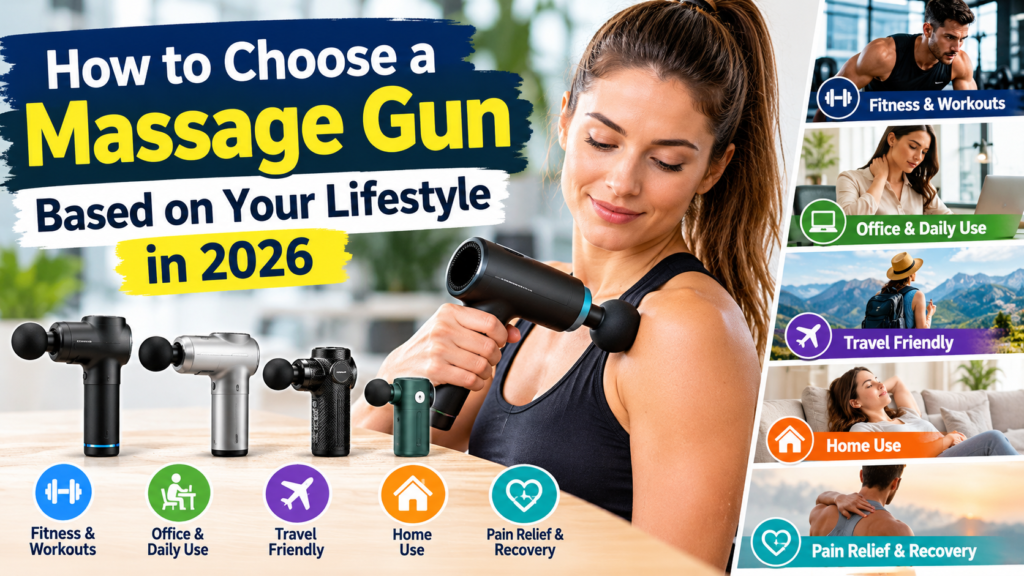
A frequent traveler may prefer a lightweight mini massage gun, while someone who exercises regularly at home may value comfortable handling and versatility. An office worker may care more about noise and easy controls than maximum percussion strength.
The best way to choose a massage gun is to start with your routine, not the specification sheet.
This guide explains how to narrow your options based on usage frequency, portability, comfort, target muscle groups, battery needs, features, and budget. It focuses on choosing the right type of device rather than ranking individual products.
Quick Answer: How Should You Choose a Massage Gun?
Choose a massage gun by answering these five questions:
- How often will you use it?
- Where will you use it: at home, at the gym, at work, or while traveling?
- Which three body areas will you target most often?
- Do you prioritize portability, comfortable handling, or stronger percussion?
- What features will you genuinely use within your budget?
For occasional use, a straightforward model with comfortable handling and adjustable intensity may be sufficient. Frequent users may benefit from better ergonomics, dependable battery performance, and durable construction. Travelers should prioritize weight and size, while people seeking a single device for several muscle groups should consider versatility and self-reach.
You do not automatically need the most expensive massage gun or the highest advertised motor specifications.
1. Match the Massage Gun to Your Usage Frequency
How often you expect to use the device determines which features deserve your money.
Occasional use
If you expect to use a massage gun once or twice a week, prioritize:
- Comfortable grip and manageable weight
- Simple, easy-to-understand controls
- Adjustable speed settings
- A few useful attachments
- Reasonable battery life
- A price that fits your budget
You may not need app integration, specialized accessories, or premium construction designed for demanding daily use.
Regular use
If you exercise several times a week, small differences in comfort and usability become more noticeable.
Look for a device that feels balanced in your hand, offers useful intensity adjustments, and has sufficient battery life for your normal routine.
Durability and warranty support also deserve attention when you expect to use the device regularly.
Frequent or daily use
Daily users should consider the experience over months of ownership rather than focusing on a single specification.
Prioritize ergonomics, convenient charging, consistent operation, accessible replacement accessories, and a clear warranty.
A comfortable device that you can use correctly is generally a more sensible purchase than one with impressive specifications that you find difficult to handle.
2. Choose According to Where You Will Use It
Your environment can change which massage gun makes the most sense.
At home
If the device will remain at home, portability may be less important. You can focus on grip comfort, versatility, battery convenience, and whether the design suits your preferred muscle groups.
A full-size model may be practical, but it is not automatically necessary.
At the gym
Gym users should consider how easily the device fits into a gym bag, how quickly they can operate it, and whether its weight makes carrying it inconvenient.
A protective case can be useful if one is included or available separately.
At the office
For desk breaks or shared workspaces, prioritize manageable weight, straightforward controls, and acceptable noise levels.
A compact device may be easier to store and use discreetly. However, consider workplace policies and whether using a powered massage device in a shared space is appropriate.
While traveling
Travelers should pay particular attention to dimensions, weight, charging requirements, and protective storage.
A mini massage gun may be more practical than a larger model when luggage space is limited. Check the manufacturer’s battery and airline guidance before flying, particularly if the device contains a removable or spare lithium-ion battery.
Buying rule: If you rarely carry your massage gun outside the home, do not sacrifice comfort solely to get the smallest device available.
3. Mini vs. Full-Size Massage Guns
This is one of the most useful decisions to make before comparing brands.
| Consideration | Mini massage gun | Full-size massage gun |
|---|---|---|
| Portability | Usually easier to carry | Usually bulkier |
| Storage | Convenient for small bags | May require more space |
| Handling | Often lightweight, with a smaller grip | May offer more substantial grip options |
| Large muscle groups | Can work, but may offer less leverage | Often practical for quads, glutes, and hamstrings |
| Self-reach | Depends on handle design | Some models offer more grip positions |
| Best fit | Travel and convenience | Home use and broader routines |
These are general tendencies, not guarantees. Individual models vary in weight, motor performance, handle shape, and attachments.
Choose a mini model if portability is a major priority. Consider a full-size model if you prefer a more substantial handle and expect to work on several large muscle groups.
Neither format is automatically more effective for everyone.
4. Start With Your Three Most Important Muscle Groups
Rather than choosing a massage gun for every possible body area, identify where you expect to use it most often.
Mainly legs
Runners, walkers, cyclists, and people who train their lower body may focus on their quadriceps, hamstrings, calves, and glutes.
Comfortable handling, appropriate attachments, and manageable intensity are sensible priorities.
For product-specific comparisons, see our Best Massage Guns for Full-Body Recovery in 2026.
Mainly shoulders and upper-body muscles
Desk workers and gym-goers may prioritize maneuverability and control over maximum output.
A device that is easy to hold and guide can be more practical than a heavier model that becomes tiring during use.
Avoid using a massage gun on the front or sides of the neck. Do not assume that every type of neck or shoulder pain is muscular.
Several areas across the body
If you want one device for your legs, arms, and back, prioritize versatility.
Look for comfortable grip positions, useful intensity settings, a manageable weight, and a design that allows you to reach your intended muscles without awkward movements.
A larger attachment collection is not necessarily an advantage if you will only use two or three heads.
5. Prioritize Control Over Maximum Intensity
A high maximum speed does not automatically make a massage gun the right choice.
What matters is whether the available settings let you use the device comfortably.
Beginners may prefer a straightforward model with a low, comfortable starting setting. Frequent exercisers may want a broader range of adjustments.
Before buying, ask:
- Can I start gently?
- Can I adjust the intensity easily?
- Are the controls simple to operate?
- Can I keep the device steady without pressing aggressively?
You do not need to maximize speed or force to obtain a useful massage sensation.
For a detailed explanation of amplitude, stall force, speed settings, attachments, battery performance, and noise, see our Massage Gun Buying Guide 2026.
6. Consider Weight, Grip, and Self-Reach
A massage gun may feel comfortable when you hold it in a store, yet become tiring when you use it for several minutes.
Weight alone does not determine comfort. Balance, handle shape, grip position, and reach also matter.
Before choosing a model, consider:
- Whether you can hold it securely
- Whether the handle feels balanced
- Whether the controls are easy to reach
- Whether you can maneuver it without straining your wrist
- Whether you can reach your intended muscle groups safely
Self-reach is especially important if you plan to use the device on your own back or the backs of your legs.
An adjustable or angled handle may help some users, but the actual design matters more than the label.
If possible, try holding the device before buying. Otherwise, check the retailer’s return policy so you understand your options if the ergonomics do not suit you.
7. Decide Whether You Need Quiet Operation
Noise becomes important when you use a massage gun around other people.
A quieter model may be preferable if you live in an apartment, share a bedroom, work in a shared space, or use the device while watching television.
If you primarily use it alone at the gym or at home, noise may be less important.
Be cautious when comparing advertised decibel figures. Different manufacturers and reviewers may use different distances, speeds, attachments, and testing environments.
If noise is a deciding factor, look for independent measurements taken under comparable conditions rather than relying exclusively on phrases such as “ultra-quiet.”
8. Match Battery Life to Your Routine
You do not need the longest advertised battery life on the market. You need enough runtime for your intended use.
An occasional user may be satisfied with a basic built-in battery. Someone who uses the device daily may prefer longer runtime, convenient charging, or a replaceable battery.
Travelers should also consider charging compatibility and the convenience of carrying the necessary accessories.
Check the following before purchasing:
- Advertised runtime and any stated test conditions
- Charging time
- Charging connector
- Whether the battery is replaceable
- Availability of replacement batteries or chargers
- Warranty coverage for the battery
Actual runtime can change with speed, pressure, battery age, and usage patterns. Treat manufacturer estimates as estimates, not guarantees.
9. Pay for Features You Will Actually Use
Some massage guns include smartphone apps, guided routines, pressure indicators, displays, heat features, or additional accessories.
These may be useful for certain buyers, but they are not essential for everyone.
An app may appeal to someone who wants structured guidance. Pressure feedback may help a user monitor how much force they apply. Someone who wants a simple, short session may prefer basic controls.
Before paying extra, ask yourself whether the feature solves a real problem in your routine.
Also distinguish convenience from proven health benefits. A connected app or premium accessory should not be treated as evidence that a device produces superior recovery outcomes.
10. Set a Realistic Budget
Massage gun prices vary by brand, model, retailer, and product generation. The following ranges are broad shopping guidelines rather than verified market-wide price tiers.
Under $100
Potentially suitable for beginners, occasional users, and buyers who want a straightforward device.
Check ergonomics, seller reliability, return terms, and warranty coverage carefully.
Around $100–$250
This range may offer a useful balance for regular home users, depending on the model.
Compare comfort, battery convenience, intensity adjustments, construction, and the accessories you will actually use.
Above $250
Higher-priced models may offer more refined ergonomics, specialized controls, additional features, or stronger manufacturer support.
Those advantages may matter to frequent users, but higher prices do not guarantee better recovery outcomes.
For a detailed comparison of the trade-offs, read our Premium vs. Budget Massage Guns in 2026.
Before buying, confirm the exact model generation, current US price, warranty terms, and return policy.
11. What Does Research Say About Massage Guns?
Research suggests that percussive massage may provide some short-term benefits, particularly for flexibility and range of motion, but the evidence has limitations.
A 2023 systematic review of massage guns and performance or recovery examined 11 studies. The authors reported potential benefits for flexibility and certain recovery-related outcomes, while findings for several athletic performance measures were mixed or showed no improvement.
A later study examining different percussion-therapy protocols also highlights that treatment methods and durations vary. See the 2024 study on massage-gun protocols and lower-body flexibility.
These findings do not establish that a particular massage gun is best for everyone, that more expensive devices work better, or that stronger percussion guarantees better results.
A sensible buying decision should therefore focus on comfort, usability, appropriate intensity, and whether the device suits your actual routine.
12. Know When a Massage Gun Is Not the Right Tool
A massage gun is not appropriate for every kind of pain or injury.
Ordinary muscle tightness differs from nerve-related symptoms, significant swelling, joint problems, acute injuries, and persistent unexplained pain.
If symptoms are severe, unusual, worsening, or related to an injury, do not rely on a massage gun instead of professional assessment.
For practical guidance on appropriate use, read the Cleveland Clinic’s overview of massage guns and percussive therapy.
General precautions include:
- Start with a comfortable intensity.
- Let the device do the work rather than pressing aggressively.
- Use it only on appropriate soft tissue and according to the manufacturer’s instructions.
- Avoid direct use over bones, joints, the spine, and the front or sides of the neck.
- Do not use it over open wounds or irritated skin.
- Stop if you experience sharp pain, numbness, tingling, or unusual symptoms.
- Ask a healthcare professional for advice if you have a relevant medical condition, recent surgery, reduced sensation, unexplained swelling, or another reason percussion therapy may be unsuitable.
13. Use the Five-Minute Reality Test
Before purchasing, imagine using the device for a typical five-minute session.
Ask yourself:
- Can I hold it comfortably?
- Can I reach the muscles I intend to target?
- Are the controls easy to understand?
- Is the noise acceptable in my environment?
- Will I have to recharge it constantly?
- Does it offer the intensity range I need?
- Will I actually keep it accessible and use it regularly?
If several answers are no, impressive specifications are unlikely to compensate.
The most useful device is one that fits your routine and that you can use comfortably and appropriately.
Final Checklist Before Buying
Use this checklist to narrow your options.
Usage
- How often will I use the device?
- Will it stay at home or travel with me?
Body areas
- Which three muscle groups will I target most?
- Do I need a compact device or a versatile full-size model?
Comfort
- Can I hold and maneuver it comfortably?
- Can I reach the areas I intend to treat?
- Is the noise acceptable?
Features
- Are the intensity settings useful?
- Do I need the included accessories?
- Is the battery sufficient for my routine?
Budget
- Am I paying for features I will use?
- Have I checked the exact model, warranty, and return policy?
Final Verdict
Choosing a massage gun does not require comparing every specification on every product page.
Start with your routine. Prioritize portability if you travel, comfortable handling if you use the device frequently, and versatility if you want to target several muscle groups.
Beginners can start with a straightforward model that offers comfortable control. Frequent users may find better ergonomics, convenient charging, and durable construction worth paying for.
Most importantly, do not assume that the highest price or biggest specification guarantees better recovery.
Choose a massage gun that suits your habits, fits your budget, and can be used comfortably and safely. That is a more practical starting point than buying a device simply because its specification sheet looks impressive.
This article is for general informational purposes and is not a substitute for individualized medical advice.