
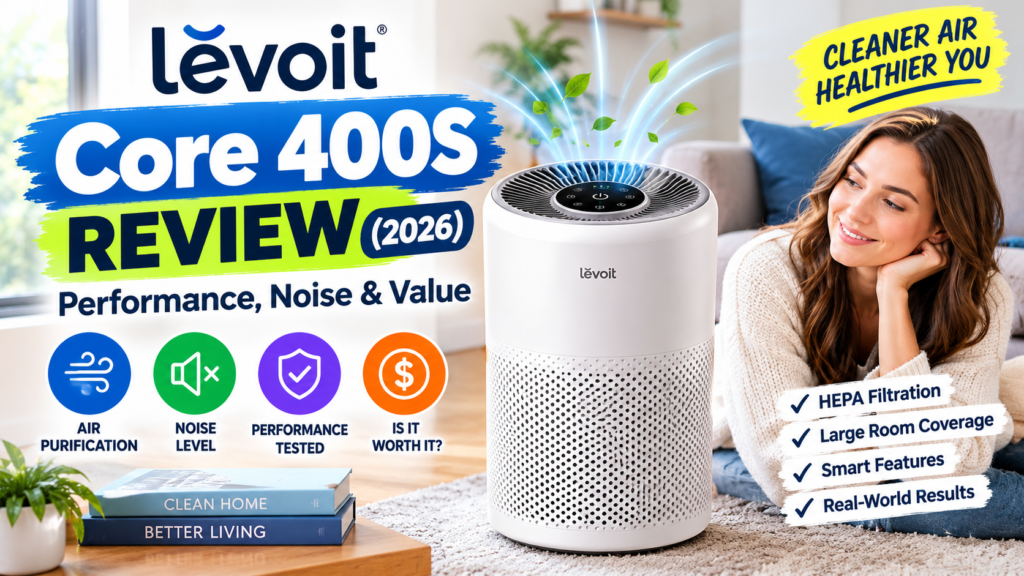
Read our Levoit Core 400S review for 2026, including verified CADR, room coverage, filtration, noise, filter costs, smart features, and alternatives.
LifeCareBalance.com is reader-supported. When you buy through links on our site, we may earn an affiliate commission at no extra cost to you. As an Amazon Associate, we earn from qualifying purchases.
If you’re shopping for an air purifier for a bedroom, home office, or medium-sized living room, the Levoit Core 400S deserves a closer look. It combines a cylindrical design, a particle filter, activated carbon, an onboard air-quality sensor, and Wi-Fi app control in a unit designed for everyday residential use.
But there is an important detail to understand before buying: older reviews of the Core 400S often quote 260 CFM and approximately 403 square feet of coverage. The current Core 400S-P product listing publishes a different set of specifications, including a 231 CFM CADR and 358 square feet of recommended coverage at 4.8 air changes per hour. Those figures should not be mixed without explaining the difference.
This review examines the current published specifications, independent testing, filtration limits, replacement-filter costs, and competing models to help you decide whether the Levoit Core 400S is the right purifier for your home.
Quick Answer: Is the Levoit Core 400S Worth Buying?
Yes, the Levoit Core 400S is worth considering if you want a smart air purifier for a bedroom or medium-sized living room and value app control, particle filtration, and a compact cylindrical design. Its suitability depends on the size of your room, the fan speed you can tolerate, and the pollutants you want to address.
The current Core 400S-P specifications list a smoke CADR of 231 CFM, a dust CADR of 240 CFM, a pollen CADR of 259 CFM, and recommended coverage of 358 square feet at 4.8 air changes per hour.
Its strongest advantages are smart controls, a real-time PM2.5 display, automatic fan adjustment, and a relatively compact footprint. Its limitations include a combined replacement-filter cartridge, noticeable noise at higher fan speeds, and limited published quantitative evidence for removing specific gases such as formaldehyde.
Best for: Bedrooms, home offices, and medium living rooms where particle filtration and smart controls are priorities.
Less suitable for: Very large open-plan spaces, heavy indoor smoking, or situations requiring verified removal of specific chemical gases.
Levoit Core 400S Specifications
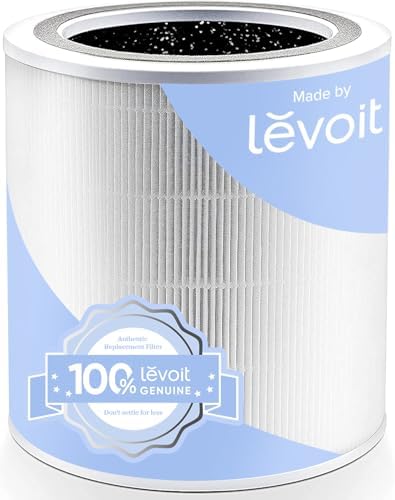
- 𝐆𝐄𝐍𝐔𝐈𝐍𝐄 𝐑𝐄𝐏𝐋𝐀𝐂𝐄𝐌𝐄𝐍𝐓 𝐅𝐈𝐋𝐓𝐄𝐑: Designed for Core 400S-P air purifiers to maintain peak performance. Use genuine filters for…
- 𝐇𝐄𝐏𝐀-𝐆𝐑𝐀𝐃𝐄 𝐏𝐄𝐑𝐅𝐎𝐑𝐌𝐀𝐍𝐂𝐄 𝐈𝐍 𝐒𝐋𝐄𝐄𝐏 𝐌𝐎𝐃𝐄: Helps Levoit Core 400S-P achieve HEPA* filtration efficiency during Sleep Mode. Ze…
- 𝟑-𝐒𝐓𝐀𝐆𝐄 𝐅𝐈𝐋𝐓𝐑𝐀𝐓𝐈𝐎𝐍 𝐒𝐘𝐒𝐓𝐄𝐌: Pre-filter traps hairs, dust, and large particles. Main filter removes 99.97% of ultrafine pa…
The table below uses the current manufacturer’s published Core 400S-P specifications. Independent test measurements are identified separately rather than presented as manufacturer ratings.
| Specification | Published detail |
|---|---|
| Model | Levoit Core 400S-P |
| Filtration | Three-stage filter system |
| Smoke CADR | 231 CFM |
| Dust CADR | 240 CFM |
| Pollen CADR | 259 CFM |
| Recommended room size | 358 sq. ft. at 4.8 ACH |
| Low-intensity coverage | 1,718 sq. ft. at 1 ACH |
| Rated power | 38 watts |
| Published noise range | 22–52 dB |
| Dimensions | 10.8 × 10.8 × 20.5 inches |
| Weight | Approximately 11 pounds |
| Smart controls | VeSync app and Wi-Fi |
| Voice assistants | Amazon Alexa and Google Assistant |
| Filter replacement | Core 400S-compatible replacement cartridge |
| Purchase price | Check current retailer pricing |
Specifications are based on the manufacturer’s current Levoit Core 400S-P product page. The original Core 400S and current Core 400S-P may appear under similar names, so confirm the exact model and filter compatibility before ordering.
Room Coverage: What Does 358 Square Feet Really Mean?
Room coverage is one of the most important specifications to understand when shopping for an air purifier.
Levoit lists two coverage figures for the current Core 400S-P: 1,718 square feet at one air change per hour and 358 square feet at 4.8 air changes per hour.
These figures describe different cleaning intensities.
Air changes per hour, or ACH, estimates how many times the purifier can process an air volume equivalent to the room’s volume in one hour. A higher ACH generally means faster particle removal when the device is appropriately positioned and operated.
One air change per hour is a relatively low cleaning rate. It should not be treated as equivalent to the 4.8 ACH figure when comparing purifiers for dust, allergies, or smoke particles.
For this reason, 358 square feet is the more useful planning figure for buyers who want more frequent air cleaning. It is still a guideline rather than a guarantee of identical results in every home.
Is the Core 400S suitable for a bedroom?
For many small and medium bedrooms, it can be a practical option. A smaller room gives the purifier less air volume to process, which may allow you to use a lower fan speed while still achieving useful particle filtration.
However, low-speed operation delivers less clean air than maximum-speed operation. If your room has a high ceiling, frequent pollution sources, or open doorways to other rooms, allow for those conditions when choosing a model.
Can it clean a large living room?
It depends on the actual floor area and the layout. A closed 300-square-foot living room is different from a 400-square-foot room connected to a kitchen, dining area, and hallway.
Measure the combined area that the purifier is expected to serve. Do not assume that a large marketing coverage number means the device will clean a large open-plan space quickly.
For more help matching CADR to room size, see our Air Purifier Buying Guide for Beginners 2026.
Filtration Performance: Dust, Pollen, and Pet Dander
The Core 400S uses a three-stage filtration arrangement consisting of a pre-filter layer, a main particle-filtering layer, and activated carbon.
Each stage serves a different purpose.
- Pre-filter: Captures larger airborne debris such as hair, lint, and some dust.
- Main particle filter: Captures airborne particles as air passes through the filter media.
- Activated carbon: Adsorbs certain gases and odor compounds, depending on the type and quantity of carbon and the substance involved.
The manufacturer describes the unit as suitable for filtering airborne particles such as dust, pollen, smoke particles, and pet dander.
Independent testing by RTINGS also evaluates the Core 400S for particle filtration and practical use. Its results are useful for comparison, but they should not be interpreted as proof that the purifier eliminates every allergen or pollutant from an occupied home.
Does it help with allergies?
It may help reduce airborne particles associated with common allergy triggers when the purifier is appropriately sized and operated consistently.
However, air purification is not a cure for allergies or asthma. It cannot remove allergens that have already settled on bedding, upholstery, or carpet unless those particles become airborne and pass through the filter.
For better results, combine filtration with routine cleaning, washing bedding, controlling moisture, and reducing exposure to the specific trigger where possible.
Our related guide, Do Air Purifiers Really Improve Health in 2026?, discusses the difference between measurable air-quality improvements and broader health claims.
Does the Levoit Core 400S Remove Smoke and Odors?
Smoke contains both particles and gases. These require different approaches to filtration.
Smoke particles
The main particle filter is intended to capture airborne particles, including fine smoke particles. The current model’s published smoke CADR is 231 CFM.
A CADR figure is useful because it describes the delivery of filtered air for a particular particle category. It does not mean that every smoke-related substance is removed at the same rate.
During wildfire-smoke events, the appropriate purifier size, operating speed, and duration of use all matter. Follow local air-quality advice and reduce outdoor-air entry when outdoor pollution is high.
Cigarette smoke
For occasional exposure, a properly sized particle-filtering purifier may reduce some airborne smoke particles. That does not make it a dependable solution for regular indoor smoking.
Cigarette smoke also contains gases and odor compounds. A general-purpose carbon layer has limited capacity, and its effectiveness depends on the amount of carbon, the pollutant, contact time, and saturation.
The best strategy is to avoid smoking indoors rather than rely on an air purifier to make indoor smoking safe.
Cooking odors
The carbon layer may help with some everyday household odors. It should not replace an exhaust hood, adequate ventilation, or removing the source of persistent smells.
If strong odors are your main concern, compare the amount and type of carbon in competing filters rather than relying on a general statement that a purifier removes odors.
Does It Remove VOCs or Formaldehyde?
This is an area where buyers should be particularly cautious.
Volatile organic compounds, or VOCs, include a range of gases released by sources such as paints, cleaning products, furnishings, and other materials. Different compounds behave differently, and a filter that adsorbs one gas may perform differently against another.
Activated carbon can capture certain gas-phase compounds, but the presence of a carbon layer does not establish a verified removal rate for every VOC or for formaldehyde.
The current published specifications do not provide a quantitative, model-specific removal rate for formaldehyde or individual VOCs. We therefore cannot responsibly claim that the Core 400S is a certified formaldehyde-removal solution.
If chemical gases are your main concern, prioritize source control and ventilation where appropriate. Look for product-specific, independently documented testing for the particular compound you need to address.
Noise and Bedroom Use
Noise depends on the fan speed, measurement distance, room acoustics, and background sound.
Levoit publishes a 22–52 dB range for the current Core 400S-P. Independent tests may report different figures because they use different measurement conditions.
In HouseFresh testing of the U.S. Core 400S, measured sound ranged from approximately 35.5 dBA on Sleep Mode to around 60.3 dBA at maximum speed, measured from three feet. Those results are not directly interchangeable with the manufacturer’s published range, but they illustrate why the measurement method matters.
For overnight use, consider the speed at which you can comfortably sleep—not just the quietest number printed on the box.
A practical approach is to run the purifier at a higher speed before bedtime when needed, then reduce the speed overnight if noise is disruptive. Remember that lower fan speeds also deliver less filtered air.
The display-off feature is useful for people who prefer a dark bedroom. The cylindrical design also takes up relatively little floor space, although the unit still needs enough clearance for unobstructed airflow.
Smart Features and the VeSync App
Smart controls are a meaningful advantage of the Core 400S.
The onboard sensor monitors airborne particle levels and provides a PM2.5 reading. Auto Mode uses the sensor’s readings to adjust fan speed, while the VeSync app provides remote controls and other connected features.
Depending on the current app and firmware, available features include:
- Remote power and fan-speed control.
- Scheduling and timers.
- Air-quality readings and historical information.
- Filter-life monitoring.
- Voice control through compatible Alexa and Google Assistant devices.
These features can make routine operation more convenient. For example, you can increase the fan speed after a dusty activity or check the displayed particle level without standing next to the purifier.
However, a consumer particle sensor is not a substitute for a calibrated laboratory instrument. Its readings represent the particles detected by that sensor, not a complete assessment of every pollutant in the room.
Auto Mode is convenient for routine operation, but manually selecting a higher speed can be useful when you know a pollution event has occurred.
Filter Replacement and Maintenance Costs
The Core 400S uses a combined replacement cartridge, meaning the particle-filtering and carbon stages are replaced together.
The standard replacement filter is commonly listed as Core 400S-RF. Confirm the exact purifier model and compatibility statement before purchasing, because Core-series replacement filters are not all interchangeable.
Levoit’s current U.S. website lists the standard replacement filter at $49.99, with specialty filter options listed at higher prices. Retail prices and availability can change.
Filter life depends on use, pollution levels, pets, cooking, smoke exposure, and the filter variant. Rather than assuming every household will get the same lifespan, monitor the filter indicator, airflow, and any return of persistent odors.
How much does electricity cost?
The purifier has a published rated power of 38 watts. At that draw, running it continuously for 24 hours would use approximately 0.912 kWh per day.
At an illustrative electricity rate of $0.16 per kWh:
- Daily electricity cost: approximately $0.15.
- Monthly electricity cost: approximately $4.38.
- Annual electricity cost: approximately $53.26.
These calculations assume the unit continuously draws its full 38-watt rated power. Actual usage will differ by fan speed, standby operation, and time spent in Auto or Sleep Mode.
If you budget $49.99 for one standard replacement filter, the illustrative combined annual cost is approximately $103.25 before taxes or any additional filter changes. Your actual total could be higher if you replace filters more frequently or choose a specialty cartridge.
Levoit Core 400S vs. Core 300S
The Core 300S is the smaller smart-purifier option in Levoit’s Core family. The Core 400S is worth considering when you need more airflow for a larger room.
| Factor | Core 400S-P | Core 300S-P |
|---|---|---|
| Best fit | Medium rooms | Smaller rooms |
| Smart controls | Yes | Yes |
| Air-quality monitoring | Yes | Yes |
| Footprint | Larger cylindrical unit | More compact unit |
| Main decision | More airflow for the room | Lower-cost fit for smaller spaces |
Do not select between them based on the advertised maximum coverage alone. Compare the relevant CADR figures and recommended room sizes for the exact versions being sold.
Choose the Core 300S-P if your room is small and its performance rating meets your needs. Choose the Core 400S-P if you need the additional airflow and can accommodate its larger footprint.
Levoit Core 400S vs. Vital 200S
The Vital 200S-P is another smart Levoit model worth comparing, particularly for homes with pets.
The Vital series uses a different body and filter arrangement. Its removable pre-filter can be more convenient for cleaning pet hair and larger debris, while the Core 400S’s cylindrical form may suit buyers who prefer a smaller floor footprint.
Before choosing, compare the current model-specific CADR, recommended room coverage, filter prices, and dimensions. The Core 400S is not automatically the better choice simply because it has a higher number in its model name.
For a larger-room comparison, read our Best Air Purifiers for Large Rooms in 2026.
Levoit Core 400S vs. Winix 5500-2
The Winix 5500-2 is a long-established competitor in the mid-size purifier category.
The Core 400S has an advantage for shoppers who want connected controls, app-based monitoring, and a digital particle reading. The Winix 5500-2 offers a different filter arrangement, including a pellet-style carbon filter and PlasmaWave technology that users can switch off.
Neither model should be treated as a guaranteed solution for every gas or odor. Compare verified particle CADR, filter availability, replacement costs, noise at usable fan speeds, and whether you want an ionization-related feature.
The Winix 5500-2 may be attractive to buyers who prefer its filter design, while the Core 400S is the more natural fit for someone who values smart-home features.
Levoit Core 400S vs. Coway Airmega 250
The Coway Airmega 250 is another option for buyers who prioritize room cleaning performance and filter maintenance.
The standard Airmega 250 does not offer the same app connectivity as the 250S version, so be careful not to confuse those models when comparing prices and features.
The Core 400S-P is a better fit for shoppers who specifically want VeSync app control, a numeric PM2.5 display, and voice-assistant compatibility. Coway may suit buyers who prefer its design and washable pre-filter arrangement.
For the full model-to-model comparison, see Levoit Core 400S vs. Coway Airmega 250. You can also review our Coway Airmega 250 Review 2026 before deciding.
Pros and Cons
Pros
- Three-stage filtration for everyday airborne particles and some odors.
- Smart controls through the VeSync app.
- Onboard PM2.5 display and automatic fan adjustment.
- Compact cylindrical footprint.
- Sleep Mode and a display-off option for bedroom use.
- Published energy and room-coverage specifications.
- Voice-assistant compatibility.
Cons
- The current 358-square-foot recommendation is more useful than the much larger one-ACH marketing figure.
- Higher fan speeds can be noticeably noisy.
- The combined cartridge means the carbon and particle-filtering stages are replaced together.
- Quantitative formaldehyde and individual-VOC removal performance is not established by the published specifications reviewed here.
- The sensor’s readings should not be treated as a complete indoor-pollution assessment.
- Long-term costs depend on filter replacement frequency and local electricity prices.
Who Should Buy the Levoit Core 400S?
Consider the Core 400S-P if you:
- Need a smart purifier for a bedroom or medium-sized living room.
- Want to monitor a consumer PM2.5 reading on the unit.
- Value app scheduling and remote controls.
- Want to reduce airborne dust, pollen, or pet-dander particles.
- Prefer a cylindrical design rather than a wide rectangular purifier.
- Are comfortable budgeting for replacement cartridges.
Who Should Skip It?
Look at other options if you:
- Need a purifier sized for a substantially larger open-plan space.
- Mainly need verified removal of formaldehyde or specific chemical gases.
- Expect a purifier to eliminate heavy indoor cigarette smoke and its odors.
- Want a separately washable main filter.
- Prefer not to use a connected smart-home device.
- Need very low noise while running at high airflow.
Frequently Asked Questions
Is the Levoit Core 400S worth buying in 2026?
It can be a worthwhile choice for medium-sized rooms when particle filtration and smart features are priorities. Check the current price against competing models and confirm the coverage rating for the exact version.
What is the CADR of the Levoit Core 400S-P?
The current manufacturer’s published figures are 231 CFM for smoke, 240 CFM for dust, and 259 CFM for pollen.
What room size is recommended for the Core 400S-P?
Levoit lists 358 square feet at 4.8 air changes per hour and 1,718 square feet at one air change per hour. The smaller figure is more useful when comparing cleaning intensity for typical residential use.
Is the Core 400S a True HEPA purifier?
Do not assume that older “True HEPA” or “H13” descriptions establish independent certification for the current model. The current product specifications describe a three-stage filtration system; check the precise claims and certification documents for the model being purchased.
Does the Core 400S remove cigarette smoke?
Its particle filtration can help reduce airborne smoke particles. It should not be relied upon as the primary solution for regular indoor smoking or complete removal of smoke odors and gases.
Does it remove formaldehyde?
The published specifications reviewed here do not establish a quantitative formaldehyde removal rate for this model. If formaldehyde removal is your primary need, look for product-specific test data for that compound.
How much does it cost to run?
At a constant 38-watt draw and $0.16 per kWh, the illustrative electricity cost is about $53 per year. Actual use varies with fan speed and operating patterns; replacement filters are an additional cost.
Can I leave it running overnight?
It is designed for normal residential operation, but choose a fan speed that balances noise and cleaning needs. Sleep Mode reduces noise but also moves less air than higher settings.
Is the Core 400S better than the Vital 200S?
Neither is universally better. The Core 400S suits buyers who prefer a cylindrical design and its smart controls. The Vital 200S-P may appeal to pet owners who value its different pre-filter arrangement. Compare room coverage and current filter costs.
Does it replace ventilation or cleaning?
No. Source control, appropriate ventilation, and regular cleaning remain important. An air purifier supplements those steps rather than eliminating all indoor pollutants.
Final Verdict: Should You Buy the Levoit Core 400S?
The Levoit Core 400S-P is a sensible candidate for buyers who want smart controls, a PM2.5 display, and particle filtration in a bedroom or medium-sized living room.
Its strongest selling point is the combination of connected features and a practical cylindrical design. Its biggest buying consideration is matching the purifier to the actual room: the 358-square-foot recommendation at 4.8 ACH is much more useful than assuming the one-ACH coverage figure represents fast cleaning.
It is not the right choice for every household. Buyers who need dedicated, quantitatively verified gas removal, have a very large open-plan room, or want the easiest possible pre-filter cleaning should compare alternatives carefully.
Our recommendation: Consider the Core 400S-P if your room is appropriately sized, smart features matter to you, and you are comfortable with the replacement-filter costs. Confirm the model variant, current specifications, and genuine filter compatibility before ordering.
Editorial transparency: This article is based on published manufacturer specifications and third-party testing. LifeCareBalance has not independently laboratory-tested this unit, and no personal hands-on experience is claimed.