
LifeCareBalance.com is reader-supported. When you buy through links on our site, we may earn an affiliate commission at no extra cost to you. As an Amazon Associate, we earn from qualifying purchases.
SEO Title: Coway Airmega 250 Review 2026: Specs, Room Size & Value
Meta Description: Read our Coway Airmega 250 review covering CADR, realistic room size, HEPA filtration, noise, filter costs, energy use, and alternatives.
URL Slug: coway-airmega-250-review-2026
Focus Keyword: Coway Airmega 250 review
Secondary Keywords: Coway Airmega 250 CADR, Coway Airmega 250 room size, Coway Airmega 250 filter replacement, Coway Airmega 250 vs Levoit Core 400S, AP-1720H review
Quick Answer: Is the Coway Airmega 250 Worth Buying?
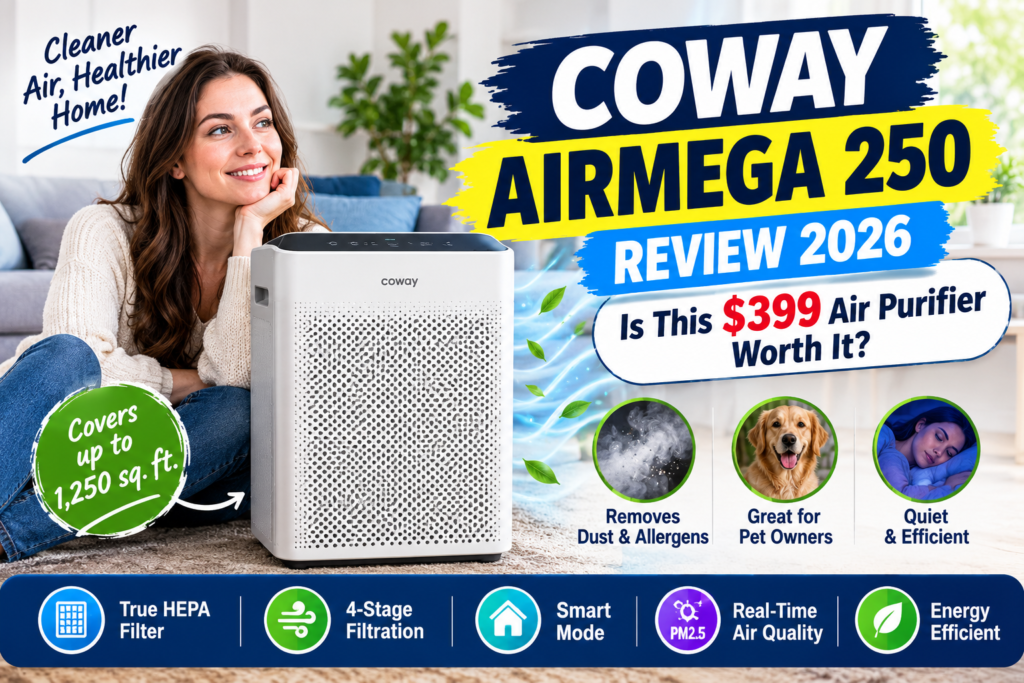
The Coway Airmega 250 (AP-1720H) is a large-room air purifier with a washable pre-filter, a combined HEPA-and-activated-carbon Max2 filter, automatic fan control, and a relatively slim design. Coway lists its U.S. price at $399, with a smoke CADR of 249 CFM, dust CADR of 261 CFM, and pollen CADR of 230 CFM.
Its strongest selling points are straightforward maintenance, a reusable pre-filter, and useful particle-cleaning capacity. Its biggest drawbacks are the upfront price, a replacement filter that adds to long-term costs, and no Wi-Fi or app control on the standard model.
Our verdict: Consider the Airmega 250 if you want a simple, wide-and-shallow purifier and value its washable pre-filter. Compare it carefully with the less expensive Coway Mighty and Levoit Core 400S-P before paying $399.
This is a specification-based editorial review, not a hands-on test. LifeCareBalance has not independently measured this unit’s particle removal, noise, or energy consumption.
Coway Airmega 250 Specifications
The following figures are published by Coway for the standard AP-1720H model. Prices and availability may change.
| Specification | Coway Airmega 250 |
|---|---|
| Model number | AP-1720H |
| Smoke CADR | 249 CFM |
| Dust CADR | 261 CFM |
| Pollen CADR | 230 CFM |
| Coverage at 1 ACH | 1,860 sq. ft. |
| Coverage at 2 ACH | 930 sq. ft. |
| Coverage at 4 ACH | 465 sq. ft. |
| Filtration | Washable pre-filter + Max2 HEPA/carbon filter |
| Published noise range | 22–54 dB(A) |
| Listed power consumption | 64 W |
| Dimensions | 18.5 × 19.7 × 8.3 inches |
| Weight | 20.5 lb |
| Fan controls | Speeds 1–3, Smart Mode, Rapid Mode |
| Timer | 1, 4, or 8 hours |
| Filter life | Approximately one year in the specification table; Coway also states 6–12 months |
| Wi-Fi and app | No on standard Airmega 250 |
| U.S. list price | $399 at the time checked |
Source: Coway Airmega 250 official product page.
What Is the Coway Airmega 250?
The Airmega 250 is a floor-standing air purifier designed for living rooms, bedrooms, home offices, and other spaces where airborne particles are a concern. Its 8.3-inch depth makes it shallower than many cylindrical purifiers, although its 18.5-inch width and 20.5-pound weight mean it is not a particularly small appliance.
It combines automatic operation with manual controls. Smart Mode adjusts operation according to the purifier’s air-quality monitoring system, while Rapid Mode provides a higher-airflow option when faster particle removal is desired.
The standard Airmega 250 should not be confused with the Airmega 250S. The 250S adds connected features, including app control. Check the exact model number before buying so you do not pay for—or expect—features that are not included.
If you are comparing several types of air cleaners, our Air Purifier Buying Guide for Beginners 2026 explains how to evaluate room size, CADR, filtration, noise, and replacement-filter costs.
Airmega 250 Room Size: What Does 1,860 Square Feet Really Mean?
Room coverage is one of the most important details in this review.
Coway lists three different coverage figures for the Airmega 250:
- 1,860 sq. ft. at 1 ACH
- 930 sq. ft. at 2 ACH
- 465 sq. ft. at 4 ACH
ACH means air changes per hour. One ACH means the equivalent of the room’s air volume passes through the cleaner once per hour. Four ACH means an equivalent of four room volumes per hour.
These figures are not contradictory. They describe different rates of air cleaning.
For buyers who want more frequent filtration, the 465-square-foot figure at four ACH is more useful than the headline figure at one ACH. Actual performance also depends on ceiling height, room layout, airflow obstructions, and operating speed.
The U.S. Environmental Protection Agency recommends choosing a portable air cleaner with an appropriate clean air delivery rate for the room. Its guidance is available in the EPA Guide to Air Cleaners in the Home.
How Much Room Can It Handle?
For a room around 300–400 square feet, the Airmega 250 is a reasonable model to investigate if you want a relatively strong rate of particle filtration. For a much larger open-plan space, you may need more than one purifier or a model with higher CADR, depending on the cleaning rate you want.
Do not assume the maximum coverage figure means the purifier will clean a very large room rapidly. The rate of air turnover matters just as much as the square footage.
For another useful comparison, our Levoit Core 400S vs. Coway Airmega 250 guide compares the two models’ room-size claims and features.
CADR: Smoke, Dust, and Pollen
Clean Air Delivery Rate (CADR) estimates how quickly an air cleaner delivers filtered air for particular particle categories. Higher CADR generally means faster particle cleaning when comparing appropriately tested products.
Coway publishes these Airmega 250 figures:
| Particle category | CADR |
|---|---|
| Smoke | 249 CFM |
| Dust | 261 CFM |
| Pollen | 230 CFM |
The smoke CADR is especially useful when evaluating particle filtration for smoke-related conditions. However, CADR is not a measure of how effectively a purifier removes every gas, odor, or volatile organic compound (VOC).
ENERGY STAR explains CADR and room sizing in its Air Cleaners guidance. Use CADR as one part of the decision rather than relying solely on a brand’s largest coverage claim.
How the Filtration System Works
The Airmega 250 uses a washable pre-filter and a Max2 filter that combines fine-particle filtration with activated carbon.
Washable Pre-Filter
The pre-filter is intended to capture larger debris, such as lint, hair, and coarse dust. It helps keep the finer filter from accumulating larger particles too quickly.
A washable pre-filter is a practical advantage for households with pets or frequent dust accumulation. It does not mean the unit eliminates the need to vacuum, clean surfaces, or remove dust from the home.
Follow the manufacturer’s cleaning and drying instructions before reinstalling the pre-filter.
HEPA and Fine-Particle Filtration
Coway markets the Max2 filter as using HEPA filtration. High-efficiency particle filters can reduce airborne particles such as pollen, fine dust, and some particles associated with smoke.
The EPA’s What Is a HEPA Filter? guidance explains the commonly cited benchmark of capturing at least 99.97% of particles at 0.3 microns for a qualifying HEPA filter.
That benchmark should not be interpreted as proof that an entire room becomes particle-free or that the purifier prevents or treats a medical condition. Room size, airflow, filter condition, and the continuing sources of pollution all matter.
Activated Carbon for Odors
The Max2 filter also includes activated carbon, which can adsorb some gases and odor-causing compounds. Its effectiveness depends on the carbon amount, the chemical involved, airflow, and how much contaminant the material has already absorbed.
Coway does not provide enough public detail in the standard specification table to quantify how much of every household gas or VOC the Airmega 250 will remove. Do not purchase it on the assumption that it eliminates all odors, gases, or chemical pollutants.
If you have a persistent odor, investigate and remove the source where possible. Ventilation and source control can be more effective than relying on a portable purifier alone.
Air-Quality Sensor and Operating Modes
Coway lists real-time air-quality monitoring and several operating options.
- Smart Mode: Automatically adjusts operation according to the unit’s air-quality monitoring system.
- Sleep Mode: Intended for quieter nighttime operation.
- Eco Mode: An energy-saving mode listed within Smart Mode.
- Rapid Mode: Provides a high-airflow option.
- Manual fan speeds: Three numbered speed settings.
- Timer: One-, four-, or eight-hour options.
A sensor can be useful for noticing changes in the air, such as a rise in particles after cooking or cleaning. However, a consumer purifier’s indicator is not a complete indoor-air-quality assessment. Unless a specific sensor is documented, do not assume the indicator measures every gas, chemical, or odor.
Noise also matters in practice. Coway publishes a range of 22–54 dB(A), but the quietest and loudest figures represent different operating conditions. If you plan to run the purifier in a bedroom, consider whether you will tolerate the fan speed needed to maintain your desired cleaning rate.
Replacement Filters and Long-Term Costs
Coway’s specification table lists the Max2 filter’s life at about one year, while its product highlights describe a 6–12-month range. The practical replacement interval will depend on use, air quality, and the manufacturer’s maintenance guidance.
The replacement filter is a meaningful part of ownership cost. Coway’s U.S. Max2 filter listing showed a price of about $89 when checked; confirm the current price and exact model compatibility before ordering.
Official replacement filters are listed through Coway’s website. Confirm that the replacement is specifically compatible with the standard Airmega 250/AP-1720H or the corresponding 250S model.
For planning purposes:
| Assumed replacement interval | Approximate filter cost per year at $89 per filter |
|---|---|
| Every 12 months | $89 |
| Every 6 months | $178 |
These are simple estimates, not a prediction of how often your particular unit will need a filter. If the filter lasts longer, the annual cost is lower; if it needs replacing more often, the cost rises.
The washable pre-filter helps reduce the need to replace that first layer, but it does not remove the recurring cost of the Max2 filter.
Energy Use: What Could It Cost to Run?
Coway lists power consumption at 64 watts. A simple estimate can illustrate the upper-bound planning cost if the unit used 64 W continuously. This is a calculation, not a measured electricity bill.
At 64 watts running 24 hours per day:
- Daily energy use: 1.536 kWh
- 30-day energy use: 46.08 kWh
| Electricity rate | Estimated cost for 46.08 kWh |
|---|---|
| $0.15/kWh | $6.91 per month |
| $0.20/kWh | $9.22 per month |
| $0.30/kWh | $13.82 per month |
Actual consumption may be lower if the unit operates at lower speeds or cycles its operation. Your local electricity rate and usage pattern determine the real cost.
Coway Airmega 250 vs. Coway Mighty
The Coway Mighty AP-1512HH is a useful alternative for shoppers who want to spend less.
The Airmega 250 has a published smoke CADR of 249 CFM, compared with the Mighty’s commonly listed 233 CFM. The Mighty is smaller and lighter, and its listed U.S. price is lower than the Airmega 250’s $399 list price.
The Airmega 250 may appeal to buyers who prefer its shallow design and combined Max2 filter. The Mighty may be more attractive for a bedroom or smaller room where its capacity is sufficient and the lower initial price matters more.
Compare the exact current specifications, replacement filters, and room-size assumptions before deciding. Coverage figures based on different ACH values are not directly interchangeable.
Coway Airmega 250 vs. Levoit Core 400S-P
The Levoit Core 400S-P is another important comparison because it offers app connectivity at a substantially lower typical list price.
The Airmega 250’s advantages include its washable pre-filter and slightly higher published smoke and dust CADR figures. The Levoit Core 400S-P offers Wi-Fi and app control, a smaller footprint, and a lower upfront price. Published specifications vary by product version, so compare the current model rather than relying on older reviews of the original Core 400S.
For many budget-conscious buyers, the Levoit is worth considering first. The Airmega 250 is more compelling if you specifically value its design and washable pre-filter enough to justify the price difference.
Use the Air Purifier Buying Guide to compare CADR, ACH, and filter costs consistently rather than choosing by coverage headlines alone.
Pros and Cons
Pros
- Published CADR figures for smoke, dust, and pollen.
- Washable pre-filter for larger debris.
- Combined HEPA-and-carbon Max2 filter.
- Smart Mode and Rapid Mode.
- Real-time air-quality monitoring.
- Shallow 8.3-inch depth.
- Multiple fan settings and timer options.
Cons
- $399 U.S. list price is relatively high.
- Standard model does not include Wi-Fi or app control.
- Max2 replacement filters add recurring cost.
- At 20.5 pounds, it is not especially lightweight.
- Maximum published noise is 54 dB(A).
- The 1,860-square-foot coverage figure is based on one ACH, not four.
- Activated carbon should not be assumed to remove every gas or VOC.
Who Should Buy the Coway Airmega 250?
The Airmega 250 is worth considering if you want a relatively high-capacity purifier, prefer a washable pre-filter, and are comfortable paying more for the design and maintenance approach.
It may suit households dealing with airborne dust, pollen, and other particles, provided the room size and expected cleaning rate fit the unit’s CADR. Pet owners may also appreciate being able to clean the pre-filter rather than immediately replacing a filter layer that catches larger debris.
It is less appealing if you need app control on a strict budget, want a compact bedroom unit, or have a specific gas-removal requirement that needs independently documented performance.
People with asthma, allergies, or other health concerns should use air-cleaning devices as one possible part of a broader plan, not as a substitute for medical advice or treatment.
Final Verdict: Is the Airmega 250 Worth $399?
The Coway Airmega 250 offers a practical filtration layout, useful published CADR, automatic operation, and a washable pre-filter. Its slim depth may be convenient in a living room or home office, and its combined Max2 filter keeps routine replacement relatively simple.
However, its value depends heavily on the room. The largest coverage number—1,860 square feet—represents one air change per hour. For a faster cleaning rate, the 465-square-foot figure at four ACH is the more relevant published number.
Before buying, compare the Airmega 250 with the Coway Mighty and Levoit Core 400S-P, and check current prices and genuine replacement-filter availability. If app control and lower ownership cost matter most, the alternatives may be better value. If you prefer Coway’s shallow design and washable pre-filter, the Airmega 250 remains a reasonable option.
Bottom line: Buy it for the specific features and room-size performance you need—not simply for the headline square-footage claim.
Frequently Asked Questions
Does the Coway Airmega 250 have Wi-Fi?
No. The standard AP-1720H does not list Wi-Fi or app control. The Airmega 250S is the connected version.
What size room is the Airmega 250 best for?
Coway lists 465 square feet at four air changes per hour, 930 square feet at two ACH, and 1,860 square feet at one ACH. Choose the figure that matches your desired air-cleaning rate and room conditions.
How often should I replace the Max2 filter?
Coway’s specification table lists about one year, while its product highlights say 6–12 months. Follow the manual and filter indicator, and adjust for actual conditions.
Does it remove odors?
The activated-carbon layer may adsorb some odor-causing compounds, but effectiveness varies. Do not assume it removes every odor or gas. Removing the source and improving ventilation remain important.
Is the Airmega 250 a medical device?
No. It is a consumer air purifier. It may help reduce airborne particles, but it does not diagnose, prevent, or treat medical conditions.
Is it better than the Levoit Core 400S-P?
There is no universal winner. Coway offers a washable pre-filter and slightly higher published smoke and dust CADR; Levoit offers app connectivity and a lower upfront price. Compare current specifications, filter prices, and room-size assumptions before purchasing.
Affiliate disclosure: LifeCareBalance is reader-supported. As an Amazon Associate, we may earn from qualifying purchases at no extra cost to you. This article is based on published specifications and editorial analysis; LifeCareBalance has not independently laboratory-tested the Coway Airmega 250.