
LifeCareBalance.com is reader-supported. When you buy through links on our site, we may earn an affiliate commission at no extra cost to you. As an Amazon Associate, we earn from qualifying purchases.
If you want reliable heart-rate data during running, cycling, or gym workouts, a chest strap may be worth considering. The COOSPO H9Z is a rechargeable chest heart-rate monitor designed for athletes and everyday fitness users who want real-time workout data without paying premium prices for an advanced sports sensor.
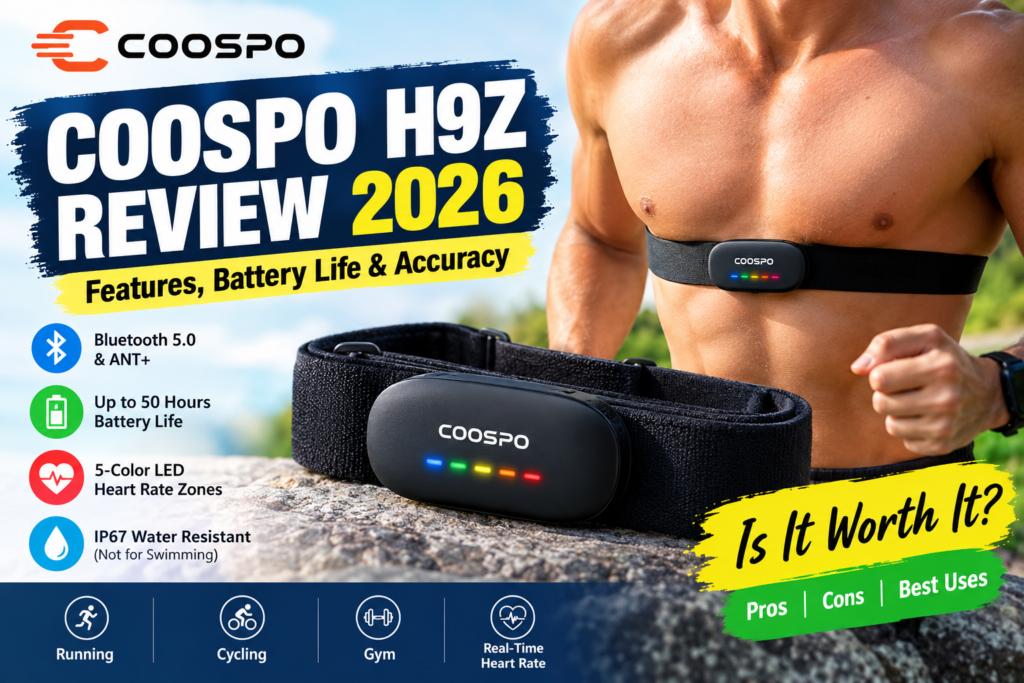
Its main selling points include Bluetooth and ANT+ connectivity, an advertised battery life of up to 50 hours, and a five-color heart-rate zone indicator. However, the H9Z is not a complete fitness tracker. It relies on a compatible phone, watch, cycling computer, or fitness application to display and record workout data.
In this COOSPO H9Z review, we examine its published specifications, available independent testing, battery life, connectivity, comfort, limitations, and alternatives to help you decide whether it suits your training routine in 2026.
Quick answer: The COOSPO H9Z is worth considering if you want a rechargeable chest strap for running, cycling, or indoor exercise. Its Bluetooth and ANT+ connectivity and advertised 50-hour battery life are useful advantages. However, it does not store workouts internally, is not intended for swimming, and does not provide advanced running-dynamics data.
Review transparency: This article evaluates published product specifications and third-party testing. LifeCareBalance has not independently laboratory-tested the H9Z, so we do not claim original accuracy measurements or hands-on testing.
COOSPO H9Z Review: Key Specifications

- Precision Heart Rate Tracking: COOSPO H9Z is equipped with an advanced HR sensor, our heart rate monitor chest strap del…
- Rechargeable & Long-Lasting Battery: Say goodbye to disposable batteries! H9Z built-in rechargeable battery that offers …
- Comfortable Wear: Crafted with soft, breathable materials and an adjustable strap, our heart rate monitor ensures a secu…
| Feature | COOSPO H9Z |
|---|---|
| Product type | Chest-strap heart-rate monitor |
| Connectivity | Bluetooth 5.0 and ANT+ |
| Advertised battery life | Up to 50 hours |
| Battery | Rechargeable 70 mAh lithium battery |
| Water resistance | IP67; not intended for swimming |
| Weight | Approximately 43 g with sensor and strap |
| Heart-rate zone indicator | Five-color LED |
| Workout storage | No internal workout recording |
| Charging | Dedicated charging dock and cable |
| Compatible devices | Supported smartphones, watches, cycling computers and fitness equipment |
| Primary use | Real-time exercise heart-rate monitoring |
Specifications are based on the official COOSPO H9Z product page and the manufacturer’s user documentation. Check the current product listing before purchasing because specifications and software compatibility can change.
What Is the COOSPO H9Z?
The COOSPO H9Z is a chest-worn sensor that measures heart rate and transmits the information wirelessly to compatible equipment.
Unlike a smartwatch, it does not have a screen for displaying workout summaries, GPS maps, or notifications. Instead, you pair it with a supported device or application that displays your heart rate and records your exercise session.
This design can be useful for runners who already own a sports watch, cyclists who use a cycling computer, or gym users who want real-time heart-rate information during exercise.
The H9Z also includes a five-color LED indicator intended to show your current heart-rate training zone. Depending on the workout and clothing, this feature may be more useful during indoor exercise than during outdoor running.
Its main purpose is straightforward: transmit exercise heart-rate data without requiring you to buy a complete wearable ecosystem.
COOSPO H9Z Accuracy: How Reliable Is It?
Accuracy is one of the most important factors when choosing a heart-rate monitor. If your sensor produces inconsistent readings, it can make it harder to manage workout intensity, interval sessions, and training zones.
Chest straps generally detect the electrical activity associated with heartbeats. Optical wrist sensors estimate heart rate by measuring changes in blood flow beneath the skin. Both approaches have limitations, but chest straps can respond more consistently during rapid changes in exercise intensity.
What Independent Testing Reports
A published review by Coach reported encouraging results during easy runs, cycling, and hard running intervals. The reviewer compared the H9Z with another heart-rate monitor and found its readings consistent with expected performance.
A separate review by Men’s Fitness also reported positive results during testing, including comparisons with other heart-rate monitoring equipment.
These reports are useful because they describe actual testing rather than relying exclusively on manufacturer specifications. Nevertheless, independent reviews do not establish that every unit will produce identical readings for every user.
COOSPO advertises an accuracy claim of approximately ±1 beat per minute. Treat this as a manufacturer claim rather than a guarantee that all measurements will remain within that range under every condition.
What Can Affect Heart-Rate Readings?
Even a capable chest strap can produce unreliable readings when the electrodes do not make proper contact with the skin.
Common causes include:
- Dry electrodes before a workout.
- A loose strap that moves during running or cycling.
- Incorrect sensor placement.
- Low battery power.
- Pairing or wireless connection problems.
- Interference or incompatibility with the receiving device.
Before exercise, moisten the electrode areas according to the manufacturer’s instructions. Position the sensor securely at the front of your chest and adjust the band so it remains in place without restricting breathing.
If the readings seem implausible, check the fit, battery, and connection before assuming that the sensor is defective.
Accuracy verdict: Published independent testing is encouraging, but the available evidence does not justify promising perfect accuracy or a particular error rate for every workout. The H9Z is intended for exercise monitoring, not medical diagnosis.
COOSPO H9Z Battery Life: How Long Does It Last?
COOSPO advertises up to 50 hours of battery life from the H9Z’s rechargeable 70 mAh lithium battery.
For someone exercising several times a week, this can be convenient. You can recharge the monitor periodically instead of buying replacement coin-cell batteries.
However, the advertised figure should not be interpreted as a guarantee of identical runtime for every user. Actual performance can vary with usage, battery condition, operating conditions, and the way the sensor is used.
Charging the H9Z
The package includes a charging cable, dock, and user manual. COOSPO recommends a DC 5V power source or computer USB port and lists an approximate charging time of 1.5 to 2 hours.
Check the charging indicator before assuming the device is fully charged. Because the H9Z uses a dedicated charging accessory, keep the dock and cable somewhere safe.
Rechargeable vs. Replaceable Batteries
A rechargeable battery is convenient if you regularly charge fitness devices. It avoids the need to purchase and replace coin-cell batteries.
A replaceable-battery strap may be more appealing if you prefer not to manage another charging routine or want to carry a spare battery.
The H9Z’s advertised runtime is competitive for a rechargeable sensor, but battery life alone should not determine which monitor you buy.
Bluetooth and ANT+ Connectivity
The H9Z supports Bluetooth 5.0 and ANT+, two common wireless technologies used by fitness sensors.
Bluetooth can connect the monitor to supported smartphones, apps, watches, and other equipment. ANT+ is particularly useful for compatible sports watches, cycling computers, and exercise equipment.
However, dual connectivity does not mean the H9Z works with every device. A receiving device may support only one wireless standard, and individual apps can have additional compatibility requirements.
Before buying, check the specifications of your exact watch, cycling computer, or fitness application. Do not assume that any smartwatch advertising Bluetooth will automatically support external heart-rate sensors.
Can You Use the H9Z With Fitness Apps?
COOSPO identifies support for its own applications and compatible third-party platforms. The available features depend on the app and the connected device.
The H9Z is a sensor, not the software that manages your entire training history. A compatible application or receiving device normally handles the display, workout recording, and historical graphs.
If you want to use the H9Z with a particular training platform, confirm that the current version supports external Bluetooth or ANT+ heart-rate sensors.
Five-Color LED and Heart-Rate Zone Indicators
The H9Z includes a five-color LED intended to provide a quick visual indication of heart-rate training zones.
This feature can be useful during indoor cycling, gym workouts, or interval training when you want a basic indication of intensity without constantly checking your phone.
The monitor also supports configurable heart-rate-zone and alert functions through compatible software.
However, the LED is not a replacement for a full workout display. It does not provide the detailed graphs, training summaries, or analysis available through a compatible receiving device.
Heart-rate zones are also estimates rather than universal measurements of effort. Age-based formulas and device settings may not reflect your individual maximum heart rate. Use the readings as training guidance rather than a diagnosis or guarantee of exercise safety.
Is the COOSPO H9Z Waterproof?
COOSPO lists the H9Z as IP67-rated but explicitly states that it should not be used for swimming.
That distinction matters. A water-resistance rating does not automatically establish that a device is suitable for every water-based activity.
For ordinary workouts involving sweat or exposure to rain, the rating may be useful. Follow the manufacturer’s care instructions and do not treat the H9Z as a swimming heart-rate monitor.
After exercise, detach the sensor from the strap as directed. Clean and dry the strap according to the manual, and avoid washing or drying the sensor in ways the manufacturer prohibits.
If swimming data is important to your training, choose a monitor specifically designed and documented for that purpose.
Comfort, Fit, and Everyday Use
The H9Z combines a compact sensor with an adjustable chest strap. The manufacturer lists a combined weight of approximately 43 grams.
Its relatively light construction can make it practical for regular exercise, but comfort depends on more than weight. Strap tension, body shape, skin sensitivity, clothing, and workout duration all affect the experience.
Some users prefer chest straps because they stay in place during intense exercise. Others dislike the feeling of wearing a band around the torso.
Published reviews have noted that the H9Z’s strap is not as comfortable as some competing models. That does not mean it will be uncomfortable for everyone, but it is a useful consideration before buying.
A correctly adjusted strap should remain secure without making breathing uncomfortable. If it slips during exercise, adjust it before your next session. If you experience persistent skin irritation, stop using it until the cause is addressed.
Check the seller’s return policy if you are uncertain whether you will tolerate a chest strap during long workouts.
What the COOSPO H9Z Does Not Do
Understanding the limitations is essential before deciding whether this monitor offers good value.
It does not store workouts internally. The H9Z transmits heart-rate information to compatible equipment or apps. You need a receiving device to display or record the session.
It does not provide advanced running dynamics. Buyers who want additional running-form measurements should investigate sensors specifically designed to provide those features.
It is not intended for swimming. COOSPO explicitly advises against swimming with the H9Z.
It is not a standalone fitness tracker. There is no smartwatch-style screen, built-in GPS mapping system, or comprehensive daily activity dashboard.
It is not a medical diagnostic device. Its exercise heart-rate data should not replace clinical assessment, prescribed monitoring, or professional medical advice.
These limitations are not necessarily deal-breakers. They simply mean that the H9Z is best evaluated as a focused exercise sensor rather than a complete wearable.
COOSPO H9Z vs. Other Heart-Rate Monitors
The best alternative depends on which features matter most to you.
| Feature | COOSPO H9Z | Polar H10 | COOSPO H6 |
|---|---|---|---|
| Design | Chest strap | Chest strap | Chest strap |
| Connectivity | Bluetooth and ANT+ | Bluetooth and ANT+ | Bluetooth and ANT+ |
| Battery | Rechargeable | Replaceable coin cell | Replaceable coin cell |
| Internal recording | No | Limited onboard recording options | No |
| Main advantage | Rechargeable design and zone indicator | Additional recording options and established ecosystem | Replaceable battery |
| Main consideration | No internal workout storage | Higher price may apply | Different feature set and battery approach |
Features can vary by model version and setup. Confirm the current manufacturer specifications before purchasing.
COOSPO H9Z vs. Polar H10
The Polar H10 is worth considering if you want additional recording options and prefer the Polar ecosystem.
The H9Z may appeal more to buyers who want a rechargeable sensor with basic training-zone indicators and do not need advanced features.
Do not choose between them on accuracy claims alone. Consider device compatibility, comfort, recording requirements, battery preferences, and total price.
COOSPO H9Z vs. COOSPO H6
The H6 is another option in COOSPO’s chest-strap range. Its replaceable battery may appeal to users who prefer not to recharge their sensor regularly.
The H9Z offers a rechargeable design and a five-color zone indicator. The better choice depends on whether you value charging convenience, battery replacement, or a particular feature set.
Check the current product comparison before purchasing because model specifications and availability can change.
Who Should Buy the COOSPO H9Z?
The H9Z is worth considering if you:
- Run or cycle and want real-time heart-rate data.
- Prefer a chest strap to wrist-based optical tracking.
- Want Bluetooth and ANT+ options for compatible devices.
- Prefer a rechargeable battery.
- Want a basic visual heart-rate-zone indicator.
- Already own a compatible watch, phone app, or cycling computer.
It may not be the best choice if you:
- Need a monitor specifically designed for swimming.
- Want GPS, a screen, or internal workout storage.
- Require advanced running-dynamics measurements.
- Cannot confirm compatibility with your current equipment.
- Need medical-grade monitoring or diagnostic information.
- Find chest straps uncomfortable.
For broader fitness-device comparisons, see our Fitness and Movement Products guide for 2026, which discusses how different fitness products fit different exercise goals.
How to Set Up the COOSPO H9Z
Follow the supplied instructions for your exact model. A typical setup involves these steps:
- Charge the sensor using the supplied charging accessories.
- Attach the sensor securely to the chest strap.
- Moisten the electrode areas as directed by the manufacturer.
- Position the strap around your chest and adjust the fit.
- Enable the supported wireless connection on your receiving device.
- Open the compatible app or device settings and search for the H9Z sensor.
- Confirm that heart-rate data appears before beginning a demanding workout.
If the sensor does not connect, check the battery, strap contact, Bluetooth or ANT+ support, and whether another app or device is already connected.
Restarting the app and following the manufacturer’s troubleshooting instructions may help. Do not assume that every connection problem means the sensor is broken.
Care and Maintenance
Basic maintenance can help preserve the strap and sensor.
After exercise, detach the sensor if the manual instructs you to do so. Rinse and dry the strap according to the manufacturer’s care instructions. Avoid harsh cleaning agents and machine washing or drying when prohibited.
Store the sensor and charging dock in a dry location. Inspect the strap periodically for wear, damage, or reduced elasticity.
If readings become inconsistent, check electrode contact, strap fit, battery level, and pairing before replacing the unit.
For a wider overview of consumer tracking devices, our Sleep Tracker Buying Guide 2026 explains how to compare wearable measurements, battery life, comfort, and app features. Sleep trackers serve a different purpose from workout chest straps, but the same principle applies: understand what the device actually measures before relying on its data.
Is the COOSPO H9Z Worth It in 2026?
The COOSPO H9Z is a practical option for people who want a rechargeable chest heart-rate monitor with Bluetooth, ANT+, and basic heart-rate-zone indicators.
Its advertised 50-hour battery life is convenient, and published independent testing provides encouraging evidence that the sensor can perform well during running and cycling. However, those results are not a guarantee of identical accuracy for every user.
The lack of onboard workout storage, absence of advanced running metrics, and explicit restriction against swimming narrow its appeal. You should also confirm compatibility with your existing devices before buying.
Our recommendation is to consider the COOSPO H9Z if you want a straightforward rechargeable chest strap for everyday exercise and already have compatible equipment to display and record the data.
Compare it with the Polar H10 if you need additional features or prefer a different ecosystem. If you only need occasional heart-rate readings, your existing fitness tracker may already be sufficient.
Our Best Wellness Products for 2026 guide provides a broader overview of consumer wellness equipment, while our Trending Wellness Products in 2026 guide explores additional product categories.
For readers building a personal exercise routine, the Personalized Wellness Guide explains why tracking tools work best when they support a specific goal rather than becoming a substitute for consistent habits.
Frequently Asked Questions
Is the COOSPO H9Z accurate?
Published independent testing reported good performance during running and cycling, including intervals. LifeCareBalance has not independently tested the device, and no consumer sensor should be assumed to produce perfect readings in every situation.
How long does the COOSPO H9Z battery last?
COOSPO advertises up to 50 hours per charge. Actual runtime depends on usage, battery condition, and operating conditions.
Does the COOSPO H9Z work with Garmin watches?
It may work with compatible Garmin devices that support the relevant Bluetooth or ANT+ heart-rate sensor connection. Check the specifications for your exact watch model before purchasing.
Can I use the COOSPO H9Z with Zwift?
The H9Z supports Bluetooth and ANT+, but successful pairing depends on your Zwift setup, receiving device, and available wireless connections. Verify compatibility with your equipment before buying.
Can I swim with the COOSPO H9Z?
No. Although the manufacturer lists an IP67 water-resistance rating, COOSPO explicitly says the H9Z should not be used for swimming.
Does the COOSPO H9Z store workout data?
No. It transmits heart-rate information to compatible equipment or apps but does not provide built-in workout memory.
Is the COOSPO H9Z better than a smartwatch?
It depends on your needs. A chest strap may respond more consistently during rapid changes in exercise intensity, while a smartwatch offers convenience and additional tracking features. Neither option is automatically better for every user.
Does the COOSPO H9Z measure heart-rate variability?
COOSPO lists HRV support through compatible software. Available readings and analysis depend on the app and how the device is used. HRV values should not be treated as a medical diagnosis.
Is the COOSPO H9Z a medical device?
It is intended for exercise heart-rate monitoring, not medical diagnosis or treatment. If you need heart monitoring for a medical condition, consult a qualified healthcare professional about suitable equipment.
What should I check before buying?
Confirm compatibility with your watch or app, understand the advertised battery life, consider chest-strap comfort, and remember that the H9Z is not intended for swimming and does not store workouts internally.
Final Verdict
The COOSPO H9Z is worth considering for everyday runners, cyclists, and gym users who want a rechargeable chest strap without unnecessary complexity.
Its main strengths are dual wireless connectivity, an advertised 50-hour battery life, and a five-color heart-rate zone indicator. Its main limitations are the lack of internal workout storage, no advanced running-dynamics data, and no swimming support.
Choose it if those features match your needs and your receiving device is compatible. Compare alternatives if you need advanced training functions or a different battery system.
The best heart-rate monitor is the one that works with your equipment, fits comfortably, and provides useful data for the way you actually train.