
LifeCareBalance.com is reader-supported. When you buy through links on our site, we may earn an affiliate commission at no extra cost to you. As an Amazon Associate, we earn from qualifying purchases.

- THE WORLD’S SMALLEST SMART RING – 40% smaller than the previous generation, Oura Ring 5 is thinner, lighter and smaller …
- SIZING IS ESSENTIAL – Oura Ring 5 uses unique sizing different from standard jewelry rings and other Oura Ring generatio…
- EVERYDAY HEALTH SENSING – Oura tracks over 50 health metrics, including sleep, activity, stress, heart health, metabolic…
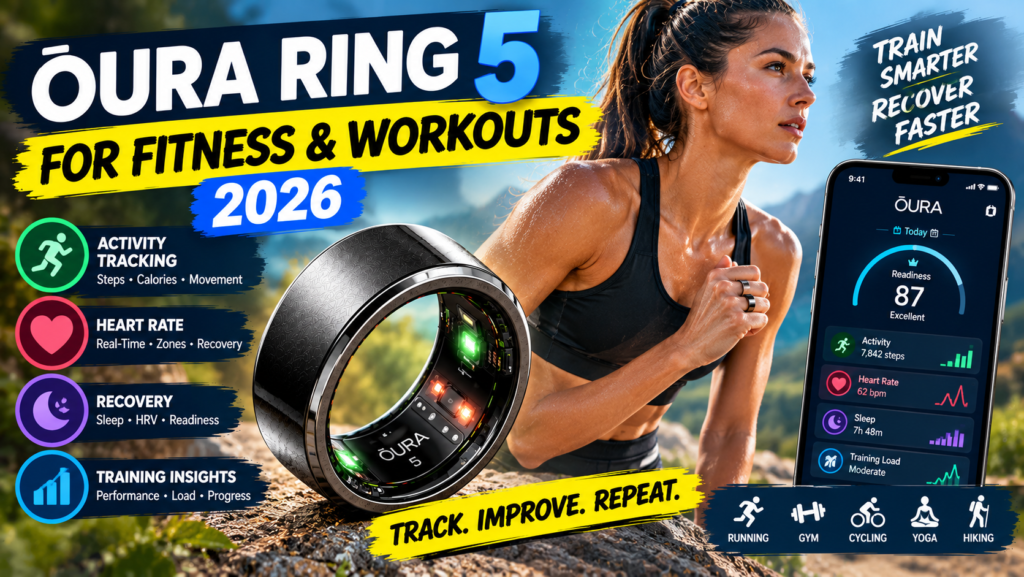
The Oura Ring 5 is best known as a sleep and recovery wearable, but its fitness features make it useful for much more than overnight tracking. It can monitor daily movement, workout heart rate, activity, calories, and recovery trends while staying small enough to wear throughout the day.
The important question is what kind of fitness tracking you actually need.
Oura Ring 5 can be useful for walking, running, gym sessions, cycling, yoga, and general activity tracking. It can also provide recovery context that helps you understand how your body responds to training.
But it is not designed to replace a dedicated running watch or advanced sports computer.
This guide focuses specifically on using Oura Ring 5 for fitness and workouts in 2026, including what it tracks, how workout recording works, where GPS comes from, how heart-rate tracking works, and where the ring’s limitations become important.
Quick answer: Oura Ring 5 is most useful as a daily activity and recovery tracker. It works well for general fitness and workout logging, but athletes who need detailed live performance metrics may still want a dedicated sports watch.
What Does Oura Ring 5 Track During Fitness?
Oura separates everyday activity, workout tracking, recovery, and sport-specific performance into different areas.
For fitness users, the most relevant measurements include:
- Daily activity and steps
- Workout duration
- Workout heart rate
- Heart-rate zones
- Active calorie estimates
- Resting heart rate
- Heart-rate variability (HRV)
- Readiness
- Recovery-related trends
- Outdoor pace and distance through phone GPS
This distinction matters because tracking a workout is not the same as providing advanced sports analytics.
Oura is strongest when you want to understand how much you moved and how your body is responding rather than when you need detailed live information during every second of a workout.
Is Oura Ring 5 Good for Workouts?
Yes, but it depends on the type of workout.
Oura Ring 5 is particularly useful for:
- Walking
- General cardio
- Gym sessions
- Strength training
- Yoga
- Pilates
- Cycling
- Hiking
- General daily activity
It can record workout duration and heart-rate information, while its recovery features provide additional context after training.
The limitation is that the ring has no display. You cannot simply glance at your finger to check pace, heart rate, or other live metrics during exercise.
For casual fitness, that may not matter.
For structured training, racing, or performance-focused workouts, it matters much more.
Oura Ring 5 Activity Tracking
Activity tracking is one of the areas where Oura makes the most sense.
The ring continuously tracks movement throughout the day rather than limiting its usefulness to formal workouts.
Depending on the activity and software experience, you can use Oura to monitor:
- Steps
- Daily movement
- Activity levels
- Active calories
- Workout sessions
- Activity goals
- Recovery-related activity recommendations
This makes the ring useful for people whose fitness routine includes a mixture of workouts and everyday movement.
Instead of looking only at one gym session, you can see how that session fits into your overall activity.
Automatic Workout Detection
Oura can automatically recognize a range of activities, which means you do not always have to manually start a workout.
This is convenient for activities such as walking and other common exercises.
However, automatic detection should not be treated as perfect.
If a workout is important to you, manually recording it is generally the safer approach because you are explicitly telling the app when the session starts and ends.
That distinction becomes especially important for outdoor activities where you care about route, distance, pace, or other workout details.
Live Activity Tracking
Oura’s Live Activity Tracking allows you to start a workout from the Oura app.
For supported outdoor activities, the phone provides GPS information while the ring contributes its available sensor data.
Supported outdoor activities can include:
- Running
- Walking
- Hiking
- Cycling
With the phone’s GPS, the workout can provide information such as:
- Distance
- Pace
- Route
- Active calories
- Average heart rate
- Heart-rate zones
The important detail is that the GPS is phone-based.
Oura Ring 5 itself is not a replacement for a GPS sports watch with built-in navigation and a wrist display.
Does Oura Ring 5 Have Built-In GPS?
Oura’s outdoor workout tracking relies on your phone for GPS.
That means you normally need to take your phone with you when you want GPS-based pace, distance, and route information.
This is fine for people who already carry their phone during walks, runs, or hikes.
It is less convenient for runners and athletes who prefer to leave their phone at home.
A dedicated sports watch can provide built-in GPS and display workout information directly on the wrist.
Oura Ring 5 Heart Rate During Exercise
Heart-rate tracking is an important part of Oura’s fitness experience.
The ring uses optical sensors to measure physiological signals, and workout summaries can include average heart rate and time spent in heart-rate zones.
Heart rate can help you understand workout intensity, but optical sensors are not perfect in every situation.
Potential challenges include:
- Fast changes in intensity
- Rapid arm movement
- Gripping weights
- Cold hands
- Poor ring fit
- High-intensity intervals
This is particularly relevant during strength training and HIIT.
If precise heart-rate zones are central to your training, an external Bluetooth heart-rate monitor can be a better option.
Can Oura Ring 5 Track Live Heart Rate?
The ring can record workout heart rate, but it is not designed like a smartwatch that continuously displays your current heart rate on your wrist.
For users who need live heart-rate information during intervals or structured training, an external compatible heart-rate sensor can provide a more practical setup.
This is one of the biggest differences between Oura and a traditional fitness watch.
Oura Ring 5 for Running
Oura Ring 5 can be useful for runners who care about general activity and recovery.
During supported outdoor runs, your phone can provide GPS information for:
- Pace
- Distance
- Route
The workout summary can also include heart-rate information and other activity data.
However, runners should understand what they are giving up compared with a dedicated running watch.
Oura does not provide:
- A wrist-mounted display
- On-device pacing
- Advanced running navigation
- A full running-metrics ecosystem
- The same level of sport-specific training tools
Best Use for Runners
Oura works particularly well as a recovery companion.
A runner might use a sports watch during the run and Oura throughout the day and night to monitor longer-term recovery patterns.
That combination makes more sense than expecting the ring to replace every function of a running watch.
Oura Ring 5 for Walking
Walking is one of the most natural fitness use cases for Oura.
The ring can track daily movement and steps, while live activity tracking can add pace, distance, and heart-rate information when using the phone’s GPS.
For people who primarily walk for fitness, general health, or daily activity, the lack of a screen may not be a major disadvantage.
You can simply start the workout and review the details afterward.
Oura Ring 5 for Cycling
Oura supports outdoor cycling through phone-based GPS tracking.
You can use the app to record:
- Distance
- Pace
- Route
- Heart rate
- Activity duration
For casual cyclists, this may be enough.
Serious cyclists who use power meters, cadence sensors, bike computers, or structured cycling training will still need dedicated cycling equipment for those metrics.
Oura’s role is better understood as an additional recovery and wellness layer.
Oura Ring 5 for Strength Training
Strength training is an interesting use case because GPS is largely irrelevant.
Instead, the useful information comes from:
- Workout duration
- Heart rate
- Activity load
- Recovery trends
- Overall activity
Oura does not replace a lifting log.
It does not automatically provide the detailed strength-training information many lifters want, such as:
- Reps
- Sets
- Weight used
- Exercise selection
- Progressive overload
- Detailed lifting volume
If you already use a workout app or training log, Oura can complement it by showing how your body responds to the training.
Oura Ring 5 for HIIT
HIIT workouts are more challenging for optical heart-rate sensors because intensity can change quickly.
If you only want a general picture of the workout, Oura can still be useful.
If your training depends heavily on precise heart-rate zones, consider pairing the app with a compatible external heart-rate monitor.
This is especially relevant for athletes who use heart-rate zones to control interval intensity.
Oura Ring 5 for Yoga and Mobility
Yoga, Pilates, and mobility work are another area where Oura’s discreet design can be useful.
The ring does not need to provide detailed sport-specific metrics for these activities to be useful.
Instead, the value comes from recording activity and looking at the relationship between movement, heart rate, and recovery.
Low-motion workouts have also been part of Oura’s improvements to automatic activity detection.
Oura Ring 5 for Hiking and Outdoor Activity
For hiking, Oura can record supported outdoor activity using your phone’s GPS.
That can provide route and distance information while the ring contributes its available physiological data.
However, phone dependence matters on longer hikes.
Before heading into a remote area, consider:
- Phone battery
- GPS availability
- Mobile coverage
- Navigation requirements
- Whether you need offline maps
If navigation is a priority, a dedicated outdoor watch may be a better primary device.
Oura Ring 5 Recovery and Training Readiness
Recovery is where Oura becomes different from many basic activity trackers.
Instead of simply asking:
“How much did I exercise?”
Oura also helps you consider:
“How is my body responding to that training?”
Readiness-related information can incorporate signals such as:
- Heart rate
- HRV
- Temperature trends
- Sleep
- Previous activity
This makes Oura particularly interesting for people who train regularly but also care about avoiding unnecessary accumulation of fatigue.
However, a readiness score should not be treated as an instruction.
One low score does not automatically mean you should skip a workout.
Look at trends and combine the data with:
- Muscle soreness
- Energy
- Motivation
- Workout performance
- Sleep quality
- How you actually feel
Oura Ring 5 vs a Sports Watch for Fitness
The two devices serve different purposes.
| Feature | Oura Ring 5 | Dedicated Sports Watch |
|---|---|---|
| Daily activity | Strong use case | Strong |
| Sleep tracking | Major focus | Available on many models |
| Recovery trends | Major focus | Available on many models |
| Workout recording | Yes | Yes |
| Live workout display | No | Yes |
| Built-in GPS | No | Usually |
| Phone-free GPS | No | Usually |
| Running metrics | Limited | Much deeper |
| Strength-training metrics | Basic | Usually broader |
| Navigation | Phone-dependent | Often built in |
| On-wrist heart rate | No | Yes |
| Screen | No | Yes |
| 24/7 discreet wear | Major advantage | Depends on model |
The choice depends on what you want the device to do.
If your priority is continuous activity and recovery tracking, the ring makes sense.
If your priority is live workout performance, a sports watch is generally the more appropriate primary device.
Can Oura Ring 5 Replace a Garmin or Apple Watch?
For some users, yes—but not for the same use case.
If you mainly want:
- Daily movement
- Recovery trends
- Heart-rate trends
- Sleep-related recovery context
- Basic workout recording
Oura may cover much of what you need.
If you need:
- Built-in GPS
- Live pace
- On-device navigation
- Live heart rate
- Advanced running metrics
- Sport-specific training tools
a dedicated sports watch remains the better fit.
Many users can also use both devices because they serve different roles.
Oura Ring 5 Fitness Tracking Limitations
Before buying Oura primarily for workouts, keep these limitations in mind:
No Display
You cannot glance at the ring for live workout information.
Phone-Dependent GPS
Outdoor pace, distance, and route tracking rely on your phone.
Limited Sport-Specific Metrics
The ring focuses more on general activity and recovery than advanced performance analytics.
Automatic Detection Isn’t Perfect
Important workouts are better recorded manually.
Strength Tracking Is Basic
The ring does not replace a detailed lifting log.
Live Heart Rate Is Limited
Users who require precise live heart-rate monitoring may prefer an external sensor or sports watch.
Membership Matters
Some Oura features require an active membership, so check current pricing and included features before buying.
Who Should Use Oura Ring 5 for Fitness?
Oura Ring 5 is particularly suitable for:
- General fitness users
- People who walk regularly
- Recovery-focused exercisers
- Gym users who want additional recovery context
- People who dislike wearing a smartwatch
- Athletes who already own a sports watch
- Users interested in long-term activity and recovery trends
Who Should Choose a Different Fitness Device?
Consider a sports watch or another fitness device if you need:
- Live pace on your wrist
- Built-in GPS
- Advanced running analytics
- Detailed cycling metrics
- Navigation without a phone
- Advanced sport-specific training data
- Live workout heart rate without another device
How to Get Better Fitness Data From Oura Ring 5
A few habits can make the data more useful.
1. Wear the Ring Consistently
Long-term trends become more useful when there are fewer gaps in your data.
2. Get the Fit Right
A poor fit can affect sensor contact and potentially reduce the quality of readings.
For sizing-specific guidance, use the site’s dedicated Oura Ring sizing guide rather than repeating sizing information in this article.
3. Manually Record Important Workouts
If a workout matters, don’t rely entirely on automatic detection.
4. Carry Your Phone for Outdoor GPS
Phone-based GPS is required for supported outdoor route, pace, and distance tracking.
5. Consider an External Heart-Rate Monitor
For intervals and zone-focused training, a compatible chest strap or armband can provide more dependable live heart-rate information.
6. Look at Trends
Don’t make training decisions based on one isolated score or reading.
7. Combine Data With Perceived Effort
Your own experience remains an important part of training.
Is Oura Ring 5 Good for Fitness in 2026?
Oura Ring 5 is a useful fitness wearable when you understand what it is designed to do.
It is strongest at combining daily activity tracking, workout information, heart-rate trends, and recovery context in a small screenless device.
It is less suitable as a replacement for a dedicated sports watch when you need detailed live performance information.
For a general fitness user, walker, gym-goer, or recovery-focused athlete, that distinction may not be a problem.
For a serious runner, cyclist, or athlete following structured training, Oura is better viewed as a complementary recovery device rather than the primary training computer.
Final Takeaway
Oura Ring 5 doesn’t need to replace your fitness watch to be useful.
Its biggest fitness advantage is the ability to sit quietly in the background while collecting activity and recovery information throughout your day.
Use it for the big picture—movement, workout load, heart-rate trends, and recovery—and use dedicated equipment when you need detailed live performance data.
That division of roles is where Oura Ring 5 makes the most sense for fitness in 2026.
Frequently Asked Questions
Is Oura Ring 5 good for workouts?
Yes. It can record workouts, heart rate, activity, and recovery-related information, but it is less suited to detailed live workout performance.
Does Oura Ring 5 track workouts automatically?
Yes. Oura supports automatic activity detection for a range of activities. For important workouts, manual recording can provide a more controlled start and finish.
Does Oura Ring 5 have GPS?
The ring relies on your phone for GPS-based outdoor activity tracking rather than providing the same built-in GPS experience as a dedicated sports watch.
Can Oura Ring 5 track heart rate during workouts?
Yes. Workout summaries can include heart-rate information and zones. Users who need live, highly precise zone monitoring can use a compatible external heart-rate sensor.
Is Oura Ring 5 good for running?
It can be useful for runners who want heart-rate, activity, and recovery information. Runners who need live pace, navigation, and advanced running metrics may prefer a dedicated running watch.
Can Oura Ring 5 track strength training?
It can record workout duration and heart-rate information, but it does not replace a lifting log for tracking sets, reps, and weights.
Is Oura Ring 5 useful for recovery?
Yes. Recovery and readiness are among the ring’s important fitness-related strengths. The data is most useful when viewed as a longer-term trend rather than a single daily score.
Can Oura Ring 5 replace a Garmin or Apple Watch?
It can replace some basic fitness-tracking functions, but it does not provide the same combination of screen-based live data, built-in GPS, and sport-specific metrics.
Who is Oura Ring 5 best for?
It is particularly useful for general fitness users, walkers, gym users, recovery-focused exercisers, and athletes who want a recovery layer alongside another training device.