
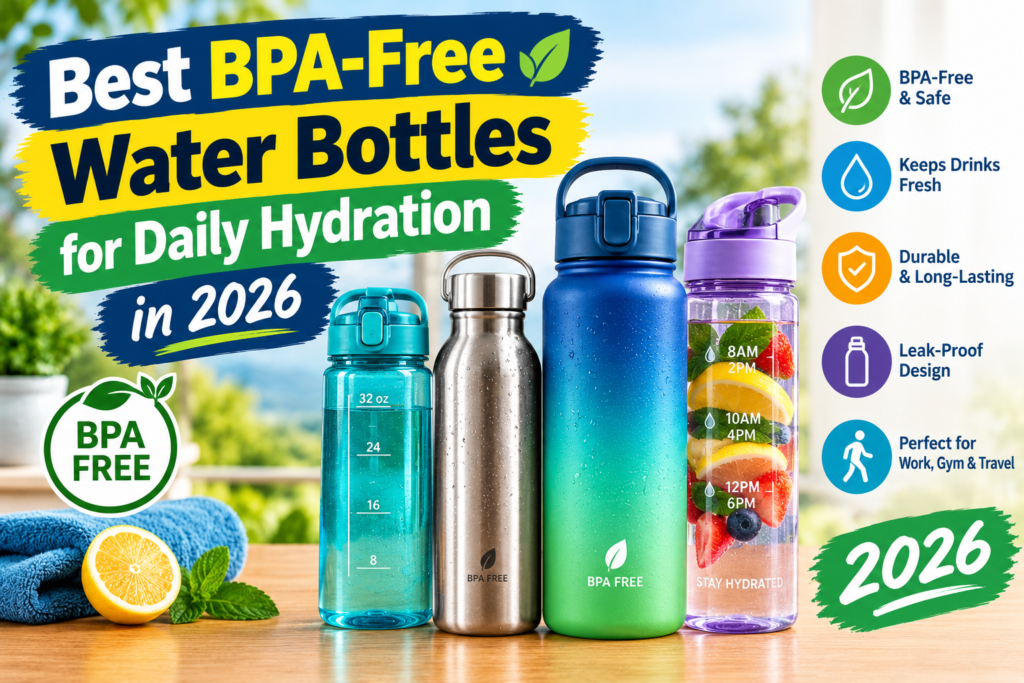
Discover the best BPA-free water bottles for daily hydration in 2026. Compare stainless steel, Tritan plastic, and glass bottles for the gym, office, travel, and everyday use.
LifeCareBalance.com is reader-supported. When you buy through links on our site, we may earn an affiliate commission at no extra cost to you. As an Amazon Associate, we earn from qualifying purchases.
A reusable water bottle is one of those everyday products that looks simple until you actually start comparing your options.
You have stainless steel, BPA-free plastic, glass, insulated bottles, straw lids, chug lids, wide-mouth designs, slim bottles, large 40-ounce bottles, and compact options for commuting. Then there is the bigger question: What does BPA-free actually mean, and which bottle makes the most sense for everyday hydration?
For most people, the best BPA-free water bottle is not simply the bottle with the highest price or the biggest capacity. The better choice depends on how you use it.
If you want cold water to stay cold for hours, insulated stainless steel is usually the strongest choice. If low weight matters most, BPA-free plastic can be more practical. Glass can work well for an office or home environment where breakage is less of a concern.
This guide compares the most important materials, features, and use cases and then highlights four strong options for different types of buyers.
Quick Answer: What Is the Best BPA-Free Water Bottle?
For most everyday users, the Owala FreeSip is one of the most versatile choices because it combines insulated stainless steel with a built-in straw and wide-mouth drinking option.
For maximum insulation, the Hydro Flask Wide Mouth is a strong choice.
For shoppers who want something lightweight and simple, the Nalgene Wide Mouth is a practical alternative.
For people who want a premium stainless-steel bottle with long cold retention, the Klean Kanteen TKWide is another excellent option.
The best choice depends on your routine rather than one universal ranking.
Best BPA-Free Water Bottles at a Glance
| Water Bottle | Best For | Material | Main Advantage |
|---|---|---|---|
| Owala FreeSip | Best Overall | Stainless Steel | Flexible sip-or-swig design |
| Hydro Flask Wide Mouth | Best Insulation | Stainless Steel | Strong temperature retention |
| Nalgene Wide Mouth | Best Lightweight | BPA/BPS-Free Plastic | Lightweight and durable |
| Klean Kanteen TKWide | Best Premium Stainless Steel | Stainless Steel | Long cold retention and versatile caps |
1. Owala FreeSip — Best Overall for Everyday Hydration
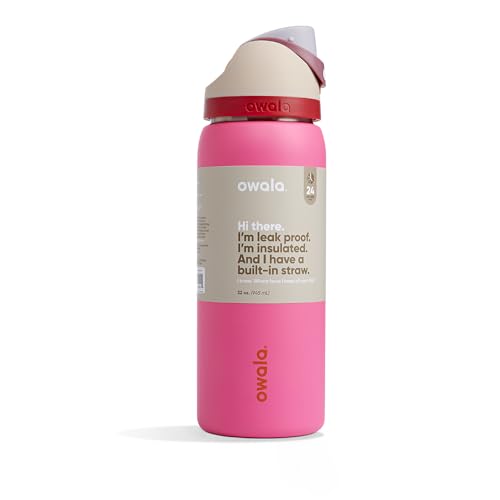
If you want one bottle that can handle work, the gym, commuting, travel, and everyday hydration, the Owala FreeSip is one of the easiest options to recommend.
Its main difference is the FreeSip drinking system. You can drink through the built-in straw or tilt the bottle and drink through the wider opening. Owala lists the FreeSip as BPA-free, lead-free, and phthalate-free, with insulated stainless-steel construction and 24-, 32-, and 40-ounce sizes.
This makes it particularly useful for people who do not want to choose between a straw bottle and a traditional wide-mouth bottle.
Why the Owala FreeSip stands out
- Insulated stainless-steel construction
- BPA-free, lead-free, and phthalate-free components according to the manufacturer
- Built-in straw
- Wide-mouth drinking option
- Leak-proof lid design
- Available in multiple sizes
- Designed for easier cleaning
- Useful carry loop
Best for
The Owala FreeSip is best for people who want one everyday bottle for multiple situations.
It is particularly useful for office workers, gym users, commuters, and people who frequently sip water throughout the day.
Potential limitation
The lid has more components than a simple screw-top bottle, so cleaning the lid properly is important.
Product Recommendation
Owala FreeSip Insulated Stainless Steel Water Bottle — Best Overall
Use the exact Amazon variant you have verified for your affiliate link. Sizes and colors can have different Amazon listings and ASINs.
Why we recommend it: Excellent combination of portability, insulation, drinking flexibility, and everyday convenience.
2. Hydro Flask Wide Mouth — Best for Insulation

- 20 OZ BLACK BOTTLE: Fill and refill with the Hydro Flask Wide Mouth insulated water bottle with leakproof cap. With a co…
- 24 HOURS COLD. 12 HOURS HOT: The insulated water bottle keeps drinks cold for 24 hours and hot for 12 thanks to double-w…
- LEAKPROOF: Say goodbye to leaky water bottles. The Hydro Flask Flex Cap is leakproof when closed. Toss it into your bag …
If your biggest priority is keeping water cold for long periods, the Hydro Flask Wide Mouth deserves serious consideration.
Hydro Flask’s current Wide Mouth models use double-wall vacuum insulation and stainless steel construction. The company lists up to 24 hours of cold retention on its current Wide Mouth models, along with a leakproof-when-closed design and BPA-free construction.
The wide opening is also useful because it makes adding ice easier and gives you more room for cleaning.
Why choose Hydro Flask?
- Double-wall vacuum insulation
- Durable stainless-steel construction
- BPA-free
- Wide opening
- Leakproof when closed
- Designed for cold and hot beverages depending on the specific lid/model
- Available in multiple capacities
- Dishwasher-safe on current models according to manufacturer specifications
Best for
Hydro Flask makes the most sense for people who spend long periods away from home and want cold water available throughout the day.
It can work particularly well for:
- Office workers
- Road trips
- Hiking
- Outdoor activities
- Gym sessions
- Long commutes
Potential limitation
A large insulated stainless-steel bottle is heavier than a lightweight plastic bottle, especially when completely full.
Product Recommendation
Hydro Flask Wide Mouth Insulated Water Bottle — Best for Insulation
Choose the capacity according to your routine instead of automatically buying the largest size.
Why we recommend it: Strong insulation, durable construction, and a practical wide-mouth design.
3. Nalgene Wide Mouth — Best Lightweight BPA-Free Plastic Bottle
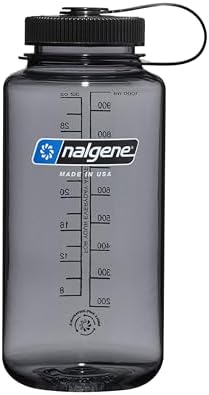
- FOR EVERYDAY & EVERYTHING: From the office to the outdoors, the Nalgene 32 oz Wide Mouth Water Bottle keeps you hydrated…
- DURABLE & LEAK-PROOF: This impact-resistant bottle survives drops on trails, streets, and subway floors. The leak-proof …
- VERSATILE & EASY TO CLEAN: This wide-mouth travel bottle is dishwasher safe and has curved corners for easy scrubbing. M…
Not everyone wants to carry a heavy stainless-steel bottle.
If weight, simplicity, and durability matter more than insulation, the Nalgene Wide Mouth is one of the better-known options in the category.
Nalgene states that its Wide Mouth bottles are BPA/BPS-free and designed for everyday use as well as outdoor activities such as hiking, camping, and climbing. The wide opening also accommodates ice and many filtration devices.
This is an important distinction: a BPA-free plastic bottle is not automatically inferior to stainless steel. It simply solves a different problem.
Why choose Nalgene Wide Mouth?
- Lightweight
- BPA/BPS-free according to the manufacturer
- Durable plastic construction
- Wide opening
- Easy to add ice
- Useful for hiking and outdoor activities
- Simple design
- Lifetime guarantee from the manufacturer
Best for
Nalgene is particularly attractive for:
- Hiking
- Camping
- Travel
- Backpacking
- Outdoor workouts
- Anyone who dislikes carrying a heavy bottle
Potential limitation
Traditional plastic bottles generally do not provide the same level of temperature retention as vacuum-insulated stainless steel.
Product Recommendation
Nalgene Wide Mouth Water Bottle — Best Lightweight Option
If you want a simple bottle that is easy to carry and does not require premium insulation, this is a strong category choice.
Why we recommend it: Low weight, durable construction, and straightforward everyday use.
4. Klean Kanteen TKWide — Best Premium Stainless-Steel Alternative

- Insulated Bottle: The TKWide Insulated Coffee Tumbler keeps beverages iced for up to 66 hours with Climate Lock technolo…
- Portable Stainless Steel: This water bottle comes with a Chug Cap with an easy-carry handle loop for convenience from ou…
- BPA-Free & Safe Materials: Crafted from BPA-free, non-toxic materials for a clean taste; ideal for commuting, workouts, …
For shoppers who want premium stainless steel but also care about long cold retention and flexible lid options, the Klean Kanteen TKWide is worth considering.
The current 32-ounce TKWide uses 18/8 stainless steel, has a leakproof Twist Cap with a reusable steel straw, and is listed as BPA-free and lead-free. Klean Kanteen states that its 32-ounce model can keep contents iced for up to 75 hours under its specified conditions.
The brand also offers interchangeable cap options, which can be useful if your preferred drinking style changes.
Why choose Klean Kanteen TKWide?
- 18/8 stainless steel
- BPA-free and lead-free
- Leakproof Twist Cap
- Reusable steel straw
- Long cold-retention performance
- Cup-holder-friendly design
- Replaceable/interchangeable cap options
- Lifetime limited warranty
Best for
This is a strong option for people who want a premium reusable bottle for:
- Everyday hydration
- Outdoor activities
- Gym use
- Long travel days
- Cold-water storage
Important limitation
The current Twist Cap with steel straw is not intended for very hot liquids or carbonated beverages, according to Klean Kanteen.
Product Recommendation
Klean Kanteen TKWide 32 oz — Best Premium Stainless-Steel Alternative
Why we recommend it: Premium stainless-steel construction, strong insulation, and a versatile cap system.
BPA-Free Water Bottles: What Does BPA-Free Actually Mean?
BPA stands for bisphenol A, a chemical used in the production of certain polycarbonate plastics and epoxy resins.
The important point for consumers is that BPA-free does not mean plastic-free.
A bottle can be made from BPA-free plastic and still contain other materials in its cap, seal, straw, or other components.
The National Institute of Environmental Health Sciences explains that BPA has been used in products including certain water bottles and food-contact materials and continues to support research into potential health effects.
The FDA’s current information on BPA says that available evidence continues to support the safety of BPA for currently approved uses in food-contact applications.
That means a responsible buying guide should avoid saying that every plastic bottle is dangerous or that BPA-free automatically makes a product completely risk-free.
Instead, look at the complete product construction and follow the manufacturer’s intended-use instructions.
For readers who want the official regulatory background, see the FDA’s BPA information for food-contact applications.
Stainless Steel vs. BPA-Free Plastic vs. Glass
Stainless Steel
Stainless steel is usually the best choice when you want insulation and durability.
It works especially well for people who carry water throughout the day and want it to remain cold for extended periods.
Choose stainless steel if you want:
- Strong insulation
- Long-term durability
- Outdoor use
- Gym use
- Travel use
- Cold water retention
The trade-off is additional weight.
BPA-Free Plastic
BPA-free plastic is useful when portability is the priority.
A lightweight plastic bottle can be much easier to carry during hiking, travel, cycling, or long days outdoors.
Research has also examined migration of chemicals from reusable plastic bottles under different conditions, which is why following manufacturer temperature and cleaning instructions matters.
Choose BPA-free plastic if you want:
- Low weight
- Easy portability
- Shatter resistance
- Outdoor practicality
- A lower-cost option
Glass
Glass is attractive for people who prefer a glass drinking surface and primarily use their bottle at home or in the office.
The obvious disadvantage is breakage.
For a desk or kitchen, glass can be practical. For hiking or a crowded gym bag, stainless steel or durable BPA-free plastic is usually more convenient.
How to Choose the Right BPA-Free Water Bottle
1. Choose the Right Size
For many people, 24–32 ounces is a practical everyday range.
Smaller bottles are easier to carry, while 40-ounce models reduce the number of refills but become heavier when full.
The best bottle is the one you will actually carry.
2. Check the Lid
A bottle’s lid can determine whether you enjoy using it.
Look for:
- Straw lids for frequent sipping
- Chug lids for faster drinking
- Screw caps for simplicity
- Wide openings for easier cleaning
- Secure closures for bags and travel
3. Think About Cleaning
A complicated lid can collect residue in areas that are easy to overlook.
Look for bottles with removable components and follow the manufacturer’s cleaning instructions.
If you are building a broader healthy home environment, our guide to designing a kitchen that supports your health goals also covers practical ways to make healthy daily habits easier.
4. Consider Your Main Use
Office: compact, quiet, easy to clean.
Gym: comfortable grip, easy sipping, leak resistance.
Travel: durable, secure lid, appropriate size.
Hiking: lightweight, durable, easy to carry.
Home: glass or stainless steel can both work well.
BPA-Free Water Bottle Buying Mistakes to Avoid
Buying Only Because It Says BPA-Free
BPA-free is useful, but it is only one factor.
Also consider material, lid design, cleaning, capacity, durability, and intended use.
Choosing the Biggest Bottle
A huge bottle can reduce refills but become inconvenient to carry.
Ignoring the Lid
A great bottle with a frustrating lid can end up unused.
Forgetting About Cleaning
Straws, seals, and mouthpieces need regular attention.
Assuming Expensive Means Better
A premium bottle may offer better insulation or construction, but the most expensive option is not automatically the best choice for your routine.
For people comparing reusable products with broader fitness gear, our Fitness and Movement Products guide provides additional product-selection ideas.
How Often Should You Clean a Reusable Water Bottle?
Regular cleaning matters regardless of whether the bottle is plastic, stainless steel, or glass.
At minimum:
- Empty the bottle regularly.
- Wash it according to the manufacturer’s instructions.
- Clean the lid and mouthpiece.
- Remove and clean straws and seals when applicable.
- Allow all components to dry properly.
- Deep-clean the bottle when odors or residue appear.
This becomes particularly important when the bottle is used for beverages other than plain water.
BPA-Free Bottles and Everyday Wellness
A reusable bottle is not a health product by itself.
Its biggest benefit is convenience: keeping water available can make hydration easier to maintain during work, exercise, travel, and daily activities.
That is why bottle selection should fit into a larger routine rather than being treated as a miracle wellness upgrade.
If you are building a broader everyday wellness setup, our Best Wellness Products for 2026 guide covers other categories of products designed around daily routines.
If you track your body composition, remember that hydration can also affect bioelectrical impedance analysis (BIA) readings. Our Smart Scale Body-Fat Accuracy guide explains why smart-scale body-fat numbers can vary.
What Does the Research Say About Bottle Materials?
The science around food-contact materials is more nuanced than many online articles suggest.
Studies have investigated migration of BPA and other compounds from different bottle materials under different temperature and storage conditions. One PubMed-indexed study found that migration from certain polycarbonate bottles increased with temperature and storage time, while other bottle materials showed different results.
Another study examined reusable plastic bottles and identified compounds that could migrate into drinking water, particularly under dishwasher-related conditions. That does not mean every reusable plastic bottle presents the same risk, but it does reinforce the importance of following product-specific care instructions rather than exposing bottles to temperatures or cleaning conditions they were not designed for.
For consumers, the practical takeaway is simple:
Use the bottle according to the manufacturer’s instructions, replace damaged components, and choose a clearly specified material from a reputable manufacturer.
For scientific background, readers can review the PubMed research on chemical migration from reusable plastic bottles and the research on BPA migration from reusable drinking bottles.
Final Buying Guide: Which Bottle Should You Choose?
Choose Owala FreeSip if you want the best all-around combination of convenient drinking, portability, insulation, and everyday versatility.
Choose Hydro Flask Wide Mouth if your highest priority is strong insulation and cold-water retention.
Choose Nalgene Wide Mouth if you want a lightweight, durable, straightforward BPA/BPS-free plastic bottle for everyday or outdoor use.
Choose Klean Kanteen TKWide if you want a premium stainless-steel bottle with long cold retention and flexible cap options.
There is no single bottle that is perfect for everyone.
The right choice depends on what you value most: insulation, weight, durability, cleaning, capacity, lid design, or portability.
The most important thing is to choose a bottle that fits your lifestyle well enough that you will actually carry it and use it consistently.
Frequently Asked Questions
Are BPA-free water bottles safe for daily use?
BPA-free bottles are widely used for everyday hydration. However, BPA-free is a specific material claim and does not automatically describe every component of a bottle. Check the manufacturer’s material and care information.
Is stainless steel better than BPA-free plastic?
Neither is universally better. Stainless steel is generally stronger for insulation and durability, while BPA-free plastic is usually lighter and easier to carry.
Is BPA-free the same as plastic-free?
No. A BPA-free bottle can still be made from plastic.
What size water bottle is best for everyday use?
For many adults, 24–32 ounces is a practical range. Larger bottles can reduce refills but are heavier when full.
Which BPA-free bottle is best for the gym?
The Owala FreeSip is a strong everyday gym option because of its flexible drinking design, while an insulated Hydro Flask is another good choice if cold retention is your priority.
Which BPA-free bottle is best for hiking?
A lightweight Nalgene Wide Mouth can be especially practical for hiking because it reduces the weight you need to carry.
How often should I clean my water bottle?
Clean it regularly according to the manufacturer’s instructions and pay particular attention to lids, straws, mouthpieces, and seals.
Can BPA-free bottles go in the dishwasher?
Some can, while others require hand washing. Always follow the manufacturer’s specific instructions for the bottle and its components.
Should I replace a cracked water bottle?
Yes. A cracked or badly damaged bottle can become harder to clean and may no longer perform as intended.
Is glass better than stainless steel?
Glass can be excellent for home or office use, especially for people who prefer a glass drinking surface. Stainless steel is generally more practical for travel, outdoor activities, and situations where durability matters.
Final Verdict
The best BPA-free water bottle is not necessarily the biggest, cheapest, or most expensive option.
For most shoppers, the smartest approach is to start with your routine.
Need versatility? Choose Owala FreeSip.
Need strong insulation? Choose Hydro Flask Wide Mouth.
Need lightweight outdoor portability? Choose Nalgene Wide Mouth.
Want premium stainless steel and long cold retention? Consider Klean Kanteen TKWide.
BPA-free is an important specification, but it should be considered alongside material quality, lid design, cleaning requirements, capacity, durability, and the way you actually plan to use the bottle.
That is what turns a simple water-bottle purchase into a genuinely useful everyday hydration upgrade