
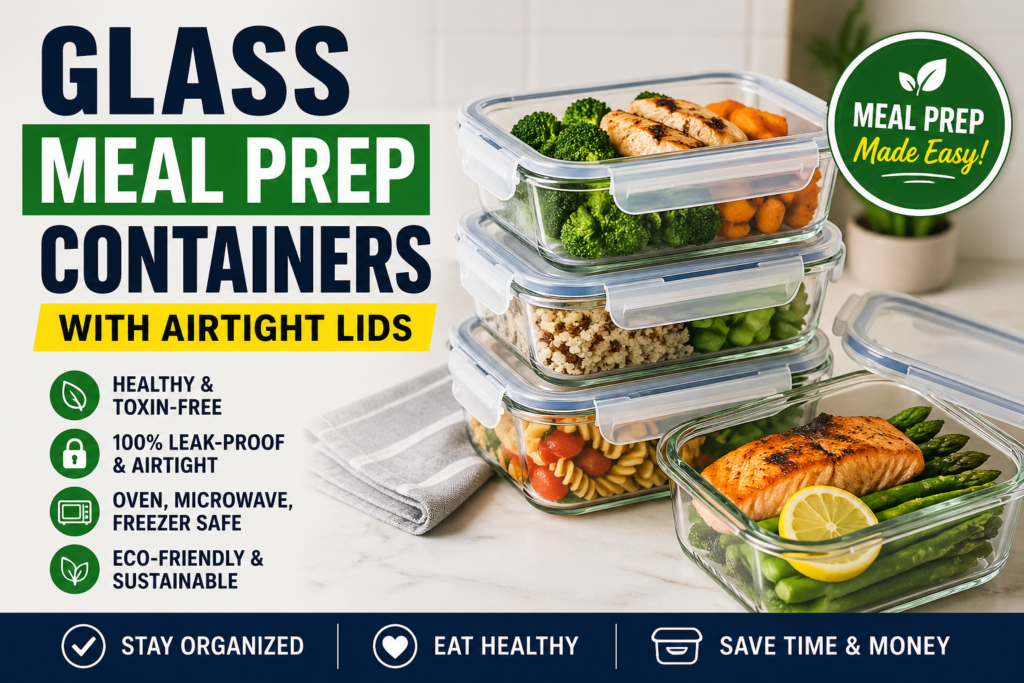
Find the best glass meal prep containers with airtight lids for lunches, leftovers, and weekly meal prep. Compare glass types, seals, sizes, safety, and cleaning tips.
LifeCareBalance.com is reader-supported. When you buy through links on our site, we may earn an affiliate commission at no extra cost to you. As an Amazon Associate, we earn from qualifying purchases.
Meal prep becomes much easier when your food storage containers are reliable, easy to clean, and practical enough for everyday use. Glass meal prep containers with airtight lids are especially popular because they combine reusable glass bases with secure lids designed for storing prepared meals, leftovers, snacks, and ingredients.
But not every glass container with a lid is equally useful.
Some lids are better for preventing leaks than others. Some containers are designed mainly for refrigerator storage, while others can safely move between the refrigerator, freezer, microwave, or oven when the manufacturer’s instructions allow it. Container size also matters. A 30-ounce container may work well for a full lunch, while smaller containers can be better for snacks, sauces, overnight oats, or side dishes.
The best choice depends on how you actually meal prep.
This guide explains what to look for before buying glass meal prep containers with airtight lids, including glass type, lid construction, capacity, leak resistance, microwave and oven safety, freezer storage, cleaning, stacking, and everyday meal-prep convenience.
Why Choose Glass Meal Prep Containers?
Glass has several practical advantages for food storage.
Unlike many plastics, glass does not easily retain food odors or become permanently stained by foods such as tomato sauce, curry, or heavily seasoned meals. It also does not warp in the same way some plastic containers can when exposed to heat.
Another advantage is visibility. Clear glass makes it easy to see what is inside your refrigerator, which can make prepared meals easier to organize and remember.
Glass containers can also be useful for people who want one reusable system for storing meals and reheating food. However, the exact temperature limits and safe-use instructions vary by product, so you should always follow the manufacturer’s instructions rather than assuming every glass container is oven or freezer safe.
For example, Anchor Hocking advises avoiding sudden temperature changes and specifically warns against moving certain glass food-storage dishes directly from the freezer into a preheated oven or microwave. Anchor Hocking glass food-storage care and safety guide
What Makes a Glass Meal Prep Container Truly Useful?
The glass itself is only part of the equation.
For meal prep, I would evaluate a container using six main factors:
- Glass durability
- Lid sealing system
- Leak resistance
- Size and portion capacity
- Temperature compatibility
- Cleaning and storage convenience
A container can have excellent glass but still be frustrating if the lid leaks or the sizes do not match your meals.
That is why the lid deserves almost as much attention as the glass base.
Airtight vs. Leakproof: What Is the Difference?
These terms are often used together, but they are not necessarily identical.
An airtight lid is designed to create a seal that limits air exchange.
A leak-resistant or leakproof lid is designed to prevent liquids from escaping when the container is transported or tipped.
For dry foods, an airtight seal may be sufficient.
For soups, sauces, oatmeal, marinades, pasta dishes, and other foods containing liquid, you want a lid with a strong sealing mechanism.
Look for features such as:
- Silicone sealing rings
- Four-sided locking tabs
- Secure snap closures
- Tight-fitting lids
- Removable gaskets
- Clearly stated leak-resistant construction
Current competing guides repeatedly identify the silicone gasket and locking mechanism as major factors in whether a container performs well with liquids.
A lid that simply snaps onto the top may be convenient, but it should not automatically be assumed to be leakproof.
Borosilicate vs. Tempered Glass
One of the most important buying decisions is the type of glass.
Borosilicate Glass
Borosilicate glass is valued for its resistance to thermal shock. This can make it attractive for people who regularly move containers through different temperature environments.
For example, if your routine involves freezing prepared meals and later reheating them, thermal-shock resistance becomes an important consideration.
However, borosilicate does not mean the container can automatically go directly from a frozen state into a hot oven. You still need to follow the specific manufacturer’s instructions.
Tempered Glass
Tempered glass is also widely used for food storage.
It can provide excellent everyday durability and is common in many mainstream food-storage systems.
The important point is not simply to choose one word over another. Check the actual manufacturer’s temperature and use instructions.
Do not assume that every container advertised as “glass” has identical thermal properties.
What Size Glass Containers Are Best for Meal Prep?
There is no single perfect size.
A useful meal-prep collection normally contains several capacities.
Small Containers
Small containers are useful for:
- Snacks
- Nuts
- Fruit
- Sauces
- Dips
- Small portions
- Overnight oats
Medium Containers
Medium containers are excellent for:
- Lunches
- Salads
- Rice bowls
- Pasta
- Chicken and vegetables
- Leftovers
Large Containers
Large containers work well for:
- Family leftovers
- Batch cooking
- Large salads
- Casseroles
- Larger meal portions
A mixed-size set is usually more useful than buying ten identical containers.
One of the reasons popular 2026 sets perform well in search is that they combine different capacities or offer larger meal-prep sizes with smaller containers.
Best Glass Meal Prep Containers With Airtight Lids to Consider
If you are shopping for a practical setup, these are the types of products worth comparing.
1. M MCIRCO 10-Pack Glass Meal Prep Containers

- 10 PACK GLASS MEAL PREP CONTAINERS: With 5 packs 34oz containers and 5 packs 13oz containers, they are great for meal pr…
- PREMIUM BOROSILICATE GLASS:Our glass storage containers are made from premium borosilicate glass, which is thinner, ligh…
- AIRTIGHT SMART LOCKING LIDS: MCIRCO Glass food storage containers use snap lock lids that comes with silicone seals to m…
This set combines larger 34-ounce containers with smaller 13-ounce containers. The manufacturer lists borosilicate glass, BPA-free lids with silicone seals, airtight construction, and compatibility with microwave, oven, freezer, and dishwasher use when following the product instructions.
Best for: People who want a mixed-size meal-prep set.
2. M MCIRCO 8-Pack 30-Ounce Glass Food Storage Containers

- 8 PACK GLASS MEAL PREP CONTAINERS: Our glass containers sets (8 lids and 8 containers) size: 30 Oz, 7.8 in x 5.7 in x 2….
- PREMIUM BOROSILICATE GLASS:Our glass storage containers are made from premium borosilicate glass, which is stronger than…
- AIRTIGHT SMART LOCKING LIDS: MCIRCO Glass food storage containers use snap lock lids that comes with silicone seals to m…
This is a strong option for people who prefer larger, consistent containers for lunches and full meals. Current Amazon-market tracking shows this model among the stronger-selling glass meal-prep options.
Best for: Full-size lunch and dinner meal prep.
3. M MCIRCO 10-Pack 22-Ounce Glass Food Storage Containers

- 10 PACKS GLASS MEAL PREP CONTAINERS: With 10 packs 22oz (6.7 in x 4.9 in x 2.1 in) single compartment food Prep Containe…
- PREMIUM BOROSILICATE GLASS:Our glass storage containers are made from premium borosilicate glass, which is stronger than…
- AIRTIGHT SMART LOCKING LIDS: MCIRCO Glass food storage containers use snap lock lids that comes with silicone seals to m…
The 22-ounce capacity provides a useful middle ground for people who find 30-ounce containers too large.
Best for: Moderate portions and everyday lunches.
4. Rubbermaid Brilliance Glass Food Storage Containers

- LEAK-PROOF AND AIRTIGHT: Rubbermaid Brilliance Glass Food Storage Containers have crystal-clear lids that are 100% airti…
- EASY STORAGE AND REHEATING: Glass containers have vented, microwave-safe lids for easy, splatter-resistant microwaving
- SPACE SAVING: Space-saving, modular Rubbermaid containers are perfect for stacking and organization
This set is positioned around leak-proof storage, clear construction, and multiple sizes. Current 2026 Amazon-market tracking places this model among the strongest-selling glass food-storage products.
Best for: Buyers who want a recognizable mainstream food-storage system.
5. C CREST 10-Pack Glass Meal Prep Containers

- If you find any damaged or defective product after receiving it or during daily use, please contact us.
- [10 PACK GLASS MEAL PREP CONTAINERS] Set of 20 Piece (10 lids & 10 containers) : The containers are versatile to meet yo…
- [OVEN, MICROWAVE(Not the lids), DISHWASHER SAFE /FREEZER SAFE] Our glass storage containers are made from high quality b…
This is another established option in the glass meal-prep category, particularly for shoppers looking for a larger set with locking lids.
Best for: Budget-conscious shoppers building a larger container collection.
6. M MCIRCO 5-Pack 36-Ounce Two-Compartment Containers

- PREMIUM BOROSILICATE GLASS:Our glass storage containers are made from premium borosilicate glass, which is stronger than…
- PORTION CONTROL FEATURE:The portion control feature of the divided glass lunch containers allows you to regain control o…
- AIRTIGHT SMART LOCKING LIDS: MCIRCO Glass food storage containers use snap lock lids that comes with silicone seals to m…
Divided containers can be useful when you want to keep vegetables, grains, protein, or other meal components separated.
Best for: Portion-separated lunches and meal prep.
7. HOMBERKING 10-Pack Glass Meal Prep Containers

- [5Pack of 36oz & 5Pack of 14oz] HOMBERKING 20 pieces glass food storage containers set (10 lids & 10 containers) include…
- [Leak Proof Design] HOMBERKING glass storage containers use the improved locking lid, the snap lock and silicone seal he…
- [Microwave/Oven & Freezer Safe] Our containers can withstand temperatures from -4℉ to 752℉, you can use them in oven/mic…
This type of mixed-size set is useful when you want both larger meal containers and smaller portions in one purchase. Current 2026 product-market tracking shows strong demand for this configuration.
Best for: Mixed meal sizes and family meal prep.
5 LifeCareBalance Articles to Read Alongside This Guide
For readers who want to build a more organized and health-focused kitchen, these LifeCareBalance articles complement this guide without replacing its specific container-buying intent:
- Kitchen Pantry Storage Containers for Organization — useful for dry-food and pantry organization. Read the LifeCareBalance pantry storage guide
- Design a Kitchen That Supports Your Health Goals — useful for creating a dedicated meal-prep and storage zone. Read the LifeCareBalance kitchen setup guide
- Adjustable Portion Control Plates for Weight Loss — useful when combining meal prep with portion awareness. Read the LifeCareBalance portion-control guide
- Best Wellness Products 2026: Top Picks for a Healthier Lifestyle — broader wellness product context for readers building healthier routines. Read the LifeCareBalance wellness products guide
- Holistic Wellness Guide: Mind-Body Habits for a Healthier Life — connects nutrition, healthy routines, movement, sleep, and overall wellness. Read the LifeCareBalance holistic wellness guide
How to Choose the Right Lid
If you are buying containers specifically for meal prep, pay close attention to the lid.
Silicone Gasket
A silicone gasket creates a seal around the container.
For foods with liquid, this is generally more useful than a simple press-on lid.
Locking Tabs
Four-sided locking mechanisms can provide a stronger closure and are especially useful when transporting meals.
Removable Seals
Removable gaskets are convenient because food residue can accumulate underneath the seal.
A lid that cannot be cleaned properly can eventually become a hygiene problem.
Venting
Some containers have venting systems designed for reheating.
Do not assume that an airtight lid should remain completely sealed during microwave reheating.
Anchor Hocking specifically warns that sealing a plastic cover during microwave reheating can allow steam pressure to build up, and recommends following the specific lid instructions.
Are Glass Meal Prep Containers Microwave Safe?
Many glass containers are microwave compatible, but the exact instructions vary.
The glass itself is usually not the main issue.
The lid is often the part that requires special attention.
The FDA notes that glass containers can be used in microwave cooking because microwaves pass through glass, but containers can still become hot because of the food inside.
Before microwaving:
- Check the manufacturer’s instructions.
- Remove or loosen plastic lids when required.
- Use microwave-safe venting instructions.
- Never microwave a damaged container.
- Avoid sudden temperature changes.
- Use oven mitts when removing hot glass.
Never assume that an oven-safe glass base means the plastic lid is oven safe.
Pyrex’s own use-and-care guidance, for example, states that plastic covers should not be used in conventional or convection ovens. Pyrex use and care instructions
Can You Put Glass Meal Prep Containers in the Freezer?
Many food-storage glass containers are designed for freezer storage.
However, freezing introduces an important issue: expansion.
Food containing water expands when frozen, so containers should not be filled completely to the top.
Leave appropriate headspace according to the manufacturer’s instructions.
Also, do not automatically transfer a frozen glass container directly into a hot oven.
Anchor Hocking specifically advises allowing frozen food-storage glassware to thaw before cooking or reheating in a preheated oven or microwave.
Are Airtight Containers Better for Leftovers?
A good seal can be useful for leftovers because it reduces exposure to air and helps prevent refrigerator odors from transferring between foods.
The USDA recommends covering leftovers, wrapping them properly, or placing them in storage containers and refrigerating or freezing them promptly. USDA guidance says refrigerated leftovers generally should be used within 3 to 4 days. USDA Food Safety — Leftovers and Food Safety
So an airtight container is useful, but the container does not make food safe indefinitely.
Food safety still depends on proper cooling, refrigeration, storage time, and handling.
How to Clean Glass Meal Prep Containers and Lids
Glass is generally straightforward to clean, but lids deserve extra attention.
For the Glass Base
Use:
- Warm water
- Dish soap
- Non-abrasive sponges
- Soaking for dried food
Avoid harsh scraping tools that can scratch the surface.
For Plastic Lids
Clean the lid carefully around:
- Silicone seals
- Locking tabs
- Corners
- Vents
- Gasket channels
If the gasket is removable, take it out periodically and clean underneath it.
Anchor Hocking recommends non-scratch cleaning methods and placing plastic lids on the top dishwasher rack to reduce the risk of warping or cracking. Anchor Hocking food-storage care guide
How Many Containers Do You Really Need?
You do not necessarily need a 20-piece set.
For one person, a practical starting system could be:
- 3–4 medium containers
- 2 larger containers
- 2 small containers
For a couple or family, a larger mixed-size set may make more sense.
The goal is to have enough containers to support your actual cooking schedule without filling your cabinets with unused pieces.
If you meal prep twice a week, calculate how many meals you prepare and add a few containers for leftovers and snacks.
Glass Meal Prep Containers vs. Plastic
| Feature | Glass | Plastic |
|---|---|---|
| Odor resistance | Excellent | Varies |
| Stain resistance | Excellent | Varies |
| Weight | Heavier | Lighter |
| Microwave use | Often possible | Depends on material |
| Oven use | Some products | Generally not for standard plastic |
| Freezer use | Often possible | Often possible |
| Break resistance | Lower | Higher |
| Long-term appearance | Usually excellent | Can scratch or stain |
| Meal prep use | Excellent | Excellent |
There is no universal winner.
Glass is particularly attractive if you prioritize stain resistance, odor resistance, and a durable reusable base.
Plastic may be preferable when weight, portability, or break resistance matters more.
Common Mistakes When Buying Glass Meal Prep Containers
1. Buying Only One Size
A set of identical containers may look neat but can be inconvenient.
2. Assuming Every Lid Is Leakproof
Always check the actual sealing mechanism.
3. Ignoring the Gasket
The silicone seal can be one of the most important parts of the entire container.
4. Assuming Glass Means Oven Safe
Always check the manufacturer’s instructions.
5. Microwaving With the Lid Fully Sealed
Steam pressure can build up. Follow the lid’s microwave instructions.
6. Filling Freezer Containers Completely
Frozen food can expand.
7. Buying Too Many Containers
A giant set is not automatically better.
Choose the sizes you will actually use.
Best Features for Different Meal-Prep Styles
For Office Lunches
Prioritize:
- 20–34 oz capacity
- Leak-resistant lids
- Secure locking system
- Stackability
- Reasonable weight
For Family Meal Prep
Prioritize:
- Larger capacities
- Multiple sizes
- Durable glass
- Easy dishwasher cleaning
- Stackable shapes
For Portion-Controlled Meals
Prioritize:
- Consistent capacities
- Divided compartments
- Smaller sizes
- Clear visibility
For Freezer Meals
Prioritize:
- Freezer-safe glass
- Appropriate headspace
- Thermal-shock instructions
- Secure lids
For Soups and Sauces
Prioritize:
- Strong silicone gasket
- Multiple locking points
- Leak-resistant design
- Adequate headspace
Are Glass Meal Prep Containers Worth It?
For many households, yes.
The strongest reason to buy them is not simply that they look better than plastic. It is their combination of durability, cleanability, visibility, and versatility.
A good set can become part of your weekly routine:
Cook → portion → refrigerate or freeze → reheat when appropriate → wash → reuse.
The important part is choosing a set that matches your actual routine.
If you mostly prepare lunches, medium containers may be the best investment.
If you freeze meals, prioritize freezer-safe glass and clear temperature instructions.
If you carry soups or sauces to work, spend more attention on the lid and gasket than on the appearance of the container.
If you want a flexible household system, choose a mixed-size set.
Final Buying Checklist
Before buying glass meal prep containers with airtight lids, check these points:
- Food-grade glass
- Clearly stated temperature compatibility
- Secure sealing lid
- Silicone gasket if needed
- Leak-resistant design for liquids
- Multiple useful sizes
- Dishwasher instructions
- Microwave instructions
- Freezer instructions
- Stackable design
- Easy-to-clean lid
- Replacement-lid availability if possible
- Appropriate capacity for your meals
Do not buy a container simply because the product title says “airtight” or “leakproof.” Look at how the lid actually seals and read the manufacturer’s use instructions.
FAQ
Are glass meal prep containers better than plastic?
They can be better for shoppers who prioritize stain resistance, odor resistance, durability, and easy cleaning. Plastic can still be preferable when lighter weight and break resistance are more important.
What makes a glass container airtight?
A silicone gasket combined with a secure locking or sealing mechanism usually creates a stronger seal than a simple loose-fitting lid.
Can I put airtight glass containers in the microwave?
The glass base may be microwave safe, but the lid may require removal, loosening, or venting. Always follow the manufacturer’s instructions.
Can glass meal prep containers go from freezer to oven?
Do not assume they can. Check the specific manufacturer’s instructions. Some manufacturers specifically advise against moving frozen glass directly into a preheated oven because of thermal-shock risk.
What size glass container is best for lunch?
A medium container around 20–34 ounces is a practical range for many adult lunches, although the ideal capacity depends on the meal and portion size.
Are glass containers good for soups?
Yes, provided the container has a secure leak-resistant lid and enough headspace. They are particularly useful for storing and reheating soups when the manufacturer permits it.
How long can leftovers stay in glass containers?
The container does not determine food-safety time. USDA guidance generally recommends using refrigerated leftovers within 3–4 days.
How do I stop glass containers from leaking?
Check that the lid is properly seated, the gasket is clean and undamaged, and all locking mechanisms are fully closed. Do not overfill the container.
Are borosilicate glass containers worth paying more for?
They can be worthwhile for people who frequently deal with temperature changes, but you should still follow the specific product’s temperature instructions.
How many meal prep containers should I buy?
Start with enough containers for your normal weekly meal-prep schedule. For many individuals, 6–8 mixed-size containers are a practical starting point.
Bottom Line
The best glass meal prep containers with airtight lids are not necessarily the biggest set or the cheapest option.
Look for a combination of durable glass, a dependable sealing system, useful sizes, easy cleaning, and clearly stated microwave, freezer, and oven instructions.
For most meal preppers, a mixed-size set is more versatile than a collection of identical containers. If you regularly carry liquids, prioritize the lid and gasket. If you freeze meals, prioritize thermal-shock guidance and freezer compatibility. If you mainly prepare lunches, focus on practical capacity, stackability, and transport.
A good container should make meal prep easier—not create another kitchen problem to manage.