
LifeCareBalance.com is reader-supported. When you buy through links on our site, we may earn an affiliate commission at no extra cost to you. As an Amazon Associate, we earn from qualifying purchases.
Overlapping toes can make everyday activities uncomfortable, especially when walking, exercising, or wearing shoes with a narrow toe box. When one toe moves over or underneath another, friction and pressure can develop between the toes. This may lead to irritation, corns, calluses, and discomfort.
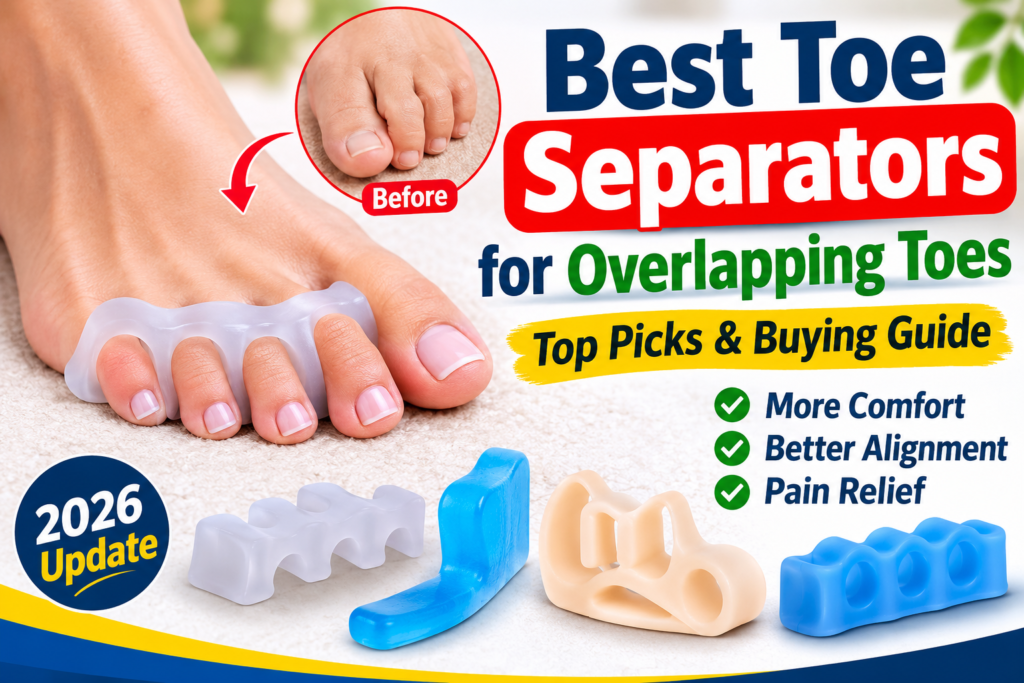
Toe separators are popular foot-care accessories designed to create space between neighboring toes. They come in different materials and designs, including silicone spacers, gel separators, individual toe cushions, and adjustable toe spreaders.
However, choosing the right product is important. Some separators are designed for the big toe, while others target smaller toes or provide spacing across the entire foot.
In this guide, we compare the best types of toe separators for overlapping toes, explain their features, and help you choose an option based on comfort, material, sizing, and intended use.
Quick Answer: What Are the Best Toe Separators for Overlapping Toes?
The best toe separator depends on which toes overlap and how much spacing and cushioning you need.
Soft silicone and gel separators are practical options for many people because they can create temporary space and reduce friction between neighboring toes.
Here are five products worth comparing:
| Product | Best For | Material |
|---|---|---|
| Correct Toes Original Toe Spacers | Full-foot toe spacing | Silicone |
| ZenToes Gel Toe Separators | Individual toe separation | Gel |
| Mind Bodhi Toe Separators | Everyday toe spacing | Gel |
| YogaToes Gems | Relaxation and stretching | Gel |
| Dr. JK ToePal Separators | Multiple spacing options | Gel |
These products have different designs and intended uses. Not every option is suitable for every overlapping toe condition.
A toe separator may improve comfort while being worn, but it should not be considered a guaranteed permanent correction for a structural toe deformity.
1. Correct Toes Original Toe Spacers
Best for: Full-foot toe spacing
Correct Toes Original Toe Spacers are designed to create space between all five toes.
Their silicone construction provides flexibility, while different available sizes help users find a more appropriate fit.
Unlike individual toe separators, this design focuses on spacing the entire forefoot.
Key Features
- Silicone construction.
- Multiple sizing options.
- Full-foot toe spacing.
- Designed for use with suitable footwear.
- Reusable design.
Pros
- Covers multiple toe spaces.
- Flexible material.
- Different sizes available.
- Suitable for people seeking full-foot spacing.
Cons
- More expensive than simple gel separators.
- Requires appropriate sizing.
- May not fit comfortably inside narrow shoes.
This product may be worth considering if several toes are crowded rather than just one toe pair.
Check the official Correct Toes product information before purchasing.
2. ZenToes Gel Toe Separators
Best for: Targeted toe separation
ZenToes offers gel toe separators designed for specific spacing needs.
Some designs use a loop that fits around one toe while a gel section sits between neighboring toes.
This can make them useful for people who do not need a full-foot spacer.
Key Features
- Soft gel construction.
- Individual separator designs.
- Washable and reusable options.
- Different product configurations.
- Compact design.
Pros
- Targeted separation.
- Smaller than full-foot spacers.
- Convenient for specific toe pairs.
- Multiple product configurations.
Cons
- Fit may vary between users.
- Some designs may move during walking.
- Not every model is suitable for every toe deformity.
ZenToes may be a practical option when the main concern is friction between two particular toes.
Review the ZenToes product range to compare designs and sizing.
3. Mind Bodhi Toe Separators
Best for: Everyday toe spacing
Mind Bodhi Toe Separators are designed to fit between the toes and provide gentle spacing.
Their gel construction makes them a popular style for people looking for a simple separator that can be worn during suitable everyday activities.
Key Features
- Flexible gel material.
- Multiple toe spacing.
- Compact construction.
- Designed for use with suitable socks and footwear.
- Reusable design.
Pros
- Simple design.
- Easy to put on.
- Useful for general toe crowding.
- Suitable for different everyday activities when properly fitted.
Cons
- May feel unusual initially.
- Can create pressure in tight shoes.
- Sizing options may be limited.
Mind Bodhi is worth comparing if you prefer a simple separator instead of a more complicated adjustable device.
4. YogaToes Gems Gel Toe Stretchers
Best for: Relaxation and passive stretching
YogaToes Gems use a different approach from small individual toe separators.
The design spreads multiple toes simultaneously and is generally intended for use while resting rather than wearing inside ordinary shoes.
Its gel construction provides cushioning while the device creates space between neighboring toes.
Key Features
- Gel construction.
- Multiple toe spacing.
- Designed for barefoot use.
- Suitable for relaxation routines.
- Easy-to-clean design.
Pros
- Provides spacing across multiple toes.
- Comfortable for some users.
- Useful for short stretching sessions.
- Different design from individual separators.
Cons
- Bulky compared with small separators.
- Not designed for most everyday shoes.
- May feel uncomfortable if the toes are stiff.
YogaToes Gems may be more appropriate for people who want a passive stretching accessory rather than a separator for walking.
5. Dr. JK ToePal Gel Toe Separators
Best for: Different toe separation needs
Dr. JK ToePal products offer different gel separator configurations.
Some designs use loops, while others provide open separation between neighboring toes.
This variety can be helpful when comparing different separator styles.
Key Features
- Gel material.
- Different separator configurations.
- Multiple spacing designs.
- Washable product options.
- Suitable for targeted foot-care routines.
Pros
- More than one design option.
- Flexible material.
- Useful for comparing separator styles.
- Targeted spacing options.
Cons
- Different configurations may fit differently.
- Some designs may feel bulky.
- Correct placement is important.
Before purchasing, check which configuration is included and whether it matches the toes you want to separate.
Comparison: Best Toe Separators for Overlapping Toes
| Product | Main Use | Material | Design |
|---|---|---|---|
| Correct Toes | Full-foot spacing | Silicone | Multi-toe |
| ZenToes | Targeted spacing | Gel | Individual |
| Mind Bodhi | Everyday spacing | Gel | Multi-toe |
| YogaToes Gems | Relaxation | Gel | Full-foot |
| Dr. JK ToePal | Different spacing needs | Gel | Multiple styles |
Which should you choose?
- For full-foot spacing: Compare Correct Toes.
- For individual toe separation: Consider ZenToes.
- For a simple everyday design: Compare Mind Bodhi.
- For relaxation: Consider YogaToes Gems.
- For different separator configurations: Compare Dr. JK ToePal.
These are product comparisons, not clinical rankings proving that one product treats overlapping toes better than another.
What Causes Overlapping Toes?
Overlapping toes occur when one toe crosses over or underneath an adjacent toe.
The condition can affect different toes, although the second toe is commonly involved.
Several factors may contribute to this problem.
Narrow or Poorly Fitting Shoes
Shoes with narrow toe boxes can squeeze the toes together.
Repeated pressure may contribute to toe crowding and irritation.
The American Academy of Orthopaedic Surgeons explains that crossover toes can develop when toes are repeatedly compressed in footwear.
Read the AAOS guide to tight shoes and foot problems for more information.
Foot Structure
Some people naturally have foot shapes that make toe crowding more likely.
Inherited foot structure can influence toe positioning and the distribution of pressure across the forefoot.
Bunions
A bunion can change the position of the big toe and affect the space available for neighboring toes.
This may contribute to crowding around the second toe.
Muscle and Tendon Imbalances
Muscles and tendons help maintain normal toe movement and positioning.
Changes in their balance may contribute to toe deformities.
Previous Injuries
Previous injuries involving the toes or forefoot may affect joint movement and alignment.
Persistent changes should be assessed by a qualified healthcare professional.
How to Choose the Right Toe Separator
Before purchasing a toe separator, consider these important features.
1. Material
Silicone and gel are common materials.
Silicone products often provide a flexible structure that can maintain their shape.
Gel products generally provide cushioning and can be useful when friction is a concern.
Neither material is automatically better for every user.
2. Correct Size
The separator should fit comfortably between the affected toes.
A product that is too small may provide insufficient spacing.
A product that is too large may stretch the toes excessively.
Always review the manufacturer’s sizing information.
3. Individual or Full-Foot Design
Consider how many toes overlap.
An individual separator may be more practical when only two toes are affected.
A full-foot design may be worth considering when multiple toes are crowded.
4. Shoe Compatibility
If you plan to wear the separator with shoes, make sure your footwear has enough room.
Adding a spacer inside a narrow shoe can increase pressure.
For more information about choosing suitable footwear for exercise and walking, see our best walking pads for 2026 guide.
5. Comfort
The device should not cause pain, numbness, tingling, or skin irritation.
Start with a comfortable fit rather than forcing the toes into a wider position.
6. Cleaning and Maintenance
Check whether the separator is washable and reusable.
Follow the manufacturer’s instructions for cleaning and drying.
Toe Separators for Different Overlapping Toe Problems
Different toe positions may require different product designs.
Overlapping Second Toe
The second toe may move toward or over the big toe.
An individual separator may provide temporary space between the affected toes.
However, the cause of the overlap matters when selecting a product.
Overlapping Middle Toes
The third and fourth toes may become crowded together.
A small gel separator may help reduce direct rubbing between these toes.
A full-foot spacer is not always necessary.
Overlapping Little Toe
The fifth toe may move underneath the fourth toe or become compressed by footwear.
A small separator or protective gel sleeve may help reduce friction.
Avoid products that increase pressure against the outside of the foot.
Multiple Overlapping Toes
When several toes overlap, a multi-toe separator may seem like the obvious choice.
However, forcing multiple toes apart can create discomfort.
A podiatrist can help determine whether a full-foot spacer is appropriate.
How to Use Toe Separators Correctly
Using a toe separator properly is important for comfort and skin protection.
Follow these steps:
Step 1: Clean Your Feet
Wash and dry your feet before putting on the separator.
Step 2: Inspect the Product
Check for damage, rough edges, or deterioration.
Step 3: Position the Separator
Gently place the device between the affected toes.
Do not force your toes apart.
Step 4: Start With a Short Period
Begin with a short session and follow the manufacturer’s instructions.
Step 5: Check Your Skin
Remove the separator and look for redness, irritation, or pressure marks.
Stop using it if discomfort develops.
Step 6: Clean the Device
Wash and dry reusable separators according to the manufacturer’s instructions.
Can Toe Separators Permanently Fix Overlapping Toes?
Toe separators can temporarily create space between neighboring toes while they are being worn.
They may also help reduce rubbing and pressure.
However, they are not proven to permanently correct every type of overlapping toe deformity.
The Royal College of Podiatry explains that non-surgical measures may help relieve symptoms, but they do not necessarily correct the underlying deformity.
Read its guidance on toe deformities.
The difference between flexible and fixed overlapping toes is particularly important.
A flexible toe may be moved into a different position, while a fixed toe cannot easily be repositioned manually.
Treatment options depend on the underlying condition.
Are Toe Separators Safe for Daily Use?
Some people can use appropriately fitted toe separators for short periods without problems.
However, wearing a separator for longer periods does not automatically produce better results.
Avoid continuing to use a device if it causes:
- Pain.
- Numbness.
- Tingling.
- Blisters.
- Swelling.
- Skin irritation.
People with diabetes, reduced sensation, poor circulation, or recurring foot wounds should consult a healthcare professional before using toe separators.
The Cleveland Clinic also recommends paying attention to comfort, footwear compatibility, and skin irritation.
See its guide to the benefits and limitations of toe separators.
Toe Separators vs. Toe Cushions
Toe separators and toe cushions serve different purposes.
| Feature | Toe Separators | Toe Cushions |
|---|---|---|
| Main purpose | Create space | Reduce pressure |
| Position | Between toes | Around or under toes |
| Common materials | Silicone and gel | Gel and foam |
| Best use | Toe crowding | Friction and pressure |
If your main problem is rubbing between two toes, a separator may be appropriate.
If a toe rubs against the inside of your shoe, a protective cushion or toe sleeve may be more useful.
Common Mistakes to Avoid
Choosing the Wrong Size
Incorrect sizing can cause additional pressure.
Always review the sizing guide before purchasing.
Using a Rigid Product Without Guidance
A stiff separator is not automatically more effective.
Comfort and suitable positioning are more important.
Wearing Separators in Tight Shoes
A narrow toe box can make a separator uncomfortable.
Choose shoes with sufficient width and depth.
For additional home exercise equipment ideas, see our best walking pads for home use guide.
Expecting Instant Results
A toe separator is not a guaranteed solution for an established deformity.
Avoid products making unrealistic permanent-correction claims.
Ignoring Persistent Pain
Pain that continues or worsens deserves professional assessment.
A separator should not replace medical evaluation.
Frequently Asked Questions
1. What is the best toe separator for overlapping toes?
Soft silicone and gel separators are common options. The best design depends on the affected toes, foot shape, and comfort requirements.
2. Do toe separators straighten overlapping toes?
They can temporarily separate toes while being worn, but they are not proven to permanently correct every structural toe deformity.
3. Can I wear toe separators inside shoes?
Some low-profile designs can be worn inside shoes if there is enough room in the toe box.
4. Are silicone toe separators better than gel separators?
Both materials have advantages. Silicone can provide flexible spacing, while gel designs often provide cushioning.
5. Can toe separators help with second toe overlap?
A targeted separator may provide temporary space between neighboring toes. Persistent or painful overlap should be assessed by a podiatrist.
6. Can I sleep with toe separators?
Follow the manufacturer’s instructions. Do not use a separator overnight unless it is specifically designed for that purpose and appropriate for your condition.
7. How long should I wear toe separators?
Start with short sessions and follow the manufacturer’s instructions. Stop if you experience discomfort or skin irritation.
8. Are toe separators suitable for older adults?
Some older adults may find appropriately fitted separators useful for comfort. However, reduced sensation and circulation problems require additional caution.
9. Can toe separators prevent corns?
They may reduce friction between neighboring toes, which can help reduce one source of irritation. They cannot prevent every cause of corns and calluses.
10. When should I see a podiatrist?
Seek professional advice if the toe becomes painful, stiff, swollen, develops wounds, or interferes with walking.
Final Verdict: Which Toe Separator Should You Buy?
The best toe separator for overlapping toes depends on your specific foot condition and comfort requirements.
Correct Toes offers a full-foot spacing design, while ZenToes provides targeted gel separator options. Mind Bodhi is worth comparing for everyday spacing, YogaToes Gems for relaxation, and Dr. JK ToePal for different separator configurations.
Before purchasing, compare the material, size, design, and shoe compatibility.
Remember that toe separators may improve temporary spacing and comfort, but they are not guaranteed to permanently correct overlapping toes.
Choose a suitable product, use it according to its instructions, and consult a podiatrist if your toe deformity is painful or worsening.