
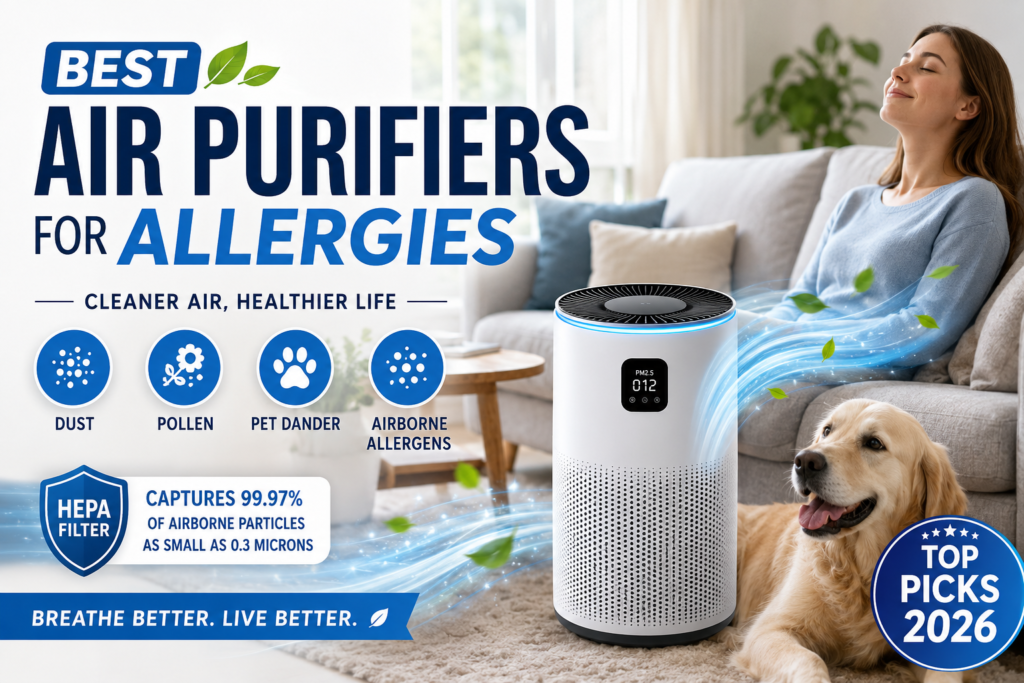
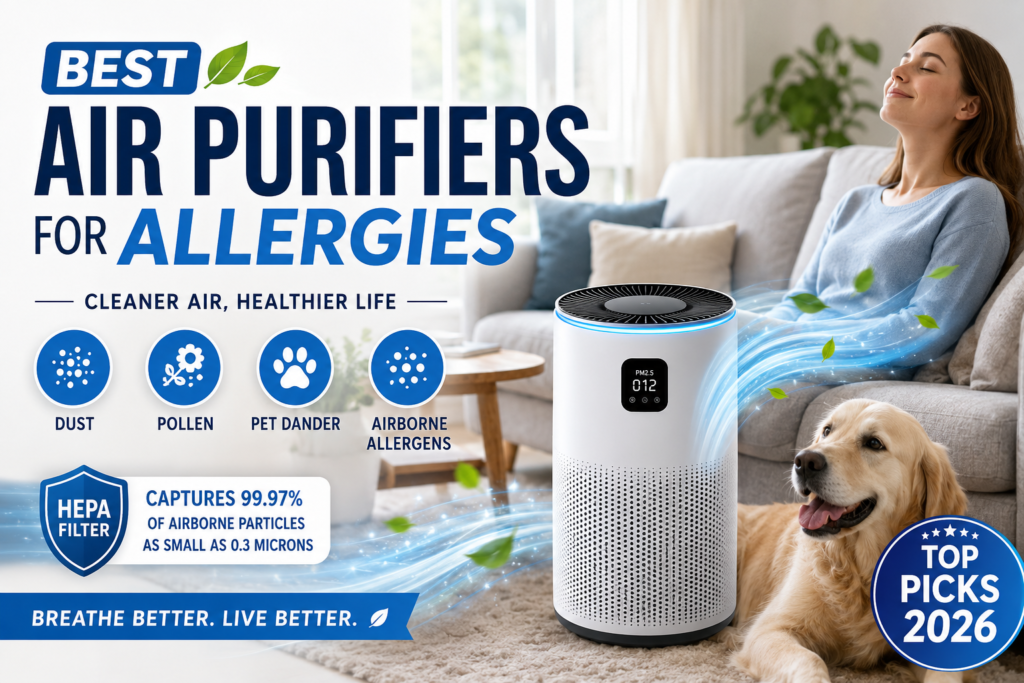
Discover the best air purifiers for allergies in 2026. Compare top HEPA air cleaners for dust, pollen, pet dander, and cleaner indoor air to breathe easier at home.
LifeCareBalance.com is reader-supported. When you buy through links on our site, we may earn an affiliate commission at no extra cost to you. As an Amazon Associate, we earn from qualifying purchases.
If you’ve ever woken up with a stuffy nose in your own bedroom, or noticed your eyes start itching the second the dog jumps on the couch, you already know that the air inside your home isn’t always as clean as it looks. Indoor air can actually carry more dust, pollen, pet dander, and other irritants than the air outside, especially in homes that are well-sealed for energy efficiency.
That’s where a good air purifier earns its keep. The right HEPA air purifier won’t cure your allergies, but it can meaningfully cut down on the airborne triggers that set them off, which means fewer sneezing fits, less congestion, and a home that actually feels breathable.
We spent weeks comparing the specs, filtration technology, real owner feedback, and lab-reported CADR numbers of the most trusted air purifier brands on the market — Coway, Levoit, Blueair, Winix, Honeywell, Dyson, Molekule, and Rabbit Air — to put together this guide. Below, you’ll find honest, detailed reviews to help you pick the best air purifier for allergies in 2026, whether you’re shopping for a small bedroom, a large open-plan living room, or a household with pets.
Quick note: this article contains affiliate links. If you buy through one of our links, we may earn a small commission at no extra cost to you. It doesn’t affect which products we recommend.
Why Allergy Sufferers Need an Air Purifier
Seasonal allergies, pet allergies, and dust sensitivities aren’t just an outdoor problem. According to the Environmental Protection Agency, indoor air pollutant levels can run two to five times higher than outdoor levels, largely because pollen, dust, mold spores, and pet dander get trapped indoors with nowhere to go.
For people who deal with allergic rhinitis, asthma, or general sensitivity to airborne particles, that trapped air adds up. A few of the most common indoor triggers include:
- Pollen that hitches a ride indoors on clothing, shoes, and open windows during spring and fall
- Pet dander, which is microscopic and can stay airborne for hours
- Dust mites, tiny organisms that live in bedding, carpet, and upholstery
- Mold spores, especially in humid bathrooms, basements, and kitchens
- Smoke and VOCs from cooking, candles, wildfires, or nearby traffic
The American Lung Association notes that reducing exposure to these indoor triggers is one of the most practical steps people with asthma or allergies can take at home. A quality air purifier, used alongside regular cleaning and good ventilation, is one of the simplest ways to do that.
It’s also worth mentioning that an air purifier works best as part of a broader wellness routine. Many of the households we talked to while researching this guide also track things like sleep quality and daily movement — if you’re building out a healthier home setup, our guide to the best smart scales and our breakdown of the best walking pads for home use pair well with cleaner indoor air as part of an overall health routine.
How HEPA Air Purifiers Work
Most of the purifiers worth buying in 2026 use True HEPA filtration, a standard that requires a filter to capture at least 99.97% of particles as small as 0.3 microns. That size matters because 0.3 microns is considered the “most penetrating particle size” — the hardest size for a filter to catch. If a filter can trap particles that small at that rate, it will do an even better job with larger particles like pollen, dust, and pet dander.
Here’s the basic process:
- Pre-filter – A coarse mesh or fabric layer captures large particles like hair, lint, and coarse dust, protecting the finer filters underneath.
- True HEPA filter – Dense pleated fibers trap fine particles, including pollen, mold spores, dust mite debris, and pet dander.
- Activated carbon filter – Porous carbon adsorbs odors, smoke, and some volatile organic compounds (VOCs) that HEPA media alone can’t catch.
- Optional extras – Some premium models add UV-C light, ionizers, or catalytic filters for formaldehyde and gases, though these features vary widely in real-world benefit.
The Mayo Clinic points out that while air purifiers can help reduce airborne allergens, they work best as part of a broader allergy management plan that also includes regular vacuuming, washing bedding in hot water, and controlling indoor humidity to limit dust mites and mold.
Callout Tip: A HEPA filter only works as well as its seal. Cheap purifiers sometimes let air leak around the filter instead of through it. Look for models with a fully enclosed filtration path — this is one of the biggest differences between budget and premium units.
How We Chose the Best Air Purifiers
We didn’t just pull a list of popular Amazon listings. Each product on this list was evaluated against a consistent set of criteria that actually matters for allergy sufferers:
- True HEPA certification — not “HEPA-type” or “HEPA-like” filters, which don’t meet the same standard
- CADR (Clean Air Delivery Rate), verified where possible through AHAM (Association of Home Appliance Manufacturers) testing
- Manufacturer-stated room coverage, cross-checked against independent reviews
- Noise level, since a purifier you turn off because it’s too loud isn’t helping anyone
- Filter replacement cost and maintenance, because the sticker price is only part of the real cost
- Smart features and app support, useful but not essential
- Real owner and third-party lab feedback on performance for dust, pollen, and pet dander specifically
We did not invent or estimate specifications. All CADR, coverage, and noise figures below reflect manufacturer specs and third-party testing publicly available for each model.
Top Air Purifiers for Allergies in 2026
| Rank | Product | Best For |
|---|---|---|
| 1 | Coway Airmega 400 | Best Overall / Best for Large Rooms |
| 2 | Levoit Core 600S | Best Value for Money |
| 3 | Blueair Blue Pure 211+ | Best for Pet Owners |
| 4 | Winix 5500-2 | Best Budget Pick |
| 5 | Honeywell HPA300 | Best for Large Rooms (Budget Alternative) |
| 6 | Dyson Purifier Cool Formaldehyde | Best Smart Air Purifier |
| 7 | Molekule Air Pro | Best for VOCs and Chemical Sensitivities |
| 8 | Rabbit Air MinusA2 | Best for Bedrooms |
Detailed Review of Each Product
1. Coway Airmega 400 — Best Overall

- [Coverage] Designed to clean spaces up to 3,120 sq. ft. in 60 minutes
- [HyperCaptive Filtration System] Combination of a pre-filter, active carbon filter, and HEPA Filter reduces 99.97% of 0….
- [APP and Voice Control] IoCare mobile app includes indoor and outdoor air quality monitoring, filter notification, sched…
Overview: The Coway Airmega 400 has built a reputation as one of the most reliable large-room purifiers on the market, and it’s the model we’d point most allergy sufferers toward if they only want to buy one. Its nearly square footprint houses a dual-filter system that’s easy to maintain and consistently rated among the highest for real-world particulate reduction.
Key Features:
- Real-time air quality monitoring with a color-coded LED indicator
- Auto (Smart) mode that adjusts fan speed based on detected air quality
- Washable pre-filter that extends the life of the main filter
- Available Wi-Fi-enabled 400S variant for app control and scheduling
Specifications:
- Coverage: Up to 1,560 sq. ft. (at 2 air changes per hour)
- CADR: Approximately 328 CFM (smoke), 328 CFM (dust), 400 CFM (pollen)
- Filter type: True HEPA (Max2 filter) + activated carbon, washable pre-filter
- Noise level: Roughly 22–52 dB depending on fan speed
- Filter life: Around 12 months under typical use
Pros:
- Exceptional coverage for open floor plans and large bedrooms
- Quiet on lower settings for its size
- Long filter life keeps ongoing costs reasonable
- 5-year limited warranty
Cons:
- Bulky footprint that needs its own floor space
- Base model lacks Wi-Fi (only the 400S has app control)
- Genuine replacement filters are pricier than off-brand alternatives
Best For: Large living rooms, open-concept homes, and households that want one purifier to handle a whole main floor.
Why We Recommend It: The Airmega 400’s CADR numbers are genuinely among the highest in the consumer market, not inflated marketing claims. For allergy sufferers dealing with a big shared space, that horsepower matters.
Real-World Use Case: In an open-plan 600–700 sq. ft. living and kitchen area, owners report the unit comfortably running 2–3 full air changes per hour on Smart Mode, which is more than enough to keep up with cooking smoke, pet dander, and pollen tracked in from outside.
2. Levoit Core 600S — Best Value for Money

- 𝐖𝐇𝐘 𝐂𝐇𝐎𝐎𝐒𝐄 𝐀𝐇𝐀𝐌 𝐕𝐄𝐑𝐈𝐅𝐈𝐃𝐄 𝐀𝐈𝐑 𝐏𝐔𝐑𝐈𝐅𝐈𝐄𝐑𝐒: AHAM (Association of Home Appliance Manufacturers) is an ANSI-accredited organiz…
- 𝐋𝐄𝐕𝐎𝐈𝐓’𝐒 𝐌𝐎𝐒𝐓 𝐏𝐎𝐖𝐄𝐑𝐅𝐔𝐋 𝐀𝐈𝐑 𝐏𝐔𝐑𝐈𝐅𝐈𝐄𝐑: A powerhouse at purifying your air in any room. It scans for tiny airborne contamin…
- 𝐔𝐋𝐓𝐑𝐀-𝐏𝐎𝐖𝐄𝐑𝐅𝐔𝐋 𝐏𝐔𝐑𝐈𝐅𝐈𝐂𝐀𝐓𝐈𝐎𝐍 𝐅𝐎𝐑 𝐄𝐗𝐓𝐑𝐀-𝐋𝐀𝐑𝐆𝐄 𝐒𝐏𝐀𝐂𝐄𝐒: The Levoit Core 600S-P Air Purifier is built for extra-large rooms, …
Overview: Levoit’s Core 600S sits at the top of the brand’s popular Core lineup, and it’s become a go-to recommendation for people who want large-room performance without paying premium-brand pricing.
Key Features:
- VeSync app control with scheduling, auto mode, and filter-life tracking
- Three-stage filtration: pre-filter, True HEPA, and activated carbon
- Sleep mode that dims the display and quiets the fan for bedroom use
- Voice assistant compatibility (Alexa and Google Assistant)
Specifications:
- Coverage: Up to 635 sq. ft.
- CADR: Approximately 410 CFM (smoke/dust/pollen combined rating from manufacturer; independent labs report figures in the 390–410 CFM range)
- Filter type: True HEPA + activated carbon
- Noise level: As low as roughly 24–26 dB on sleep mode, up to the high-50s dB on turbo
- Filter life: Up to 12 months with the updated filter
Pros:
- Strong CADR for the price point
- Genuinely quiet on sleep mode
- App connectivity is smooth and reliable
- Long filter life reduces maintenance hassle
Cons:
- Gets noticeably loud on the highest fan speed
- Auto-sensor can be inconsistent with certain particle types
- Tall, heavy design (about 18–19 lbs) isn’t the easiest to move room to room
Best For: Medium-to-large living rooms and open-plan apartments where you want strong performance without Coway or Blueair pricing.
Why We Recommend It: Few purifiers under $350 deliver this much genuine CADR. It’s the pick we’d suggest for someone who wants near-premium performance on a mid-range budget.
Real-World Use Case: In a 400–600 sq. ft. living room, the Core 600S can run on auto mode most of the day and only ramp up noticeably during high-pollen afternoons or when the sensor detects cooking smoke.
3. Blueair Blue Pure 211+ — Best for Pet Owners

- POWERFUL AIR PURIFIER FOR LARGE SPACES: Quickly cleans rooms up to 705 sq ft in just 12.5 minutes and 3,385 sq ft every …
- ADVANCED FILTRATION FOR CLEANER, FRESHER LIVING: Blueair’s advanced 7-stage HEPASilent filtration captures 99.97%** of a…
- WHISPER-QUIET PERFORMANCE: Operating as low as 23 dB, helping clean the air without disrupting sleep, focus, relaxation,…
Overview: The Blue Pure 211+ uses Blueair’s proprietary HEPASilent technology, which combines mechanical filtration with an electrostatic charge to trap particles efficiently while keeping noise lower than a comparable pure-mechanical HEPA unit. Its fabric pre-filter also comes in swappable colors, which is a nice touch if you care about matching your decor.
Key Features:
- Washable, interchangeable fabric pre-filter sleeves
- Three-stage filtration: pre-filter, particle filter, activated carbon
- Simple three-speed control with no confusing menus
- AHAM Verified and ENERGY STAR certified
Specifications:
- Coverage: Up to 540 sq. ft.
- CADR: Approximately 350 CFM (smoke, dust, and pollen)
- Filter type: True HEPA-equivalent HEPASilent + activated carbon
- Noise level: Roughly 31–56 dB depending on speed
- Filter life: Main filter about every 6 months with heavy pet use
Pros:
- Excellent CADR-to-price ratio
- Fabric pre-filter does a great job catching pet hair before it clogs the main filter
- Minimalist controls make it easy for non-tech-savvy users
- Durable build with a long manufacturer warranty
Cons:
- No app or smart home integration
- Built-in ionizer function can’t be disabled on some versions
- Filter replacement costs add up with heavy pet dander exposure
Best For: Homes with dogs or cats, especially multi-pet households dealing with dander and pet hair.
Why We Recommend It: The washable pre-filter is a genuine advantage for pet owners — it catches the bulk of hair and coarse dander before it ever reaches the HEPA layer, which extends the life of the more expensive main filter.
Real-World Use Case: Owners with shedding dogs report the 211+ noticeably cutting down on visible pet hair buildup on furniture within the first couple of weeks, alongside reduced sneezing near the pet’s favorite napping spots.
4. Winix 5500-2 — Best Budget Pick
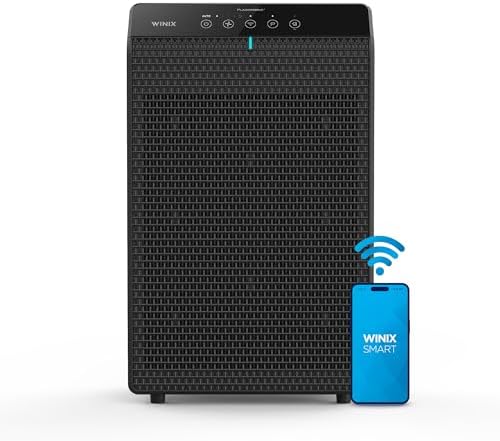
- 𝐀𝐇𝐀𝐌 𝐕𝐞𝐫𝐢𝐟𝐢𝐝𝐞 𝐚𝐭 𝟑92 𝐬𝐪 𝐟𝐭.: Also cleans rooms up to 1,882 sq ft in 1 hour (941 sq ft in 30 minutes, 627 sq ft in 20 min…
- 𝐖𝐢𝐧𝐢𝐱 𝐓𝐫𝐮𝐞 𝐇𝐄𝐏𝐀: Captures 99.99%* of airborne allergens including pollen, dust, smoke, and pet dander, as small as 0.01 …
- 𝐀𝐝𝐯𝐚𝐧𝐜𝐞𝐝 𝐎𝐝𝐨𝐫 𝐂𝐨𝐧𝐭𝐫𝐨𝐥 𝐂𝐚𝐫𝐛𝐨𝐧 𝐅𝐢𝐥𝐭𝐞𝐫: Reduces VOCs and household odors from cooking, pets, and smoke. It is designed to c…
Overview: The Winix 5500-2 has been a budget favorite for years, and it’s still one of the best entry points for anyone who wants True HEPA filtration without spending premium money.
Key Features:
- PlasmaWave technology (can be switched off if you prefer to avoid ionization)
- Washable AOC (Advanced Odor Control) carbon filter
- Auto mode with a built-in air quality sensor
- Compact tower design that fits easily into bedrooms
Specifications:
- Coverage: Up to 360 sq. ft.
- CADR: Approximately 232 CFM (smoke), 243 CFM (dust), 246 CFM (pollen)
- Filter type: True HEPA + washable activated carbon
- Noise level: Low on sleep mode, moderate on higher fan speeds
- Filter life: True HEPA filter roughly every 12 months; carbon filter washable and reusable
Pros:
- One of the most affordable True HEPA options available
- PlasmaWave can be disabled for anyone avoiding ionizers
- Compact enough for bedrooms or home offices
- Reliable, well-reviewed brand with a long track record
Cons:
- Smaller coverage area than most other picks on this list
- No smartphone app
- Not powerful enough for large open-plan rooms
Best For: Bedrooms, home offices, nurseries, and anyone shopping on a tighter budget who still wants certified True HEPA performance.
Why We Recommend It: It punches above its price point. For the cost, you’re getting genuine HEPA filtration, a washable carbon filter, and a design that’s been refined over several generations.
Real-World Use Case: In a 250–300 sq. ft. bedroom, the 5500-2 is quiet enough to run overnight on low and still shows a measurable drop in dust buildup on surfaces within a few weeks.
5. Honeywell HPA300 — Best for Large Rooms (Budget Alternative)

- AQSense Auto Mode with Air Quality Sensor: This Honeywell Air Purifier with HEPA air filter continuously monitors air an…
- Compact, Stylish & Effective: Sleek tabletop design of this Honeywell HEPA air purifier fits easily in small rooms and s…
- Whisper Quiet for Bedrooms & Nurseries: This air purifier Honeywell features a Sleep Mode that operates as low as 20.81 …
Overview: The HPA300 has been a trusted name in home air purification for over a decade, and it remains a solid choice for anyone who wants large-room coverage without paying Coway or Blueair prices.
Key Features:
- Three True HEPA filters that can be rotated for even wear
- Turbo Clean setting for rapid air changes when needed
- Simple dial and button controls, no app required
- AHAM Verified for smoke, dust, and pollen CADR
Specifications:
- Coverage: Up to 465 sq. ft. (AHAM suggested room size), with the ability to clean larger spaces at 1 air change per hour
- CADR: Approximately 300 CFM (smoke), 320 CFM (dust), 300 CFM (pollen)
- Filter type: True HEPA + pre-filter/carbon combo
- Noise level: Noticeable on Turbo Clean, quieter on lower settings
- Filter life: HEPA filter roughly every 12 months; pre-filter every 3 months
Pros:
- Strong CADR numbers for the price
- No smart features to fuss with — just plug in and go
- Long-standing reputation for reliability
- Filters are widely available and reasonably priced
Cons:
- No air quality sensor or auto mode
- Runs louder than newer competitors on high speed
- Bulky, boxy design
Best For: People who want dependable large-room coverage and don’t care about smart features or sleek design.
Why We Recommend It: It’s a workhorse. The HPA300 doesn’t have the bells and whistles of newer models, but it consistently delivers on its CADR promises, which is what actually matters for allergy relief.
Real-World Use Case: In a 400–450 sq. ft. living room, users report visibly cleaner air within the first hour of running on high, especially useful during high-pollen weeks or wildfire smoke events.
6. Dyson Purifier Cool Formaldehyde — Best Smart Air Purifier
- Automatically senses, captures, and traps pollutants for cleaner air.
- Detects and destroys formaldehyde released from household items.¹
- Air Multiplier technology generates the circulation power to draw distant pollutants into the machine, projecting purifi…
Overview: Dyson’s purifier lineup is built for people who want a single device that does more than filter particles — it also cools the room, monitors multiple pollutants in real time, and looks like it belongs in a design magazine.
Key Features:
- Fully sealed HEPA H13 filtration system with no air bypass
- Solid-state formaldehyde sensor plus additional gas and particle sensors
- Bladeless Air Multiplier fan doubles as a room cooling fan
- LCD screen and MyDyson app for real-time air quality reporting
Specifications:
- Coverage: Designed for medium-to-large rooms (Dyson reports performance based on its own POLAR test methodology rather than standard CADR in most listings)
- Filter type: Fully sealed HEPA H13 + activated carbon/catalytic layer for formaldehyde
- Noise level: Competitive on lower settings for a bladeless design
- Smart features: Full app integration, voice assistant compatible, real-time multi-pollutant tracking
Pros:
- Multi-function design (purifies and cools) saves space
- Fully sealed filtration prevents the air bypass issues found in some budget units
- Detailed real-time air quality data via app and LCD screen
- Sleek design that works in modern living spaces
Cons:
- Significantly more expensive than HEPA-only competitors with comparable CADR
- Replacement filters cost more than most other brands
- Some of the “smart” features are more novelty than necessity for basic allergy relief
Best For: Design-conscious buyers who want a dual-purpose device and don’t mind paying a premium for build quality and monitoring features.
Why We Recommend It: If you want a purifier that also functions as a cooling fan and gives you granular, real-time pollutant data, nothing else on this list matches Dyson’s engineering. Just know you’re paying for the extras, not just raw CADR.
Real-World Use Case: In a shared living/dining space, the always-on air quality display gives allergy-prone households an early warning when pollen or VOC levels spike, letting them close windows or run the unit on a higher setting proactively.
7. Molekule Air Pro — Best for VOCs and Chemical Sensitivities

- FDA-Cleared Air Purification: Molekule Air Pro is FDA-cleared as a 510(k) Class II medical device to destroy viruses, ba…
- Designed for Large Spaces: For large residential or business spaces and high-traffic areas up to 1000 sq ft, such as liv…
- PECO vs. HEPA Filters: Photo Electrochemical Oxidation (PECO) filters work at the molecular level to destroy indoor air …
Overview: Molekule takes a different approach than the rest of this list. Instead of relying solely on HEPA filtration, its PECO (Photo Electrochemical Oxidation) technology is designed to break down pollutants, including some VOCs and gases, at a molecular level, in addition to filtering particles.
Key Features:
- PECO-HEPA Tri-Power filter combines mechanical filtration with the PECO process
- Designed to address certain VOCs and odors that pure HEPA filters can’t capture
- App connectivity for monitoring and control
- Quiet operation profile relative to its filtration power
Specifications:
- Coverage: Designed for medium-to-large rooms (varies by specific Molekule model)
- Filter type: PECO-HEPA Tri-Power filter (combination mechanical/HEPA and photocatalytic technology)
- Price positioning: Premium tier, generally in the $500–$1,200 range across the Molekule lineup
Pros:
- Targets VOCs and odors in addition to particulates
- Sleek, modern design
- App-based monitoring and filter tracking
Cons:
- Premium pricing compared to HEPA-only alternatives
- Some independent testing has questioned whether real-world particle performance justifies the cost versus high-CADR HEPA units
- Replacement filters are a recurring, non-trivial expense
Best For: People who are specifically sensitive to VOCs, chemical odors, or off-gassing (from new furniture, paint, or renovations) in addition to standard allergens.
Why We Recommend It: For allergy sufferers whose triggers extend beyond dust and pollen into chemical sensitivities, Molekule’s PECO approach offers something HEPA-only purifiers don’t directly address. It’s a niche pick, not a default recommendation for typical dust and pet allergies.
Real-World Use Case: Households who recently renovated or bought new furniture and are dealing with lingering chemical odors alongside their usual allergy symptoms often turn to Molekule specifically for the odor and VOC component.
8. Rabbit Air MinusA2 — Best for Bedrooms
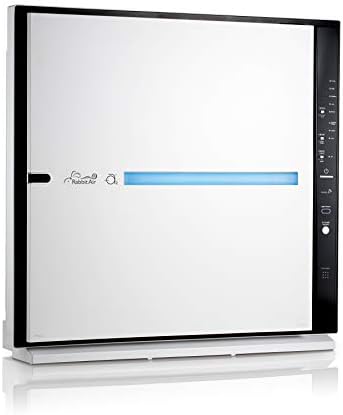
- ADVANCED HEPA AIR PURIFIER: Experience ultimate air purification with our air purifier, featuring six stages of advanced…
- SMART APP CONTROL: Connect to your WiFi network and control your air purifier from anywhere with the Rabbit Air App. Thi…
- GERM DEFENSE CUSTOMIZED FILTER: Our advanced HEPA air purifier filter effectively traps and reduces airborne bacteria, m…
Overview: The Rabbit Air MinusA2 stands out for two reasons: it can be wall-mounted to save floor space, and it’s engineered to run exceptionally quietly, which makes it a favorite for bedrooms.
Key Features:
- Wall-mountable design, unusual among home air purifiers
- Customizable front panels to match wall art or decor
- BioGS HEPA filter designed specifically for allergen reduction
- Optional additional filter inserts (odor, germ defense, toxin absorber) depending on your specific needs
Specifications:
- Coverage: Roughly 700 sq. ft. (varies by source and speed setting)
- CADR: Approximately 200–230 CFM range depending on the specific pollutant measured
- Filter type: True HEPA (BioGS) + customizable secondary filter
- Noise level: Around 25 dB on low settings, among the quietest units in this guide
- Warranty: Long-standing reputation for durability with an extended manufacturer warranty
Pros:
- Exceptionally quiet, ideal for light sleepers
- Wall-mount option frees up floor and furniture space
- Customizable filter inserts let you target specific allergens
- Attractive design options beyond the typical plastic tower
Cons:
- Higher price point relative to its CADR compared to some competitors
- Wall mounting requires installation effort
- Replacement filters and custom panels add to long-term cost
Best For: Bedrooms, nurseries, and anyone who’s sensitive to fan noise at night but still wants strong allergen filtration.
Why We Recommend It: Few purifiers manage to stay this quiet while still delivering meaningful CADR performance. For allergy sufferers whose symptoms are worst overnight, that’s a genuinely useful tradeoff.
Real-World Use Case: In a primary bedroom, owners report running the MinusA2 on its low-noise setting overnight without disruption, while still noticing less morning congestion and fewer sneezing episodes tied to dust mites and pillow allergens.
Comparison Table
| Product | Coverage Area | Filter Type | Noise Level | Smart Features | Best For | Overall Rating |
|---|---|---|---|---|---|---|
| Coway Airmega 400 | Up to 1,560 sq. ft. | True HEPA (Max2) + carbon | ~22–52 dB | Auto mode; app on 400S variant | Best Overall / Large Rooms | 4.8/5 |
| Levoit Core 600S | Up to 635 sq. ft. | True HEPA + carbon | ~24–58 dB | Full app control, voice assistant | Best Value for Money | 4.6/5 |
| Blueair Blue Pure 211+ | Up to 540 sq. ft. | HEPASilent + carbon | ~31–56 dB | None | Best for Pet Owners | 4.5/5 |
| Winix 5500-2 | Up to 360 sq. ft. | True HEPA + washable carbon | Low–moderate | Auto sensor, no app | Best Budget Pick | 4.4/5 |
| Honeywell HPA300 | Up to 465 sq. ft. | True HEPA + carbon | Moderate–high on turbo | None | Best for Large Rooms (Budget) | 4.3/5 |
| Dyson Purifier Cool Formaldehyde | Medium–large rooms | Sealed HEPA H13 + catalytic filter | Competitive | Full app + LCD display | Best Smart Air Purifier | 4.5/5 |
| Molekule Air Pro | Medium–large rooms | PECO-HEPA Tri-Power | Moderate | App control | Best for VOCs/Chemical Sensitivity | 4.1/5 |
| Rabbit Air MinusA2 | Up to 700 sq. ft. | True HEPA (BioGS) + custom filter | ~25 dB+ | Optional app on some versions | Best for Bedrooms | 4.5/5 |
Buying Guide: What to Look for in an Air Purifier for Allergies
True HEPA Filters
Not all “HEPA-style” or “HEPA-like” filters meet the same standard. Look specifically for True HEPA or HEPA H13 in the product description — this guarantees the 99.97% capture rate at 0.3 microns.
CADR Rating
The Clean Air Delivery Rate tells you how quickly a purifier cleans air for smoke, dust, and pollen specifically. Higher numbers mean faster cleaning. AHAM-certified CADR ratings are the most trustworthy since they’re independently tested rather than self-reported.
Room Size
Match the purifier’s coverage rating to your actual room, not your whole house, unless the unit is specifically rated for open floor plans. A common rule of thumb (based on AHAM’s “two-thirds rule”) is that the purifier’s CADR should be at least two-thirds of your room’s square footage for effective coverage.
Noise Level
If a purifier is too loud to run overnight, it won’t get used when you need it most — during sleep, when dust mite and pollen exposure often peaks. Look for a documented low-speed noise level under 35 dB for bedroom use.
Energy Efficiency
ENERGY STAR-certified models use less electricity to run continuously, which matters since most allergy sufferers benefit from running their purifier 24/7 rather than intermittently.
Smart Controls and App Support
Auto mode, scheduling, and remote control aren’t essential, but they help the unit respond to changing air quality without you having to manually adjust it — useful during high-pollen days or when you’re away from home.
Air Quality Sensors
Built-in particle sensors let a purifier automatically ramp up when air quality drops, which is especially helpful for pet owners or during allergy season.
Filter Replacement Cost
Factor in ongoing costs, not just the sticker price. Some HEPA filters need replacing every 6 months, others last up to a year. Washable pre-filters can meaningfully reduce main-filter replacement frequency.
Maintenance
Vacuum or wash pre-filters regularly, and don’t wait for a filter to look visibly dirty before replacing the HEPA core — by that point, airflow and efficiency have already dropped.
For Pet Owners
Prioritize a washable pre-filter and a higher CADR rating, since pet dander is finer and more persistent than typical household dust.
For Asthma Sufferers
Look for AHAM Verified CADR ratings and consider models certified or recommended in resources from organizations like the American Lung Association for indoor air quality management.
For Seasonal Allergies
Run your purifier continuously during high-pollen months rather than only when symptoms flare — prevention works better than reaction. Pair it with basic habits like changing clothes after time outdoors and keeping windows closed during peak pollen hours, guidance echoed by the CDC’s environmental health resources.
Callout Tip: If allergies are disrupting your sleep, an air purifier works best alongside other recovery-focused habits. Some readers building a full wellness setup also look into recovery tools like the best massage guns for post-workout tension, or supplement-based approaches like the one covered in our Mito Red MitoPRO 300 review.
Frequently Asked Questions
1. What is the best air purifier for allergies in 2026? For most households, the Coway Airmega 400 offers the best overall balance of coverage, CADR performance, and reliability. Budget shoppers do well with the Winix 5500-2, while pet owners tend to prefer the Blueair Blue Pure 211+.
2. Do air purifiers actually help with allergies? Yes, when paired with a True HEPA filter and appropriate room coverage, air purifiers can meaningfully reduce airborne allergens like pollen, dust, and pet dander. They work best as part of a broader allergy management approach that includes regular cleaning and humidity control.
3. What size air purifier do I need for my bedroom? Match the CADR and coverage rating to your room’s square footage, using roughly two-thirds of the room’s area as the minimum CADR benchmark. For a typical 200–300 sq. ft. bedroom, most mid-range purifiers on this list, including the Winix 5500-2 or Rabbit Air MinusA2, are more than sufficient.
4. How often should I replace my air purifier’s HEPA filter? Most True HEPA filters need replacing every 6 to 12 months, depending on usage and air quality. Washable pre-filters should be cleaned every 2–4 weeks to extend the main filter’s life.
5. Are air purifiers safe to run all day and night? Yes, most modern purifiers are designed for continuous use and are energy efficient enough to run 24/7. Continuous operation is actually recommended for allergy control since it prevents allergen buildup rather than reacting to it.
6. Can an air purifier help with pet dander specifically? Yes, especially models with a strong CADR rating and a washable pre-filter designed to catch pet hair and coarse dander before it reaches the HEPA layer, such as the Blueair Blue Pure 211+.
7. What’s the difference between HEPA and True HEPA? “True HEPA” meets the certified industry standard of capturing 99.97% of particles at 0.3 microns. “HEPA-type” or “HEPA-like” filters are not held to the same standard and typically perform worse.
8. Do air purifiers help with asthma? Many people with asthma find that reducing airborne triggers like dust, pollen, and pet dander helps manage symptoms, though air purifiers should complement, not replace, medical treatment. Consult a healthcare provider for personalized asthma management.
9. Is a smart air purifier worth the extra cost? Smart features like app control and auto sensors add convenience but aren’t essential for allergen reduction. They’re most useful for households that want the purifier to respond automatically to changing air quality without manual adjustment.
10. How do I know what CADR rating I actually need? Check the purifier’s CADR rating against your room’s square footage using the AHAM two-thirds rule, and prioritize AHAM Verified ratings over unverified manufacturer claims for accuracy.
Final Verdict
There’s no single “best” air purifier for every household — the right choice depends on your room size, budget, and specific allergy triggers.
- If you want the strongest all-around performer for a large living space, the Coway Airmega 400 is our top pick.
- If you’re after the best balance of price and performance, the Levoit Core 600S delivers near-premium results without the premium price tag.
- Pet owners will likely get the most value from the Blueair Blue Pure 211+, thanks to its washable pre-filter.
- Budget-conscious buyers shouldn’t overlook the Winix 5500-2, which still delivers certified True HEPA filtration.
- Light sleepers and bedroom shoppers should look closely at the Rabbit Air MinusA2 for its whisper-quiet operation.
Whichever model you choose, the biggest factor in how well it works is matching its coverage rating to your actual room size and running it consistently, not just when symptoms flare up. Combined with basic habits like regular cleaning, humidity control, and keeping windows closed during high-pollen periods, a good HEPA air purifier can make a real, noticeable difference in how you feel at home.;https://lifecarebalance.com/