
LifeCareBalance.com is reader-supported. When you buy through links on our site, we may earn an affiliate commission at no extra cost to you. As an Amazon Associate, we earn from qualifying purchases.
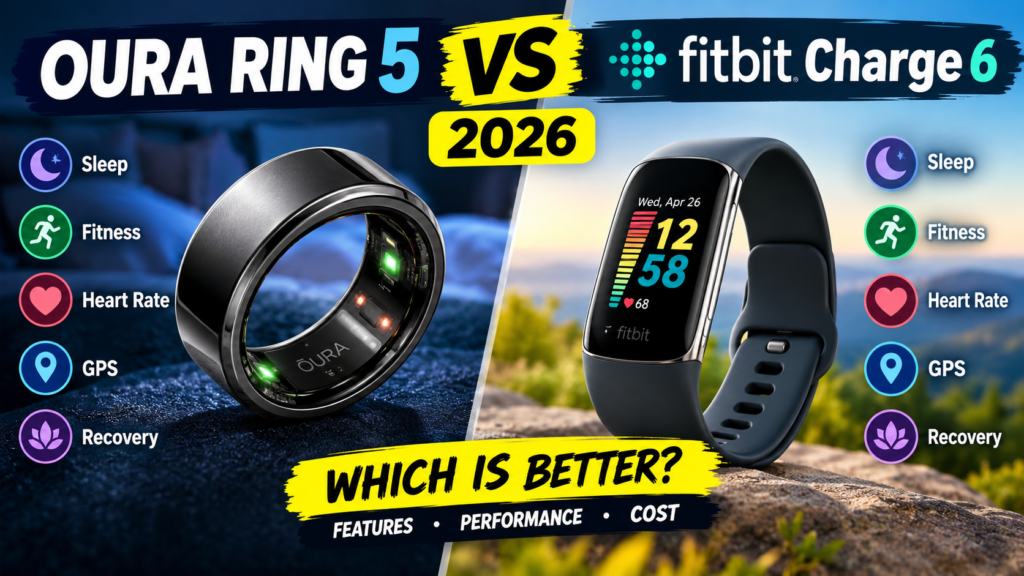
Comparing the Oura Ring 5 and Fitbit Charge 6 means comparing two different approaches to wearable technology. Oura Ring 5 is a screen-free titanium smart ring designed to collect health and activity data in the background, with most insights viewed through the Oura app. Fitbit Charge 6 is a wrist-worn fitness tracker with a color touchscreen, built-in GPS, workout features, and on-device information.
Those differences affect how each device works for sleep tracking, recovery, workouts, heart-rate monitoring, GPS, battery life, and everyday use.
Instead of asking which wearable is universally better, this comparison focuses on the features and trade-offs that matter when choosing between them. Oura Ring 5 is particularly centered around sleep, readiness, recovery, and long-term health trends, while Fitbit Charge 6 combines sleep and health tracking with a stronger emphasis on visible workout data, GPS, and wrist-based fitness features.
This is a research-based comparison rather than a hands-on laboratory test. Specifications, pricing, subscription features, and availability can change, so check the manufacturer’s current information before purchasing.
Oura Ring 5 vs Fitbit Charge 6: Quick Comparison
| Feature | Oura Ring 5 | Fitbit Charge 6 |
|---|---|---|
| Form factor | Titanium smart ring; weight varies by size and finish | Wrist-worn fitness tracker |
| U.S. starting price | $399 for Silver/Black; other finishes cost more | $159.95 list price; promotions may reduce the price |
| Subscription | Oura Membership: $5.99/month or $69.99/year in the U.S. | Core tracking available without Google Health Premium; paid features available through Google Health Premium |
| Battery | Typically 6–9 days | Up to 7 days |
| Display | None | Color AMOLED touchscreen |
| GPS | No onboard GPS; uses phone GPS for supported outdoor activities | Built-in GPS plus connected phone GPS |
| Sleep tracking | Yes | Yes |
| Sleep stages | Light, deep and REM estimates | Light, deep and REM estimates |
| Heart rate | Continuous tracking, including overnight and activity measurements | Continuous tracking with on-device workout readings |
| HRV | Yes | Yes |
| SpO2 | Yes | Yes |
| Workout tracking | Automatic activity detection and app-based workout tracking | 40+ exercise modes, automatic activity detection and live workout information |
| ECG | No ECG app | ECG app available in supported regions |
| Water resistance | Up to 100 m | Up to 50 m |
| Phone compatibility | iOS and Android | Android and iOS |
| Screen-free experience | Yes | No |
| Best suited to | Sleep, recovery, trends and screen-free wear | Fitness, GPS and live workout information |
Specifications and pricing can vary by market, size, finish, software version, and promotions.
Oura Ring 5 vs Fitbit Charge 6: The Biggest Differences
1. Finger vs. wrist

- THE WORLD’S SMALLEST SMART RING – 40% smaller than the previous generation, Oura Ring 5 is thinner, lighter and smaller …
- SIZING IS ESSENTIAL – Oura Ring 5 uses unique sizing different from standard jewelry rings and other Oura Ring generatio…
- EVERYDAY HEALTH SENSING – Oura tracks over 50 health metrics, including sleep, activity, stress, heart health, metabolic…
The most obvious difference is physical design.
Oura Ring 5 is worn on your finger and collects health and activity information without a display. Fitbit Charge 6 sits on your wrist and gives you a screen where you can see information without taking out your phone.
Neither form factor is automatically better for everyone. A ring may feel less noticeable to some people during sleep, while a wrist tracker is easier to check during exercise.
2. Screenless vs. display
Oura Ring 5 has no screen. You normally check the Oura app on your phone for detailed information.
Charge 6 has a color touchscreen that can display workout information, heart rate, time, notifications, and other supported features.
This creates an important difference in everyday use. If you prefer a device that stays in the background, Oura’s screen-free design may be appealing. If you want to see workout information while exercising, Charge 6 provides that information directly on your wrist.
3. Recovery and fitness emphasis
Both devices track sleep, heart rate, activity, and other health-related signals.
Oura puts greater emphasis on sleep, readiness, recovery, and long-term trends within its app.
Charge 6 combines sleep and health tracking with a stronger focus on exercise modes, heart-rate zones, GPS, and real-time workout information.
The difference is therefore less about what each device can measure and more about how the information is presented and used.
4. GPS
Charge 6 includes built-in GPS as well as connected phone GPS.
Oura Ring 5 does not have onboard GPS. For supported outdoor activities, Oura uses your phone’s GPS for location, route, pace, and distance information.
This is an important distinction for runners, walkers, cyclists, and hikers who sometimes exercise without carrying a phone.
5. Workout feedback
Charge 6 can display workout information directly on your wrist, including heart rate and other supported exercise data.
Oura can automatically detect many activities and record workouts, but its screen-free design means you normally review detailed information through the phone app.
Oura can also provide live activity information in the app. However, live workout heart-rate display during Live Activity Tracking requires a compatible third-party heart-rate monitor.
6. Subscription model
Oura Membership is an important part of the Oura experience. The membership unlocks the platform’s full set of software insights and features.
Charge 6 provides core tracking without a paid subscription. Google Health Premium, formerly known as Fitbit Premium, adds additional features and coaching.
Therefore, the upfront hardware price and long-term software cost are both important when comparing the two.
7. Ecosystem
Oura is designed primarily around the Oura app and its health, sleep, recovery, and activity insights.
Charge 6 integrates with Google’s health ecosystem and supports features such as Google Maps, Google Wallet, and YouTube Music controls. Some features require a compatible phone or additional subscription.
Sleep Tracking: Oura Ring 5 vs Fitbit Charge 6
Sleep is one of the biggest reasons people consider either device.
Both Oura Ring 5 and Fitbit Charge 6 estimate sleep duration and sleep stages and provide sleep-related scores and insights. Both can also track overnight heart rate and other signals that contribute to their respective health and recovery features.
Sleep score and insights
Oura’s Sleep Score combines several sleep-related measurements and is closely integrated with its broader Readiness and Activity experience.
Charge 6 also provides a Sleep Score and sleep-stage information. Some more detailed sleep features are part of Google Health Premium.
The key difference is the way each platform organizes the information.
Oura puts sleep and recovery near the center of the user experience, while Charge 6 combines sleep information with activity and fitness tracking.
Overnight heart rate, HRV and SpO2
Both devices can collect overnight health signals.
Oura Ring 5 tracks metrics including heart rate, HRV, blood oxygen, temperature-related information, and respiration-related measurements.
Charge 6 tracks heart rate and HRV and provides additional measurements such as SpO2, breathing rate, and skin-temperature variation.
These measurements can be useful for observing trends over time, but individual readings should not be treated as medical diagnoses.
Sleep comfort
Oura Ring 5 weighs relatively little compared with a wrist-worn fitness tracker and has no screen or notifications.
Charge 6 is also relatively lightweight for a device with a display, but it remains a wrist-worn tracker.
Comfort is highly personal. Some people prefer wearing a ring during sleep, while others are more comfortable with a wrist device.
Sleep-stage accuracy
Oura has published a manufacturer claim about sleep-stage performance compared with polysomnography-based testing. However, that claim relates to a specific methodology and should not be interpreted as proof that Oura provides clinically equivalent sleep staging in everyday use.
The American Academy of Sleep Medicine has emphasized that consumer sleep technologies should not be used to diagnose or treat sleep disorders and should not replace appropriate clinical evaluation.
For that reason, sleep-stage information from either device is best viewed as a consumer wellness estimate and trend indicator rather than a clinical measurement.
For a broader explanation of wearable sleep tracking, see our Sleep Tracker Buying Guide 2026.
Recovery and Readiness
Both platforms convert multiple measurements into proprietary wellness insights.
Oura’s Readiness experience uses information such as sleep, heart rate, HRV, temperature-related trends, and activity to provide a daily picture of recovery.
Oura also provides longer-term trend features that can help users understand changes in their activity, sleep, and recovery patterns.
Fitbit’s Daily Readiness Score provides a similar type of general wellness guidance. Google lists Daily Readiness among the features available through Google Health Premium.
The important distinction is that these scores are proprietary wellness metrics. They are not medical measurements and should not override how you feel or replace professional medical advice.
For someone who wants a wearable experience heavily organized around recovery and daily readiness, Oura’s interface is particularly focused on that type of information.
For someone who wants readiness information alongside workouts, GPS, activity tracking, and a wrist display, Charge 6 offers a more fitness-oriented combination.
Heart Rate and HRV Tracking
“Heart-rate tracking” can mean several different things, so it is useful to separate them.
Overnight heart rate and HRV
Both devices can collect heart-rate information while you sleep and use HRV as part of their broader wellness insights.
Resting heart rate
Resting heart rate is useful primarily as a trend rather than as a single number. Both devices track heart-rate information that can contribute to resting-heart-rate trends.
Daytime heart rate
Oura tracks heart-rate information throughout the day and night, including during supported activities.
Charge 6 also tracks heart rate and allows you to see readings directly on its display.
Workout heart rate
Charge 6 has an advantage in terms of visibility because you can view supported workout heart-rate information directly on the wrist.
Oura records workout heart-rate information and provides workout information through its app. During supported Live Activity Tracking, live on-screen heart rate requires a compatible third-party heart-rate monitor.
HRV
Both devices use HRV as part of their health and recovery insights.
Accuracy claims should be treated carefully. Oura and Fitbit/Google have published performance claims using different testing methods and reference measurements. Those claims cannot be used to establish a universal accuracy winner between the two devices.
Fitness and Workout Tracking
The biggest practical difference appears during exercise.
Walking and running
Charge 6 can use built-in GPS or connected phone GPS and can show workout information directly on the wrist.
Oura can automatically detect supported activities and use your phone’s GPS for supported outdoor activities.
For runners who want pace, distance, and route information without carrying a phone, Charge 6 has a significant functional difference because it includes onboard GPS.
Cycling
Charge 6 supports cycling-related tracking and GPS functionality.
Oura can also track cycling activities and use phone GPS for supported outdoor sessions.
The important distinction remains the same: Charge 6 can perform GPS tracking without relying on the phone’s GPS connection.
Gym and strength training
Charge 6 supports more than 40 exercise modes and provides workout information on the device.
Oura can automatically detect many activities, including strength-related activity, but its screen-free design means you will not have the same on-wrist workout display.
For someone who regularly wants to glance at a heart-rate zone, timer, or other workout information during exercise, Charge 6 is designed around that use case.
Automatic activity detection
Both platforms can automatically identify certain activities.
Oura says it can automatically detect more than 40 activities.
Fitbit’s SmartTrack can automatically detect and record supported activities, including qualifying workouts that were not manually started.
Heart-rate zones
Charge 6 provides on-device workout information and Active Zone Minutes, making heart-rate-zone feedback practical during exercise.
Oura can provide heart-rate zone information in the app after or during supported activity tracking, but its screen-free design makes the experience different from a wrist tracker.
GPS: Oura Ring 5 vs Fitbit Charge 6
GPS is one of the clearest differences between these devices.
Fitbit Charge 6
Charge 6 has built-in GPS and also supports connected phone GPS.
This means you can record outdoor routes and workout distance without depending entirely on your phone’s GPS.
GPS usage can consume more battery, so longer GPS workouts may reduce battery life.
Oura Ring 5
Oura Ring 5 does not have onboard GPS.
For supported outdoor activities such as walking, running, hiking, and cycling, the Oura app can use your phone’s GPS to record route and distance information.
That means your phone needs to be with you if you want phone-based GPS data during those activities.
For users who regularly run or walk without a phone, this difference may be important.
Battery Life and Charging
Battery life is another area where both devices have strengths.
Oura Ring 5 is typically rated for approximately 6–9 days of battery life, depending on factors such as size, settings, and usage.
Charge 6 is rated for up to 7 days under specified conditions. Features such as GPS and display settings can increase battery consumption.
Actual battery life will vary.
The charging routine also matters for sleep tracking. If a wearable is charging during your normal sleep period, it cannot record sleep during that time.
A useful approach is to create a regular charging window when you are awake, such as while showering, working at a desk, or getting ready for bed.
Neither device should be judged only by its maximum battery rating. Your actual usage pattern matters more.
App Experience and Health Insights
The two ecosystems are organized differently.
Oura app
The Oura app emphasizes:
- Sleep
- Readiness
- Activity
- Recovery
- Long-term trends
- HRV
- Temperature-related trends
- Resilience
- Cardiovascular insights
The overall experience is designed around helping users interpret patterns over time rather than constantly looking at the device itself.
Because the ring has no display, the phone app is central to the Oura experience.
Google Health and Fitbit experience
Charge 6 works within Google’s health ecosystem and provides information related to:
- Sleep
- Activity
- Heart rate
- Exercise
- GPS
- Active Zone Minutes
- Workout information
Charge 6 also supports Google ecosystem features such as Google Maps, Google Wallet, and YouTube Music controls, subject to device, phone, account, and subscription requirements.
For a wider comparison of sleep-focused devices, see our Best Sleep Trackers in 2026.
Subscription and Long-Term Cost
The hardware price is only part of the total cost.
Oura Ring 5
Oura Ring 5 starts at $399 for selected finishes, while other finishes cost more.
Oura Membership is currently listed at $5.99 per month or $69.99 per year in the U.S.
An active membership provides access to Oura’s full software experience and health insights.
Fitbit Charge 6
Charge 6 has a substantially lower hardware price than Oura Ring 5.
Core tracking features can be used without a paid Google Health Premium subscription.
Google Health Premium, formerly Fitbit Premium, provides additional features such as Daily Readiness, more detailed sleep-related insights, coaching, and other premium content/features depending on current availability.
Pricing, promotions, and included trial periods can change, so check the current Google Store and Google Health information before purchasing.
Long-term cost comparison
Using the regular $399 starting price for Oura Ring 5 and the $69.99 annual Oura Membership cost gives the following approximate hardware-plus-membership totals:
| Timeframe | Oura Ring 5 + Membership | Charge 6 without Premium |
|---|---|---|
| 1 year | $468.99 | $159.95 list price |
| 2 years | $538.98 | $159.95 list price |
| 3 years | $608.97 | $159.95 list price |
These figures exclude taxes, promotions, replacement devices, and optional paid services.
For Charge 6, the hardware price can be lower during promotions. If you choose Google Health Premium, add the current subscription cost to your ownership calculation.
The main takeaway is that Oura’s lower annual software fee does not change the fact that its starting hardware price is considerably higher.
Comfort and Everyday Wear
Weight and size
Oura Ring 5 is designed as a compact ring and its weight varies according to size and finish.
Oura recommends using its sizing kit before purchasing because its sizing differs slightly from standard U.S. ring sizes and half sizes are not offered.
Charge 6 is a wrist-worn device weighing approximately 30 grams.
Both are relatively lightweight wearables, but they feel different because one is worn on the finger and the other on the wrist.
Sleep and workouts
Some users may prefer a ring during sleep because there is no wrist band, display, or screen.
However, rings can be noticeable during weightlifting, gripping exercises, or movements where the fingers repeatedly contact equipment.
Charge 6 is easy to check during a workout but may be more noticeable while sleeping or during exercises involving wrist movement.
Comfort is subjective, so return policies and sizing options are worth considering before buying.
Screen and notifications
Charge 6 can display supported notifications, workout information, time, and other information directly on the wrist.
Oura Ring 5 has no screen.
For people who want fewer digital interruptions, the lack of a display can be a positive feature. For people who want instant information during workouts, it can be a limitation.
Water resistance
Oura Ring 5 is rated for water resistance up to 100 meters and is designed for activities including swimming and other water activities. Oura also states that it is suitable for sauna use but should not be used for diving.
Charge 6 is rated for water resistance up to 50 meters.
Always follow the manufacturer’s current water-use instructions.
For another perspective on ring-versus-watch form factors, see our Oura Ring vs Apple Watch comparison.
Which Device May Fit Different Types of Users?
| Priority or user type | Device that may fit better | Main reason |
|---|---|---|
| Sleep + screen-free wear | Oura Ring 5 | Ring design and sleep-focused app experience |
| Recovery/readiness trends | Oura Ring 5 | Strong emphasis on readiness and long-term trends |
| Built-in GPS | Fitbit Charge 6 | Onboard GPS |
| Live workout information | Fitbit Charge 6 | Color touchscreen and wrist-based stats |
| Runner who leaves phone behind | Fitbit Charge 6 | Built-in GPS |
| Screen-free experience | Oura Ring 5 | No display |
| Lower hardware cost | Fitbit Charge 6 | Much lower starting hardware price |
| User avoiding a paid membership | Fitbit Charge 6 | Core tracking works without Google Health Premium |
| iPhone user | Either | Both support iOS |
| Android user | Either | Both support Android |
| Sleep + recovery priority | Oura Ring 5 | Sleep and readiness are central to the experience |
| Sleep + workouts with on-device GPS | Fitbit Charge 6 | Combines sleep tracking with GPS and live workout information |
| User who wants Google ecosystem features | Fitbit Charge 6 | Google Maps, Wallet and YouTube Music integration |
| User who wants minimal device interaction | Oura Ring 5 | Screen-free design |
Oura Ring 5 Pros and Cons
Pros
- Screen-free titanium ring design
- Typically 6–9 days of battery life
- Strong focus on sleep and readiness
- Detailed long-term health and recovery trends
- 100-meter water resistance
- Works with iOS and Android
- Compact form factor
Cons
- No onboard GPS
- Detailed information requires the phone app
- Oura Membership adds an ongoing cost
- Higher starting hardware price
- Ring sizing is important
- Some users may find a ring uncomfortable during certain strength exercises
Fitbit Charge 6 Pros and Cons
Pros
- Built-in GPS
- Color touchscreen
- Live workout information
- More than 40 exercise modes
- Lower starting hardware cost
- Core tracking works without Google Health Premium
- Google Maps, Google Wallet and YouTube Music controls
- ECG app available in supported regions
- Sleep and health tracking included
Cons
- Wrist-worn design may be more noticeable during sleep
- Some advanced features require Google Health Premium
- GPS can increase battery consumption
- 50-meter water-resistance rating
- Requires a Google account
- Display may be undesirable for users who prefer a screen-free wearable
Oura Ring 5 vs Fitbit Charge 6: Which Should You Choose?
There is no single choice that fits every user.
Oura Ring 5 may fit you if your priorities are:
- Sleep tracking
- Overnight trends
- Recovery and readiness
- Screen-free wear
- Long-term health patterns
- A ring form factor
- Checking detailed information on your phone rather than on your wrist
Fitbit Charge 6 may fit you if your priorities are:
- Fitness tracking
- Built-in GPS
- Live workout information
- Heart-rate visibility during exercise
- A wrist display
- Lower upfront hardware cost
- Google ecosystem features
- Tracking workouts without carrying a phone for GPS
The choice ultimately comes down to how you plan to use the wearable.
If your main interest is sleep, recovery, and passive health tracking and you prefer a screen-free device, Oura Ring 5 is designed around that experience.
If you want a wearable that combines sleep tracking with on-device workout information, built-in GPS, and a display, Fitbit Charge 6 is designed around that use case.
For a deeper look at Oura’s features and overall experience, see our Oura Ring Review 2026.
If you are comparing other smart rings, our Oura Ring 5 vs Samsung Galaxy Ring comparison can also help you understand how Oura differs from another ring-based platform.
Current product links:
[Oura Ring 5 Amazon Link]
[Fitbit Charge 6 Amazon Link]
Frequently Asked Questions
1. Is Oura Ring 5 better than Fitbit Charge 6 for sleep?
Both devices track sleep and estimate sleep stages, but their approaches differ. Oura places sleep and readiness at the center of its app and uses a screen-free ring design. Charge 6 combines sleep tracking with broader fitness and activity features.
There is not enough independent evidence to claim a universal accuracy winner between the two.
2. Does Fitbit Charge 6 have built-in GPS?
Yes. Fitbit Charge 6 has built-in GPS and also supports connected phone GPS.
This allows supported outdoor workouts to record GPS information without relying entirely on the phone’s GPS.
3. Does Oura Ring 5 have GPS?
Oura Ring 5 does not have onboard GPS. For supported outdoor activities, the Oura app can use your phone’s GPS to record information such as route, distance, and pace.
4. Which tracks heart rate better?
Both devices provide heart-rate tracking and both manufacturers publish performance information based on their own testing methods.
Because those tests use different reference methods and conditions, they should not be used to declare one device universally more accurate.
Charge 6 has an important practical advantage during workouts because it can show heart rate directly on its wrist display.
5. Which is better for workouts?
The answer depends on the type of workout experience you want.
Charge 6 is designed for live workout information, heart-rate zones, exercise modes, and built-in GPS.
Oura is more focused on recording activity and connecting workout information with sleep, readiness, and recovery trends.
6. Does Oura Ring 5 require a subscription?
Oura Membership is $5.99 per month or $69.99 per year in the U.S. An active membership provides access to the full Oura software experience.
7. Does Fitbit Charge 6 require Google Health Premium?
No. Core tracking works without Google Health Premium.
Google Health Premium, formerly Fitbit Premium, provides additional features and content. Availability and pricing can change by country and over time.
8. Which has better battery life?
Oura Ring 5 is typically rated for approximately 6–9 days, while Charge 6 is rated for up to 7 days under specified conditions.
Actual battery life depends on settings and usage. GPS and certain display settings can increase Charge 6 battery consumption.
9. Can Oura Ring 5 or Fitbit Charge 6 diagnose sleep apnea?
No. Consumer wearables should not be used as a substitute for clinical diagnosis.
The American Academy of Sleep Medicine advises that consumer sleep technologies should not be used to diagnose or treat sleep disorders. If you have concerns about sleep apnea or another sleep disorder, speak with a qualified healthcare professional.
10. Does Fitbit Charge 6 have an ECG?
Yes. Charge 6 supports an ECG app in supported countries and regions. Availability can vary, so check Google’s current regional requirements.
11. Which is better for someone who wants both sleep and fitness tracking?
Both can track sleep and fitness, but they emphasize different experiences.
Charge 6 combines sleep tracking with built-in GPS, a display, exercise modes, and live workout information.
Oura combines sleep and activity tracking with a stronger emphasis on readiness, recovery, and long-term trends.
12. Which costs less over time?
Charge 6 has a much lower starting hardware price, and its core tracking does not require a paid subscription.
Oura Ring 5 costs more initially and requires Oura Membership for its full software experience.
Your actual long-term cost will depend on promotions, membership choices, and how long you keep the device.
Final Takeaway
Oura Ring 5 and Fitbit Charge 6 are not identical types of wearable.
Oura Ring 5 is built around a screen-free ring experience with a strong emphasis on sleep, readiness, recovery, and long-term trends.
Fitbit Charge 6 is a wrist-based fitness tracker that combines sleep and health tracking with a display, built-in GPS, workout modes, and live exercise information.
The most important question is therefore not simply which device has more features. It is which features you will actually use every day.
If sleep and recovery are central to your wearable routine and you prefer a discreet, screen-free design, Oura Ring 5 offers that type of experience.
If workouts, GPS, on-device information, and a lower hardware cost are more important, Charge 6 provides those capabilities in a wrist-based format.
Before purchasing either device, check the current manufacturer’s pricing, subscription terms, regional features, and return policy because those details can change.