
LifeCareBalance.com is reader-supported. When you buy through links on our site, we may earn an affiliate commission at no extra cost to you. As an Amazon Associate, we earn from qualifying purchases.

- THE WORLD’S SMALLEST SMART RING – 40% smaller than the previous generation, Oura Ring 5 is thinner, lighter and smaller …
- SIZING IS ESSENTIAL – Oura Ring 5 uses unique sizing different from standard jewelry rings and other Oura Ring generatio…
- EVERYDAY HEALTH SENSING – Oura tracks over 50 health metrics, including sleep, activity, stress, heart health, metabolic…

If you’ve narrowed your smart ring search down to two names, you’re probably comparing Oura and Samsung. Both are screen-free, finger-worn health trackers built around continuous physiological monitoring — but the way they collect, price, and present that data is genuinely different. One asks for a monthly membership and works across iPhone and Android. The other skips the subscription entirely but ties full functionality to Samsung’s own ecosystem. Picking the wrong one means either paying for features you can’t use on your phone, or paying a recurring fee you didn’t expect.
This guide breaks down where each ring actually differs — not just battery life and subscriptions, but sleep-stage accuracy, recovery scoring, real fitness limitations, and total three-year cost — so you can match the ring to how you actually plan to use it.
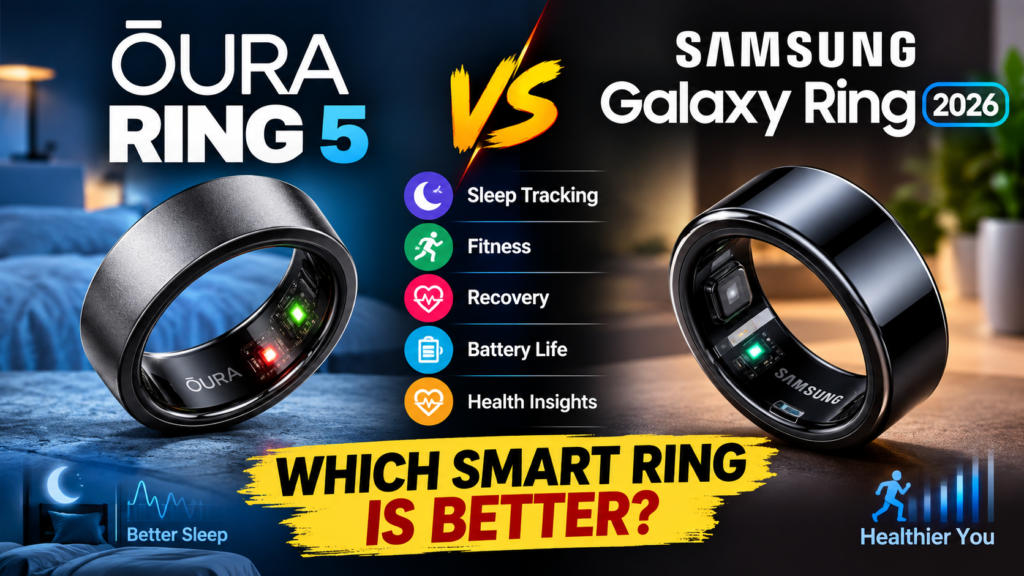
A quick note on naming: as of September 2026, Samsung has not released a “Galaxy Ring 2.” A patent dispute with Oura, filed in November 2025 with Samsung launching a countersuit, has made launching a new generation mid-litigation difficult, and initial Galaxy Ring sales also came in below expectations. The successor is currently expected in early 2027. So “Samsung Galaxy Ring 2026” in this guide refers to the original Galaxy Ring hardware, now in its third year on the market, compared against the genuinely new Oura Ring 5. mobilemasr
Quick Answer
There isn’t a single universal winner here — the right choice depends on a handful of factors specific to you:
- Phone ecosystem: Oura Ring 5 works with iPhone and Android. Galaxy Ring requires a Samsung Galaxy phone for setup and full Galaxy AI features.
- Subscription tolerance: Oura requires an active Oura Membership ($5.99/month or $69.99/year) for most insights. Galaxy Ring’s Samsung Health features are free with no subscription.
- Sleep and recovery depth: Oura’s sleep algorithm has more independent, peer-reviewed validation data behind it and offers deeper composite scoring (Readiness, Resilience, Cardiovascular Age).
- Comfort and size: Oura Ring 5 is dramatically thinner and lighter than its predecessor; Galaxy Ring is also very light, but sizing tops out at 13 versus Oura’s slightly wider range historically.
- Long-term cost: Galaxy Ring wins on sticker price and ongoing cost if you never subscribe to anything. Oura costs more over time but bundles more clinically-oriented features into that fee.
If you want the short version: Oura Ring 5 is the stronger pick for people who want the deepest sleep and recovery insights and don’t mind paying a subscription, especially iPhone users. Galaxy Ring is the stronger pick for Samsung Galaxy owners who want solid, free, no-subscription health tracking without needing every advanced metric.
Oura Ring 5 vs Samsung Galaxy Ring: Comparison Table
| Spec | Oura Ring 5 | Samsung Galaxy Ring |
|---|---|---|
| Current model | Oura Ring 5 (2026) | Galaxy Ring, original generation (Galaxy Ring 2 not yet released as of Sept 2026) |
| Starting price | $499 (Deep Rose finish; other finishes may vary) | From $299.99 before trade-in |
| Subscription | Oura Membership: $5.99/month or $69.99/year in the U.S. | None required for core Samsung Health features |
| Battery life | Typically 6–9 days, depending on ring size and usage | Up to 7 days (size 12–13); smaller sizes rated for up to 6 days |
| Charging method | Charges in about 80 minutes; optional Charging Case adds a full day of battery in 10 minutes | Charging case with pogo pins; combined ring + case use is rated up to 14 days between outlet charges |
| Weight | From 2 grams, depending on size | 2.3g (size 5) to 3.0–3.2g (size 13) |
| Dimensions | Width 6.09mm, thickness 2.28mm | Approximately 7.0mm width x 2.6mm thickness |
| Material | Fully titanium exterior and interior with PVD coating | Titanium Grade 5 frame |
| Water resistance | 100m/328ft; suitable for sauna and water sports, not diving | 10ATM and IP68 rated |
| Sensors | Two tri-LED emitters, two photodetectors, digital temperature sensor, accelerometer | Accelerometer, PPG (optical bio-signal sensor), skin temperature sensor |
| Sleep tracking | Yes — stages, efficiency, sleep score, coaching | Yes — sleep stages, sleep score based on sleep time, restfulness, cycles, and recovery, plus sleep coaching |
| Heart-rate tracking | 24/7 heart rate (daytime, nighttime, activity) | Continuous heart rate via optical bio-signal sensor |
| HRV | Yes, feeds into Readiness | Yes, feeds into Energy Score |
| Blood oxygen | Yes, SpO2 sensing | Yes, tracked overnight, though independent reviewers have flagged accuracy concerns |
| Skin temperature | Yes, advanced temperature monitoring | Yes, regular readings during sleep |
| Recovery/readiness score | Readiness Score (proprietary composite) | Energy Score, powered by Galaxy AI |
| Activity tracking | Automatic Activity Detection with dynamic goals | Accelerometer-based automatic tracking of walking and running |
| Workout tracking | Automatic detection, no live screen feedback | Auto Workout Detection, currently limited to walking and running |
| GPS | No onboard GPS | No onboard GPS |
| Phone compatibility | iOS and Android | Android 11+ with 1.5GB+ RAM; full Galaxy AI features require a compatible Samsung Galaxy phone |
| App ecosystem | Oura App; integrates with 100+ third-party apps | Samsung Health / Galaxy Wearable app |
| Smartwatch integration | Standalone; pairs alongside any smartwatch | Designed to pair with Galaxy Watch and Galaxy Buds |
| Best use case | Deep sleep/recovery insight seekers, cross-platform households | Samsung Galaxy owners who want free, integrated health tracking |
Sleep Tracking: A Detailed Breakdown
Both rings estimate sleep the same fundamental way: by combining heart rate, HRV, movement, skin temperature, and (for both) blood oxygen, then running that signal through a proprietary algorithm to infer sleep stages. Neither ring is a medical device, and neither replaces polysomnography (PSG), the in-lab, EEG-based gold standard for diagnosing sleep disorders.
Oura’s sleep-stage evidence. Oura has published more independent, peer-reviewed validation research than most competitors. A National University of Singapore validation study of Oura’s sleep-staging algorithm found 76–78% accuracy for 4-stage classification (light, deep, REM, wake) against gold-standard polysomnography, and 92–93% accuracy for simple 2-stage sleep/wake classification, using a larger, more realistic at-home dataset than most sleep-tech validation studies. That’s a meaningfully strong result for a consumer device, but it also means roughly one in four sleep-stage classifications can be off — this is estimation, not diagnosis. ouraring
Samsung’s sleep tracking. The Galaxy Ring measures the same core signals — heart rate variability to detect stage transitions, blood oxygen to assess breathing patterns, skin temperature to identify disruptions, and movement to distinguish wake from sleep — and reports Awake, REM, Light, and Deep stages, plus a 1–100 sleep score and snore detection. Samsung’s own documentation is explicit that this feature is designed for general wellness tracking and should not be used for medical diagnosis or treatment. Samsung has not published the same volume of independent, peer-reviewed sleep-staging validation research that Oura has, which doesn’t mean it’s inaccurate — but it does mean there’s less third-party evidence to evaluate the claims against. duckdnsduckdns
What both fall short of. The American Academy of Sleep Medicine’s position statement on consumer sleep technology is unambiguous: “Given the lack of validation and United States Food and Drug Administration (FDA) clearance, CSTs cannot be utilized for the diagnosis and/or treatment of sleep disorders at this time.” Neither ring diagnoses sleep apnea, insomnia, or any other sleep disorder — including Samsung’s snore detection and abnormal-signal monitoring, which flag patterns for your awareness, not clinical findings. If you have a suspected sleep disorder, see a sleep medicine specialist; treat either ring’s data as a conversation-starter, not a diagnosis. For a broader look at how these devices stack up across the category, see our Sleep Tracker Buying Guide 2026. aasm
Sleep coaching and consistency. Oura layers in bedtime consistency tracking, a “body clock”/chronotype feature, and weekly/monthly trend reports. Samsung’s Wellness Tips deliver a similar function — for example, surfacing a sleep habit achievement rate and coaching suggestions based on recent trends — through Galaxy AI. samsung
Recovery and Readiness: How the Scores Are Built
Oura Readiness draws on overnight HRV, resting heart rate, sleep quality, previous-day activity, and body temperature deviation to produce a single composite score intended to represent how recovered you are. Oura also layers in a separate Resilience metric and Cardiovascular Age estimate, giving you more than one lens on recovery.
Samsung Energy Score, introduced with Galaxy AI, works similarly: it calculates physical readiness based on yesterday’s sleep, heart rate, and activity, delivered each morning as a single number with a qualitative label like “Excellent.” samsung
Neither score is “more scientific” in an objectively provable sense — both are proprietary composites built from the same broad category of signals (HRV, sleep, prior activity), and neither company has published a peer-reviewed validation of the composite score itself (as distinct from the individual sensor signals feeding it). The practical difference is depth: Oura exposes more of the underlying contributors and historical trend data, which matters if you like to understand why your score moved. Samsung’s presentation is simpler and faster to digest, which suits someone who wants a daily number without a deep dive. The core limitation for both: a single composite score can mask which specific input drove the change, so use it as a trend indicator rather than a precise physiological measurement.
Fitness: Where Screenless Rings Hit Their Ceiling
Smart rings are not a replacement for a dedicated sports watch, and it’s worth being honest about why. Neither Oura Ring 5 nor Galaxy Ring has:
- A screen for real-time pace, heart-rate zone, or workout feedback mid-session
- Onboard GPS — both rely on your phone for location data during outdoor workouts, so a run without your phone won’t get accurate distance or route mapping
- Dedicated strength-training tracking — automatic activity detection on both rings is tuned primarily for walking, running, and general movement, not set/rep tracking
Oura’s approach centers on automatic activity detection with dynamic daily goals, feeding workout data back into Readiness. It’s built more for recovery-aware fitness than in-the-moment coaching.
Samsung’s approach currently limits Auto Workout Detection to walking and running, though manually logged workouts capture more detail. Because Galaxy Ring pairs naturally with Galaxy Watch, Samsung’s implicit answer to the “no screen” problem is: wear both. Samsung markets the ring and watch together as “the ultimate tracking team,” combining detailed real-time data from the watch with the ring’s passive recovery insight. noelleemingsamsung
For committed athletes, especially runners, cyclists, and strength trainers who want real-time metrics, both rings work best as recovery-and-sleep companions to a smartwatch rather than a full replacement. See our Oura Ring vs WHOOP comparison if you’re weighing a ring against a more fitness-forward wearable.
Battery Life: Manufacturer Claims vs Real-World Variables
Oura Ring 5: Typically 6–9 days per charge, with the battery system rebuilt for the smaller Ring 5 form factor and tuned with dedicated firmware to preserve life despite the size reduction. Charging takes about 80 minutes. Oura’s own optional Charging Case can restore a full day of battery in 10 minutes. ouraringouraring
Samsung Galaxy Ring: Rated up to 7 days for larger sizes, with a charging case providing supplemental power for up to roughly 14 days of combined use before needing an outlet. samsungmobilepress
Both manufacturers are explicit that these numbers are best-case: “Battery life and longevity depend on Oura Ring size, Oura App settings, feature configuration, activity, battery age, usage, and many other factors; actual results will vary.” The same caveats apply to Samsung. In practice, expect shorter runtime if you enable continuous SpO2 tracking, use larger ring sizes with smaller cell capacities, or charge irregularly rather than topping off daily. Neither company guarantees a specific number of days for every user — treat both ranges as a realistic estimate, not a promise. ouraring
Comfort and Overnight Wear
Both rings were designed with overnight comfort as a priority, and both use concave, low-profile shapes intended to avoid catching on bedding.
Oura Ring 5’s headline change is size: it has 40% less volume than Oura Ring 4, with a much thinner width and lower sensor-dome height, which reviewers and Oura itself position as a meaningful jump in all-day and overnight comfort. The tradeoff: Oura Ring 5 is available in sizes 6–13, a narrower range than Ring 4’s sizes 4–15, so people at the small or large end of the sizing spectrum should check fit carefully before buying. ouraringouraring
Galaxy Ring is also extremely light — as little as 2.3 grams at the smallest size — and Samsung’s sizing kit process mirrors Oura’s: you order sample rings, wear one for 24+ hours (including sleep), and confirm fit before your final ring ships. samsungmobilepress
Health Monitoring and Data Privacy
Both companies collect continuous physiological data, and both store it in the cloud tied to your account rather than the physical device. Oura data lives in your Oura account (with membership governing what you can see); Galaxy Ring data is transferred and stored in Samsung Cloud, connected to your Samsung account. Before buying either, it’s worth reading the company’s specific health-data privacy policy — Samsung publishes a dedicated Consumer Health Data Privacy Statement, and Oura publishes its own privacy policy — rather than assuming general privacy practices apply equally to health-specific data. samsung
Neither ring’s heart-rate, SpO2, or sleep features are FDA-cleared for diagnosing disease. Samsung is explicit about this in its own disclosures: “The heart rate software functions are not intended for use in the diagnosis of disease or other conditions, or in the cure, mitigation, treatment or prevention of disease.” Oura’s marketing describes its sensors as delivering “research-grade accuracy,” but that phrase describes measurement precision in research contexts, not regulatory clearance for medical diagnosis. samsung
Compatibility: iPhone, Android, and Samsung Galaxy Users
| User | Oura Ring 5 | Samsung Galaxy Ring |
|---|---|---|
| iPhone user | Fully supported — Oura App is available on iOS | Not compatible — Galaxy Ring requires an Android/Samsung setup |
| Samsung Galaxy user | Fully supported | Fully supported, with full Galaxy AI features unlocked |
| Other Android user | Fully supported on Android | Technically works with Android 11+ and 1.5GB+ RAM, but Galaxy AI features require a compatible Samsung Galaxy phone specifically |
| Samsung Health user | Works alongside Samsung Health via third-party integration, not a native replacement | Native, built for Samsung Health |
| Apple Health user | Syncs via Oura’s app integrations | Not applicable — no iPhone support |
This is the single clearest differentiator in the whole comparison. If you’re an iPhone user, Galaxy Ring is not an option at all. If you’re a non-Samsung Android user, Galaxy Ring will pair, but you’ll miss the Galaxy AI-branded features (Energy Score insights, Wellness Tips) that are the ring’s main value-adds beyond raw sensor data.
Cost of Ownership: 1, 2, and 3 Years
| Ownership Period | Oura Ring 5 | Samsung Galaxy Ring |
|---|---|---|
| Year 1 | $499 hardware + $69.99 annual membership = ~$569 | $299.99 hardware, no subscription = ~$300 |
| Year 2 | $499 + ($69.99 × 2) = ~$639 total spent | $299.99, no new cost = ~$300 total spent |
| Year 3 | $499 + ($69.99 × 3) = ~$709 total spent | $299.99, no new cost = ~$300 total spent |
Assumptions: hardware bought once and not replaced; Oura Membership paid annually at the $69.99/year rate (monthly billing at $5.99 costs more over a year — about $71.88 — so annual is the cheaper Oura path); no promotions, trade-in credits, warranty upgrades, or accessory purchases (Oura’s optional charging case, Samsung’s optional wireless charger) factored in; U.S. pricing. Actual cost will vary with promotions — Samsung’s page shows periodic trade-in credits, and Oura occasionally includes trial membership periods with new-ring purchases.
The math is straightforward: Galaxy Ring is meaningfully cheaper to own over any multi-year horizon if you never subscribe to anything extra. Oura’s ongoing cost is the price of the deeper feature set and evolving software — new features like glucose tracking and expanded women’s health insights have been added to Oura Membership over time without requiring a hardware upgrade.
Is Oura Membership Worth It?
Without a membership, an Oura Ring still provides limited information, including Oura’s three daily scores — but detailed sleep-stage breakdowns, HRV trends, activity coaching, and most of what makes Oura’s app distinctive sit behind the subscription. If you’re buying an Oura Ring, budget for the membership; buying the hardware alone gets you a fraction of the experience. Whether that’s worth $5.99–$6/month depends on how much you value continuous trend data and composite scoring versus a free alternative doing something similar. subscriptioninsider
Is Samsung’s No-Subscription Model a Real Advantage?
Yes, for the audience it’s built for. If you’re already a Samsung Galaxy phone owner, Galaxy Ring gives you continuous sleep, heart rate, and activity tracking with zero ongoing cost — a genuine advantage over Oura’s model. The tradeoff is platform lock-in: that “free” model only fully applies if you’re staying in the Samsung ecosystem, and the feature depth (fewer composite scores, less granular historical trend analysis) is narrower than Oura’s paid tier.
Oura Ring 5 Pros and Cons
Pros:
- Cross-platform (iOS and Android)
- Meaningfully thinner and lighter than Oura Ring 4
- Deepest peer-reviewed sleep-validation evidence in the category
- Broad feature set: cardiovascular age, VO2 max, glucose tracking, women’s health, resilience
- HSA/FSA eligible
Cons:
- Requires ongoing membership for most features
- Sizing tops out at 13, narrower than Ring 4’s range
- Reduced onboard memory (3 days) means more frequent syncing is needed
- Higher total cost of ownership over time
Samsung Galaxy Ring Pros and Cons
Pros:
- No subscription required for core features
- Lower upfront price
- Extremely light and comfortable for overnight wear
- Deep integration with Galaxy Watch and Galaxy Buds
- 10ATM/IP68 water resistance
Cons:
- Requires a Samsung Galaxy phone for full functionality; no iPhone support at all
- Independent reviewers have raised blood-oxygen accuracy concerns
- Less independent peer-reviewed validation research than Oura
- Auto workout detection currently limited to walking and running
- No confirmed successor yet — Galaxy Ring 2 isn’t expected until early 2027
Choose Oura Ring 5 if…
- You use an iPhone, or your household mixes iPhone and Android
- You want the deepest, most research-backed sleep and recovery insight available in a ring
- You’re comfortable paying a modest ongoing subscription for continuously updated features
- You want a noticeably slimmer, lighter ring than previous smart-ring generations
Choose Samsung Galaxy Ring if…
- You own a Samsung Galaxy phone and want the ring to plug directly into that ecosystem
- You want solid sleep, heart rate, and activity tracking without any recurring cost
- You already own or plan to own a Galaxy Watch and want a unified Samsung Health experience
- Budget and long-term cost matter more to you than the deepest possible feature set
Consider a Smartwatch Instead if…
- You want real-time workout feedback, onboard GPS, or a screen mid-exercise
- You’re a serious runner, cyclist, or strength trainer who needs pace, route, and rep tracking
- You want notifications, calls, or app access on your wrist
- You’d rather track recovery and workouts on one device instead of splitting them between a ring and a watch
For a broader view of where rings sit among today’s wearables, our Best Sleep Trackers of 2026 and Best Wellness Products 2026 guides cover watches and rings side by side.
Frequently Asked Questions
Is Oura Ring 5 better than Samsung Galaxy Ring for sleep?
Oura has more independent, peer-reviewed sleep-staging validation research, and its sleep insights are generally considered more detailed. Samsung’s sleep tracking covers similar ground (stages, score, snore detection) but with less third-party validation published.
Is Galaxy Ring more accurate than Oura?
Neither has a definitive, direct head-to-head accuracy study publicly available. Independent reviewers have flagged specific concerns with Galaxy Ring’s blood oxygen readings; Oura has more published validation research overall.
Does Oura Ring 5 require a subscription?
Yes for full functionality — without an active membership, you only get Oura’s three daily scores, at $5.99/month or $69.99/year. subscriptioninsider
Does Samsung Galaxy Ring require a subscription?
No. Core Samsung Health features are included with no ongoing fee.
Which has better battery life?
Oura Ring 5 is rated 6–9 days; Galaxy Ring is rated up to 7 days for larger sizes. Actual results depend on size, sensor settings, and usage for both. ouraringsamsungmobilepress
Does Galaxy Ring work with iPhone?
No. Galaxy Ring requires a Samsung account set up through an Android device, and full features require a compatible Samsung Galaxy phone.
Does Oura Ring 5 work with Android?
Yes, Oura’s app is available on both iOS and Android. ouraring
Which is better for recovery and HRV?
Both track HRV and produce a composite recovery score (Oura Readiness, Samsung Energy Score). Oura exposes more of the underlying trend data; Samsung’s presentation is simpler and phone-tied to Galaxy AI.
Which is better for fitness tracking?
Neither replaces a dedicated sports watch. Samsung’s tighter integration with Galaxy Watch may suit fitness-focused Samsung users better; Oura is more built around recovery-aware activity tracking than in-workout metrics.
Can either ring diagnose sleep apnea?
No. Consumer sleep technology lacks FDA clearance for diagnosing sleep disorders, and Samsung explicitly states its sleep features are “designed for general wellness tracking and should not be used for medical diagnosis or treatment purposes.” The same applies to Oura. aasmduckdns
Which smart ring is better for beginners?
Galaxy Ring’s simpler, free feature set may be less overwhelming if you just want basic sleep and activity numbers. Oura’s richer dashboard rewards people willing to dig into trends over time.
Is Oura worth the subscription?
It depends on how much you value deep historical trend data and an expanding feature set (glucose tracking, cardiovascular age, resilience) versus keeping costs at zero.
Is Galaxy Ring worth buying without a Samsung phone?
Not recommended. Galaxy AI features require a compatible Samsung Galaxy phone, and the ring won’t pair with iPhone at all, so most of its value is lost outside the Samsung ecosystem. samsung
Buying Framework: Making Your Decision
Run through these ten factors in order of what matters most to you:
- Sleep tracking depth — Oura has more validation research behind it
- Recovery insight — both offer composite scores; Oura’s is more granular
- Fitness needs — neither replaces a sports watch; pair with one if you need real-time data
- Battery life — comparable, both in the 6–9 day range depending on size
- Subscription tolerance — Oura costs ongoing money; Galaxy Ring doesn’t
- Phone compatibility — this alone may decide it: iPhone owners can’t use Galaxy Ring at all
- App ecosystem — Oura integrates with 100+ third-party apps; Samsung integrates deeply with its own hardware
- Long-term cost — Galaxy Ring is cheaper over 1–3 years by a wide margin
- Comfort — both are genuinely lightweight; check sizing ranges carefully
- Personal priorities — the “best” ring is the one that matches your phone, your budget tolerance, and how deep you want your health data to go
There’s no universally correct answer here — only the one that fits your phone, your budget, and how much depth you want from your sleep and recovery data.