
LifeCareBalance.com is reader-supported. When you buy through links on our site, we may earn an affiliate commission at no extra cost to you. As an Amazon Associate, we earn from qualifying purchases.
If you’ve ever finished a hard training block and wondered why you feel flat instead of fit, sleep is usually part of the answer. Recovery doesn’t happen in the gym — it happens afterward, mostly while you’re asleep. Sleep tracking can’t make that recovery happen faster on its own, but it can help you see the patterns that are getting in the way of it.
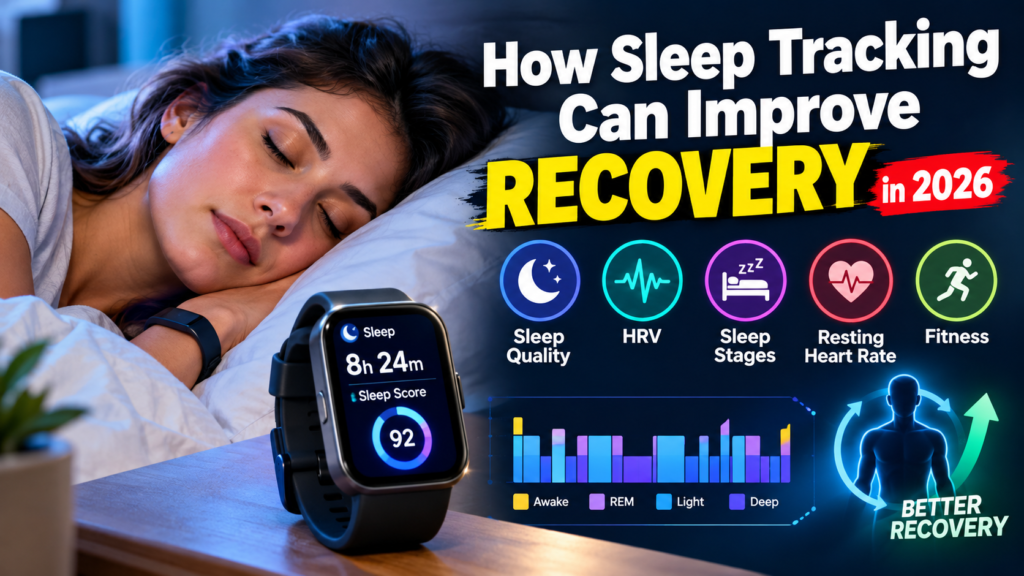
Quick answer: Sleep tracking improves recovery indirectly. It doesn’t heal your body — sleep does that. What a tracker does is surface patterns in your duration, consistency, HRV, resting heart rate, and sleep stages that you’d otherwise miss, so you can make better decisions about training intensity, rest days, and sleep habits over time.
How Sleep Tracking Can Improve Recovery
A sleep tracker’s real value isn’t the nightly score — it’s the trend line underneath it. Most people have a rough sense of whether they slept badly. Far fewer notice that their resting heart rate has been creeping up for four days, or that their sleep window has shifted by 90 minutes since starting a new work schedule. Those slower-moving patterns are what actually connect to recovery, and they’re easy to miss without data.
Used well, sleep tracking helps you:
- Notice when duration or consistency is slipping before it becomes a problem
- Spot multi-day recovery trends instead of reacting to one bad night
- Understand your own baseline for HRV and resting heart rate, rather than comparing yourself to someone else’s numbers
- Make more informed, not perfect, decisions about training intensity
It’s a support tool for awareness and habit change — not a treatment, and not a guarantee of faster recovery.
Why Sleep Matters for Physical Recovery
Physical recovery involves tissue repair, hormonal regulation, immune function, and nervous system rebalancing after the stress of training. Sleep is the period when much of this repair work is concentrated. The Centers for Disease Control and Prevention notes that sleep plays a central role in physical health, including recovery from illness and physical exertion, and that consistently insufficient sleep is linked to a range of negative health outcomes over time (CDC — About Sleep).
For athletes specifically, sleep problems are common. A recent narrative review of the relationship between physical activity, sleep, and recovery noted that sleep complaints are widely reported in athletic populations and identified sleep as a key determinant of athletic performance (PubMed — Physical activity, athletic performance, and recovery: The role of sleep). That’s a strong reason to pay attention to sleep as part of a training plan, not just as a lifestyle nicety.
If you’re shopping for a device to help with this, our sleep tracker buying guide 2026 walks through what to look for before you spend money on one.
The Sleep Metrics That Matter Most for Recovery
Not every number on a sleep app screen is equally useful. Here are the ones worth your attention.
Sleep Duration
Duration is the most basic and most reliable metric most trackers report. Adults generally need 7 or more hours per night, and chronic short sleep is associated with a wide range of health effects, according to the CDC (CDC — About Sleep). If you’re training hard, consistently falling short of that range is one of the clearest recovery red flags a tracker can show you.
Sleep Consistency
Going to bed and waking up at wildly different times, even if total duration looks fine on paper, disrupts your circadian rhythm. Consistency is often a better recovery signal than a single night’s duration, because your body adapts to routine.
Sleep Efficiency
Sleep efficiency is the percentage of time in bed that you actually spend asleep. Lying awake for long stretches lowers efficiency even if your total sleep time looks acceptable — it’s a useful way to catch a night that felt worse than the duration number alone would suggest.
Sleep Stages
Trackers estimate time spent in light, deep, and REM sleep. Deep sleep is associated with physical restoration, while REM is linked more to cognitive and emotional processing. Both matter, but stage estimates from wearables should be read as approximations rather than precise measurements — more on that in the accuracy section below.
Sleep Disturbances
Frequent awakenings, restlessness, or a low efficiency score alongside decent total duration can point to disrupted, lower-quality sleep even when the “hours slept” number looks fine.
How HRV Can Help You Understand Recovery
Heart rate variability (HRV) measures the variation in time between heartbeats and is often used as a proxy for how your autonomic nervous system is balancing stress and recovery. Generally, a higher HRV (relative to your own baseline) is associated with a body that’s handling stress well, while a lower HRV can suggest accumulated fatigue, illness, or poor recovery.
The key word there is your own baseline. HRV is highly individual — it’s shaped by age, fitness level, genetics, and even how your particular device measures it. There is no single “good” HRV number that applies across people. Comparing your HRV to a friend’s, or to a number you saw quoted online, isn’t meaningful. What matters is whether today’s reading is notably lower or higher than your personal trend over the past several weeks.
Because HRV can be affected by alcohol, illness, travel, stress, and even hydration, a single low reading isn’t necessarily a recovery crisis. It becomes more informative when you look at it alongside sleep quality and resting heart rate over several days.
How Resting Heart Rate Can Reveal Recovery Trends
Resting heart rate (RHR) is one of the simpler, more stable metrics trackers offer. Most people’s RHR sits in a fairly narrow personal range. When it’s elevated several beats above your normal baseline — especially alongside poor sleep — it can be a sign that your body is still working to recover from training load, stress, illness, or poor sleep the night before.
Like HRV, RHR should be read in context. One night with a slightly elevated RHR after a late dinner or a stressful day isn’t cause for alarm. A RHR that stays elevated for several consecutive days, paired with poor sleep and low HRV, is a more meaningful signal that you may need extra rest.
How Sleep Stages Relate to Recovery
Deep, slow-wave sleep is the stage most closely associated with physical restoration, including tissue repair processes. REM sleep, meanwhile, supports cognitive recovery — mood regulation, memory, and mental sharpness, all of which matter for training too, since fatigue and poor decision-making increase injury risk.
It’s tempting to fixate on maximizing deep sleep minutes, but stage breakdowns from consumer wearables are estimates, not lab-grade measurements (see the accuracy section below). Rather than chasing a specific deep sleep number, it’s more useful to watch whether your stage distribution looks unusually different from your own normal pattern over time.
How to Use Sleep Data Before a Workout
Before a hard training session, sleep data can help you calibrate — not dictate — your effort:
- Check the trend, not just last night. Has sleep and recovery data looked off for one day or several?
- Cross-reference HRV and RHR. Are both pointing the same direction, or is the picture mixed?
- Factor in how you actually feel. Data is one input, not the whole decision.
- Adjust intensity, not necessarily volume. A lighter session is often a better call than skipping training entirely.
This is where devices like the ones covered in our Oura Ring vs WHOOP 2026 comparison differ in how they summarize this information — some emphasize a single readiness score, others show the underlying metrics more directly.
What to Do When Your Sleep Data Looks Poor
This is where a lot of people overreact to their tracker. A single poor night is common and usually not meaningful on its own. Multi-day trends carry far more weight.
| Scenario | What it may suggest | Reasonable response |
|---|---|---|
| Good sleep + normal HRV + normal RHR | Recovery looks on track | Train as planned |
| Poor sleep + normal HRV | Isolated bad night, body handling it | Proceed, but stay attentive to how you feel |
| Poor sleep + lower-than-usual HRV | Possible accumulated fatigue | Consider reducing intensity or volume |
| Poor sleep + elevated RHR | Body may still be under stress from training, illness, or poor sleep | Prioritize rest, hydration, and an easier session |
| Several days of poor sleep/recovery data | A real trend, not a fluke | Reassess training load and sleep habits, consider a lighter week |
| Poor tracker score but you feel normal | Possible tracker inaccuracy or a non-issue | Trust how you feel, but keep watching the trend |
This table is general fitness and wellness guidance, not a medical assessment. If poor sleep or elevated recovery markers persist for more than a week or two, or if you suspect a sleep disorder, that’s a conversation for a healthcare provider rather than an app.
How Accurate Are Sleep Trackers?
Consumer sleep trackers are estimates, not diagnostic instruments. It’s worth understanding their real-world accuracy before putting too much weight on any single number.
- Sleep/wake detection is generally easier than sleep-stage classification. Most consumer devices are reasonably consistent at telling whether you’re asleep or awake, but distinguishing light, deep, and REM sleep is a harder computational problem.
- Different devices use different sensors and algorithms. Some rely primarily on movement (actigraphy-style), others add heart rate, heart rate variability, temperature, or blood oxygen data — and manufacturers each use proprietary algorithms to translate that raw data into a sleep stage estimate.
- Results vary by device. A recent systematic review and meta-analysis comparing consumer wearables to polysomnography — the clinical gold standard for sleep measurement — found that wearables tended to overestimate total sleep time and sleep efficiency, and underestimate time spent awake after falling asleep, with meaningful variability between devices and no single device consistently outperforming the others (PubMed — Are Wearable Sleep-Tracking Devices Reliable Alternatives to Polysomnography? A Systematic Review and Meta-Analysis).
- Trackers are best used for trends, not lab-grade precision. Cleveland Clinic notes that while sleep trackers can help people become more aware of their habits, they aren’t a substitute for clinical sleep testing and shouldn’t be relied on for diagnosing a sleep disorder (Cleveland Clinic — Do Sleep Trackers Help You Achieve Better Sleep?).
- Polysomnography remains the clinical reference standard. It measures brain waves, eye movement, and muscle activity directly in a lab setting — something no wrist- or finger-worn consumer device currently replicates.
If accuracy and sensor differences are a deciding factor for you, our best sleep trackers in 2026 roundup compares how several popular devices approach measurement.
How to Get Better Recovery From Your Sleep Data
Data only helps if it changes something. A few practical ways to act on it:
- Protect a consistent sleep and wake window, even on weekends, rather than chasing one “perfect” night.
- Watch trends over 7–14 days instead of reacting to daily scores.
- Pair sleep data with training load. A dip in recovery metrics after a heavy training week is expected; the same dip with no clear cause is worth more attention.
- Adjust intensity gradually, not all-or-nothing, when the data and how you feel both suggest fatigue.
- Build a real baseline first. Several weeks of data are far more useful than any single reading, especially for HRV.
Who Benefits Most From Sleep Tracking?
Sleep tracking tends to be most useful for:
- Endurance and strength athletes managing meaningful training loads
- People returning from injury or illness who want to track recovery patterns
- Shift workers or frequent travelers dealing with inconsistent sleep schedules
- Anyone trying to build more consistent sleep habits and wants objective feedback
It’s less essential for casual exercisers with light, low-intensity routines, though even then, it can highlight habits worth adjusting.
Common Sleep Tracking Mistakes
- Treating a single bad night as a crisis
- Comparing your HRV number directly to someone else’s
- Ignoring how you actually feel in favor of the score
- Not accounting for training load, travel, illness, or alcohol when reading the data
- Assuming a tracker can diagnose sleep apnea or another sleep disorder
- Switching devices frequently, which resets your personal baseline
Best Sleep Trackers for Recovery
Different wearables emphasize recovery data differently — some lean heavily on a single composite score, others surface raw HRV, RHR, and sleep stage numbers for you to interpret yourself. If you’re comparing specific options, our Oura Ring review 2026 and WHOOP 5.0 review 2026 go into how each device collects and presents this data, and our broader sleep tracker buying guide covers what to prioritize based on your training goals.
Frequently Asked Questions
Can sleep tracking improve recovery?
Not directly. Sleep tracking can’t make your body recover faster. It can help you notice patterns in duration, consistency, HRV, and resting heart rate that support better decisions about training and sleep habits, which in turn can support recovery.
What sleep metric is most important for recovery?
No single metric tells the whole story. Duration, consistency, HRV, and resting heart rate are all useful, and they’re most informative when read together rather than individually.
Does HRV show recovery?
It can be a useful signal when compared to your own baseline over time. A single day’s HRV reading, taken in isolation, is less meaningful than a multi-day trend.
What does resting heart rate tell you about recovery?
An RHR that’s elevated above your personal normal, especially for several days in a row, can suggest your body is still working to recover from training, poor sleep, or stress.
Is deep sleep important for muscle recovery?
Deep sleep is associated with physical restoration processes. That said, stage estimates from consumer wearables are approximations, so it’s more useful to watch your overall pattern than to chase a specific deep sleep number each night.
How accurate are sleep trackers?
They’re reasonably good at detecting sleep versus wake but less precise at classifying specific sleep stages, and accuracy varies by device. They should be used for trends, not treated as lab-grade measurements.
Should I train if my sleep score is low?
Usually yes, especially after just one bad night — but it’s reasonable to consider a lighter session if poor sleep is paired with a lower-than-usual HRV or elevated resting heart rate, or if it’s part of a multi-day pattern.
Is higher HRV always better?
Not universally. HRV is individual, and what matters is how today’s reading compares to your own baseline — not how it compares to anyone else’s number or to a general “good” HRV threshold.
How many hours of sleep do athletes need?
General adult guidance points to at least 7 hours per night, and athletes managing heavy training loads often need sleep at the higher end of or beyond that range to support recovery.
Can a sleep tracker detect sleep problems?
Consumer sleep trackers are not diagnostic tools and shouldn’t be used to diagnose a sleep disorder. If you consistently have trouble sleeping or suspect a disorder like sleep apnea, talk to a healthcare provider.
Final Takeaway
Sleep tracking doesn’t recover your body for you — sleep does that. What tracking offers is visibility: a way to see duration, consistency, HRV, resting heart rate, and sleep stage patterns you’d otherwise have to guess at. Used with a bit of context and patience, that visibility can genuinely support smarter training decisions. Used to chase a perfect nightly score, it mostly just adds stress. The goal isn’t a perfect number — it’s a clearer picture of your own trends over time.