
LifeCareBalance.com is reader-supported. When you buy through links on our site, we may earn an affiliate commission at no extra cost to you. As an Amazon Associate, we earn from qualifying purchases.
Your calves feel like rope after a long run. Or leg day left your quads unwilling to handle stairs. A massage gun looks like an easy fix until you meet the spec sheets: “16mm amplitude,” “85 lb stall force,” “3,200 PPM.”
Most roundups rank all-purpose devices for the whole body. Legs and calves are different. The muscles are dense, a sensitive tendon sits nearby, and you may hold the device for several minutes at an awkward angle.
This guide narrows to what matters for leg and calf recovery. It also keeps the evidence honest. A massage gun can feel good and can temporarily improve ankle motion. It has not been shown to heal tissue or guarantee faster recovery.
How we built this guide: LifeCareBalance did not lab-test these devices. Specs come from manufacturer pages, retailer listings, and reviewers who report their own measurements. Every spec is labeled with its source. Prices change often, so check the retailer or manufacturer for the current price.
Quick Answer
- Most people: Choose a device around 2 lb, with 12–16 mm amplitude, a quiet motor, and a soft or ball head. The Hypervolt 3 is our best all-rounder.
- Want deeper reach and premium ergonomics: The Theragun Prime Plus or Hypervolt 3 Pro.
- Want value: The Ekrin B37 (battery and warranty) or Bob and Brad D6 Pro (power per dollar, but heavy).
- Tight budget, mostly calves: The Bob and Brad C2 Pro.
- How to use it: Use light pressure for about 30–90 seconds per area. Avoid the Achilles tendon, bones, and joints. See a clinician first if you have an injury or unexplained pain.
For a broader look beyond legs, see our Best Massage Guns 2026 roundup.
Quick Picks: Best Massage Guns for Leg and Calf Recovery
Key: M = manufacturer-listed. R = reported by a reviewer or retailer listing (method not always stated). I = measured with instruments by an independent reviewer. On mobile, use a horizontally scrolling table.
| Product | Best For | Price | Amplitude | Stall Force | Speeds | Battery | Weight | Noise | Attachments | Why It Works for Legs/Calves |
|---|---|---|---|---|---|---|---|---|---|---|
| Hypervolt 3 | All-round leg and calf routines | $249 (M) | ~12 mm (R) | 60 lb (M) | 5 | Up to 4 hr (M) | 2 lb (M) | “Near-silent” (M); no dB found | 5: heated, flat, wedge, fork, cushion | Light, strong enough for quads, pressure sensor discourages over-pressing |
| Hypervolt 3 Pro | Heavy training, dense muscle | $349 (M) | ~14 mm (R) | 70 lb (M) | 6 | Up to 4 hr (M) | 2.5 lb (M) | 51 dB (M) | 5 (same set) | Most stall force here with a quiet motor; heavier for long calf sessions |
| Theragun Prime Plus | Ergonomics, 16 mm depth, heat | $429.99 (M) | 16 mm (R) | Up to 40 lb (M) | 5 | 150 min (M) | 31.2 oz (M) | No dB on page checked | 4: heated, dampener, ball, wedge | Triangle grip reaches calves and hamstrings; dampener suits tender calves |
| Ekrin B37 (v2) | Battery life, value, warranty | $187.50 sale / $249.99 list (M, Sept 2026) | ~12 mm (R) | 56 lb (M) | 5 | Up to 8 hr (M) | ~2.2 lb (R) | 35–55 dB (M) | 4: flat, bullet, silicone round, fork | Angled handle, long battery, soft silicone head |
| Bob and Brad D6 Pro | Power per dollar | $249.99 list (M) | 16 mm (M) | 85 lb (M); ~60 lb (R) | 6 | Up to 180 min (M) | 2.8 lb (M) | “Ultra-quiet” (M); no dB | 7 | Deep stroke for quads and glutes; adjustable arm; heavy |
| Bob and Brad C2 Pro | Budget, calves and light use | ~$109 (R, Apr 2026) | 10 mm (M); 8.5–8.6 mm (I) | 44+ lb (M); ~30 lb (R) | 5 | ~3 hr low speed (R) | 1.5 lb (M) | ~55 dB (R) | 5, plus heat/cold | Light and affordable; shallow stroke is fine for calves, limited on big muscles |
Generation note: We used only current-generation specs. The Hypervolt 3 line launched in March 2026, so older Hypervolt 2 Pro reviews don’t apply. Therabody sells several Theragun tiers, including a non-heated Theragun Prime (6th Gen, $329.99). Make sure a listing matches the exact model you’re buying.
Best Massage Guns for Leg and Calf Recovery: Product Breakdowns
1. Hypervolt 3: Best All-Rounder

- Hypervolt 3 percussion massager is for everyday movers. Whether you’re recovering from a workout or countering long hour…
- Built with 5 speeds of percussion, 5 redesigned attachments including the Heated Head Attachment, and a comfortable 2 lb…
- A built-in pressure sensor guides your intensity, Bluetooth unlocks personalized routines via the Hyperice App, and an 1…
- Why it suits legs and calves: It pairs a light 2 lb body with 60 lb of manufacturer-listed stall force. That’s easy on the hand during a 2–3 minute calf session and strong enough for quads. The pressure sensor helps you back off, and pressing too hard is a common mistake.
- Calf performance: The cushion or flat head glides well over the gastrocnemius. The heated head is optional, and independent evidence that heat adds benefit is limited.
- Leg performance: It handles quads and hamstrings comfortably. On very dense glutes, a longer stroke may feel more effective.
- Specs: Amplitude ~12 mm (R; not on the US page we checked). Stall 60 lb (M). Noise described as near-silent (M), with no dB figure found. Battery up to 4 hr (M). Five heads.
- Ergonomics: Two pounds is manageable for longer sessions.
- Pros: Light for its power, long battery, five heads, pressure feedback.
- Cons: Shorter stroke than 16 mm models, and some features depend on the app.
- Best for: Runners and gym-goers who want one device for calves and legs.
- Skip it if: You want maximum depth on dense muscle, or your budget is under about $150.
- Price context: $249 list at launch. Prices can change; check the retailer/manufacturer for the current price.
2. Hypervolt 3 Pro: Best for Heavy Training and Dense Muscle

- Hypervolt 3 Pro is built for athletes and high performers who need to warm up faster, recover stronger, and keep moving …
- With 6 speeds of percussion, 5 interchangeable attachments including the Heated Head Attachment, and a 2.5 lb weight, th…
- Hypervolt 3 Pro has a 4 hour battery life, connects via Bluetooth to the Hyperice App, charges with an 18V wall charger,…
- Why it suits legs and calves: It has the highest stall force here (70 lb, M), so it resists bogging down on large muscles. It’s also rated at a quiet 51 dB (M).
- Calf performance: Very capable, but at 2.5 lb your hand may tire before your calf is done.
- Leg performance: This is its strength. Quads, hamstrings, and glutes are where the extra power helps.
- Specs: ~14 mm (R). Six speeds. Up to 4 hr battery. Five heads including the heated head.
- Ergonomics: The pill-shaped, slanted handle suits several grips, but the weight matters for self-treatment.
- Pros: Strong and quiet, with long battery life.
- Cons: Heavier and pricier than the standard Hypervolt 3.
- Best for: High-volume trainees and heavy leg-day lifters.
- Skip it if: You mostly treat calves or have smaller hands.
- Price context: $349 (M). Check current pricing.
3. Theragun Prime Plus: Best for Ergonomics and Depth
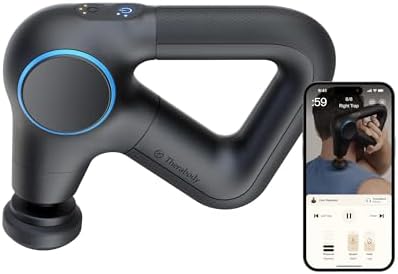
- POWERFUL MASSAGE PLUS HEAT: 3 heat levels speed recovery, optimize warm-up, reduce soreness, and relieve pain. This mass…
- MORE TREATMENTS, ONE DEVICE: Compatible with Theragun Plus Attachments. Add Cold Plus for treating injuries and reducing…
- PERSONALIZE TREATMENT IN A SIMPLE, EASY-TO-USE DESIGN: Simple on-device controls for massage speed and heat levels. Choo…
- Why it suits legs and calves: The triangular handle offers multiple grips, which helps when you’re reaching your own hamstrings or the back of your calf. It weighs about 1.95 lb (31.2 oz, M).
- Calf performance: The dampener head is a good choice for tender calves after a long run. The heated head is available for warm-ups.
- Leg performance: The 16 mm stroke (R) gives a deeper “punch” into thighs. Its stall force is lower on paper (up to 40 lb, M). That matters little if you’re not leaning hard, which you shouldn’t be.
- Specs: 16 mm (R; not on Therabody’s US page). Five speeds. 150 min battery (M). Four heads. Therabody’s page shows no dB figure.
- Pros: Ergonomic grip, deep stroke, heated head, app routines.
- Cons: Highest price here. Cold and vibration heads are sold separately. Battery is shorter than some rivals.
- Best for: People who value grip comfort and depth, and want heat included.
- Skip it if: You’re price-sensitive. The non-heated Theragun Prime (6th Gen, $329.99) is a cheaper sibling. Shopping Therabody’s flagship instead? Read our Theragun Pro review.
- Price context: $429.99 on Therabody’s US site. Check current pricing.
4. Ekrin B37 (v2): Best Value for Battery Life

- Professional-Grade Electric Massager: Equipped with a powerful level 3 brushless motor, the B37 massage gun delivers a p…
- Optimized Speed Range: Tailor your massage experience with 5 adjustable speeds (1400-3200 RPM) engineered for highly per…
- 4 Locking Attachments: The B37v2 features 4 interchangeable attachments including a new silicone ball. This deep tissue …
- Why it suits legs and calves: The 15° angled handle reduces wrist strain, the battery is very long, and the silicone round head is gentle on calves.
- Calf performance: The soft round head suits post-run soreness.
- Leg performance: 56 lb of stall force (M) is solid. The ~12 mm stroke (R) is more moderate for thick quads and glutes.
- Specs: 12 mm (R). 56 lb (M). Speeds 1400–3200 RPM. Up to 8 hr battery (M). 35–55 dB (M). Four heads.
- Pros: Battery life, lifetime warranty, quiet, USB-C fast charging.
- Cons: No app. Some smaller-handed users find the handle large. If you buy through a retailer, Ekrin says you must register the warranty.
- Best for: People who want a reliable, quiet device and rarely want to charge it.
- Skip it if: You want the deepest stroke or built-in heat.
- Price context: $187.50 on sale versus $249.99 list on Ekrin’s site in September 2026. Prices can change.
5. Bob and Brad D6 Pro: Most Power Per Dollar

- Developed by Famous PTs Bob & Brad + World-Class Support: Created by the “Two Most Famous Physical Therapists on the Int…
- Pro-Grade 16mm Amplitude & 85lbs Stall Force: Unlike standard massagers, the D6 Pro delivers true deep tissue percussion…
- Innovative Adjustable Arm & Ergonomic Grip: Designed by physical therapists, the D6 Pro features a 90° rotating arm and …
- Why it suits legs and calves: It has a 16 mm stroke and an 85 lb manufacturer stall claim at a price below premium brands. The rotating arm and multiple grips help with self-treatment.
- Calf performance: Capable, but at ~2.8 lb it can tire your hand during longer calf work.
- Leg performance: Its strongest use, on quads, hamstrings, and glutes.
- Specs: 16 mm (M). Stall 85 lb (M), though one reviewer reports roughly 60 lb (R). Six speeds. Up to 180 min. Seven heads.
- Pros: Deep stroke, many heads, OLED display, USB-C fast charging.
- Cons: Heavy. Non-removable battery. One-year default warranty, extendable on request. The stall claim and the reviewer’s figure differ, so treat 85 lb as a marketing ceiling.
- Best for: Lifters who want depth on a budget.
- Skip it if: You want a light device for daily calf work.
- Price context: $249.99 list on the brand site (out of stock there when we checked). Amazon pricing varies.
6. Bob and Brad C2 Pro: Best Budget Pick for Calves
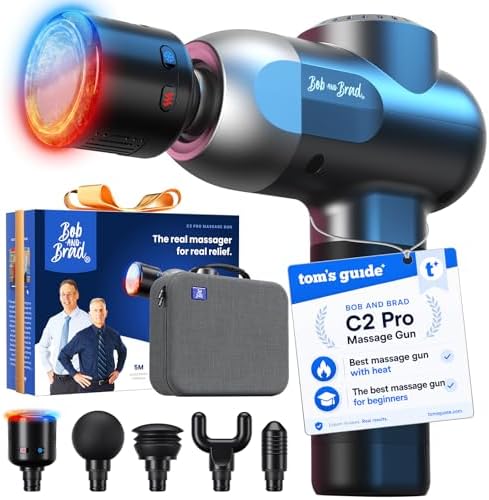
- Experience Instant Pain Relief with the Innovative Hot & Cold Massage Head: Struggling with workday neck and back pain? …
- Melt Stubborn Muscle Knots Deeply Driven by 44 lbs of Stall Force: Unlike weak devices that stop under pressure, our han…
- Enjoy Guesswork-Free Comfort via an Intuitive LED Display and 5 Speeds: Say goodbye to complicated settings. Exceptional…
- Why it suits legs and calves: At 1.5 lb it’s easy to hold, and a gentler stroke suits sore calves.
- Calf performance: Good for post-run soreness and general tightness.
- Leg performance: Limited for large, dense muscles. One reviewer measured about 8.5–8.6 mm of amplitude with calipers, below the 10 mm claim (I).
- Specs: 10 mm claimed (M). 44+ lb claimed (M), ~30 lb per a reviewer (R). Five speeds. Battery ~3 hr at low speed (R). ~55 dB (R). Five heads plus heat/cold.
- Pros: Light, inexpensive, quiet enough for most homes.
- Cons: Shallow stroke, lower real-world stall force.
- Best for: Walkers, beginners, calf-focused users.
- Skip it if: You plan to work quads and glutes hard.
- Price context: About $109 in April 2026 per one reviewer. Bob and Brad’s lineup changes, so verify the exact model.
Also worth knowing: Therabody’s Theragun Mini (3rd Gen, $219.99 on its site) is a compact option for travel. We didn’t profile it here because portability, not leg recovery, is its main selling point.
What Makes a Massage Gun Good for Calf Recovery?
Calf Anatomy: Gastrocnemius vs. Soleus
Your “calf” is two muscles.
- Gastrocnemius: The visible calf bulge. It has two heads and crosses both the knee and the ankle. It tends to do the powerful pushing in running and jumping.
- Soleus: A flatter muscle beneath the gastrocnemius that crosses only the ankle. It works constantly in walking, standing, and endurance running.
Both feed into the Achilles tendon. Because the gastrocnemius crosses the knee, bending your knee slackens it and makes the soleus easier to reach. Gastrocnemius work is a “surface” job. Soleus work benefits from a bent knee and a head that reaches along the calf’s edges. The Achilles zone is off-limits (see the safety section).
Amplitude
Amplitude is how far the head travels with each stroke, typically 10–16 mm in consumer guns. A longer stroke reaches further into big muscles like quads and glutes. Calves are smaller, so 10–14 mm is workable. Shorter isn’t useless. One small 2025 trial used a 6 mm device and still favored percussion over stretching for DOMS recovery, though the sample was tiny.
For deeper-tissue leg work, our best deep tissue massage gun guide goes further.
Stall Force
Stall force is the pressure at which the motor bogs down, like an engine stalling on a hill. It matters for dense muscle, where the motor could stall under firm pressure. But medical guidance says not to push down, and the gun supplies the pressure. So think of stall force as a buffer, not a target.
As a rule of thumb (our judgment, not a clinical standard), 30–40 lb is fine for calves and light work, and 50–60+ lb is comfortable for large muscles. Manufacturer claims can outrun reviewer numbers, as with the D6 Pro and C2 Pro above.
Speed/PPM
PPM (or RPM) counts strokes per minute. Most guns run roughly 1,400–3,200. A short stroke at high PPM can feel like buzzing, while a long stroke at lower PPM feels like a thump. The numbers aren’t comparable across brands, so don’t buy on PPM alone. For calves you’ll probably use the lowest few speeds. What matters is how finely you can control intensity.
Weight and Ergonomics
UCLA Health and Cleveland Clinic both suggest a device in the roughly 2–4 lb range, since you may hold it for 10 minutes or more. Calves are awkward to reach, so grip variety matters. Triangle handles (Theragun), angled handles (Ekrin), and rotating arms (Bob and Brad) all help. If you have smaller hands, check handle size.
Massage Heads
- Ball/standard: General-purpose and good on calves and large muscles.
- Flat: Broad and firm. Suits quads, hamstrings, and glutes.
- Soft/dampener/cushion: Gentler. A good starting point for tender calves.
- Fork/bullet/thumb: Pinpoint or channel heads. Most beginners can skip them, and they’re not for the Achilles or bone.
- Heated: A comfort feature. Forbes Vetted’s tester found the warmth relaxing but not clearly more soothing than other heads.
Noise
Noise matters in apartments, offices, and early mornings. Brushless motors tend to run quieter. Manufacturer dB figures (like 51 dB for the Hypervolt 3 Pro or 35–55 dB for the Ekrin) are usually measured lightly loaded. Pressing harder raises the volume.
Battery Life
You don’t need an 8-hour battery. At 10 minutes a day, a 150-minute battery lasts about two weeks. Longer life adds convenience for travel. Check charging (USB-C helps) and airline rules. Hyperice notes its guns are TSA friendly but must go in carry-on luggage.
How Massage Guns May Help Leg and Calf Recovery
What the evidence supports so far (results vary):
- Temporary muscle relaxation and comfort. The muscle may feel looser for a while.
- Perceived soreness. Findings are mixed (see the research section).
- Range of motion (ROM) and mobility. Short-term gains in ankle motion appear in some lab studies.
- Warm-up. Some people use a gun as a warm-up step before workouts.
- Post-exercise comfort. It may simply feel good.
What isn’t established: that a gun speeds actual tissue repair, prevents injuries, or improves speed, power, or endurance. We won’t tell you a gun “clears lactic acid.” The evidence doesn’t support that. If you want the broader picture for athletes, read our benefits-of-massage-guns-for-athletes guide.
What Does the Research Say About Massage Guns?
Research is still developing. Results depend on protocol, muscle group, timing, and population, and many studies use small groups of young, healthy men.
- Clinical guidance (Cleveland Clinic): A physical therapist says these devices haven’t been proven to improve speed, power, or endurance. They may improve range of motion and perceived fatigue. He advises starting low, moving slowly, avoiding added pressure, and skipping bony areas. Read the Cleveland Clinic guidance.
- Clinical guidance (UCLA Health): Suggests a 2–4 lb device, no more than about two minutes per muscle group per session, and staying on muscle rather than joints and bones. See UCLA Health’s percussive therapy guidance.
- Randomized crossover lab trial (calf ROM): In 16 healthy men, five minutes of percussion on the calves increased dorsiflexion ROM by 5.4° (versus 1.6° for sitting), with no change in strength. Small, short-term, and men only. Konrad et al., J Sports Sci Med, 2020.
- Controlled lab study (post-exercise calves, active adults): In 65 active young adults, five minutes of massage gun use after strenuous calf exercise had little effect on physical measures. There was a small increase in perceived soreness immediately and at four hours. Leabeater et al., J Athl Train, 2024.
- Systematic review and meta-analysis (2026): Across 12 randomized trials, percussive therapy may improve jump recovery and reduce early creatine kinase (low and very low certainty). It did not clearly improve maximum strength recovery or soreness. The authors say dose findings are preliminary. Zhu et al., Chiropr Man Therap, 2026.
Takeaway: a gun may change how your calves move and feel for a short time. That is different from proven faster recovery.
How to Use a Massage Gun on Your Calves
- Start low. Choose the lowest speed and a soft or ball head. Turn the gun on before it touches your leg.
- Set up. Sit with your leg supported and knee bent, or lie face down.
- Gastrocnemius. Glide slowly from just below the knee (not the hollow behind it) toward the lower calf, along the inner and outer bulges. About 30–60 seconds per side.
- Soleus. Bend your knee more and work the lower two-thirds along the calf’s inner and outer edges. Keep pressure light.
- Keep it moving. Don’t press hard. If a spot is tender, pause a few seconds at most.
- Stop if you feel sharp pain, numbness, tingling, or anything unusual.
- Avoid the Achilles tendon, ankle bones, shin bone, and joints.
Suggested duration: Start with 10–30 seconds per area. Most guidance suggests staying under about two minutes per muscle group per session. Research protocols vary (the calf study above used five minutes), so treat these as sensible starting points, not medical rules. An exploratory finding in the 2026 review linked longer sessions with higher DOMS scores.
Pre-Run vs. Post-Run: When Should You Use a Massage Gun?
| Timing | Goal | Approach | Watch-outs |
|---|---|---|---|
| Before a run/workout | Loosen up, prep | 30–60 seconds per muscle, light to moderate, then do a dynamic warm-up | Doesn’t replace warming up; performance benefits aren’t proven |
| Right after a run | Comfort | Gentle, short, soft head | After very hard efforts, calves may feel sore, so go lighter or wait (per the Leabeater study) |
| Later that day / next day | Ease stiffness | Light passes on tight areas | Bruising or tenderness means reduce pressure |
| Rest days | Maintenance | Short, easy sessions | Don’t use it to push through sharp pain |
How to Use a Massage Gun on Other Leg Muscles
- Quads: Flat or large ball head. Long, slow glides from above the knee up the thigh. Skip the kneecap.
- Hamstrings: Sit or lie face down. Work the back of the thigh, avoiding the crease behind the knee. A massage gun for quads and hamstrings needs some stall force, but keep the pressure light.
- Glutes: Flat head, side-lying or seated on a firm surface. Avoid the tailbone and spine.
- Calves: As described above.
The outer thigh can be tender, so go lighter there.
Massage Gun vs. Foam Roller for Leg Recovery
| Massage Gun | Foam Roller | |
|---|---|---|
| Precision | High (small heads) | Lower |
| Coverage | Small to medium areas | Large areas |
| Portability | Compact, battery-powered | Bulky, no charging |
| Ease of use | Easier seated; less effort | Needs arm and body weight |
| Calf targeting | Easy from a seat | Doable but awkward |
| Large muscle groups | Good, slower | Efficient for thighs and glutes |
| Price | ~$100–$450+ | ~$10–$40 |
| Travel | Carry-on rules for battery | Bulky but no restrictions |
Research on both is mixed, with modest short-term effects on ROM and soreness perception. Neither is proven universally better, so many people use both. If you like mixing tools, our leg recovery boots guide covers a different approach.
What Runners Should Look For
A massage gun for runners should be light (about 2 lb or less), quiet, and have a soft head for post-run calves. Battery life matters if you travel to races. Focus on the calves, hamstrings, and quads. Keep the Achilles off limits, and ease off after very hard efforts.
What Walkers Should Look For
Prioritize comfort and simplicity: low weight, gentle heads, easy controls. A 10–12 mm device is enough. Focus on soleus and calf tightness, and you can skip premium features.
What Gym Users Should Look For
For leg day, prioritize amplitude (14–16 mm) and stall force (50+ lb) to handle quads, hamstrings, and glutes. A flat head helps. Weight matters less than for runners, though you’ll still hold it for several minutes.
What Active Adults Should Look For
Choose quiet, simple, and comfortable. A mid-range device with a soft head and easy grip works for most people. If you have a desk job plus weekend activity, a light model you’ll actually use beats a powerful one that sits in a drawer.
Safety: Where NOT to Use a Massage Gun
Never use a massage gun directly on:
- The Achilles tendon
- The knee joint (including the hollow behind the knee)
- The shin bone (front and side of the tibia)
- Ankle bones
- The spine
- Open wounds
- Areas of acute injury
- Unexplained swelling
A rare case report links percussion massage gun use with rhabdomyolysis, so avoid excessive pressure and duration, and follow the manufacturer’s instructions. We don’t diagnose anything here. If something feels wrong, stop.
Who Should Ask a Healthcare Professional First?
Check with a clinician before using a percussion device if you:
- Have a recent injury or surgery, or are recovering from one
- Have unexplained pain, or swelling, warmth, or redness in one leg
- Have blood-clotting concerns, take blood thinners, or have a bleeding disorder
- Have reduced sensation (for example from neuropathy)
- Have fragile bones, a skin condition, an implanted device, or are pregnant
- Have any condition your manufacturer’s precautions list mentions
Manufacturer pages list their own precautions and contraindications, so read them.
How to Choose the Right Massage Gun for Your Legs
Use this checklist:
- Primary use: calves only, or quads/hamstrings/glutes too?
- Amplitude: 10–14 mm for calves; 14–16 mm if big muscles matter.
- Stall force: 30–40 lb for light use; 50+ lb for firm or large-muscle work (rule of thumb).
- Weight: aim for roughly 2–4 lb.
- Grip: try triangle, angled, or T-handles; check hand size.
- Heads: at least a ball and a soft or flat head.
- Noise: check dB claims if you’ll use it in an apartment.
- Battery: more than 90 minutes is plenty for most.
- Budget: under $150, roughly $150–$300, or over $300.
- Warranty: check length and registration rules.
For more on the buying process, see our guide to choosing the right massage gun.
Budget, mid-range, premium:
- Budget (~$100–$150): Fine for calves and everyday tension. Expect shallower strokes.
- Mid-range (~$150–$300): Best balance for most people (Hypervolt 3, Ekrin B37, D6 Pro).
- Premium ($300+): Adds ergonomics, heat, app features, and build quality (Theragun Prime Plus, Hypervolt 3 Pro).
The “best” device depends on your muscles, hands, budget, and routine, not on any single spec.
FAQ
What is the best massage gun for calf recovery?
It depends on your needs. For most people, a ~2 lb device with 12–16 mm amplitude, a quiet motor, and a soft head works well. The Hypervolt 3 is our all-rounder. Budget shoppers can consider the C2 Pro, and lifters may prefer the D6 Pro or Hypervolt 3 Pro.
Is a massage gun good for sore calves?
It may ease tightness and improve ankle motion temporarily. One study found little effect, and a slight rise in perceived soreness, when it was used right after hard calf exercise. Start gently.
What amplitude is best for calves?
About 10–14 mm is workable. Higher amplitude matters more for quads and glutes. Light pressure matters more than raw depth.
How long should you use a massage gun on your calves?
Start with 10–30 seconds per area, building toward 30–90 seconds. Guidance from UCLA Health and Cleveland Clinic suggests staying under roughly two minutes per muscle group per session. This isn’t a medical mandate.
Can I use a massage gun after running?
Yes, gently. If your calves feel very sore, go lighter or wait until later that day.
Can I use a massage gun on my Achilles tendon?
No. Avoid the Achilles tendon, the ankle bones, and joints.
Can massage guns help with DOMS?
Evidence is mixed. A 2026 meta-analysis found no clear soreness benefit, while a small 2025 trial favored percussion with long sessions. Results vary.
Is a massage gun better than a foam roller?
Neither is proven universally better. Guns are more precise and easier for calves, while rollers are cheaper and efficient for big muscles.
Are expensive massage guns worth it?
Sometimes. Premium models add ergonomics, heat, and build quality, but a mid-range device covers most leg and calf needs.
Can beginners use a massage gun?
Generally yes, starting on the lowest speed with a soft head. Check with a clinician first if you have injuries or medical conditions.