
LifeCareBalance.com is reader-supported. When you buy through links on our site, we may earn an affiliate commission at no extra cost to you. As an Amazon Associate, we earn from qualifying purchases.
If your muscles laugh off a standard massage gun, the problem usually isn’t the brand — it’s the specs. Deep tissue performance comes down to two numbers most shoppers never check: amplitude and stall force. A gun with a shallow stroke or a weak motor will vibrate the surface of a big muscle group without ever reaching the knot underneath it.
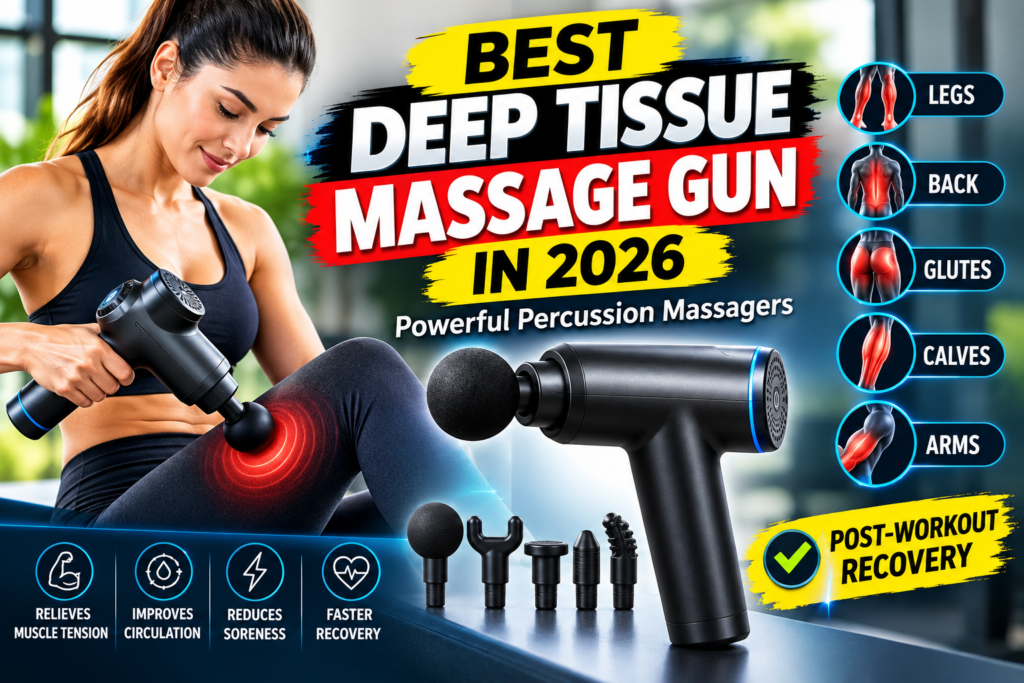
This guide breaks down which 2026 massage guns actually deliver deep-tissue-level percussion, how to match amplitude and attachments to specific body areas like legs, glutes, calves, and the back, and how to use one safely. For a broader look at the category, see our best massage guns of 2026 roundup. Fortune
Quick Comparison Table
| Product | Best For | Amplitude | Stall Force | Speed | Battery | Weight | Noise | Approx. Price | Warranty |
|---|---|---|---|---|---|---|---|---|---|
| Theragun Pro (Gen 5) | Deepest overall penetration | 16mm | 60 lbs | 1,750–2,400 PPM | Dual batteries, all-day with swaps | 2.9 lbs | Moderate | ~$599 | 2 years |
| Hyperice Hypervolt 3 Pro | High pressure tolerance, quiet use | 14mm | 70 lbs | 6 speeds, digital dial | 4 hours | 2.5 lbs | ~51 dB | ~$349 | 2 years |
| Ekrin B37 | Best value + longest warranty | 12mm | 56 lbs | 5 speeds, 1,400–3,200 RPM | Up to 8 hours | ~2 lbs | Quiet | ~$160–$200 | Limited lifetime |
| Achedaway Pro | Max claimed amplitude on a budget | 16mm | Mfr.-stated 80 lbs* | 5 speeds, 1,700–2,800 PPM | ~2–3 hours | ~2.5 lbs | Moderate | ~$189–$249 | 2 years |
| Opove M3 Pro 2 | Strongest stall force for the price | 12mm | 70 lbs | 5 speeds | 4–8 hours | 2.4 lbs | Quiet | ~$130–$150 | 1–2 years |
| Bob and Brad D6 Pro | High amplitude at mid-range price | 16mm | 85 lbs | 6 speeds | ~2–6 hours (varies by listing) | ~2.1–2.5 lbs | Moderate | ~$250–$300 | 2 years |
| TOLOCO Massage Gun | Budget pick | 12mm | Not publicly specified | 7 speeds, up to 3,200 RPM | Up to 6 hours | Moderate | ~40–50 dB | ~$60–$90 | 1 year |
*Achedaway’s stall force is independently reported as lower than the manufacturer’s claim — see the product notes below.
What Makes a Massage Gun Good for Deep Tissue?
Five factors decide whether a massage gun actually reaches deep muscle instead of just buzzing the skin’s surface:
- Amplitude is how far the attachment head travels back and forth with each stroke, usually measured in millimeters. A longer stroke feels more like a percussive “punch” and typically translates to more perceived depth, especially on large muscles like the glutes and quads.
- Stall force is how much resistance the motor can handle before it bogs down. Higher stall force means the device keeps its full amplitude even when you lean into it — which matters more than amplitude alone for genuinely deep work.
- Speed (PPM/RPM) affects how the massage feels rather than how deep it goes. Higher speeds at lower amplitude can feel intense without delivering real depth.
- Motor strength and build quality determine whether stated specs hold up under real, repeated pressure rather than just on a spec sheet.
- Attachment design and ergonomics decide whether that power can actually be applied precisely and comfortably to the area that needs it.
One important caveat: manufacturers test stall force differently, so published numbers aren’t always apples-to-apples between brands. Independent reviewers sometimes measure meaningfully lower real-world stall force than what’s advertised — the Achedaway Pro is a good example, discussed below. If you’re weighing amplitude against stall force as your main decision factor, our Theragun vs Hypervolt comparison walks through a direct example. For a broader framework, see our guide on how to choose the right massage gun. MassageGun LabConnect The Watts
Best Deep Tissue Massage Guns in 2026
Theragun Pro (Gen 5) — Deepest Overall Performer

- Smarter and Quieter: Theragun PRO is the ultimate deep tissue personal massager for recovery and pain relief. Redesigned…
- Ergonomic Design with Patented Triangle Handle: Handheld massager with flexible positioning for reduced stress on the wr…
- 6 High-Quality Attachments: Micro-Point works as a muscle stimulator, Supersoft is best used on joints, bones and sensit…
Therabody’s flagship still sets the benchmark for raw depth: a 16mm amplitude paired with 60 lbs of stall force, delivered through six attachments and an OLED screen with guided routines. Independent testers consistently rate it as having the strongest, most reliable stall performance in the consumer category, though it runs on the louder side and weighs nearly 3 lbs, which can cause fatigue during long sessions. Best for: athletes, dedicated lifters, and anyone who wants maximum, consistent depth on large muscle groups. Skip if: you’re budget-conscious or want something lightweight for daily, casual use. See our Theragun Pro review for the full breakdown. Theragun Pro review +3
Hyperice Hypervolt 3 Pro — Best for High Pressure, Low Noise

- Hypervolt 3 Pro is built for athletes and high performers who need to warm up faster, recover stronger, and keep moving …
- With 6 speeds of percussion, 5 interchangeable attachments including the Heated Head Attachment, and a 2.5 lb weight, th…
- Hypervolt 3 Pro has a 4 hour battery life, connects via Bluetooth to the Hyperice App, charges with an 18V wall charger,…
Hyperice’s 2026 flagship trades a little amplitude for more stall force and much quieter operation: 14mm amplitude, 70 lbs stall force, a 4-hour battery, and a whisper-quiet ~51 dB motor. It ships with a heated attachment head, which can help warm tissue before percussion. Best for: people who use their massage gun in shared spaces or apartments and want high pressure tolerance without noise. Skip if: you specifically want the deepest possible stroke — the Theragun Pro’s 16mm still edges it out on amplitude. Read our full Hypervolt review for more. Specifications (Hypervolt 3 Pro) – Hyperice – Zendesk +3
Ekrin B37 — Best Value and Longest Warranty

- Professional-Grade Electric Massager: Equipped with a powerful level 3 brushless motor, the B37 massage gun delivers a p…
- Optimized Speed Range: Tailor your massage experience with 5 adjustable speeds (1400-3200 RPM) engineered for highly per…
- 4 Locking Attachments: The B37v2 features 4 interchangeable attachments including a new silicone ball. This deep tissue …
The B37 pairs a 12mm amplitude with 56 lbs of stall force and a genuinely excellent battery life of up to 8 hours, backed by a limited lifetime warranty on the motor and components. It lacks app connectivity or an LCD screen, and the handle runs a bit thick for smaller hands. Best for: buyers who want dependable deep-tissue performance without premium pricing or subscription-style tech features. Skip if: you specifically want 16mm amplitude for very dense muscle. Massage Gun AdviceRankedRev
Achedaway Pro — Highest Claimed Amplitude at a Mid-Tier Price
Achedaway lists an 80 lbs stall force and 16mm amplitude in a metal-bodied housing. Independent testers, however, measured real-world stall resistance closer to 60–65 lbs at max speed — still strong, but worth knowing the manufacturer figure may be optimistic. Best for: shoppers who want Theragun-level amplitude without the Theragun price. Skip if: you want a warranty on the longer end — Achedaway’s coverage is shorter than Ekrin’s lifetime policy. Recovery For AthletesMassage Gun Advice
Opove M3 Pro 2 — Strongest Stall Force for the Money
At roughly $130–$150, the M3 Pro 2 punches well above its price with a claimed 70 lbs stall force and a 12mm amplitude, plus a genuinely long 4–8 hour battery. It’s on the heavier side at 2.4 lbs, which some users notice during longer sessions. Best for: budget-minded lifters who prioritize resisting pressure over maximum stroke depth. Skip if: hand fatigue is a concern — lighter options exist. www.mayfairfarms.com +3
Bob and Brad D6 Pro — High Amplitude, Mid-Range Price
The D6 Pro combines a 16mm amplitude with 85 lbs of stall force and seven attachment heads, positioning it as a lower-cost alternative to premium 16mm devices. Listed pricing varies noticeably between retailers — we’ve seen it anywhere from around $250 to closer to $400 — so it’s worth comparison-shopping before buying. Best for: buyers who want near-flagship amplitude and stall force without paying full Theragun pricing. Skip if: exact battery life matters to you — reported figures vary by source. kohls
TOLOCO Massage Gun — Budget Pick
For a device usually priced under $100, the TOLOCO delivers a respectable 12mm amplitude, 7 speed settings up to 3,200 RPM, 10 attachments, and up to 6 hours of battery life. Stall force isn’t independently verified or clearly published, and the straight handle can be awkward for reaching your own back. Best for: first-time buyers testing whether percussive therapy is worth it before spending more. Skip if: you specifically need verified deep-tissue stall force for very large muscle groups. If you’re shopping strictly by price, our guides to the best massage guns under $100 and best massage guns under $50 cover more entry-level options. ggr new site logo +3
Best Deep Tissue Massage Gun for Different Body Areas
Legs and Quads: Use a flat or ball head at moderate-to-high intensity. Large muscle mass here tolerates higher amplitude well.
Hamstrings: Go slightly gentler than quads — a ball or dampener attachment and moderate speed works well, moving slowly rather than lingering in one spot.
Glutes: This is where higher stall force pays off most, since dense glute muscle can bog down a weaker motor. A flat or bullet head at higher intensity is common.
Calves: Calves are sensitive and close to bone — use a ball or dampener head, lower-to-moderate intensity, and avoid pressing directly on the shin.
Upper Back and Lats: A flat or wedge head with a moderate speed works well; an angled-handle gun (like the Ekrin B37) makes self-treatment easier here.
Lower Back: Use extra caution. Stick to the muscle tissue beside the spine, never directly on the spinal column, and keep intensity low to moderate. If lower back pain is persistent, see our best massage guns for back pain guide and the safety section below.
Arms and Forearms: Use the smallest, softest attachment at low speed — these are smaller, more sensitive muscle groups that don’t need maximum amplitude.
Amplitude vs. Stall Force: Which Matters More?
Neither wins outright — they solve different problems. A gun with high amplitude but low stall force can feel powerful on soft tissue but will visibly bog down and lose depth the moment you press into a dense muscle like the glutes. A gun with high stall force but shorter amplitude, like the Hypervolt 3 Pro, holds its strength under pressure but has a physically shorter stroke reaching into the tissue. For genuinely large, dense muscle groups, a combination of both — strong amplitude and strong stall force — gives the most consistent deep-tissue result.
How Much Amplitude Do You Actually Need?
- 10mm and under: Fine for smaller muscles, sensitive areas, or as an introduction to percussive therapy.
- 12mm: A practical middle ground that suits most people and most muscle groups, including moderate work on the back and legs.
- 14mm: Noticeably more punch, well suited to athletes and larger muscle groups without going to the extreme end.
- 16mm: The deepest widely available consumer amplitude, best reserved for large, dense muscle (glutes, quads, lats) rather than smaller or more sensitive areas.
There’s no universal “best” amplitude — it depends on your body, your pain tolerance, and which muscles you’re targeting.
Best Massage Gun Attachments for Deep Tissue
- Ball head: An all-purpose attachment for large muscle groups.
- Dampener: A softer version of the ball head for sensitive or sore tissue.
- Thumb/bullet or cone head: Designed for smaller, more targeted trigger points.
- Flat head: Good general-purpose coverage across bigger muscles like the back and quads.
- Fork head: Designed to straddle the spine and treat the muscles alongside it — never the spine itself.
Avoid using firm, pointed attachments (bullet, thumb) directly on bones, joints, or the spine — stick to soft, broad heads (dampener, flat) near those areas, and keep pressure light.
How to Use a Deep Tissue Massage Gun Safely
- Start at the lowest intensity and work up gradually.
- Move the head slowly across the muscle rather than holding it in one spot.
- Let the device’s weight do the work — don’t forcefully press it into your body.
- Avoid bones, joints, the spine itself, and the front or sides of the neck.
- Never use it on open wounds, recent injuries, or areas with visible bruising or swelling.
- Stop immediately if you feel sharp pain, numbness, or tingling.
- Keep sessions to roughly 1–2 minutes per muscle group rather than extended, continuous use.
According to Cleveland Clinic guidance on percussive therapy, massage guns can offer temporary relief and relaxation for otherwise healthy muscle tissue, but they aren’t a substitute for medical evaluation when something feels seriously wrong. UCLA Health likewise recommends keeping sessions brief, avoiding bony areas and the spine, and using lower intensity on more sensitive muscle groups.
Can a Massage Gun Help Post-Workout Recovery?
Evidence here is encouraging but limited. A 2025 randomized controlled trial examining percussion massage found it may help with delayed onset muscle soreness (DOMS) in the days following intense exercise — but the study involved a relatively small, specific participant group, so its results shouldn’t be generalized to every body type or training style. Separate research into soft tissue mobilization and percussive massage suggests it may offer short-term improvements in perceived soreness and range of motion, rather than a lasting physiological fix. Together, this evidence points toward “may help with temporary soreness and warm-up,” not “treats injuries or medical conditions.” For a deeper look at what the research does and doesn’t support, see our guide to massage gun benefits for athletes. Connect The Watts
It’s worth separating what a massage gun can plausibly do — ease muscle soreness, support a pre-workout warm-up, offer temporary mobility gains — from what it can’t: treating an actual injury, addressing nerve compression, correcting a structural spinal issue, or managing a chronic disease.
Massage Gun vs. Foam Roller
| Factor | Massage Gun | Foam Roller |
|---|---|---|
| Precision | High — targets specific spots | Lower — broader coverage |
| Coverage | Smaller area per pass | Larger muscle groups at once |
| Portability | Good, but bulkier | Very portable (some travel sizes) |
| Ease of Use | Minimal effort required | Requires body weight and positioning |
| Targeted Muscle Work | Excellent | Moderate |
| Cost | $60–$600+ | $10–$40 typically |
| Best Use | Quick, targeted, hands-free relief | Full-body myofascial release, pre/post workout |
Neither tool replaces the other — many people use both depending on the situation.
Massage Gun vs. Professional Deep-Tissue Massage
A massage gun offers convenience, repeatability, and low ongoing cost, but it can’t replicate the trained hands of a licensed massage therapist, who can adapt pressure, technique, and targeting in real time based on what they feel in your tissue. A massage gun is a reasonable maintenance tool between professional sessions — not a replacement for one, especially for chronic pain, complex injuries, or medical rehabilitation.
Who Should Avoid or Get Medical Advice Before Using a Massage Gun?
Percussive therapy isn’t appropriate for everyone. Avoid using a massage gun, or check with a doctor first, if you have a bleeding disorder, are on blood thinners, are pregnant, have a pacemaker or other implanted medical device, or have a recent fracture, surgery, or acute injury near the treatment area.
More importantly: persistent or severe back pain, pain following a significant injury, numbness, weakness, pain that radiates down a limb, fever, or changes in bowel or bladder function are all reasons to see a medical professional rather than trying to self-treat with a massage gun. These symptoms can point to something a percussion device simply isn’t designed to address.
How We Evaluated These Massage Guns
Our comparisons draw on published manufacturer specifications, reputable independent testing and review data where available, and practical factors including ergonomics, amplitude, stall force, speed control, noise, battery life, attachment quality, warranty terms, and overall value for deep-tissue use specifically. Where manufacturer claims and independent measurements diverge — as with the Achedaway Pro’s stall force — we’ve noted both rather than presenting the manufacturer figure as verified fact. LifeCareBalance has not independently lab-tested every device listed here; specifications reflect brand and third-party reporting current as of 2026.
Frequently Asked Questions
What is the deepest massage gun in 2026?
Several models now offer a 16mm amplitude, including the Theragun Pro, Achedaway Pro, and Bob and Brad D6 Pro — but combined with stall force, the Theragun Pro has the most consistently verified deep-tissue performance.
What amplitude is best for deep tissue massage?
For most people working large muscle groups, 12–16mm offers meaningful depth; 16mm is best reserved for dense areas like the glutes and quads rather than sensitive spots.
Is 16mm amplitude better than 12mm?
Not universally — 16mm delivers a deeper stroke, but 12mm can feel more comfortable and controllable on smaller or more sensitive muscles.
What is a good stall force for a massage gun?
Manufacturer-reported figures above roughly 40–50 lbs generally indicate the motor can maintain pressure on larger muscle groups without bogging down, though testing methods vary between brands.
Can a massage gun reach deep muscles?
It can meaningfully affect surface and mid-layer muscle tissue; whether it “reaches” truly deep muscle layers the way manual therapy can is still debated and not something to claim definitively.
What is the best massage gun for glutes?
Look for high stall force specifically — the Hypervolt 3 Pro, Opove M3 Pro 2, and Bob and Brad D6 Pro all perform well here.
What is the best massage gun for legs?
Most mid-to-high amplitude guns handle legs well; the Theragun Pro and Ekrin B37 are solid choices at different price points.
What is the best massage gun for calves?
Choose a gun with adjustable low-intensity settings and a softer attachment — precision matters more than raw power here.
Can you use a massage gun on your lower back?
Yes, carefully — target the muscles beside the spine at low-to-moderate intensity, and never apply it directly to the spinal column.
Can you use a massage gun on your spine?
No — avoid direct application to the spine, and use a fork attachment or work around it instead.
How long should you use a massage gun?
Generally around 1–2 minutes per muscle group is a reasonable starting point, rather than extended continuous sessions.
Can you use a massage gun every day?
Many people do use one daily for short sessions, but it’s reasonable to build in rest days if you notice ongoing soreness or discomfort.
Are massage guns good after workouts?
Emerging research suggests they may help with short-term soreness and perceived recovery, though evidence is still limited and shouldn’t be overstated.
Is a massage gun better than a foam roller?
Neither is strictly “better” — they serve different purposes, and many people benefit from using both.
What massage gun attachment is best for deep tissue?
A firm ball or flat head is typically used for deep tissue work on large muscles, while bullet/thumb heads suit smaller, targeted trigger points.
FAQ questions: (see FAQ section above — 15 questions used as schema candidates)
Internal links used:
- https://lifecarebalance.com/best-massage-guns-2026/ — “best massage guns of 2026”
- https://lifecarebalance.com/theragun-pro-review-2026/ — “our Theragun Pro review”
- https://lifecarebalance.com/hypervolt-2-pro-review-2026/ — “Hypervolt review”
- https://lifecarebalance.com/theragun-pro-vs-hypervolt-2-pro-2026/ — “Theragun vs Hypervolt comparison”
- https://lifecarebalance.com/how-to-choose-right-massage-gun-2026/ — “how to choose the right massage gun”
- https://lifecarebalance.com/benefits-of-massage-guns-for-athletes-2026/ — “massage gun benefits for athletes”
- https://lifecarebalance.com/best-massage-guns-back-pain-2026/ — “best massage guns for back pain”
- https://lifecarebalance.com/best-massage-gun-under-100-2026/ — “best massage guns under $100”
- https://lifecarebalance.com/best-massage-gun-under-50-2026/ — “best massage guns under $50”
(Note: the neck/shoulder tension link was not a natural fit in this particular article’s structure since the guide is scoped to legs/back/glutes/calves/arms; it was left out to avoid an unnatural insertion rather than forced in.)
Five external sources used:
- Cleveland Clinic — https://health.clevelandclinic.org/are-massage-guns-for-percussive-therapy-worth-it
- UCLA Health — https://www.uclahealth.org/news/article/considering-a-massage-gun-heres-what-you-need-to-know-about-percussive-therapy
- PubMed (2025 RCT on percussion massage and DOMS) — https://pubmed.ncbi.nlm.nih.gov/40206177/
- Mayo Clinic — https://www.mayoclinic.org/diseases-conditions/back-pain/symptoms-causes/syc-20369906
- PubMed (soft tissue mobilization/percussive massage research) — https://pubmed.ncbi.nlm.nih.gov/38086367/