
LifeCareBalance.com is reader-supported. When you buy through links on our site, we may earn an affiliate commission at no extra cost to you. As an Amazon Associate, we earn from qualifying purchases.
If your home gym is a rack, a barbell, and a small corner of the garage, a massage gun can be a useful recovery tool. It can help temporarily relieve the feeling of tightness in muscles such as the quads, glutes, hamstrings, calves, and shoulders after demanding workouts.
But the best massage gun for a home gym isn’t necessarily the most powerful or most expensive model.
Lifters have different priorities from casual users. Heavy strength training can involve large muscle groups, longer recovery sessions, tired hands, and shared spaces where noise matters. For that reason, we looked at stroke length, stall force, weight, noise, battery life, ergonomics, attachments, price, and available evidence when comparing these massage guns.
Our top home-gym options include the Hyperice Hypervolt 3 Pro, Theragun PRO Plus, Bob and Brad D6 Pro, Theragun Prime, Hyperice Hypervolt 3, Ekrin B37, and Hypervolt Go 3.
There isn’t one massage gun that is ideal for every lifter. The right choice depends on your training style, muscle groups, budget, and how much pressure you actually need.
For a broader roundup, see our best massage guns of 2026.
Quick Comparison: Massage Guns for Home Gyms
| Massage Gun | Approx. Price* | Amplitude | Stall Force | Speeds | Best For |
|---|---|---|---|---|---|
| Hyperice Hypervolt 3 Pro | $349 | 14 mm | 70 lb† | 6 | Heavy lifting + quieter operation |
| Theragun PRO Plus | $649.99 | 16 mm | Not officially specified | 5 | Deep stroke + heat/LED features |
| Bob and Brad D6 Pro | ~$250 | 16 mm | 85 lb claimed† | 6 | Deep tissue on a lower budget |
| Theragun Prime 6th Gen | $329.99 | 16 mm | ~30 lb† | 5 | Simple deep-stroke recovery |
| Hyperice Hypervolt 3 | $249 | 12 mm | 60 lb† | 5 | All-around home-gym use |
| Ekrin B37 | ~$230 | 12 mm | 56 lb† | 5 | Value + long battery life |
| Hyperice Hypervolt Go 3 | $149 | 10 mm | 45 lb† | 5 | Beginners + portability |
*Prices are approximate and can change.
†Stall-force figures are manufacturer or reviewer claims and are not standardized across brands. They should not be treated as directly equivalent measurements.
Our Home-Gym Massage Gun Picks
1. Hyperice Hypervolt 3 Pro — Best for Heavy Lifters Who Want Lower Noise

- Hypervolt 3 Pro is built for athletes and high performers who need to warm up faster, recover stronger, and keep moving …
- With 6 speeds of percussion, 5 interchangeable attachments including the Heated Head Attachment, and a 2.5 lb weight, th…
- Hypervolt 3 Pro has a 4 hour battery life, connects via Bluetooth to the Hyperice App, charges with an 18V wall charger,…
The Hyperice Hypervolt 3 Pro is a strong fit for lifters who want substantial power without choosing one of the heaviest massage guns available.
Hyperice lists a 14 mm stroke, 70 lb stall force, six speeds, 51 dB sound output, and approximately four hours of battery life. It also includes a heated head and pressure feedback.
Why it stands out
- 14 mm amplitude
- 70 lb manufacturer-reported stall force
- Approximately four-hour battery
- 51 dB manufacturer-reported noise level
- Pressure sensor
- Heated head
- 2.5 lb weight
The 14 mm stroke is slightly shorter than the 16 mm stroke found on some Theragun models, but it can still be suitable for large muscle groups.
One advantage for a home gym is noise. If your garage or workout area is close to bedrooms or shared living space, a published noise specification can be useful when comparing models.
Best suited for: Powerlifting, bodybuilding, strength training, and lifters who regularly work large lower-body muscle groups.
See the manufacturer’s Hypervolt 3 Pro specifications.
2. Theragun PRO Plus — Best for Deep Stroke and Multi-Therapy Features

- Contoured to the Back, Spine, and Neck – Ergonomically contoured Wave Duo is the ultimate portable vibrating muscle reli…
- What’s Included – Wave Duo device, Protective Carrying Pouch, USB-A to USB-C Cable. This device has an internal battery …
- Revolutionary Technology – The Wave Duo device has 5 powerful vibration intensity settings that can be adjusted to your …
The Theragun PRO Plus is aimed at users who want more than basic percussion. It combines deep percussion with features such as heat, vibration, guided routines, and near-infrared LED.
It uses a roughly 16 mm stroke and offers five percussion speeds. Independent testing has reported a stroke of approximately 0.63 inches, or about 16 mm.
Why it stands out
- Approximately 16 mm amplitude
- Five speeds
- Heat attachment
- Vibration attachment
- Near-infrared LED
- Guided routines
- Premium build
The biggest drawback is size and price. At around $649.99, it costs considerably more than most massage guns in this guide. Its approximately 3.6 lb body can also become tiring during longer self-treatment sessions.
Another important consideration is stall force. Therabody’s US product page does not publish a definitive stall-force number. Some secondary sources repeat a 60 lb figure, while TechGearLab measured a lower figure during its testing.
That difference shows why stall-force numbers should not be the only factor you consider.
Best suited for: Lifters who specifically want deep percussion plus heat, vibration, LED, and guided features.
See our Theragun Pro review if you want a simpler Theragun option.
3. Bob and Brad D6 Pro — Best for Deep Stroke at a Lower Price

- Developed by Famous PTs Bob & Brad + World-Class Support: Created by the “Two Most Famous Physical Therapists on the Int…
- Pro-Grade 16mm Amplitude & 85lbs Stall Force: Unlike standard massagers, the D6 Pro delivers true deep tissue percussion…
- Innovative Adjustable Arm & Ergonomic Grip: Designed by physical therapists, the D6 Pro features a 90° rotating arm and …
The Bob and Brad D6 Pro is worth considering if you want a 16 mm stroke without moving into premium flagship pricing.
The brand advertises 16 mm amplitude, up to 85 lb of stall force, and up to 180 minutes of use. Garage Gym Reviews also reports seven attachments.
However, the stall-force number deserves context. Independent reviews have reported lower measurements, which illustrates the difficulty of comparing manufacturer-reported stall force between brands.
Key points
- 16 mm amplitude
- 85 lb claimed stall force
- Up to 180 minutes claimed battery life
- Seven attachments
- Approximately 2.9 lb
- Around $250
Its relatively substantial weight may become noticeable during long sessions, especially when treating your own legs, back, or shoulders.
Best suited for: Lifters who want a deep stroke and lots of attachments without paying flagship prices.
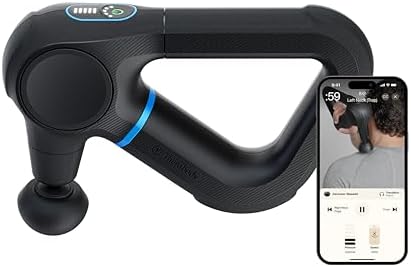
4. Theragun Prime 6th Gen — Best for Simple Deep-Stroke Recovery
- POWERFUL, PROVEN RECOVERY: Theragun Prime (6th Generation) is our most powerful deep tissue massage gun, scientifically …
- DURABLE, RUGGED MASSAGE GUN DESIGN: Built with a rugged TPU rubber exterior and reinforced corners to withstand heavy us…
- SIMPLE CONTROLS AND REAL-TIME PRESSURE FEEDBACK: One-button operation and LED indicators make it easy to switch between …
The Theragun Prime 6th Gen offers the long 16 mm stroke associated with Theragun while removing many of the more expensive features found on the PRO Plus.
Therabody lists approximately 2 lb of weight, 120 minutes of battery life, five speeds, and a 1-year limited warranty.
Key points
- 16 mm amplitude
- Approximately 30 lb stall force
- 2 lb weight
- 120-minute battery
- Five speeds
- Two included attachments
The main limitation is its lower stall-force figure compared with some high-powered competitors. It also comes with only two attachments.
That isn’t necessarily a problem if you prefer simple, moderate-pressure use.
Best suited for: Lifters who want a relatively light massage gun with a deep stroke and don’t need heat, LED, or extensive attachments.
5. Hyperice Hypervolt 3 — Best All-Around Home-Gym Option

- Hypervolt 3 percussion massager is for everyday movers. Whether you’re recovering from a workout or countering long hour…
- Built with 5 speeds of percussion, 5 redesigned attachments including the Heated Head Attachment, and a comfortable 2 lb…
- A built-in pressure sensor guides your intensity, Bluetooth unlocks personalized routines via the Hyperice App, and an 1…
The Hyperice Hypervolt 3 offers a useful balance between size, noise, power, and price.
Hyperice lists:
- 12 mm amplitude
- 60 lb stall force
- 48 dB noise
- 2 lb weight
- Approximately four-hour battery
- Five attachments
- Heated head
Its 12 mm stroke isn’t as deep as the 16 mm models, but the lighter body can be easier to use across several muscle groups.
The pressure sensor can also help users avoid applying unnecessarily aggressive pressure.
Best suited for: Lifters who want one versatile massage gun for strength training, conditioning, and general post-workout recovery.
For the previous generation, see our Hypervolt 2 Pro review.
6. Ekrin B37 — Best for Value and Battery Life

- Dual Technology for Complete Muscle Care: The B37v2 offers deep, percussive therapy with a powerful Level 3 brushless mo…
- Extended Battery Life for Continuous Relief: With up to 8 hours of battery life on the B37v2 and 6 hours on the Bantam, …
- Ultra-Quiet Operation with Advanced Ergonomics: Experience therapy sessions as quiet as rainfall (35-55 dB for B37) and …
The Ekrin B37 is a practical choice for users who care more about battery life and durability than apps or displays.
It features a 12 mm stroke, approximately 56 lb of stall force, five speeds, an angled handle, and up to eight hours of advertised battery life. Ekrin also advertises a lifetime warranty.
Key points
- 12 mm amplitude
- 56 lb claimed stall force
- Up to eight hours claimed battery
- Angled ergonomic handle
- Five speeds
- Lifetime warranty
- Approximately $230
It doesn’t include some of the smart features found on premium massage guns, and its noise level isn’t clearly published.
Best suited for: Frequent lifters who want a simple recovery tool with long battery life and a strong warranty.
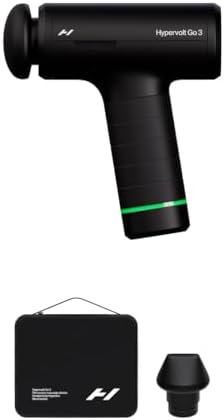
7. Hyperice Hypervolt Go
- Hypervolt Go 3 is a lightweight, travel-ready massage gun designed for life on the move. Perfect for increasing range of…
- The Hypervolt Go 3 delivers streamlined performance with 5 percussion speeds, 2 essential head attachments (Flat and Wed…
- It offers up to 4 hours of battery life, charges via USB-C, and stays discreet with QuietGlide technology, all packaged …
The Hypervolt Go 3 is the smallest and lightest option in this guide.
Hyperice lists a 10 mm stroke, 45 lb stall force, 1.6 lb weight, 55 dB noise level, and approximately four hours of battery life.
Its compact design makes it easier to keep in a gym bag or use on smaller muscle groups.
The trade-off is its shorter 10 mm stroke. Users who regularly train legs heavily may prefer a 12–16 mm model.
Best suited for: Beginners, travelers, calves, forearms, arms, and users who prioritize portability.
What Should You Look for in a Home-Gym Massage Gun?
A home-gym massage gun should be evaluated differently from a small device intended for occasional neck or shoulder use.
1. Amplitude
Amplitude describes how far the massage head travels during each stroke.
In practical terms:
- 10 mm: Better suited to lighter work and smaller muscles
- 12–14 mm: Versatile range for many lifters
- 16 mm: Deeper stroke that may feel more substantial on large muscles
Amplitude doesn’t automatically determine whether a massage gun is better. Comfort, technique, weight, and pressure control also matter.
2. Stall Force
Stall force describes how much pressure can be applied before the motor slows or stops.
A higher number can be useful if you regularly apply firm pressure, but manufacturer measurements aren’t standardized.
For that reason, don’t assume an 85 lb claim from one company is automatically stronger than a 60 lb claim from another.
3. Weight
Weight becomes particularly important when you treat several muscle groups after a workout.
A heavier massage gun may feel substantial, but it can also make your arm tired.
For self-treatment, approximately 2–4 lb is a practical range for many users.
4. Ergonomics
Look for a handle that lets you reach:
- Quads
- Hamstrings
- Glutes
- Calves
- Upper back
- Shoulders
An angled or multi-grip design can make a meaningful difference during longer sessions.
5. Noise
Noise matters more in a home gym than it might in a commercial gym.
If your gym is inside a house or garage, check whether the manufacturer publishes a decibel figure.
Remember that manufacturer-reported noise figures aren’t always directly comparable because testing conditions can differ.
6. Battery Life
A massage gun used several times per week doesn’t need an enormous battery, but two to four hours of runtime is convenient.
If you train frequently or share the device with family members, longer battery life can reduce charging frequency.
Amplitude vs. Stall Force: Which Matters More?
These specifications describe different things.
Amplitude tells you how far the head travels.
Stall force tells you how much pressure the motor can tolerate before slowing or stopping.
For large muscles such as quads and glutes, a 12–16 mm stroke can provide a more substantial sensation than a shallow stroke.
However, maximum power isn’t automatically better.
The research reviewed in this article supports using massage guns with controlled pressure rather than aggressively pressing into one area for long periods.
The 2023 systematic review also highlighted potential risks from aggressive and prolonged use.
Massage Gun Specs for Strength Training
| Feature | Practical Target | Why It Matters |
|---|---|---|
| Amplitude | 12–16 mm | Useful for larger muscle groups |
| Stall force | Around 45–70 lb is plenty for many users | Mainly relevant when applying firm pressure |
| Speed | Several useful settings, including low speed | Allows better control |
| Weight | Around 2–4 lb | Important during longer sessions |
| Ergonomics | Angled or multi-grip handle | Helps reach difficult areas |
| Noise | Published dB figure is useful | Important for home/garage gyms |
| Battery | 2–4+ hours | Convenient for frequent use |
| Attachments | Ball, flat/wedge, softer head | Different heads distribute pressure differently |
| Warranty | 1 year or longer | Useful for a frequently used gym tool |
Which Massage Gun Is Best for Different Muscle Groups?
| Muscle Group | What Matters Most | Useful Head | Important Tip |
|---|---|---|---|
| Quads | Stroke depth and control | Ball or flat/wedge | Avoid the kneecap |
| Hamstrings | Moderate depth and comfortable grip | Ball or softer head | Avoid the back of the knee |
| Glutes | Reach and control | Ball | Stay on the muscle |
| Calves | Moderate depth | Ball or dampener | Avoid Achilles tendon |
| Back | Reach and gentle pressure | Ball or flat | Never massage directly over the spine |
| Shoulders | Lighter pressure | Ball or softer head | Avoid joints and front of neck |
How to Use a Massage Gun Before a Workout
A massage gun should not replace your normal warm-up.
Evidence on pre-workout use is mixed. The article’s cited 2026 study found that a longer massage-gun protocol increased perceived readiness but impaired some performance markers. The 2023 systematic review also advised caution immediately before strength or explosive activity.
If you want to use one before training:
- Use it briefly.
- Choose a low speed.
- Apply light pressure.
- Focus only on an area that feels tight.
- Leave several minutes before your first working set.
- Complete your normal dynamic warm-up and ramp-up sets.
- Avoid relying on it immediately before maximum-effort lifts, jumps, or sprints.
A massage gun can make an area feel more mobile or comfortable, but that sensation shouldn’t be confused with improved strength or power.
How to Use a Massage Gun After Strength Training
After lifting, the goal should be comfort and temporary relief of tightness, not trying to “flush out” lactic acid.
The 2023 review cited in this article did not find meaningful differences in lactate concentration following massage-gun use.
A simple post-leg-day routine could look like this:
| Muscle | Time Per Side | Technique |
|---|---|---|
| Quads | 45–60 sec | Slow passes |
| Hamstrings | 45–60 sec | Avoid back of knee |
| Glutes | 45–60 sec | Stay on muscle |
| Calves | 30–45 sec | Avoid Achilles tendon |
Use low-to-moderate speed and gentle pressure.
Keep the massage gun moving instead of holding it aggressively on one spot.
How Long Should You Use a Massage Gun?
For most home users, longer isn’t necessarily better.
| Situation | Conservative Guidance |
|---|---|
| Beginner | 10–30 seconds per area |
| One muscle group | Up to about 2 minutes |
| Typical session | About 5–10 minutes |
| Daily use | Can be reasonable when used conservatively |
| Aggressive prolonged use | Avoid |
The research reviewed in the article found that study protocols varied considerably. UCLA Health’s practical guidance also recommends limiting the time spent on an individual muscle group.
If pain or stiffness continues despite conservative use, don’t simply increase the pressure or session length.
What Does the Research Say About Massage Guns?
The evidence is promising in some areas but remains limited.
The 2023 systematic review cited in this article screened 281 records and included 11 studies. It reported potential benefits involving short-term range of motion, flexibility, and some recovery-related outcomes, while finding no clear improvement in several performance measures.
A 2025 randomized trial also reported positive results after percussive massage following exercise-induced muscle soreness, but its small sample size and specific treatment protocol mean the findings shouldn’t be generalized to every massage-gun user.
A 2026 study involving 59 recreational athletes found that participants felt more ready after massage-gun use, while some jump-performance measures declined.
A newer 2026 meta-analysis cited in the original article reported some recovery-related benefits but did not clearly establish an improvement in maximum strength or DOMS.
What this means for lifters
The most reasonable conclusion is:
- Massage guns can be useful for temporary muscle comfort.
- They may improve short-term range of motion.
- Some recovery measures may improve.
- They haven’t been established as a tool for increasing strength.
- They shouldn’t replace proper warm-ups or recovery habits.
- More aggressive use isn’t necessarily more effective.
Massage Gun Safety: Where Should You Not Use One?
Follow your massage gun manufacturer’s instructions first.
In general, avoid using a massage gun directly over:
- Bones and bony areas
- Joints
- The spine
- Front of the neck
- Head or face
- Fresh injuries
- Open wounds
- Bruises or irritated skin
- Areas with reduced sensation
- Areas with unexplained swelling or pain
The original review also identifies several medical conditions and situations where massage-gun use may not be appropriate. If you have a relevant medical condition, ask a healthcare professional before using one.
Stop using the device and seek medical advice if you experience severe pain, unusual swelling, weakness, dark urine, numbness, or sharp pain following use.
Massage Gun vs. Foam Roller
| Factor | Massage Gun | Foam Roller |
|---|---|---|
| Cost | Higher | Usually lower |
| Effort | Handheld | Uses body weight |
| Precision | Easy to target specific areas | Less precise |
| Noise | Varies | Silent |
| Power | Battery powered | No power needed |
| Portability | Usually easy to carry | Larger |
| Best use | Targeted muscle work | Larger-area rolling |
A foam roller is a cheaper and quieter alternative. A massage gun gives you more control over where you apply pressure.
Neither should be viewed as a shortcut to greater strength.
For many lifters, the choice isn’t necessarily either/or. A foam roller and massage gun can serve different purposes.
Massage Gun vs. Recovery Boots
Massage guns and recovery boots are designed for different uses.
| Factor | Massage Gun | Recovery Boots |
|---|---|---|
| Main action | Percussion | Sequential compression |
| Target | Specific muscles | Mostly legs |
| Effort | Handheld | Mostly passive |
| Upper-body use | Yes | No |
| Portability | Generally easier | Bulkier |
| Price | Lower in most cases | Often considerably higher |
If you’re mainly looking for targeted muscle work, a massage gun is the more relevant tool.
For compression recovery options, see our best leg recovery boots of 2026.
How We Evaluated These Massage Guns
LifeCareBalance has not hands-on tested these massage guns.
Our comparison is based on:
- Published manufacturer specifications
- Independent testing where available
- Published reviews
- Weight and ergonomics
- Battery specifications
- Noise information where available
- Price/value
- Research on percussive therapy
Where manufacturer claims and independent measurements differ, we identify the difference instead of presenting the figures as directly equivalent.
Prices can change, so check the current listing before purchasing.
FAQ
What is the best massage gun for a home gym?
There isn’t one model that is ideal for every lifter.
The Hypervolt 3 Pro is suitable for users who prioritize power and relatively low reported noise. The Theragun PRO Plus is designed for users who want deep percussion plus heat, LED, and other features. The Bob and Brad D6 Pro focuses on a long stroke at a lower price, while the Ekrin B37 emphasizes value, battery life, and warranty coverage.
Is a massage gun good after weightlifting?
It may help muscles feel looser and may support some short-term recovery measures. However, research has not established massage guns as a way to increase strength or long-term athletic performance.
What amplitude is best for muscle recovery?
For large muscles such as the quads and glutes, 12–16 mm is a practical range, but there is no established research-based “optimal” amplitude for every user.
Is higher stall force better?
Not necessarily. Higher stall force mainly matters if you apply firm pressure. Manufacturer measurements also aren’t standardized, so stall-force figures shouldn’t be treated as a universal ranking system.
Can I use a massage gun every day?
Conservative daily use may be reasonable for many healthy people when the device is used as directed and individual muscle areas aren’t treated excessively.
How long should I use a massage gun after lifting?
A conservative approach is around 30–60 seconds per major muscle group, with approximately 5–10 minutes total for a typical session.
Can I use a massage gun before squats?
You can use it briefly on a tight muscle, but don’t treat it as a replacement for your warm-up. Use light pressure and leave several minutes before your working sets.
Is a massage gun better than a foam roller?
Neither has a clear universal advantage. A massage gun is easier to aim at specific areas, while a foam roller is cheaper, silent, and useful for larger areas.
What massage gun is best for glutes and quads?
Look for approximately 12–16 mm amplitude, adequate pressure tolerance, and a comfortable handle. Models such as the Hypervolt 3 Pro, Bob and Brad D6 Pro, and Theragun models offer different combinations of these features.
Can massage guns help DOMS?
Possibly, but the evidence is mixed. Some studies have reported improvements in soreness or recovery measures, while newer pooled evidence has not established a clear DOMS benefit.
Are massage guns safe?
They can generally be used safely when used according to the manufacturer’s instructions, with gentle pressure and short sessions. Avoid bones, joints, the spine, acute injuries, open wounds, and other areas listed in the safety section.
Final Buying Guide: Which Massage Gun Fits Your Training?
For serious strength training
Look for a massage gun with approximately 12–16 mm amplitude, adequate pressure tolerance, and an ergonomic handle.
The Hypervolt 3 Pro provides a 14 mm stroke and manufacturer-reported 70 lb stall force, while the Bob and Brad D6 Pro offers a 16 mm stroke at a lower price.
For all-around home-gym recovery
The Hypervolt 3 combines a 2 lb body, 12 mm stroke, pressure feedback, and manufacturer-reported 48 dB noise.
For deep-stroke massage
The Theragun PRO Plus and Theragun Prime offer approximately 16 mm amplitude. The PRO Plus adds heat, LED, and other premium features, while the Prime is simpler and lighter.
For quieter home use
Hyperice reports 48 dB for the Hypervolt 3 and 51 dB for the Hypervolt 3 Pro. These are manufacturer-reported figures, so use them as useful reference points rather than laboratory-equivalent measurements.
For value
The Ekrin B37 combines a 12 mm stroke, claimed 56 lb stall force, long advertised battery life, and lifetime warranty.
For portability
The Hypervolt Go 3 weighs approximately 1.6 lb and offers about four hours of battery life, but its 10 mm stroke is less suited to lifters who want a deeper sensation on large lower-body muscles.
For beginners
A compact model such as the Hypervolt Go 3 can make sense if portability is important. If you expect to work heavily on quads, glutes, and hamstrings, stepping up to a 12–16 mm model may provide more versatility.
Bottom Line
A massage gun can be a useful addition to a home gym, but it shouldn’t be treated as a performance shortcut.
For most lifters, the important factors are comfortable pressure, appropriate stroke length, manageable weight, useful attachments, battery life, and an ergonomic handle.
Use the device gently, keep it moving over the muscle, avoid sensitive or injured areas, and don’t assume that the highest stall-force number or longest stroke automatically makes a massage gun better.
Most importantly, choose the model that matches how you actually train rather than simply buying the most expensive option.