
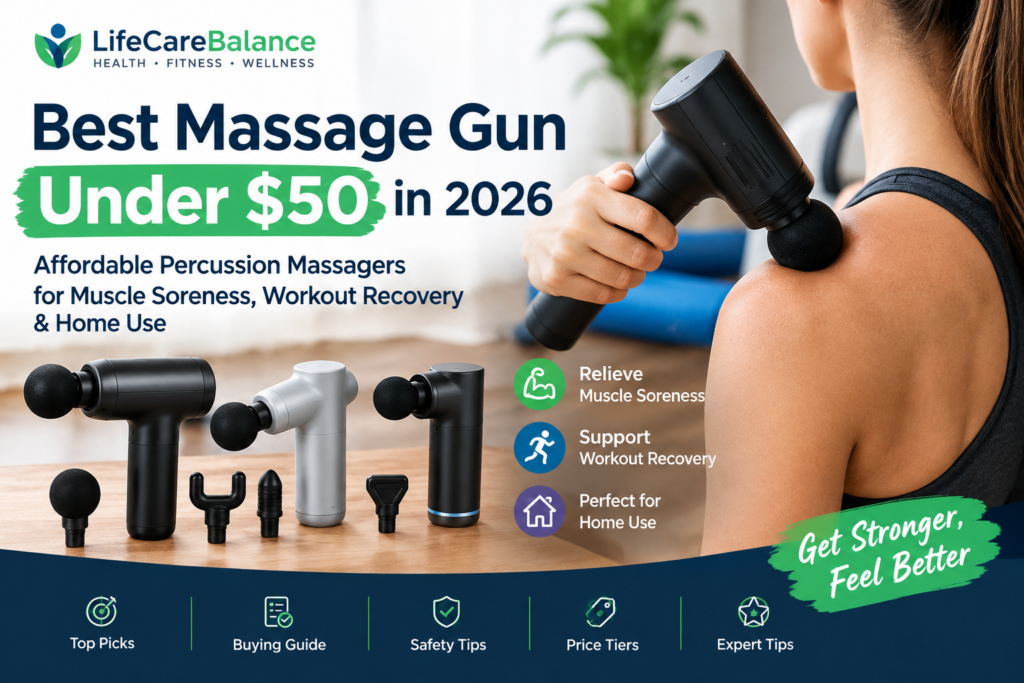
Looking for the best massage gun under $50? Compare budget percussion massagers by amplitude, stall force, and use case — plus what to expect (and not expect) from cheap models.
LifeCareBalance.com is reader-supported. When you buy through links on our site, we may earn an affiliate commission at no extra cost to you. As an Amazon Associate, we earn from qualifying purchases.
If you’re dealing with tight shoulders after a desk-bound day or sore legs after a hard training session, you don’t necessarily need to spend $300 on a premium device. A well-chosen massage gun under $50 can still deliver real percussive relief — as long as you understand what a budget motor and battery can (and can’t) do.
This guide skips the usual “here are 5 cheap massage guns” approach. Instead, we compare realistic options by use case, explain the specs that actually matter, and help you decide whether a sub-$50 percussion massager fits your needs — or whether you’d be better served by a mid-range or premium pick like the ones covered in our best massage guns of 2026 roundup.
Quick Comparison Table
Pricing on Amazon shifts often, so treat the figures below as approximate ranges rather than fixed prices. Specifications also vary between listings and seller updates, so always confirm current details on the product page before buying.
| Product Type | Approx. Price | Best For | Amplitude | Speed/PPM | Attachments | Battery | Weight | Key Trade-Off |
|---|---|---|---|---|---|---|---|---|
| TOLOCO Mini/Standard Series | ~$30–$45 | Best overall / best value | ~10mm (varies by model) | Multiple speed levels, exact PPM varies | 4–6 | Several hours per charge (varies) | Light-to-mid weight | Motor power drops below premium tier |
| RENPHO Mini or Entry Massager | ~$25–$40 | Best compact / beginners | Manufacturer-listed, confirm per SKU | Multiple speeds | 3–4 | Moderate battery life | Very lightweight | Smaller amplitude limits deep muscle work |
| Bob and Brad Budget/Mini Model | ~$35–$50 | Best for post-workout recovery | Manufacturer-listed, confirm per SKU | Multiple speeds | 4–5 | Moderate to good | Light-to-mid weight | Fewer speed levels than pro models |
| Generic Under-$30 Percussion Massager | Under $30 | Entry-level/testing the category | Often lower amplitude | Fewer speed tiers | 3–4 | Shorter battery life common | Varies | Weaker stall force, less muscle penetration |
Because exact stall force, amplitude, and battery figures differ by seller and are updated periodically, always cross-check the current Amazon listing rather than relying solely on marketing copy.
Best Massage Guns Under $50 in 2026
Below are use-case categories rather than a single “winner.” The right pick depends on your body type, activity level, and what you’re using it for.
Best Overall
For most casual users, a mid-tier TOLOCO model tends to strike the best balance of price, attachment variety, and motor consistency in the sub-$50 range. It’s not going to match a premium device on raw power, but it typically holds up for everyday tightness and light recovery work.
Best for Beginners
If you’ve never used a percussion massager, look for a model with fewer, clearly labeled speed settings and a simple attachment set. Overly complex controls or a dozen speed levels aren’t necessary when you’re still learning how much pressure and duration feels comfortable. Our guide on how to choose the right massage gun breaks down the beginner-relevant specs in more depth.
Best Compact/Mini Option
RENPHO’s mini-format devices are worth considering if portability matters more than raw power — think gym bags, travel, or desk drawers. Mini massage guns generally trade some amplitude and stall force for size and weight, so they suit smaller muscle groups (forearms, calves, traps) better than large muscle groups like glutes or quads.
Best for Post-Workout Recovery
Bob and Brad’s budget lineup is frequently mentioned by reviewers for consistent build quality at a low price point, which matters if you’re using the device several times a week after training. Consistent output across sessions matters more for recovery routines than peak advertised RPM.
Best Value
Among sub-$50 options, the models that include a reasonably firm stall force rating alongside a mid-range amplitude (rather than the highest attachment count) tend to offer the most usable value. Attachment count is a marketing point more than a performance indicator — more on that below.
Best Under $30
At this price tier, expect a functional but limited device: lower amplitude, weaker stall force, and often a shorter battery life. These are reasonable for testing whether percussive therapy suits you, or for light, occasional use — not for daily deep-tissue work.
Best Under $40
The $30–$40 tier is where you start seeing more consistent stall force and slightly better battery performance. This range is often the sweet spot for buyers who want more than an entry-level device without approaching premium pricing.
What Matters Most When Buying a Massage Gun Under $50?
Competing “best budget massage gun” articles tend to focus heavily on price, head count, and top RPM. Those numbers matter less than they appear to. Here’s what actually affects performance:
- Amplitude — how far the massage head travels per stroke (measured in mm). This is one of the biggest differentiators between cheap and premium guns.
- Stall force — how much pressure you can apply before the motor bogs down. Low stall force means the device weakens noticeably once you press into a muscle.
- RPM/PPM (percussions per minute) — speed, not depth. A high RPM with low amplitude and low stall force can feel buzzy rather than effective.
- Noise level — budget motors are often louder, which matters if you plan to use the device around others.
- Battery life — shorter runtimes are common on cheaper models; fine for occasional use, less ideal for daily multi-session use.
- Weight — heavier devices fatigue your arm faster during self-massage, especially on the back or legs.
- Attachments — useful for targeting different muscle groups, but a large attachment count doesn’t compensate for a weak motor.
- Ergonomics — grip angle and handle design affect how easily you can reach your own back or shoulders.
- Build quality/warranty — budget brands vary widely here; check current seller warranty terms rather than assuming.
For beginners and casual users, amplitude and comfort matter more than top speed. Gym users and runners typically benefit from firmer stall force and multiple speed levels to work larger muscle groups. People with everyday muscle tightness (desk workers, side sleepers, etc.) generally do fine with a mid-range amplitude and a lighter, more maneuverable device.
Amplitude vs RPM vs Stall Force

These three specs are often lumped together in marketing, but they measure different things:
- RPM tells you how fast the head moves.
- Amplitude tells you how far it moves per stroke.
- Stall force tells you how much resistance the motor can handle before losing power.
A massage gun can have a high RPM and still feel underwhelming if amplitude and stall force are low — this is the most common shortfall in sub-$50 devices. If you only compare RPM numbers between products, you’re missing the two specs that most affect how “deep” the massage actually feels.
Are Massage Guns Under $50 Actually Worth It?
For light, occasional use — loosening a tight shoulder, easing general stiffness, or trying percussive therapy for the first time — a budget device can be genuinely useful. For daily, targeted deep-tissue work on larger muscle groups, the amplitude and stall-force limitations of most sub-$50 guns become more noticeable over time.
Budget vs Premium Massage Guns
Premium devices, such as the models covered in our Theragun Pro review and Hypervolt 2 Pro review, typically offer stronger stall force, more consistent amplitude across pressure levels, quieter brushless motors, and longer battery life. Our Theragun Pro vs. Hypervolt 2 Pro comparison covers those differences directly. The trade-off is straightforward: you’re paying for motor consistency and durability, not just extra attachments.
How to Use a Massage Gun Safely
- Start on the lowest speed setting and increase gradually.
- Move the device slowly across the muscle rather than holding it in one spot.
- Limit use on any single muscle group to roughly 1–2 minutes.
- Avoid applying strong pressure; let the device do the work.
- Stop if you feel sharp pain, numbness, or increased soreness.
A 2023 systematic review of percussive massage devices found some evidence of short-term benefits for flexibility and muscle soreness, though study protocols and devices varied considerably. A more recent 2026 meta-analysis on percussive therapy dosage and recovery similarly notes that outcomes depend heavily on session length and technique, not just device power.
Where You Should NOT Use a Massage Gun
Avoid applying percussion directly to:
- The spine or vertebrae
- Bones and joints
- The front or side of the neck
- Open wounds, bruises, or acutely injured tissue
- Areas with reduced sensation
If you have a significant medical condition, a blood-clotting disorder, a recent injury, or take medication that affects bruising or circulation, talk to a qualified healthcare professional before using a massage gun.
Who Should Buy a $50-or-Less Massage Gun?
This price range suits casual users, beginners, people testing whether percussive therapy helps their routine, and anyone who wants occasional relief rather than a daily deep-tissue tool. It’s also reasonable for a secondary or travel device alongside a more powerful one at home.
Who Should Spend More?
Athletes, people managing chronic muscle tightness, or anyone using a massage gun multiple times per week for structured post-workout recovery will likely notice the limitations of a budget motor faster. In that case, a mid-range or premium device — or complementary recovery tools like leg recovery boots — may be a better long-term investment.
FAQs
Are massage guns under $50 worth it?
For light, occasional use, yes. For daily deep-tissue work, a premium device generally performs more consistently.
What is the best massage gun under $50 in 2026?
It depends on use case — see the “Best Overall,” “Best for Beginners,” and other categories above rather than a single universal pick.
Is a cheap massage gun good for muscle soreness?
It can help with general soreness and stiffness for many users, though research on percussive therapy and delayed-onset muscle soreness is still developing and protocols vary.
How much should I spend on a massage gun?
Budget for how often you’ll use it — occasional users can start under $50; frequent users may benefit from mid-range or premium options.
What amplitude is good for a budget massage gun?
Higher amplitude within the budget tier generally means a deeper-feeling massage, though exact figures should be confirmed per listing.
Is higher RPM better in a massage gun?
Not by itself — RPM affects speed, not depth. Amplitude and stall force matter more for perceived intensity.
Can I use a massage gun after a workout?
Many users do, and some research on percussive therapy and physical performance suggests possible short-term benefits, though it’s not a substitute for proper warm-up or recovery practices.
Can beginners use massage guns?
Yes, starting on the lowest setting with short sessions is generally recommended.
How long should you use a massage gun on one muscle?
Most guidance suggests roughly 1–2 minutes per muscle group, though individual tolerance varies.
Can you use a massage gun on your neck or spine?
Avoid the spine and the front/side of the neck; percussion should only be used on soft muscle tissue, and even then with caution. A related review of physical therapy interventions for DOMS underscores that technique and placement affect outcomes as much as the device itself.
Final Buying Advice
There’s no single “best” massage gun under $50 — the right choice depends on whether you prioritize portability, motor consistency, or attachment variety, and how often you plan to use it. Focus on amplitude and stall force over headline RPM numbers, and treat attachment count as a minor factor rather than a deciding one. If you find yourself using the device daily for serious recovery work, it may be worth revisiting a mid-range or premium option