
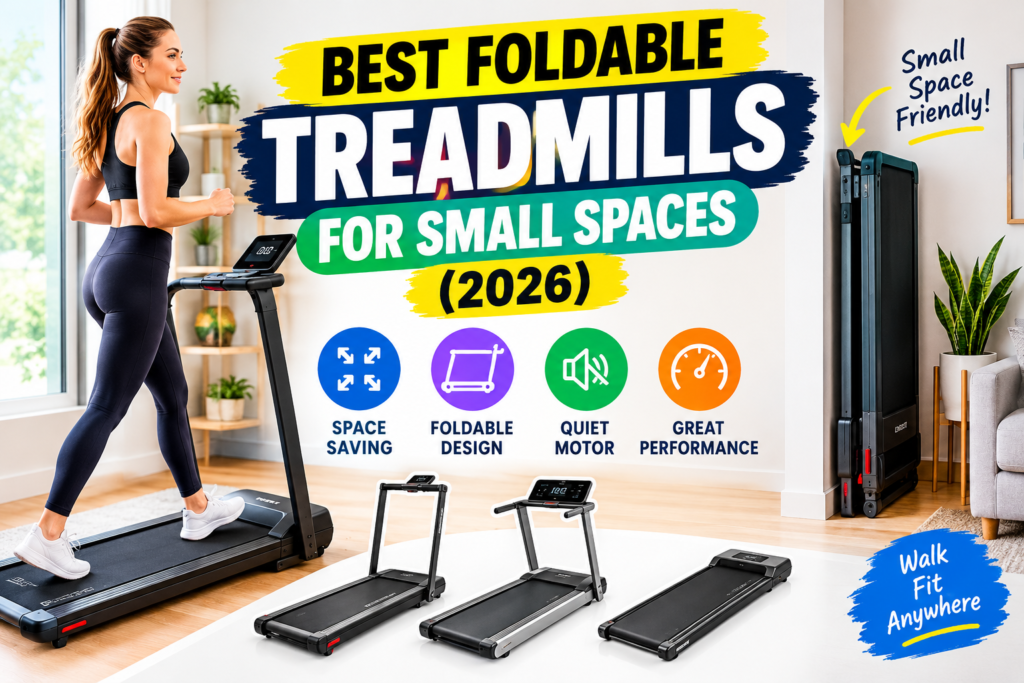
Best Foldable Treadmills for Small Spaces in 2026: Top Compact, Space-Saving Treadmills for Apartments, Home Gyms, Walking, Running & Weight Loss

Best Foldable Treadmills for Small Spaces in 2026: Top Compact, Space-Saving Treadmills for Apartments, Home Gyms, Walking, Running & Weight Loss

Last Updated on: September 4, 2026

Discover the best foldable treadmills for small spaces in 2026. Compare compact, space-saving models for apartments, home gyms, walking, running, and weight loss.

LifeCareBalance.com is reader-supported. When you buy through links on our site, we may earn an affiliate commission at no extra cost to you. As an Amazon Associate, we earn from qualifying purchases.

  • [5″ LCD Display & Device Shelf] – See your live workout stats on the clear 5” LCD display or use your own device to foll…
  • [0-10 MPH] – Run, jog, or walk at speeds of up to 10 MPH. Perfect for home workouts, cardio training, and endurance buil…
  • FITNESS ANYWHERE: Use the iFIT app on your favorite device—at home, at work, or on-the-go.
  • [5″ LCD & Device Shelf]- See your live workout stats on the clear 5” LCD display or use your own device to follow iFIT t…
  • [0-10 MPH] – Run, jog, or walk at speeds of up to 10 MPH. Perfect for home workouts, cardio training, and endurance buil…
  • [0-10% Incline] – Boost calorie burn and target more muscle groups with a 0–10% incline range.
  • [Value-Packed Membership] – An iFIT Pro Membership ($39/mo) is required to access all iFIT content and connected feature…
  • [24″ Touchscreen] – The 24” touchscreen tilts and pivots for optimal viewing, whether you’re running or following off-tr…
  • HUGE WORKOUT LIBRARY: Access over 10,000 workouts and smart features for a personalized experience. Get coaching by expe…
$2,499.00
  • 【EFFORTLESS EXERCISE FOR EVERYONE】This under-desk pedal exerciser makes it effortless to stay active. The low-impact mot…
  • 【3-IN-1 DESIGN】Perfect for both leg and arm workouts: Target upper and lower body muscle groups with ease, seamlessly sw…
  • 【RESISTANCE BANDS & PLACEMENT MAT INCLUDED】Comes with FREE two 20LB resistance workout bands, plus anti-slip mat for add…

If you live in an apartment, a studio, or any home where floor space is precious, “foldable” is usually the first word you search for — and the most misleading one. A treadmill that folds up is not automatically a treadmill that fits in your space. Some folding treadmills still stand nearly six feet tall when stowed, weigh more than 250 pounds, and need a dedicated corner just as permanent as a non-folding model would.

This guide is built specifically around the small-space problem: which treadmills genuinely combine a compact storage footprint, an easy fold-and-move process, and enough real workout performance that you won’t outgrow the machine in a month. We looked at folded height, width, and depth (not just marketing photos), machine weight and whether one person can realistically move it, and how each model behaves in an apartment — noise, vibration, and floor impact included.

We also drew a hard line the way most roundups don’t: a walking pad, a folding treadmill, and a 2-in-1 treadmill are related but different products, and mixing them together in one ranking does readers a disservice. You’ll find all three categories here, clearly labeled, so you can match the right type of machine to your actual routine — daily steps, structured cardio, or real running.

What this guide will help you decide:

  • Whether a treadmill will physically fit through your door, into your closet, or under your bed
  • Whether its folded footprint is actually smaller than a walking pad’s, or just smaller than unfolded
  • Whether the motor and belt size support your goals (walking, jogging, or running) without wasting money on power you won’t use
  • What it will really cost you over time, including subscriptions and accessories
  • Which single model we’d recommend first if you only read one section

Quick Picks — Best Foldable Treadmills for Small Spaces

CategoryPickWhy
Best OverallNordicTrack T 6.5 SThe most balanced mix of compact vertical storage, a workable 20″ x 55″ belt, incline, and price
Best for ApartmentsNordicTrack T 6.5 SVertical SpaceSaver fold plus front wheels for rolling into a closet or corner
Best BudgetSunny Health & Fitness SF-T7860Around $250–$350, 101 lbs, and one of the lightest true motorized treadmills here
Best for WalkingWalkingPad C2Ultra-low 5″ folded height, slides under most beds and sofas, built for daily steps
Best for RunningHorizon 7.0 AT20″ x 60″ belt and a 3.0 HP motor give taller or faster runners real stride room
Best Under-Bed/Low-Profile StorageWalkingPad C2Folds to roughly 5 inches tall — genuinely low enough for most bed frames
Best LightweightSunny Health & Fitness SF-T7860101 lbs total, one of the few motorized treadmills a single person can reposition alone
Best 2-in-1UREVO Strol-series (or similar 2-in-1)Under-desk walking mode plus a raised handlebar running mode in one machine
Best for Tall UsersHorizon 7.0 AT60-inch belt length gives more stride clearance than most compact folding decks
Best for Heavier UsersSole F63325 lb weight capacity with a 20″ x 60″ commercial-style belt

No single product here wins every category — that’s intentional. A treadmill built to satisfy a 6’2″ daily runner will not be the same machine that fits under a queen bed in a 500-square-foot studio.

Comparison Table

Specifications below come from manufacturer listings and major retailer product pages. Where a spec could not be reliably confirmed, we’ve marked it “Not clearly specified” rather than guess.

TreadmillBest ForPrice CategoryIn-Use Dimensions (L x W x H)Folded Dimensions (L x W x H)Machine WeightWeight CapacityMotorTop SpeedInclineRunning SurfaceStorage TypeWarranty
NordicTrack T 6.5 SBest OverallMid ($400–$800)~73.5″ x 36″ x 54″Not clearly specified (vertical SpaceSaver fold with EasyLift Assist)~203 lbs300 lbs2.6 CHP10 mph0–10%20″ x 55″Vertical, rolling10-yr frame, 2-yr parts, 1-yr labor (varies by retailer)
Horizon 7.0 ATBest for Running / Tall UsersMid–High ($900–$1,100)76″ x 35″ x 66″44″ x 35″ x 68″277 lbs325 lbs3.0 HP12 mph0–15%20″ x 60″Vertical, rollingLifetime frame/motor, 3-yr parts, 1-yr labor
Sole F63Best for Heavier UsersMid–High ($900–$1,100)Not clearly specified (setup footprint ~75″ x 33″ for a related Sole model)Not clearly specified~218 lbs (comparable Sole model)325 lbs3.0 HP12 mph0–15%20″ x 60″Vertical, rollingLifetime frame/motor, 3-yr deck/parts/electronics, 1-yr labor
Sunny Health & Fitness SF-T7860Best Budget / Best LightweightLow ($250–$350)59″ x 27.5″ x 49″30″ x 27.5″ x 52″101 lbs220 lbs1.25 HP7.5 mph3 manual levels17.7″ x 47.2″Vertical, rolling3-yr frame, 180-day parts
WalkingPad C2Best Under-Bed / Best for WalkingLow–Mid ($400–$600)Not clearly specified32.5″ x 21.5″ x 5″62 lbs220 lbs1 HP3.7 mphNone47″ x 16.5″Flat, double-fold, rollingVaries by retailer; check current listing
2-in-1 walking/running treadmills (e.g., UREVO Strol-series)Best 2-in-1Low–Mid ($200–$450)Varies by modelVaries by model (typically 4–6″ folded)~55–65 lbs250–300 lbs~2–2.5 HPWalk mode ~4 mph / run mode ~6–7.5 mphAuto-incline on some models~15″ x 40″Flat under-desk mode + optional handlebarVaries by brand; often 1–2 years

How We Selected and Ranked These Treadmills

Our approach weighs small-space suitability first, because that’s the specific problem this guide is solving. We did not personally lab-test these machines; the following methodology explains how we compared publicly available manufacturer and retailer data.

Small-Space Score — 30% Folded footprint (height, width, and depth together), realistic storage locations, portability (weight plus wheel placement), and how easy the fold/unfold process is to do alone.

Performance — 25% Motor rating, top speed, incline range, belt/deck length, and frame stability at speed.

Comfort — 15% Deck cushioning, belt width relative to natural stride, and handrail/console ergonomics.

Features — 10% Connected fitness (app, Bluetooth, subscription-based coaching), display quality, built-in programs.

Value — 10% Purchase price relative to specs and expected lifespan.

Warranty/Support — 10% Length and structure of frame, parts, motor, and labor coverage, and manufacturer reputation for support.

These weightings are a starting framework, not a rigid formula — a treadmill that is exceptional in one category but weak in another (for example, extremely compact but underpowered) may still be the right choice depending on your specific needs, which is why we call out “who should buy” and “who should avoid” for every pick below.

Best Foldable Treadmills for Small Spaces

NordicTrack T 6.5 S — Best Overall

  • [5″ LCD Display & Device Shelf] – See your live workout stats on the clear 5” LCD display or use your own device to foll…
  • [0-10 MPH] – Run, jog, or walk at speeds of up to 10 MPH. Perfect for home workouts, cardio training, and endurance buil…
  • FITNESS ANYWHERE: Use the iFIT app on your favorite device—at home, at work, or on-the-go.
  • Truly Folding Design – Walking Pad C2 features an exclusive folding design that allows for easy 180 ° folding of the tre…
  • Powerful Silent Motor – This under-desk treadmill boasts a 2.0HP motor capable of supporting up to 220 lbs. Operating qu…
  • Portable – There’s no assembly required for the walkingPad, simply unfold the treadmill, plug it in and it’s ready to us…
  • 【2 Sides Double Value】Get double the value from a single walking pad treadmill. One side is a quiet under desk treadmill…
  • 【Full-Leg Targeted Massage】Experience a massage that works where you need it most. The textured nodes are designed to ta…
  • 【5 Custom Intensities for All】From a gentle roll for sensitive feet to a deep tissue press for sore muscles, our five ad…
  • [Real-Terrain Incline & Decline Training at Home] Go beyond flat walking with this Treadmill with incline, featuring a -…
  • [6-Level Adjustable Handrails for Better Comfort] This folding treadmills for home small offers six adjustable handrail …
  • [Quiet & Powerful 2.5HP TORQGLIDE BLDC Motor] The advanced brushless motor delivers smooth, consistent power with less f…

Why it made the list: It’s one of the few treadmills that manages a genuinely usable 20″ x 55″ running belt, a 0–10% incline range, and a 10 mph top speed while keeping the folded unit narrow enough to tuck against a wall on its built-in wheels.

Who should buy it: Apartment dwellers who want to walk, jog, and occasionally run without buying a machine sized for a home gym. It’s also a solid pick for beginners who want guided workouts.

Who should avoid it: Serious or frequent runners who want a longer belt, and anyone who refuses to consider a paid iFit membership, since most of the interactive coaching features require one after the trial period.

Small-space advantages: The SpaceSaver folding frame with EasyLift Assist lets the deck fold up and lock vertically, and front-mounted wheels make it possible to roll the folded unit into a closet or corner without lifting the full weight.

In-use footprint: Approximately 73.5″ long x 36″ wide x 54″ tall when assembled and unfolded, based on retailer-listed dimensions for this model.

Folded footprint: NordicTrack does not publish a single official folded-height figure across all retail listings, so we’re not going to guess. What is consistent across sources is that the deck locks upright and reduces the floor footprint significantly, since the machine stands nearly on end rather than lying flat. If you’re measuring for a specific spot, use the assembled footprint above as your worst-case width and depth, and confirm the folded height with the retailer before buying if ceiling clearance in your storage spot is tight.

Storage practicality: Good for a bedroom corner, closet, or against a living-room wall. Not designed for under-bed storage — the vertical fold is meant for standing storage, not sliding flat.

Portability: At roughly 203 lbs, this is not a treadmill you casually pick up and carry. The wheels handle horizontal movement across a room reasonably well; moving it between floors or through narrow hallways will likely require two people.

Motor/performance: A 2.6 CHP motor is enough for consistent walking and jogging, and light-to-moderate running for most users, though NordicTrack itself and independent reviewers note that dedicated runners doing high-intensity or long-distance sessions may find the motor and shorter deck limiting compared to a higher-HP machine.

Speed: 0–10 mph.

Incline: 0–10%, useful for adding intensity without needing to run faster.

Running deck: 20″ x 55″. This comfortably fits most walkers and joggers; taller runners (roughly 6’2″ and up) with a long stride may feel the deck is short at faster paces.

Walking vs. running suitability: Strong for walking and jogging; adequate but not ideal for serious daily running.

Noise/vibration considerations: No independently verified decibel rating is available; as with any motorized treadmill, expect audible motor hum and belt noise, with footstep impact being the main variable an apartment neighbor would notice. A rubber anti-vibration mat under the unit is a reasonable investment regardless of model.

Comfort: FlexSelect cushioning lets you adjust deck firmness between a softer, joint-friendlier feel and a firmer, more road-like feel.

Features: 5″ LCD display, device shelf for a tablet or phone, Bluetooth heart-rate compatibility, and iFit compatibility (1-month trial typically included; ongoing access requires a paid membership, though the treadmill still works in manual mode without one after the trial).

Warranty/support: Warranty terms vary somewhat by retailer, but commonly include a 10-year frame warranty, with shorter coverage on parts and labor — always confirm exact terms with the seller before purchase.

Value: At its typical street price (often $400–$800 depending on retailer and promotions), it delivers a real incline range and a workable belt size that budget treadmills in this price bracket often lack.

Main pros: Compact vertical fold with assisted lifting; usable incline range; solid brand-level parts support; good beginner console.

Main cons: Full iFit experience requires a subscription; not ideal for tall or fast runners; heavy enough that repositioning is a two-person job over any distance.

Final verdict: For most apartment and small-home users who want to walk, jog, and do light running without committing to a large machine, this is the most balanced pick on this list.


Horizon 7.0 AT — Best for Running and Tall Users

Why it made the list: A 20″ x 60″ belt and a 3.0 HP motor put real running within reach — something several “compact” folding treadmills simply can’t support — while the folding frame still reduces the footprint versus a non-folding model.

Who should buy it: Taller users, regular runners, and anyone who wants meaningful incline (up to 15%) for hill-style training.

Who should avoid it: Anyone in a genuinely tight space. At 76″ x 35″ x 66″ unfolded and 44″ x 35″ x 68″ folded, this is one of the larger machines on this list even when stowed — the folded unit is still nearly six feet tall, so low-ceiling storage areas (like under a sloped attic ceiling) won’t work.

Small-space advantages: The FeatherLight folding frame and transport wheels make daily folding realistic, and the folded footprint is meaningfully smaller in floor area than the assembled unit, even though the height stays tall.

In-use footprint: 76″ L x 35″ W x 66″ H, per Horizon’s published dimensions.

Folded footprint: 44″ L x 35″ W x 68″ H. Note the folded height is actually slightly taller than the unfolded height — a good example of why folded dimensions need to be checked on every axis, not assumed to shrink uniformly.

Storage practicality: Best suited to a dedicated corner of a room with at least 68 inches of clearance above the floor. Not appropriate for under-bed or under-sofa storage given the 68″ folded height.

Portability: At roughly 277 lbs assembled, this is a heavy machine. Front wheels help with short rolls across a flat floor, but moving it up or down stairs, through narrow doorways, or between rooms will require at least two people.

Motor/performance: A 3.0 HP motor with Rapid Sync Technology comfortably supports sustained running, not just walking or jogging.

Speed: 0.5–12 mph.

Incline: 0–15%, one of the wider ranges in this price bracket.

Running deck: 20″ x 60″, close to what’s considered the “gold standard” for home treadmills and comfortable for most runners’ full stride length.

Walking vs. running suitability: Excellent for all three — walking, jogging, and running — thanks to the longer deck and stronger motor.

Noise/vibration considerations: No independently verified decibel figure is available. As with any 3.0 HP-class motor running at higher speeds, expect more audible operation than a slower walking pad, particularly at running speeds — a mat and level flooring matter more here than on lighter, slower machines.

Comfort: Variable Response cushioning is designed to reduce joint impact across the deck.

Features: 7.8″ LCD screen with additional LED windows, Bluetooth connectivity to apps like Apple Watch and Peloton (device and subscription costs not included), and QuickDial speed/incline controls.

Warranty/support: Lifetime frame and motor warranty, 3-year parts coverage, 1-year labor — one of the stronger warranty structures among mid-priced treadmills.

Value: Typically priced $900–$1,100 depending on retailer and promotions; strong performance-per-dollar for anyone who actually needs the running capability, less justified if you only walk.

Main pros: Real running capability; long belt for taller users; strong warranty; solid incline range.

Main cons: Large folded footprint, especially height; heavy and hard to move without help; not apartment-friendly for very small rooms.

Final verdict: This is the pick for runners and taller households who are willing to trade some storage compactness for genuine running performance — but it is a clear illustration that “foldable” does not mean “small,” so measure your space carefully before buying.


Sole F63 — Best for Heavier Users

  • [Value-Packed Membership] – An iFIT Pro Membership ($39/mo) is required to access all iFIT content and connected feature…
  • [24″ Touchscreen] – The 24” touchscreen tilts and pivots for optimal viewing, whether you’re running or following off-tr…
  • HUGE WORKOUT LIBRARY: Access over 10,000 workouts and smart features for a personalized experience. Get coaching by expe…
$2,499.00

Why it made the list: A 325 lb weight capacity paired with a 20″ x 60″ belt and 3.0 HP motor gives it commercial-grade specs at a home-treadmill price, with a lifetime frame and motor warranty that beats many competitors in this range.

Who should buy it: Users near or above 250 lbs who need a sturdier frame and higher capacity than most compact treadmills offer, and anyone who wants Sole’s stronger warranty structure.

Who should avoid it: Buyers in very tight apartments — Sole does not publish a single, universally confirmed folded-footprint figure across all retail listings, and comparable Sole models require a setup area in the range of 75″ x 33″, so this is not a treadmill to buy sight-unseen for a micro-apartment.

Small-space advantages: A kick-release folding mechanism and transport wheels let the deck lock upright for storage, similar in concept to the NordicTrack and Horizon models above.

In-use footprint / folded footprint: Not clearly specified with full confidence across manufacturer sources at the time of writing; we recommend confirming exact folded dimensions directly with Sole or your retailer before purchase, since Sole’s model lineup shares a similar folding design but the exact folded height can vary by year and revision.

Portability: Comparable Sole models weigh roughly 200–220 lbs, in the same range as the NordicTrack T 6.5 S — manageable to roll short distances on a flat floor, difficult to carry.

Motor/performance: 3.0 HP motor with 2.5″ rollers (larger than several competitors, which typically means smoother, quieter operation and less belt wear over time).

Speed: Up to 12 mph.

Incline: Up to 15%.

Running deck: 20″ x 60″, matching the Horizon 7.0 AT and suitable for taller users and faster runners.

Walking vs. running suitability: Strong across the board — walking, jogging, and running.

Noise/vibration considerations: Not independently verified; larger rollers are generally associated with smoother, lower-noise operation, but we won’t cite a specific decibel number without a verified source.

Comfort: Sole’s Cushion Flex Whisper Deck is designed to reduce impact compared to running on pavement, though we can’t verify an exact percentage reduction from an independent source.

Features: Bluetooth audio, USB charging, tablet holder, built-in workout programs, speed/incline controls on the arm rests.

Warranty/support: Lifetime frame and motor warranty, with parts/deck/electronics and labor coverage that varies by exact model year — historically one of the stronger warranties in the sub-$1,200 category.

Value: Frequently discounted from its list price into the same $900–$1,100 range as the Horizon 7.0 AT, making it a close head-to-head comparison for buyers choosing between the two.

Main pros: High weight capacity; strong warranty; larger rollers; full-size belt.

Main cons: Folded dimensions not consistently published, so it requires extra confirmation before a small-space purchase; heavy machine that needs two people to move any real distance.

Final verdict: A strong choice specifically for heavier users or households where weight capacity is the top priority — just confirm current folded dimensions with the retailer if your storage space is genuinely tight.


Sunny Health & Fitness SF-T7860 — Best Budget and Best Lightweight

  • 【EFFORTLESS EXERCISE FOR EVERYONE】This under-desk pedal exerciser makes it effortless to stay active. The low-impact mot…
  • 【3-IN-1 DESIGN】Perfect for both leg and arm workouts: Target upper and lower body muscle groups with ease, seamlessly sw…
  • 【RESISTANCE BANDS & PLACEMENT MAT INCLUDED】Comes with FREE two 20LB resistance workout bands, plus anti-slip mat for add…

Why it made the list: At roughly 101 lbs, this is dramatically lighter than every other true motorized treadmill on this list, and its folded footprint (30″ x 27.5″ x 52″) is small enough for a closet or a narrow gap behind furniture.

Who should buy it: Renters, first-time treadmill buyers, and anyone who needs to move the machine by themselves without help — between rooms, in and out of a closet, or even between apartments during a move.

Who should avoid it: Runners, taller users, and anyone planning frequent high-speed workouts. The 1.25 HP motor and 7.5 mph top speed, plus a narrower 17.7″ x 47.2″ deck, are built for walking and light jogging, not sustained running.

Small-space advantages: This is one of the few motorized folding treadmills genuinely light enough for one person to lift, tilt, and reposition without strain — a meaningful difference from the 200+ lb machines above.

In-use footprint: 59″ L x 27.5″ W x 49″ H.

Folded footprint: 30″ L x 27.5″ W x 52″ H. Note that the folded height (52″) is actually taller than the unfolded height (49″) because the deck stands upright — again, a reminder to check all three folded dimensions rather than assuming folding always reduces every measurement.

Storage practicality: Good for a closet, a slim gap beside a dresser, or a corner — not low enough for under-bed storage given the 52″ folded height.

Portability: At 101 lbs, this is the standout in this category. Built-in transportation wheels make it easy to roll, and the low weight means lifting the base to clear thresholds or small steps is realistic for one person.

Motor/performance: A 1.25 HP motor is intentionally modest — appropriate for its intended use (walking, light jogging) but a genuine limiting factor if your goals shift toward running.

Speed: 0.5–7.5 mph.

Incline: 3 manually adjustable levels (not motorized/auto-incline).

Running deck: 17.7″ x 47.2″ — narrower and shorter than the belts on the NordicTrack, Horizon, or Sole models above, which is the main trade-off for its light weight.

Walking vs. running suitability: Built for walking and light jogging; not recommended for regular running given the shorter, narrower deck and lower-powered motor.

Noise/vibration considerations: Not independently verified; lighter frames can transmit more vibration to the floor than heavier, more stabilized units, so a mat is worth using, especially over hard flooring or with downstairs neighbors.

Comfort: Shock-absorbing deck construction, though less structurally substantial than the heavier machines on this list.

Features: 5″ LCD display, up to 15 customizable workout programs, handrail controls for start/stop/speed/pulse.

Warranty/support: 3-year structural frame warranty, 180-day coverage on other parts and components — shorter than the premium options above, consistent with its lower price point.

Value: Typically priced well under $400, making it one of the most affordable genuinely motorized (not manual) folding treadmills reviewed here.

Main pros: Exceptionally light and easy to move alone; compact enough for closet storage; low price point; simple to fold and unfold.

Main cons: Limited top speed and shorter/narrower belt make it unsuitable for serious running; shorter parts warranty; incline is manual, not motorized.

Final verdict: The clear pick for anyone who prioritizes portability and price over performance — ideal for walkers and light joggers who need a treadmill they can move themselves.


WalkingPad C2 — Best for Under-Bed Storage and Best for Walking

  • Truly Folding Design – Walking Pad C2 features an exclusive folding design that allows for easy 180 ° folding of the tre…
  • Powerful Silent Motor – This under-desk treadmill boasts a 2.0HP motor capable of supporting up to 220 lbs. Operating qu…
  • Portable – There’s no assembly required for the walkingPad, simply unfold the treadmill, plug it in and it’s ready to us…

Why it made the list: A genuinely low 5-inch folded height is rare among treadmills of any kind, and it’s specifically what lets this model slide under many bed frames, sofas, and desks — something almost none of the full-size folding treadmills above can do.

Who should buy it: Anyone whose primary goal is daily steps, a work-from-home walking habit, or general movement rather than structured running — and anyone whose available floor space genuinely requires a flat, under-furniture storage solution.

Who should avoid it: Runners and anyone who wants incline. The WalkingPad C2 tops out at 3.7 mph with no incline function, which rules out jogging or running entirely — this is a walking pad, not a running treadmill (see our full breakdown of walking pad vs. treadmill for weight loss if you’re deciding between the two categories).

Small-space advantages: The patented double-fold design is the whole point of this product category — it folds flat rather than standing upright, which is the key difference from the vertical-fold treadmills above.

In-use footprint: Deck size is 47″ x 16.5″; full in-use footprint beyond the deck itself is not clearly specified by the manufacturer beyond the folded dimensions below.

Folded footprint: 32.5″ L x 21.5″ W x 5″ H, and roughly 62 lbs — light enough that sliding it under a bed frame with adequate clearance is realistic for most users, though you should measure your specific bed’s underside clearance first, since not every frame has 5+ inches of open space.

Storage practicality: This is the standout in this category — flat storage under furniture, against a wall, or in a closet corner all work well given the low profile.

Portability: At 62 lbs, it’s light enough for most users to lift and reposition solo, and it includes wheels for rolling.

Motor/performance: A 1 HP motor is intentionally built for walking pace, not running.

Speed: 0.3–3.7 mph.

Incline: None.

Running deck: 47″ x 16.5″ — a reasonably long belt for a walking pad, which helps with natural stride even at slower speeds.

Walking vs. running suitability: Walking only. Do not expect to jog or run on this machine — that’s not a design flaw, it’s the category. For anyone who wants a machine that supports both under-desk walking and occasional running, see the 2-in-1 category below.

Noise/vibration considerations: Not independently verified with a specific decibel figure; walking pads generally run quieter than full treadmills simply because of the lower top speed and motor size, though footstep impact and floor transmission still depend on your flooring type.

Comfort: A 4-layer cushioning system (anti-slip/anti-static top layer, wear-resistant layer, EVA shock cushion, and a high-density fiber base) is designed to ease ankle and knee pressure during walking.

Features: Smart Walk Sensors that automatically adjust speed based on foot position, a companion app, remote control, and manual mode.

Warranty/support: Coverage varies by retailer; confirm current terms before purchase, as this can change based on where you buy it.

Value: Typically priced $400–$600 depending on retailer promotions; a reasonable investment if your goal is genuinely walking-based, not running-based.

Main pros: The lowest folded height on this list by a wide margin; light enough to move solo; genuinely fits under many beds and sofas; quiet relative to full running treadmills.

Main cons: No incline; low top speed rules out running entirely; the automatic mode can take some learning to use comfortably.

Final verdict: If your space realistically requires flat, under-furniture storage and your fitness goal is walking rather than running, this is the strongest fit on this list. For a deeper dive on this exact model, see our full WalkingPad C2 review, and if you’re deciding between this and a comparable competitor, see our WalkingPad C2 vs. UREVO comparison.


Best 2-in-1 Option: 2-in-1 Walking/Running Treadmills (e.g., UREVO Strol-series)

  • 【2 Sides Double Value】Get double the value from a single walking pad treadmill. One side is a quiet under desk treadmill…
  • 【Full-Leg Targeted Massage】Experience a massage that works where you need it most. The textured nodes are designed to ta…
  • 【5 Custom Intensities for All】From a gentle roll for sensitive feet to a deep tissue press for sore muscles, our five ad…

Why this category made the list: A 2-in-1 treadmill tries to bridge the gap between a flat walking pad and a full folding treadmill by adding a removable or foldable handlebar — letting you use it flat, under a desk, for walking, and raised, with rails, for light jogging or running.

Who should buy it: Anyone who wants one machine that covers both under-desk walking during work hours and a slightly more structured cardio session later, without needing two separate pieces of equipment.

Who should avoid it: Anyone who wants strong stability at higher running speeds, or a long belt for a long stride — 2-in-1 models are generally built around a compact deck (commonly in the 15″ x 40″ range) that trades some running comfort for the dual-mode flexibility.

Small-space advantages: Most 2-in-1 models fold flat to a similar profile as a dedicated walking pad — commonly in the 4–6 inch folded-height range — while still offering a running mode when the handlebar is raised.

In-use footprint / folded footprint: Varies meaningfully by brand and model; always check the specific listing, since “2-in-1” is used loosely across many manufacturers with different actual dimensions.

Motor/performance: Typically in the 2.0–2.5 HP range, sufficient for walking and light-to-moderate jogging but not built for serious distance running.

Speed: Commonly around 0.6–4 mph in flat walking mode and up to roughly 6–7.5 mph in raised running mode, though this varies by specific model.

Incline: Some models include automatic incline (commonly up to 9–15% on higher-end 2-in-1 units); others have none — confirm before buying if incline matters to you.

Walking vs. running suitability: Good for walking in flat mode; adequate for light jogging in raised mode; not a substitute for a dedicated running treadmill like the Horizon 7.0 AT or Sole F63 if you run regularly.

Noise/vibration considerations: Not independently verified across the category; as with any compact treadmill, expect more noticeable footstep impact at higher speeds, and use a mat if you’re above ground level in a multi-unit building.

Comfort: Belt cushioning varies by brand; look for models advertising multi-layer shock absorption if joint comfort is a priority.

Warranty/support: Varies significantly by brand — often 1–2 years on parts, sometimes with a return window. Because many 2-in-1 models come from newer or smaller brands compared to NordicTrack, Horizon, or Sole, warranty terms are worth double-checking before purchase.

Value: Generally the most affordable way to get both walking-pad-style storage and some running capability in one machine, typically $200–$450.

Main pros: Dual-mode flexibility; flat, low-profile storage; generally lighter and easier to move than full running treadmills.

Main cons: Running mode is a compromise, not a true replacement for a dedicated running treadmill; warranty and build quality vary widely by brand; incline is not universal across models.

Final verdict: A sensible middle ground if you genuinely want both under-desk walking and occasional light running from a single, storage-friendly machine — but if running is your primary goal, a dedicated folding treadmill like the Horizon 7.0 AT will serve you better. For more on choosing between walking-pad-style equipment, see our walking pad buying guide and our UREVO walking pad review.

Folding Treadmill vs. Walking Pad vs. 2-in-1 Treadmill

  • [Real-Terrain Incline & Decline Training at Home] Go beyond flat walking with this Treadmill with incline, featuring a -…
  • [6-Level Adjustable Handrails for Better Comfort] This folding treadmills for home small offers six adjustable handrail …
  • [Quiet & Powerful 2.5HP TORQGLIDE BLDC Motor] The advanced brushless motor delivers smooth, consistent power with less f…

These three product types get lumped together constantly in “best of” articles, but they solve different problems.

Walking Pad Best for:

  • Walking, not running (typically capped around 3.5–4 mph)
  • Office use and under-desk placement
  • The smallest apartments and studios
  • The easiest, flattest storage — often the only category that realistically fits under a bed
  • Daily step goals rather than structured cardio training

Folding Treadmill Best for:

  • Walking, jogging, and real running, thanks to a longer belt and stronger motor
  • More substantial, structured workouts, including incline training
  • Users who want one machine to grow into over time as fitness improves
  • Households where at least one person plans to run regularly

2-in-1 Treadmill Some models are designed to operate as a low, flat under-desk walking machine and, when a handlebar is raised or attached, as a more traditional treadmill for light jogging or running. This overlap is the appeal, but it’s important to understand these categories overlap rather than being identical — a 2-in-1 model’s “running mode” is generally not as capable as a dedicated running treadmill’s belt and motor, because the whole design compromises toward compactness. If daily steps are your main goal with occasional light jogging, a 2-in-1 can be a smart single purchase. If you run several times a week, a dedicated folding treadmill will hold up better. For more on the walking-pad side of this comparison, see our guide to walking pad vs. treadmill for weight loss.

How Much Space Does a Folding Treadmill Need?

There are three different measurements to think about, and confusing them is the single most common small-space buying mistake:

  • In-use footprint — how much floor space the treadmill occupies while you’re actually walking or running on it, plus safety clearance around it.
  • Folded footprint — how much floor space it occupies once folded, which is often still substantial if the machine folds vertically rather than flat.
  • Storage footprint — the actual space in your home where the folded unit will live day to day.

A simple way to estimate the storage footprint:

Storage footprint = folded length × folded width

But don’t stop there — folded height determines whether the unit fits under furniture or needs standing clearance, which is why we listed all three folded dimensions for every product above rather than just floor footprint.

Practical storage locations to consider:

  • A bedroom corner (works for most vertical-fold treadmills)
  • A closet, if the folded height and depth allow the door to close
  • Against a living-room wall, ideally out of a walking path
  • Behind furniture like a couch or bookshelf, if the depth allows
  • Under a bed or sofa — only for genuinely low-profile models like a walking pad or select 2-in-1 units, and only after you’ve measured your specific furniture’s underside clearance

Folded vs. Unfolded Treadmill Dimensions

Before buying, check all three folded dimensions — not just one:

  1. Folded height — determines whether the unit fits under furniture or needs open standing space, and whether it will clear a shelf or slanted ceiling in a closet.
  2. Folded width — determines whether it fits through a gap between furniture or into a specific corner.
  3. Folded depth — often overlooked, but it’s what determines how far the folded unit protrudes into your room, hallway, or closet.

As the Horizon 7.0 AT and Sunny Health & Fitness SF-T7860 examples above show, folded height can sometimes be taller than the assembled height, because the deck folds upward rather than collapsing down. Always leave a few extra inches of maneuvering clearance beyond the bare folded dimensions — you need room to tilt, roll, and position the unit, not just space for it to sit motionless.

How to Choose a Foldable Treadmill for a Small Apartment

Work through these factors in order:

  • Available floor area — measure both your workout spot and your storage spot separately; they’re often not the same place.
  • Storage location — decide up front whether you’re aiming for vertical (closet/corner) or flat (under-bed/under-sofa) storage, since this determines which product category you need.
  • Door width — check every doorway the treadmill must pass through, not just the final room.
  • Hallways — narrow hallways with tight turns can be a bigger obstacle than any single doorway.
  • Stairs — if the treadmill needs to go up or down a flight, factor in both the machine’s weight and the stairwell’s turning radius.
  • Elevator — for apartment buildings, confirm the elevator’s interior dimensions can fit the packaged treadmill, not just the assembled one.
  • Ceiling height — especially relevant if you plan to use incline (see the dedicated section below).
  • Machine weight — heavier machines (200+ lbs) generally need two people for any real repositioning.
  • Wheels — confirm the treadmill has transport wheels; not all budget models do.
  • Folding mechanism — vertical lock-in-place folds (NordicTrack, Horizon, Sole) versus flat double-folds (WalkingPad, most 2-in-1 models) suit different storage plans.
  • Noise — a bigger concern in multi-unit buildings than in a standalone house.
  • Neighbors — especially relevant for upstairs units; consider flooring and mat choices.
  • Flooring — hardwood and laminate transmit more vibration than carpet; plan accordingly.
  • Workout goal — walking, jogging, or running should drive your choice as much as, or more than, size alone.

Will the Treadmill Fit Through Your Door?

A practical, step-by-step checklist before you buy:

  • Measure your narrowest doorway width, not just the front door.
  • Measure any hallway turns — a treadmill that fits through a doorway can still get stuck negotiating a tight corner.
  • Consider stair width and turning space if the treadmill needs to change floors.
  • Consider elevator interior dimensions if you’re in an apartment building.
  • Check the packaged (shipping box) dimensions, which are usually larger than the assembled folded dimensions — this matters for the delivery day, not just long-term storage.
  • Check the treadmill’s total weight against what you and any helpers can safely move.
  • Plan for two people if the machine is over roughly 150 lbs, especially for stairs or tight turns.

Best Foldable Treadmills for Under-Bed Storage

“Foldable” does not automatically mean “under-bed friendly,” and this is one of the most common gaps in other buying guides. Before assuming a treadmill will slide under your bed, check:

  • Folded height — your bed’s underside clearance must exceed the treadmill’s folded height, with a little room to spare for the wheels and any protruding handle.
  • Bed clearance — measure your specific bed frame; platform beds and beds with drawers often have little to no underside clearance at all.
  • Handle/rail design — some folded units still have handles or console components that stick out and add to the effective folded height.
  • Wheel placement — wheels can add an inch or more to the total folded height; account for this in your measurement.
  • Total thickness — measure the thickest point of the folded unit, not an average.
  • Weight — even a treadmill that fits under your bed needs to be light enough to actually slide in and out regularly without strain.

Of the models reviewed above, the WalkingPad C2 (5″ folded height) is the clearest fit for genuine under-bed storage, and select 2-in-1 models with similarly low folded profiles may also work, depending on the specific bed. The NordicTrack T 6.5 S, Horizon 7.0 AT, Sole F63, and Sunny Health & Fitness SF-T7860 are not under-bed candidates — their folded heights (roughly 52″–68″ where confirmed) are built for standing storage, not sliding storage. We are not calling any of these models under-bed compatible unless the specifications directly support it.

What Motor Size Do You Need?

Motor sizing matters, but manufacturers use different rating systems (continuous horsepower, or “CHP,” versus peak horsepower), which makes direct comparisons tricky — a treadmill advertised with a high peak horsepower figure isn’t necessarily stronger in sustained, real-world use than one with a slightly lower but continuous-duty rating.

As a general guide:

  • Light, occasional walking — a motor in the 1.0–1.5 HP range (like the Sunny Health & Fitness SF-T7860 or WalkingPad C2) is typically sufficient.
  • Daily walking — look for something in the 1.5–2.5 HP range for more consistent, longer-term reliability.
  • Jogging — 2.5–3.0 HP CHP motors, like the one in the NordicTrack T 6.5 S, generally handle regular jogging well.
  • Running — 3.0 HP CHP or higher, like the Horizon 7.0 AT or Sole F63, is the safer choice for sustained running without excess motor strain.

Because advertised horsepower figures aren’t always directly comparable between brands, pay attention to how a motor is described (continuous duty vs. peak) and cross-reference user reviews for how the treadmill performs at your intended speed and duration, rather than relying on the HP number alone.

What Running Belt Size Is Best?

Belt size affects comfort and safety more than most buyers expect:

  • Walking deck requirements — a belt around 16–18″ wide and 40–47″ long, like the ones on the WalkingPad C2 and Sunny Health & Fitness SF-T7860, is generally sufficient for walking.
  • Jogging requirements — look for closer to 20″ wide and 50–55″ long, like the NordicTrack T 6.5 S.
  • Running requirements — 20″ wide and 60″ long, like the Horizon 7.0 AT and Sole F63, is considered a strong standard for sustained running.
  • Tall-user considerations — taller users need more length to accommodate a longer stride without feeling cramped at the front or back of the belt.
  • Longer stride length — faster running naturally lengthens stride, which is why belt length matters more as speed increases.

A smaller treadmill can genuinely save space, but it’s worth being honest with yourself about the trade-off: a shorter, narrower belt can compromise running comfort and, at higher speeds, safety, since there’s less margin for error if your stride shifts.

How Much Ceiling Height Do You Need?

A simple way to think about it:

User height + treadmill deck elevation + workout clearance = required ceiling height

The treadmill deck itself sits a few inches above the floor, and incline settings raise your effective position further — someone running at a 10–15% incline is meaningfully higher off the ground than someone walking flat. If your workout space has a sloped ceiling, a low doorway header, or hanging light fixtures, measure the actual clearance at your intended treadmill spot — including the incline scenario — before buying a model with a wide incline range like the Horizon 7.0 AT or Sole F63.

Are Foldable Treadmills Good for Weight Loss?

A foldable treadmill can be a genuinely useful tool for weight loss, but no treadmill — folding or otherwise — causes weight loss on its own. Weight management comes down to maintaining a sustainable calorie deficit over time, and a treadmill’s role is simply to make consistent movement easier to fit into your life.

That said, a few principles are well supported:

  • Daily walking and consistent step goals are strongly associated with better long-term adherence than sporadic intense workouts, because they’re easier to sustain.
  • Incline walking increases calorie expenditure compared to flat walking at the same speed, and it’s lower-impact than running, which makes it a popular middle ground for people managing joint concerns.
  • Jogging and running burn calories at a faster rate per minute than walking, but only benefit weight management if they’re sustainable enough to repeat regularly.
  • Workout consistency matters more than any single session’s intensity. A treadmill you’ll actually use several times a week because it fits your space and routine will likely do more for weight management than a more powerful machine that ends up folded in a corner.

For a deeper look at how walking-focused equipment compares to full treadmills specifically for weight loss goals, see our guide on walking pad vs. treadmill for weight loss.

Are Folding Treadmills Quiet Enough for Apartments?

No folding treadmill is silent, and we’re not going to claim otherwise or cite specific decibel numbers we can’t verify from the manufacturers themselves. What we can say, based on general mechanical principles that apply across the category:

  • Motor sound increases with motor size and speed — a 3.0 HP motor running at 10 mph will generally be more audible than a 1 HP motor running at 3 mph.
  • Belt noise depends on belt tension, lubrication, and belt condition over time — well-maintained belts run quieter.
  • Footstep impact is often the bigger concern for downstairs neighbors than motor noise itself, since impact transmits directly through the floor.
  • Floor vibration is influenced by the treadmill’s weight, stability, and how it’s leveled.
  • Carpet tends to absorb more impact and vibration than hard flooring.
  • Hard flooring (wood, laminate, tile) transmits more vibration and can amplify footstep sound to the unit below.
  • Anti-vibration treadmill mats are widely recommended by manufacturers and reviewers as a practical, affordable way to reduce both noise transmission and floor damage, regardless of which treadmill you choose.

If you’re on an upper floor of a multi-unit building, walking-focused equipment like the WalkingPad C2 or a light jogging-capable model will generally be less disruptive than a full running treadmill used at higher speeds — but time of day and your neighbors’ sensitivity matter as much as the equipment itself.

How to Reduce Treadmill Noise and Vibration

Practical steps that apply to any folding treadmill:

  • Proper leveling — an unlevel treadmill can rock or vibrate more than necessary; most models have adjustable feet for this.
  • Lubrication — follow the manufacturer’s recommended belt lubrication schedule; a dry or under-lubricated belt runs louder and wears faster.
  • Anti-vibration mat — placed under the entire footprint of the treadmill, this is one of the most consistently recommended fixes across manufacturers.
  • Appropriate flooring — carpet or a thick mat over hard flooring reduces both noise and vibration transmission.
  • Correct belt tension — a belt that’s too loose or too tight can create extra noise and uneven wear; check your manual’s specifications.
  • Regular maintenance — periodic cleaning and lubrication keep moving parts from developing the rattles and squeaks that come with wear.
  • Avoiding unnecessary high-speed use in noise-sensitive environments — if you’re running late at night in a thin-walled building, consider whether a lower-speed, incline-based workout might be a better fit for that time of day.

Folding Treadmill Safety and Storage Tips

  • Safety key — always use the magnetic safety key/clip; it stops the belt immediately if you fall or step off unexpectedly.
  • Emergency stop — familiarize yourself with your model’s stop button location before your first workout.
  • Handrails — use them when getting on or off, especially at higher speeds or inclines.
  • Stable placement — always unfold the treadmill on a flat, level surface before use; never operate it in a partially folded state.
  • Safe folding/unfolding — follow the manufacturer’s specific process; models with hydraulic assist (like EasyLift Assist or SoftDrop systems) are designed to prevent the deck from dropping suddenly, but you should still keep hands and feet clear during the process.
  • Pinch points — be aware of hinge points during folding, particularly around children or pets.
  • Children/pets — keep both away from the treadmill during use and during the fold/unfold process; store the safety key out of reach when not in use.
  • Locking mechanism — confirm the fold is fully locked before walking away from a stowed treadmill, especially vertical-fold models.
  • Clearance around treadmill — maintain open space behind and to the sides during use in case you need to step off quickly.
  • Maintenance — regular inspection of bolts, belt condition, and folding hardware helps prevent both mechanical failure and safety issues over time.

Subscription Costs and Long-Term Ownership

Purchase price is only part of the real cost of owning a treadmill. Consider:

  • Subscription-based coaching — models like the NordicTrack T 6.5 S include a short iFit trial, but ongoing access to guided workouts, auto-adjusting speed/incline, and route-based training requires a paid membership. The treadmill still functions in manual mode without one after the trial.
  • Built-in (non-subscription) programs — many treadmills, including the Sunny Health & Fitness SF-T7860 and most 2-in-1 models, offer preset workout programs at no ongoing cost, though with less variety and personalization than subscription platforms.
  • Bluetooth and app connectivity — often free to use for basic tracking (speed, distance, time, calories), separate from any paid coaching tier.
  • Maintenance costs — belt lubricant, occasional replacement parts after the warranty period, and possibly a replacement belt over a multi-year lifespan.
  • Mat and accessories — an anti-vibration mat is a reasonable one-time cost (commonly in the $30–$100 range depending on size and thickness) that we’d recommend regardless of which treadmill you buy.

We won’t invent current subscription prices here, since they change and vary by promotion — check the manufacturer’s current pricing page before you commit to a model that depends on an ongoing subscription for its most useful features. As a general framework, though: a lower-priced treadmill with no subscription requirement (like the Sunny Health & Fitness SF-T7860 or most 2-in-1 models) may have a lower total cost of ownership over 1–3 years than a subscription-dependent model, even if its upfront price is similar — while a subscription-based model may deliver more workout variety and structure if that guided coaching is something you’ll actually use consistently.

Who Should Buy a Foldable Treadmill?

  • Apartment dwellers who need equipment that disappears into a corner or closet between workouts.
  • Small bedroom or studio residents who don’t have a dedicated workout room.
  • Home-gym users who want a treadmill that can share space with other equipment without a permanent footprint.
  • Walkers who want low-impact, consistent daily movement — a walking pad or entry-level folding treadmill is often the right fit.
  • Runners who want real training capability but still need the machine to fold away — a model like the Horizon 7.0 AT or Sole F63 is worth the larger folded footprint.
  • Beginners who want a low-commitment entry point into structured cardio.
  • Tall users who specifically need a longer belt (20″ x 60″ models).
  • Heavier users who need a higher weight capacity and sturdier frame, like the Sole F63.
  • People with limited storage who need vertical, closet-style storage — most of the mid-size folding treadmills above fit this.
  • People who need under-bed storage — a genuinely low-profile option like the WalkingPad C2 or a compatible 2-in-1 model is the only realistic fit.

Who Should NOT Buy a Foldable Treadmill?

A folding treadmill isn’t always the right answer:

  • If you have zero dedicated storage space at all — not even a closet corner or wall spot — even the most compact folding treadmill will feel like a burden, and a true walking pad (or no treadmill at all) may be more realistic.
  • If your primary goal is serious distance running training, a non-folding, larger commercial-style treadmill may offer more stability and a longer belt than most folding designs, at the cost of a permanent footprint.
  • If you regularly run outdoors and enjoy it, and space is genuinely at a premium, it may make more sense to rely on outdoor running and use a different, smaller piece of equipment (or no cardio machine) indoors.
  • If you live in a building with strict noise policies or very thin floors and can’t accommodate any motorized equipment, low-impact alternatives (bodyweight cardio, resistance bands, stair climbing where available) might be a better fit than any treadmill.
  • If you know from past experience that folding/unfolding equipment reduces how often you actually use it, a stationary, always-out setup — even if smaller — may serve your consistency better than a foldable one.

Frequently Asked Questions

What is the best foldable treadmill for a small apartment? Based on the models compared here, the NordicTrack T 6.5 S offers the most balanced combination of vertical, compact storage and real walking/jogging performance for most apartment dwellers. If your priority is the smallest possible folded footprint and you only need walking, the WalkingPad C2 is a stronger fit.

What is the smallest folding treadmill? Among the models reviewed here, the WalkingPad C2 has the smallest folded footprint, at 32.5″ x 21.5″ x 5″ and 62 lbs — significantly smaller and lighter than any of the full running treadmills covered.

Are foldable treadmills worth it? For most people with limited space, yes — a foldable treadmill lets you maintain a consistent indoor cardio routine without permanently sacrificing floor space. The key is matching the specific model’s size and capability to your actual space and fitness goals, rather than assuming any “foldable” label solves the space problem automatically.

Can a folding treadmill fit under a bed? Only specific low-profile models, not folding treadmills in general. Of the products in this guide, only the WalkingPad C2 (5″ folded height) and some similarly low-profile 2-in-1 models are realistic candidates — always measure your specific bed’s underside clearance first.

Are folding treadmills good for running? Some are, but not all. Models with a 20″ x 60″ belt and a 3.0 HP or higher motor, like the Horizon 7.0 AT and Sole F63, are built for real running. Lighter, more compact models like the Sunny Health & Fitness SF-T7860 or a walking pad are built for walking and light jogging, not sustained running.

Are foldable treadmills noisy? They’re not silent, but noise level depends heavily on motor size, speed, belt maintenance, and your flooring. Slower, lighter machines like walking pads are generally quieter than higher-HP running treadmills at speed. An anti-vibration mat helps in either case.

How much space does a folding treadmill need? You need to account for three separate measurements: the in-use footprint (with safety clearance), the folded footprint, and the specific storage spot in your home — which may require different clearance than the folded dimensions alone suggest, especially for maneuvering the unit into place.

What is the best foldable treadmill for walking? The WalkingPad C2 is well-suited to walking-focused routines given its low profile and easy storage, though its 3.7 mph top speed and lack of incline mean it won’t support jogging or running. For a walking-focused machine with some jogging capability, the NordicTrack T 6.5 S is a reasonable step up.

What is the best folding treadmill for tall people? Look for a 20″ x 60″ belt, which both the Horizon 7.0 AT and Sole F63 offer — the extra length reduces the cramped feeling shorter decks can create for taller runners with a longer stride.

Can a folding treadmill be stored upright? Most full-size folding treadmills, including the NordicTrack T 6.5 S, Horizon 7.0 AT, and Sole F63, are specifically designed to lock upright for vertical storage. Walking pads and most 2-in-1 models instead fold flat rather than upright.

How heavy are folding treadmills? It varies widely — from around 60–100 lbs for walking pads and lightweight models like the WalkingPad C2 and Sunny Health & Fitness SF-T7860, up to 200–280+ lbs for full-size running treadmills like the NordicTrack T 6.5 S, Horizon 7.0 AT, and Sole F63.

Do folding treadmills damage floors? They can, primarily through vibration and impact over time on hard flooring, or from wheels scuffing surfaces during moves. An anti-vibration mat placed under the full footprint of the treadmill is the most commonly recommended way to reduce this risk, regardless of which model you own.

Are folding treadmills good for weight loss? They can be a useful and convenient tool for weight loss when used consistently as part of an overall calorie deficit, but no treadmill causes weight loss by itself — consistency and overall lifestyle habits matter more than any single piece of equipment. See our guide on walking pad vs. treadmill for weight loss for a more detailed comparison of how walking-focused and running-focused equipment each fit into a weight management plan.

Leave a Comment

Your email address will not be published. Required fields are marked *