
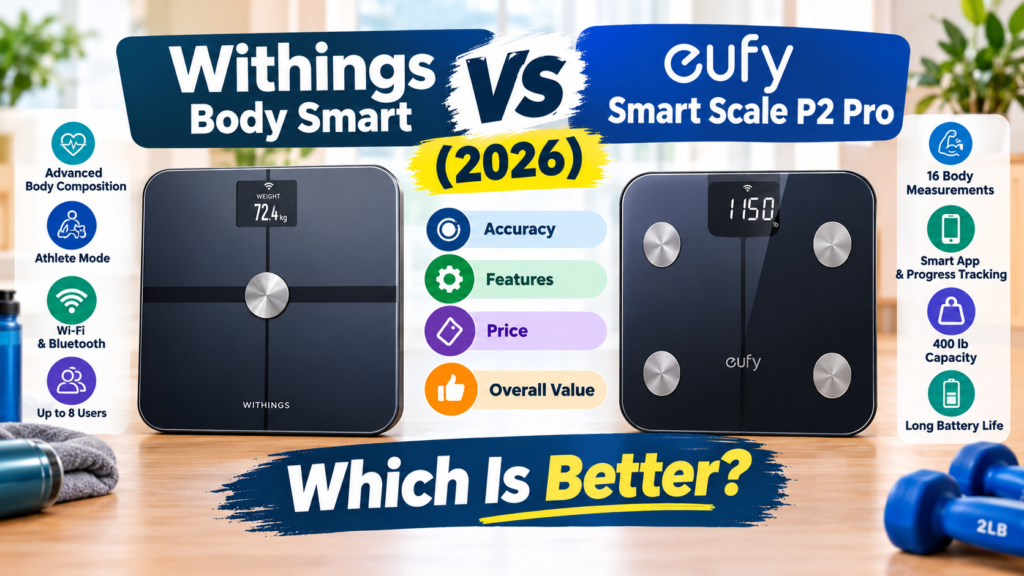
Compare Withings Body Smart vs Eufy Smart Scale P2 Pro for accuracy, body-fat tracking, app features, connectivity, price, and value in 2026.
LifeCareBalance.com is reader-supported. When you buy through links on our site, we may earn an affiliate commission at no extra cost to you. As an Amazon Associate, we earn from qualifying purchases.
If you already own an entry-level Eufy smart scale, you may be wondering whether it is worth paying more for a Withings Body Smart. Both scales connect to a smartphone app, track weight, and estimate body composition. However, their measurement technology, app experience, household features, and overall value differ in important ways.
The decision is not simply about which scale displays more numbers. A scale that reports body fat, muscle mass, water percentage, and other measurements can be useful, but those figures are estimates rather than direct measurements of every tissue in your body. App quality, data consistency, and whether you will actually use the extra features matter just as much.
In this comparison, we examine the Withings Body Smart vs Eufy Smart Scale P2 Pro across weight tracking, body-fat estimates, muscle tracking, connectivity, health-app integrations, privacy considerations, and value.
We also answer the most important buying question: Should you upgrade from Eufy to Withings, or keep the scale you already own?
Quick Verdict: Withings vs Eufy
- Best for a polished health-tracking experience: Withings Body Smart.
- Best for a broad range of body-composition metrics: Eufy Smart Scale P2 Pro.
- Best for automatic weight tracking: Both, when configured correctly.
- Best for household-specific modes: Withings Body Smart, subject to current regional feature availability.
- Best for budget-conscious buyers: Eufy P2 Pro, if its current price is lower than the Withings model.
- Best for body-fat accuracy: No proven winner based on the evidence reviewed for this comparison.
- Best for existing Eufy owners: Usually keep your current scale unless you need specific Withings features or prefer its app.
Our recommendation: Choose Withings if its app, integrations, and household features justify the additional cost. Choose Eufy if you want a wide range of measurements without paying extra for a more premium tracking experience.
Neither scale should be treated as a substitute for a clinical body-composition assessment.
Withings Body Smart vs Eufy P2 Pro: Comparison Table
| Feature | Withings Body Smart | Eufy Smart Scale P2 Pro |
|---|---|---|
| Primary purpose | Connected weight and body-composition tracking | Connected weight and body-composition tracking |
| Body-composition technology | Multi-frequency BIA | BIA-based estimates |
| Weight capacity | Up to 440 lb / 200 kg | Up to 397 lb / 180 kg |
| Weight increments | 0.1 lb / 50 g | 0.1 lb / 50 g |
| Body-fat estimate | Yes | Yes |
| Muscle-related measurements | Muscle mass and related metrics | Muscle mass and skeletal muscle mass, among other metrics |
| Other measurements | Water, bone mass, visceral fat index, BMR and more | Water, bone mass, protein, BMR, visceral fat and other estimates |
| Heart-rate reading | Yes | Yes |
| Connectivity | Wi-Fi and Bluetooth | Wi-Fi and Bluetooth |
| Wi-Fi requirement | Compatible Wi-Fi network | 2.4 GHz Wi-Fi |
| Smartphone app | Withings app | EufyLife app |
| Apple Health | Supported | Advertised by Eufy; verify current app compatibility |
| Multiple users | Up to 8 users | Multiple users; confirm current setup details |
| Special modes | Includes features such as Athlete and Eyes Closed; availability can vary by region and software version | App-based tracking and optional 3D body model |
| Subscription | Core tracking is available without a subscription; some premium features require Withings+ | Core features advertised without a subscription |
| Best reason to buy | App experience and health ecosystem | Features and value |
Specifications are based on manufacturer information. Software features and third-party integrations may change, so confirm compatibility before purchasing.
1. Withings Body Smart: What Do You Get?

- A CLINICAL SCAN OF YOUR HEALTH – Body Smart, developed in collaboration with leading hospitals and clinical institutions…
- ACHIEVE YOUR WEIGHT GOALS FASTER – Reliably track your weight to within 50 g and view your weight trends directly on the…
- INCREASE MUSCLE MASS FASTER – Increase muscle mass faster by analyzing body composition to tailor efforts.
The Withings Body Smart is a connected bathroom scale designed for people who want to follow weight and selected body-composition indicators through a smartphone app.
It combines weight sensors with multi-frequency bioelectrical impedance analysis (BIA). The scale can report measurements such as body-fat percentage, muscle mass, body water, bone mass, visceral fat index, basal metabolic rate, and standing heart rate.
The manufacturer’s US product page lists a weight capacity of up to 440 lb and a display that presents measurement information directly on the scale.
Main advantages
A more developed app experience: The Withings app organizes measurements into graphs, summaries, and historical trends. This may appeal to people who want their scale to fit into a broader health-tracking routine.
Multi-frequency BIA: The Body Smart uses multiple frequencies for its body-composition estimates. This is a meaningful hardware distinction from many simpler consumer scales, although it does not establish that every reading is clinically accurate.
Household support: Withings advertises automatic recognition for up to eight users. Certain modes are designed for different needs, although availability should be checked for the exact model, region, and current software version.
Connected tracking: Wi-Fi and Bluetooth allow the scale to send measurements to its app. Once configured, Wi-Fi syncing can reduce the need to have a phone beside the scale at every weigh-in.
Main disadvantages
The Body Smart may cost more than a budget smart scale, and some extra app insights are part of Withings+. Buyers should distinguish optional subscription features from the core measurements included with the device.
It also has limitations common to consumer body-composition scales. Multi-frequency BIA is still an estimation method, and a more sophisticated sensor system does not automatically make an individual body-fat reading equivalent to a clinical assessment.
For a closer look at its features and limitations, read our Withings Body Smart scale review.
Who should consider Withings?
The Body Smart makes the most sense if you value app design, automatic data syncing, multiple household profiles, and integration with other health-tracking tools.
It is less compelling if you only want to see your weight or expect a major improvement in body-fat accuracy simply by changing brands.
2. Eufy Smart Scale P2 Pro: What Do You Get?
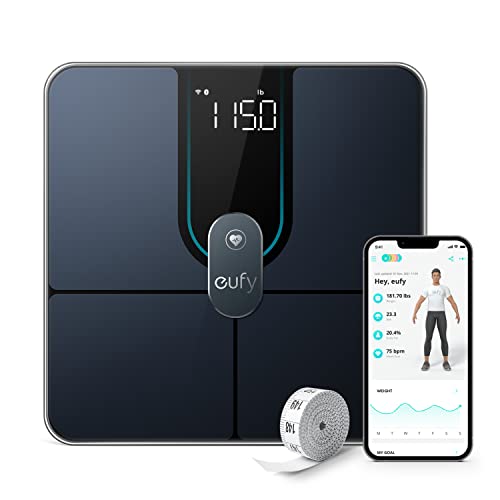
- FULL BODY COMPOSITION ANALYSIS: Track your daily progress and monitor 16 detailed measurements of your body including we…
- ADVANCED TECHNOLOGY FOR HIGH ACCURACY: The sensitive ITO-coating technology on Smart Scale P2 Pro allows you to step on …
- 3D VIRTUAL MODEL: Watch your body’s progress throughout your fitness journey with a virtual, U-Body 3D model, featuring …
The Eufy Smart Scale P2 Pro is designed to provide connected weight tracking and a wide range of estimated body-composition metrics at a competitive price.
Eufy lists 16 measurements for this model, including weight, body fat, heart rate, BMI, muscle mass, bone mass, water, protein, BMR, visceral fat, body-fat mass, lean body mass, body age, body type, skeletal muscle mass, and subcutaneous fat.
It supports Wi-Fi and Bluetooth, uses four AAA batteries, and includes an optional 3D virtual body model in the app.
Main advantages
A broad list of metrics: The P2 Pro reports several measurements that budget-focused buyers may appreciate, including skeletal muscle mass, subcutaneous fat, and body age.
Connected tracking: Wi-Fi can support automatic syncing, while Bluetooth offers another connection method. Wi-Fi setup requires a compatible 2.4 GHz network.
Optional 3D body model: Some users may find a visual representation helpful for reviewing changes over time. It should not be mistaken for a precise 3D body scan.
Practical everyday design: Its glass platform, IPX5 water-resistance rating, and replaceable batteries are useful features for a bathroom scale.
Main disadvantages
The number of measurements can create a false sense of precision. Many of the P2 Pro’s body-composition figures are algorithm-based estimates, not direct measurements of fat, muscle, or bone.
The EufyLife app may also feel more functional than premium, depending on your preferences. Some buyers may prefer Withings’ presentation of historical data and its broader connected-health ecosystem.
For the full model-specific breakdown, read our Eufy Smart Scale P2 Pro review.
Who should consider Eufy?
The P2 Pro is worth considering if you want a connected scale with many metrics, automatic weight records, and an app-based progress history without needing a premium tracking experience.
It is not necessarily the better choice for everyone just because it lists more measurements. The useful question is whether those additional metrics improve your routine.
3. Which Scale Is More Accurate?
Accuracy is the most important part of this comparison—and the area where buyers should be cautious about marketing claims.
There are two different questions:
- How consistently does the scale measure your weight?
- How closely do its body-composition estimates agree with a reference method?
Those are not the same thing.
Weight measurement
Both scales display weight in increments of 0.1 lb or 50 g. That describes the displayed resolution, not a guarantee that every reading is accurate to exactly that amount.
Weight readings can vary because of floor placement, movement, battery condition, and normal changes in your body. A scale should be placed on a firm, level surface and used consistently.
We did not establish a comparable, independent head-to-head laboratory result for the Withings Body Smart and Eufy P2 Pro. Therefore, we cannot responsibly declare one the winner for weight accuracy based on a specific numerical error rate.
Body-fat accuracy
Body-fat percentage is harder to assess than weight. Both products estimate body composition using electrical impedance and proprietary calculations.
A peer-reviewed study comparing three commercial smart scales with DXA found that body weight was measured more reliably than fat mass and muscle mass. The study did not test the Eufy P2 Pro or Withings Body Smart, so it should be used to explain the limitations of the product category—not to assign a specific error rate to either model.
Read the research: Accuracy of Smart Scales on Weight and Body Composition.
A separate study comparing consumer BIA devices with MRI and DXA also found that agreement depended on the device and measurement configuration. Its findings support caution when interpreting body-composition estimates from foot-to-foot scales.
See: Consumer BIA Devices Compared With MRI and DXA.
Does Withings’ multi-frequency technology make it the winner?
The Body Smart’s multi-frequency system is a technical difference worth considering. However, we do not have sufficiently strong, directly comparable independent evidence to say that it produces meaningfully more accurate body-fat or muscle readings than the P2 Pro for every user.
A technology specification is not the same as proof of superior real-world accuracy.
Our verdict on accuracy: There is no established winner for body-composition accuracy in this comparison. Choose based on your preferred app, features, price, and tracking routine—not an assumption that one brand provides clinically precise body-fat measurements.
For more detail, see our guide to smart-scale body-fat accuracy.
4. Body Fat, Muscle Mass, and BMI: Which Offers More Useful Data?
The P2 Pro reports a broader set of individual metrics, while the Body Smart focuses on its own collection of weight, body-composition, and health-related indicators.
Body-fat percentage
Both scales provide a body-fat estimate. This may be useful as a secondary indicator when readings are taken under similar conditions over time.
However, changes in hydration, food intake, exercise, and time of day can affect BIA results. A one-day change should not automatically be interpreted as a change in body fat.
Muscle mass
The Eufy P2 Pro lists both muscle mass and skeletal muscle mass. This gives users more individual figures to review, but additional labels do not automatically provide more accurate information.
Withings also reports muscle-related body-composition data. If your main goal is to measure muscle growth precisely, neither scale should be your only source of evidence.
Consider strength progression, training performance, measurements, and professional assessment where appropriate.
BMI
Both scales can report BMI, which uses weight and height to calculate a screening measure.
BMI does not directly measure body fat and cannot distinguish muscle from fat. Athletes and other people with higher muscle mass may find BMI less informative when used on its own.
Visceral fat and other metrics
Both products provide visceral-fat-related information, though the names and presentation may differ. Eufy also lists estimates such as body age, body type, and protein percentage.
These should be treated as algorithm-derived indicators rather than direct tests of organ fat, nutrition status, or biological aging.
Bottom line: Eufy offers a longer list of metrics, while Withings may be more attractive to users who prefer a more guided app experience. Do not choose solely by counting measurements.
5. App Experience: Withings App vs EufyLife
The app matters because the scale’s long-term value depends on how easily you can review your measurements.
Withings app
The Withings app presents weight and body-composition data through charts and summaries. People who enjoy reviewing trends may find this approach easier to use consistently.
Withings also offers optional premium services. Before paying for Withings+, confirm which features are included in the current subscription and which remain available for free.
EufyLife app
EufyLife provides access to the P2 Pro’s measurements, history, user profiles, and optional 3D model.
Its presentation may feel more data-focused than Withings’ app. That is not automatically a disadvantage: some users prefer direct access to figures rather than extra guidance or scoring.
Which app is better?
Choose Withings if you prefer a more guided and visually organized health-tracking experience.
Choose Eufy if you are comfortable with its interface and want the core scale features without paying for a premium subscription.
These are usability judgments, not results from a controlled head-to-head app test.
6. Wi-Fi, Bluetooth, and Health-App Integration
Both scales support Wi-Fi and Bluetooth, but buyers should verify their preferred integrations before purchasing.
Wi-Fi
Wi-Fi is useful when you want measurements to sync automatically without opening your phone every time. The Eufy P2 Pro specifies 2.4 GHz Wi-Fi compatibility.
If your router uses combined bands or a mesh network, check the manufacturer’s setup instructions before assuming the scale will connect without difficulty.
Bluetooth
Bluetooth provides a local connection to your smartphone and can be useful during setup. The exact syncing workflow depends on the app and current firmware.
Apple Health and other platforms
Both brands advertise connections to third-party health platforms, but integration details can change. Support for one platform does not guarantee that every measurement transfers.
Withings publishes current information about the Body Smart and its app integrations on its official US product page.
For Eufy, confirm the exact P2 Pro model and current compatibility through its official product specifications.
Before buying, check:
- Whether your phone’s operating system is supported.
- Whether the desired health platform is available in your region.
- Which measurements can be shared.
- Whether a third-party account or additional app is required.
- Whether the integration is automatic or requires periodic manual syncing.
Our recommendation: If one specific integration is essential, verify it first. Do not purchase based on an old marketplace description or an outdated app review.
7. Which Scale Is Better for Weight Loss?
For weight management, the most useful feature is often the ability to review weight trends over time.
Both scales can record measurements and display historical data. Withings may appeal to people who prefer a more guided interface, while Eufy provides a broad collection of metrics in its own app.
Neither scale causes weight loss, and neither can determine whether a particular diet or exercise program is right for you.
A practical tracking routine is simple:
- Weigh yourself under similar conditions if regular tracking suits you.
- Avoid interpreting every daily fluctuation as progress or failure.
- Review trends over several weeks rather than reacting to one reading.
- Consider other indicators, such as exercise performance and how you feel.
- Stop or reduce weighing if it increases anxiety or encourages unhealthy behaviors.
The more useful scale is the one that helps you maintain a reasonable, sustainable tracking routine.
For broader guidance on choosing wellness tools, see our personalized wellness guide.
8. Which Scale Is Better for Muscle Gain?
For strength training and body recomposition, the P2 Pro’s separate skeletal-muscle and lean-body-mass estimates may interest people who like reviewing multiple metrics.
Withings offers muscle-related measurements within its body-composition system and may be more appealing if you prefer its app and existing health-data workflow.
However, neither scale can precisely measure the exact amount of muscle gained during a training program. Changes in hydration and other factors can influence the displayed estimates.
Use scale data alongside:
- Changes in strength and exercise performance.
- Consistency with your training plan.
- Longer-term weight trends.
- Other measurements that suit your goals.
If exact body-composition assessment is necessary for a medical or professional reason, ask a qualified healthcare professional about suitable methods.
9. Which Is Better for Families?
Withings advertises support for up to eight user profiles and offers several specialized modes. Exact availability can depend on the region and current software.
Eufy also supports multiple user profiles through EufyLife, and the P2 Pro’s broad metric list may appeal to households that want to track several measurements.
When choosing a shared scale, consider how the app handles user recognition, profile setup, and data privacy.
For households with children, do not assume adult body-composition algorithms are appropriate for every age group. Follow manufacturer guidance and seek professional advice when necessary.
Family verdict: Withings may be the better fit if its household modes are important to you. Eufy can still be a practical option for general weight tracking across multiple profiles.
10. Privacy and Personal Health Data
A connected scale can store sensitive information, including weight history, body-composition estimates, and heart-rate readings.
Before connecting either scale to a health platform, review the current privacy policy and app permissions.
Pay particular attention to:
- Which measurements are stored in your account.
- Whether data is shared with third-party services you connect.
- How you can remove an account or delete stored data.
- Whether household members use separate profiles.
- What permissions the app requests and why.
Neither brand should be assumed to offer identical privacy protections across all products, regions, or app versions. Review the current policies rather than relying solely on marketing statements.
11. Price and Overall Value
Withings Body Smart is positioned as a more premium connected scale, while the Eufy P2 Pro is often considered a value-focused option.
However, prices and discounts change. Compare the current US price for the exact model rather than relying on an old review or a price shown in another country.
Also consider the total value beyond the initial purchase price.
Withings may justify a higher price if:
- You prefer its app experience.
- Its user profiles and modes meet your needs.
- Its supported integrations fit your existing routine.
- You will use the additional guidance or optional premium features.
Eufy may offer better value if:
- You want a broad selection of metrics.
- You already use EufyLife successfully.
- You do not need Withings-specific modes.
- You prefer not to pay for optional premium insights.
A more expensive scale is not automatically a better purchase. The right value is the combination of features you will use, the price you pay, and the experience you prefer.
12. Is It Worth Upgrading From Eufy to Withings?
The answer depends on what you want to improve.
Upgrade to Withings if:
- You prefer its app layout and trend presentation.
- You want specific household modes that are available for your model and region.
- Its integrations better suit your existing health-tracking routine.
- You are comfortable paying more for the features you will use.
Stay with Eufy if:
- Your current scale already tracks the measurements you care about.
- You mainly want a consistent weight history.
- You like the EufyLife app.
- You do not need Withings-specific features.
- Your main reason for upgrading is the expectation of dramatically more accurate body-fat readings.
If your main concern is body-composition accuracy, a switch between these two products is not guaranteed to solve it. Both rely on BIA estimates, and there is no established head-to-head evidence in this review proving a decisive winner for body-fat accuracy.
If you need more advanced body-composition information, compare the specific measurement technology of available devices and discuss clinical assessment options with a qualified professional.
13. Withings Body Smart vs Eufy P2 Pro: Pros and Cons
Withings Body Smart
Pros
- Multi-frequency BIA technology.
- Weight capacity up to 440 lb.
- Supports up to eight user profiles.
- Wi-Fi and Bluetooth connectivity.
- A developed app experience with historical trends.
- Multiple modes and health-platform integrations, subject to availability.
Cons
- May cost more than a budget smart scale.
- Some premium app features require a subscription.
- Body-composition readings remain estimates.
- Integration and mode availability can vary.
Eufy Smart Scale P2 Pro
Pros
- Sixteen advertised measurements.
- Weight capacity up to 397 lb.
- Wi-Fi and Bluetooth connectivity.
- Optional 3D body model.
- IPX5 water-resistance rating.
- Core features advertised without a subscription.
Cons
- Wi-Fi is limited to compatible 2.4 GHz networks.
- Body-composition metrics are estimates.
- The longer metric list can encourage overinterpretation.
- App experience may not suit users who prefer a more guided interface.
Frequently Asked Questions
Is Withings better than Eufy?
Withings is a strong choice for users who prefer its app, integrations, and household modes. Eufy may be better for buyers who want a broad selection of metrics at a competitive price. Neither is the best option for everyone.
Is Withings Body Smart more accurate than Eufy P2 Pro?
There is not enough directly comparable independent evidence in this review to declare Withings the winner for body-fat or muscle accuracy. The Body Smart uses multi-frequency BIA, while the P2 Pro provides its own BIA-based estimates. Both should be interpreted cautiously.
Is Eufy body-fat measurement accurate?
The P2 Pro estimates body fat using BIA. The result can be useful for observing trends under consistent conditions, but it is not a direct measurement and should not be treated as clinical-grade accuracy.
Does Withings Body Smart work with Apple Health?
Withings advertises Apple Health integration. Confirm the current app requirements and supported data fields for your device.
Does Eufy P2 Pro work with Apple Health?
Eufy has advertised third-party health-platform syncing. Check the current P2 Pro specifications and EufyLife app instructions to confirm the integration and available measurements.
Does either scale require a subscription?
Core tracking is available without a Withings+ subscription, although some premium insights require payment. Eufy advertises its P2 Pro’s core features without a subscription. Check current terms before buying.
Which scale is better for weight loss?
Both can help you track weight over time. Withings may suit users who prefer its app and presentation, while Eufy provides a broad range of measurements. Neither guarantees weight-loss results.
Which scale is better for muscle tracking?
Eufy lists additional individual metrics, including skeletal muscle mass. Withings also reports muscle-related data. Neither should be treated as a precise measure of muscle gained during a workout program.
Which scale is better for families?
Withings advertises up to eight user profiles and offers several specialized modes. Eufy supports multiple profiles as well. Compare the exact features available in your region and app version.
Should I upgrade from Eufy to Withings?
Upgrade if you want the Withings app experience, specific integrations, or modes that your current Eufy scale does not offer. If you mainly want more accurate body-fat numbers, the upgrade may not provide the improvement you expect.
Are smart scales accurate enough for medical decisions?
Consumer smart scales are useful for general tracking, but their body-composition estimates should not replace appropriate clinical assessment. Consult a qualified healthcare professional if you need measurements for a medical decision.
Final Verdict: Which Smart Scale Should You Buy?
The Withings Body Smart vs Eufy Smart Scale P2 Pro comparison comes down to app experience, features, price, and the way you plan to use the data.
Choose Withings Body Smart if you value a more guided health-tracking experience, multi-frequency BIA, a higher listed weight capacity, and the household or app features that suit your routine.
Choose Eufy Smart Scale P2 Pro if you want a broad list of measurements, connected weight tracking, and an optional 3D body model without paying extra for a premium tracking experience.
Should you upgrade from Eufy to Withings? For most people, only if there is a specific feature or usability improvement they want. Do not assume the upgrade will deliver clinically precise body-fat or muscle readings.
Before buying, compare current US prices, confirm the exact model, and check the health-app integrations you need.
Our final recommendation: Eufy is the value-oriented choice; Withings is the choice for people who prefer its app and broader tracking experience. For body-composition accuracy, neither deserves an unconditional win based on the available evidence.
[Check the current Amazon US listing for the exact model before purchasing — insert your verified affiliate link here.]
Disclosure: LifeCareBalance may earn a commission from qualifying purchases made through affiliate links, at no extra cost to the reader. Prices and availability may change.