
LifeCareBalance.com is reader-supported. When you buy through links on our site, we may earn an affiliate commission at no extra cost to you. As an Amazon Associate, we earn from qualifying purchases.
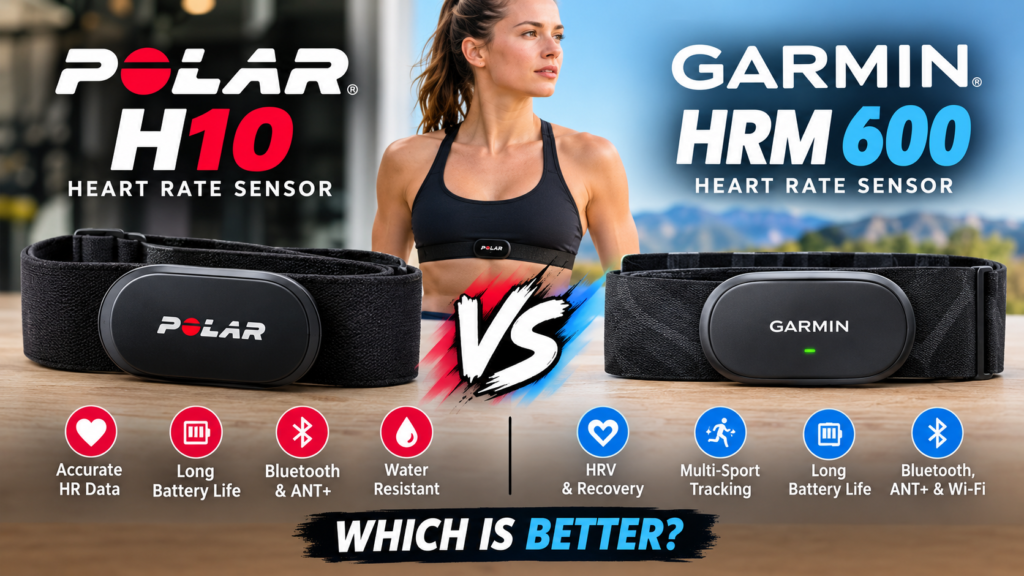
Choosing between the Polar H10 and Garmin HRM 600 comes down to your training goals, battery preferences, and the features you actually need. Both are chest-strap heart rate monitors with Bluetooth and ANT+ connectivity, but Garmin adds advanced running metrics and rechargeable operation, while Polar offers a long-lasting replaceable battery and two simultaneous Bluetooth connections.
Quick verdict: Choose the Polar H10 if you want straightforward heart rate monitoring, long battery life, and flexible connectivity. Choose the Garmin HRM 600 if you want advanced running data, rechargeable convenience, and workout recording without wearing a watch.
Polar H10 vs Garmin HRM 600: Quick Comparison

- 38% Polyamide, 29% Polyurethane, 20% Elastane, 13% Polyester
- Made in the USA or Imported
- WORKS WITH EVERYTHING: Polar HRM works with ALL HRM compatible Equipment.
| Feature | Polar H10 | Garmin HRM 600 |
|---|---|---|
| Sensor type | Electrical chest strap | Electrical chest strap |
| Connectivity | Bluetooth and ANT+ | Bluetooth and ANT+ |
| Battery | Replaceable CR2025 | Rechargeable |
| Advertised battery life | Up to 400 hours | Up to 2 months at 1 hour daily |
| Simultaneous Bluetooth connections | 2 | Up to 3 |
| Internal recording | One training session | Standalone activity recording |
| Advanced running dynamics | Limited compared with Garmin’s system | Yes, with compatible Garmin watches |
| Water resistance | Up to 30 meters | 5 ATM |
| US launch MSRP | $104.95 listed by Polar | $169.99 suggested retail price |
| Best for | Everyday training and connectivity | Data-focused runners and multisport athletes |
Specifications and prices are based on manufacturer information and may change. Check current US pricing and compatibility before buying.
1. Heart Rate Accuracy: Which Should You Trust?
Both monitors use electrical sensing through a chest strap to measure heart rate during exercise. This approach is useful for workouts where heart rate changes quickly, including running intervals, cycling, and structured gym sessions.
The Polar H10 has an established reputation for heart rate measurement. Garmin designed the HRM 600 to provide real-time heart rate and heart rate variability data to compatible devices.
However, specifications alone cannot prove that one monitor is always more accurate than the other. Strap fit, electrode contact, movement, and the receiving device can all affect results.
For reliable readings:
- Position the strap according to the manufacturer’s instructions.
- Moisten the electrodes if recommended.
- Make sure the strap fits securely without restricting breathing.
- Confirm that your watch or app is connected to the correct sensor.
Verdict: Both are serious training options. Do not pay extra for the Garmin solely on the assumption that its heart rate readings must be more accurate.
2. Battery Life: Replaceable vs Rechargeable
This is one of the clearest differences between the two products.
Polar H10
Polar advertises up to 400 hours of battery life from its replaceable CR2025 coin cell. That makes the H10 attractive if you do not want to charge another fitness accessory regularly.
The trade-off is that you will eventually need to replace the battery. Follow Polar’s instructions for replacing it and maintaining the battery seal.
Garmin HRM 600
Garmin advertises up to two months of battery life with one hour of use per day. Its rechargeable battery eliminates the need to buy replacement coin cells.
Actual battery life depends on usage and settings. You will need to recharge it periodically, especially if you train frequently.
Verdict: Polar suits buyers who prefer long stated operating time between battery changes. Garmin suits those who prefer rechargeable convenience.
3. Running Features: Garmin’s Main Advantage
The Garmin HRM 600 offers more than heart rate transmission. When paired with a compatible Garmin watch, it can provide additional running-dynamics information, including:
- Stride length
- Vertical oscillation
- Ground contact time and balance
- Step speed loss on supported devices
These metrics can help data-focused runners examine aspects of running mechanics and training consistency. Some features require specific compatible Garmin watches, so check your exact model before purchasing.
The Polar H10 is primarily a heart rate sensor. It supports heart rate and related training applications, but it does not offer the same Garmin-specific running-dynamics integration.
Verdict: The HRM 600 is the stronger choice if you want additional running metrics and already use a compatible Garmin watch. If you mainly want heart rate data, the H10 may be sufficient.
4. Connectivity and Compatibility
Both sensors support Bluetooth and ANT+, but their connection capabilities differ.
The Polar H10 supports two simultaneous Bluetooth connections, making it useful if you want to send heart rate data to two compatible devices at once.
The Garmin HRM 600 supports up to three simultaneous Bluetooth Low Energy connections and ANT+ connectivity. It also integrates with Garmin Connect and compatible Garmin devices and applications.
Neither product is guaranteed to work with every watch, phone, gym machine, or fitness app.
Before ordering, verify:
- Your device supports external chest-strap heart rate sensors.
- The required Bluetooth or ANT+ connection is supported.
- Your app supports the features you want.
- Any advanced running or swimming features are compatible with your watch.
Verdict: Both offer flexible connectivity. Garmin has the higher stated Bluetooth connection count, while Polar provides broad compatibility for everyday training setups.
5. Workout Recording Without a Watch
The Polar H10 can store heart rate data for one training session, with recording lasting up to 30 hours when used through the supported Polar Beat setup.
The Garmin HRM 600 offers broader standalone activity recording. Garmin says it can record activities and synchronize information such as heart rate, calories, speed, and distance with Garmin Connect for supported activities.
This can be particularly useful for team sports or workouts where wearing a smartwatch is inconvenient.
The two recording systems are not identical. Check which data each product can record for your particular activity and whether a compatible app is required to start or retrieve the recording.
Verdict: Garmin is more versatile for standalone activity tracking. Polar’s internal memory is useful if your main need is recording a heart rate session.
6. Comfort and Water Resistance
Both monitors use chest straps, so comfort depends on fit, strap adjustment, and skin sensitivity.
The Polar H10 comes with the Polar Pro Strap. Garmin offers the HRM 600 in two strap sizes, with a removable sensor module and a machine-washable strap.
Garmin specifies a 5 ATM water rating, while Polar lists the H10 as water-resistant to 30 meters. These ratings are not directly interchangeable, and water resistance alone does not guarantee that every underwater recording setup will work as expected.
If you plan to swim with either device, check the manufacturer’s instructions and the compatibility requirements of your receiving watch.
Verdict: Both are designed for exercise. Choose the strap size that fits you correctly and follow the cleaning instructions.
7. Price and Value for Money
Polar lists the H10 at $104.95 on its US website, while Garmin’s suggested retail price for the HRM 600 is $169.99. Retail prices and promotions may vary.
The price difference is worth considering, but the better value depends on your needs.
Choose the Polar H10 if you want a dedicated heart rate sensor with long stated battery life and dual Bluetooth connectivity.
Choose the Garmin HRM 600 if its running metrics, rechargeable battery, and standalone activity recording justify the additional cost for your training.
If you do not need Garmin’s advanced features, paying more may not provide much practical benefit.
8. Pros and Cons
Polar H10
Pros
- Up to 400 hours of advertised battery life.
- Two simultaneous Bluetooth connections.
- ANT+ support.
- Internal memory for one training session.
- Suitable for running, cycling, and gym workouts with compatible equipment.
Cons
- Uses a replaceable battery.
- No built-in screen.
- Does not provide Garmin’s full running-dynamics feature set.
- Internal memory is limited to one training session.
Garmin HRM 600
Pros
- Rechargeable battery with up to two months of advertised life under stated usage.
- Advanced running dynamics with compatible watches.
- Standalone activity recording and Garmin Connect synchronization.
- Up to three simultaneous Bluetooth connections.
- 5 ATM water rating.
Cons
- Higher suggested retail price.
- Advanced features depend on compatible Garmin devices.
- Requires periodic charging.
- Some benefits may be unnecessary for users who only need heart rate readings.
9. Which One Should You Buy?
Choose the Polar H10 if you:
- Mainly want heart rate monitoring for workouts.
- Prefer a long-lasting replaceable battery.
- Need two simultaneous Bluetooth connections.
- Want to use compatible third-party training apps.
- Do not need advanced Garmin-specific running metrics.
Choose the Garmin HRM 600 if you:
- Already own a compatible Garmin watch.
- Want additional running-dynamics information.
- Prefer a rechargeable battery.
- Want standalone activity recording for supported sports.
- Will actually use the extra data to guide training.
If you are still deciding whether a chest strap is right for you, read our Chest Strap vs Smartwatch Heart Rate Tracking guide.
You can also compare the Polar H10 with a more budget-oriented alternative in our COOSPO H9Z vs Polar H10 comparison, or see the basic features of the COOSPO H9Z review.
For another comparison involving a simpler Garmin chest strap, read COOSPO H9Z vs Garmin HRM-Dual. If you already own the H9Z, our COOSPO H9Z setup and troubleshooting guide can help with pairing and everyday use.
Frequently Asked Questions
Is the Polar H10 better than the Garmin HRM 600?
The H10 is a strong option for heart rate monitoring, long battery life, and dual Bluetooth connections. The HRM 600 is better suited to runners who need additional metrics and standalone activity recording. Neither is the best choice for everyone.
Which has better battery life?
Polar advertises up to 400 hours from a replaceable battery. Garmin advertises up to two months at one hour of use per day with its rechargeable battery. These are different manufacturer usage estimates.
Does the Garmin HRM 600 work without a watch?
Yes. It can record supported activities independently and synchronize data with Garmin Connect. Some features and measurements depend on the activity and compatible setup.
Can the Polar H10 connect to two devices at once?
Yes. Polar specifies support for two simultaneous Bluetooth connections, provided the receiving devices support the required connection.
Is the Garmin HRM 600 worth the extra money?
It may be worth the extra cost if you use its running-dynamics features, standalone recording, and rechargeable battery. If you only need workout heart rate data, the Polar H10 may be sufficient.
Final Verdict
The Polar H10 and Garmin HRM 600 are both capable chest-strap heart rate monitors, but they serve somewhat different needs.
Our recommendation: Buy the Polar H10 if you want a dedicated heart rate sensor with long stated battery life and flexible connectivity. Choose the Garmin HRM 600 if you are a data-focused runner or multisport athlete who will benefit from its extra training features.
Before purchasing, confirm your device compatibility, current price, and the exact features supported by your watch or app.
Sources and Further Reading
- Polar H10 — Official US Product Page
- Garmin HRM 600 — Official Announcement and Features
- Garmin Running Dynamics — Compatibility Information
- Wareable — Polar H10 vs Garmin HRM 600
- Polar H10 — Official Technical Specifications
Affiliate disclosure: LifeCareBalance may earn a commission from qualifying purchases made through affiliate links, at no additional cost to you.
Health note: These products are intended for exercise monitoring and are not substitutes for medical diagnosis or professional medical advice.