
LifeCareBalance.com is reader-supported. When you buy through links on our site, we may earn an affiliate commission at no extra cost to you. As an Amazon Associate, we earn from qualifying purchases.
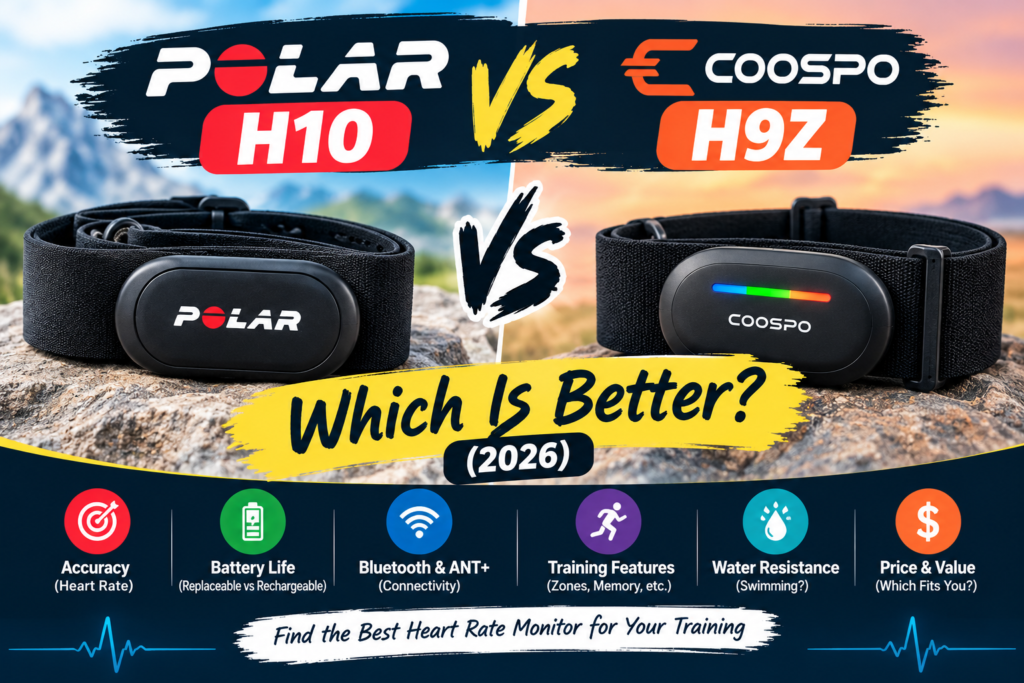
If you’re comparing the Polar H10 vs COOSPO H9Z, both chest-strap heart rate monitors offer an alternative to relying on a smartwatch’s wrist-based heart rate sensor during workouts. However, they take different approaches to battery life, connectivity, training features, and everyday convenience.
The Polar H10 is an established chest strap with Bluetooth, ANT+, support for two simultaneous Bluetooth connections, and internal memory for one training session when used with a compatible app. The COOSPO H9Z focuses on practical training features, including a rechargeable battery, five-color heart rate zone indicators, and Bluetooth 5.0 and ANT+ connectivity.
Quick verdict: The Polar H10 is the stronger choice if you value flexible connectivity, long battery life between replacements, and built-in recording for supported workouts. The COOSPO H9Z may suit you better if you prefer rechargeable power and visual heart rate zone feedback directly from the sensor.
The better option depends on your devices, training habits, and which features you will actually use.

- 38% Polyamide, 29% Polyurethane, 20% Elastane, 13% Polyester
- Made in the USA or Imported
- WORKS WITH EVERYTHING: Polar HRM works with ALL HRM compatible Equipment.

- Precision Heart Rate Tracking: COOSPO H9Z is equipped with an advanced HR sensor, our heart rate monitor chest strap del…
- Rechargeable & Long-Lasting Battery: Say goodbye to disposable batteries! H9Z built-in rechargeable battery that offers …
- Comfortable Wear: Crafted with soft, breathable materials and an adjustable strap, our heart rate monitor ensures a secu…
Quick Comparison: Polar H10 vs COOSPO H9Z
| Feature | Polar H10 | COOSPO H9Z |
|---|---|---|
| Sensor type | Electrical chest-strap heart rate sensor | Chest-strap heart rate monitor |
| Wireless connectivity | Bluetooth, ANT+, Polar GymLink | Bluetooth 5.0, ANT+ |
| Simultaneous Bluetooth connections | Supports two | Check the current model documentation for your configuration |
| Battery | Replaceable CR2025 coin cell | Rechargeable lithium battery |
| Stated battery life | Approximately 400 hours | Approximately 50 hours |
| Heart rate zone indicator | Requires a compatible display or app | Five-color LED indicator |
| Internal workout memory | One training session with supported recording | Check current official documentation for recording support |
| Water resistance | Waterproof to 30 m according to Polar | IP67; not intended for swimming |
| Compatible devices | Compatible Bluetooth and ANT+ devices | Compatible phones, watches, bike computers, and fitness equipment |
| Best suited to | Flexible training setups and longer-term use | Rechargeable convenience and visual zone feedback |
Specifications are based on manufacturer documentation. Features can vary with firmware, app, receiving device, and product revision.
1. Polar H10 vs COOSPO H9Z: Main Differences
Polar H10: Connectivity and training flexibility
The Polar H10 supports Bluetooth, ANT+, and Polar GymLink transmission. Polar specifies two simultaneous Bluetooth connections, which can be useful when you want to send heart rate data to more than one compatible device or application.
It also has internal memory for one training session when used with a supported recording setup. This can be helpful if you want to record a workout without keeping your phone with you throughout the session.
The H10 uses a replaceable CR2025 battery, with Polar specifying approximately 400 hours of use. That means you generally replace the battery rather than recharge the sensor after a set number of workouts.
Its advantages are particularly relevant to runners, cyclists, gym users, and people who train with several compatible devices.
COOSPO H9Z: Rechargeable convenience and visible zones
The COOSPO H9Z supports Bluetooth 5.0 and ANT+ and includes a five-color LED indicator designed to show heart rate zones. The manufacturer also advertises a vibration or sound prompt feature that can be configured through the supported app.
Its rechargeable battery is rated for approximately 50 hours of use. You do not need to buy a separate coin-cell battery, but you do need to charge the monitor periodically.
The visual zone indicator is useful for quick feedback during exercise, especially when your phone or watch display is not easy to see.
However, do not assume that the H9Z has the same internal recording capabilities or simultaneous connection behavior as the Polar H10. Confirm these functions in the current COOSPO manual before purchasing.
2. Which Monitor Offers Better Heart Rate Accuracy?
Heart rate accuracy is one of the main reasons people choose a chest strap instead of relying entirely on a smartwatch.
Both the Polar H10 and COOSPO H9Z are designed to measure heart rate using a chest-worn sensor. A properly fitted chest strap can be useful during activities where wrist movement, gripping handlebars, or repeated arm motion makes optical wrist measurements less reliable.
Polar H10 accuracy
Polar describes the H10 as a highly accurate heart rate sensor. It is designed for users who want heart rate data from a chest-worn electrical sensor and compatibility with a broad range of training equipment.
The H10 can be used with compatible watches, cycling computers, fitness equipment, and training applications. This flexibility is valuable if you change devices or use more than one platform.
COOSPO H9Z accuracy
COOSPO advertises an accuracy of approximately ±1 beat per minute for the H9Z under its stated conditions. This is a manufacturer claim, not proof that the device will outperform the Polar H10 in every activity or for every user.
Real-world readings can be affected by strap fit, dry electrodes, skin contact, movement, interference, and the receiving device.
Which is more accurate?
There is not enough directly comparable independent evidence here to declare one of these two models universally more accurate in every workout.
For either monitor, follow these steps to improve readings:
- Position the strap snugly against your chest.
- Moisten the electrode areas before exercise.
- Attach the sensor connector securely.
- Keep the strap clean and check for worn material.
- Update the sensor firmware and compatible app when appropriate.
Our recommendation: If you need to compare performance for a particular sport, look for independent testing under similar conditions rather than choosing based on a single advertised accuracy number.
3. Battery Life: Replaceable vs Rechargeable
Battery design is one of the clearest differences between these monitors.
Polar H10 battery life
Polar specifies approximately 400 hours of battery life for the H10. It uses a replaceable CR2025 coin cell.
This arrangement suits users who prefer to replace a battery rather than remember to charge their sensor before training. Battery life is an estimate, however, and varies with usage and operating conditions.
The battery cover and sealing ring must also be fitted correctly after replacement to help preserve water resistance.
Read our full guide: Polar H10 Battery Replacement and Care Guide.
COOSPO H9Z battery life
COOSPO specifies approximately 50 hours of battery life for the rechargeable H9Z. The manufacturer recommends charging it with a DC 5V power source or a computer USB port, with a suggested charging time of around 1.5–2 hours.
Rechargeable power is convenient if you prefer not to buy replacement coin cells. On the other hand, you need to keep track of the remaining charge.
Which battery design is better?
Choose the Polar H10 if you prefer long stated operating time between battery changes. Choose the H9Z if rechargeable power is more convenient for your routine.
Neither design is automatically better for every user. Your charging habits and the number of hours you train each week should influence the decision.
4. Connectivity: Phones, Watches, and Bike Computers
A chest strap is only useful if it can send heart rate data to your preferred device.
Polar H10 connectivity
The H10 supports Bluetooth and ANT+, along with Polar GymLink for compatible older Polar equipment and gym devices. Polar specifies two simultaneous Bluetooth connections.
This is useful if you want to pair the sensor with compatible equipment and a training app, although the exact arrangement depends on the receiving devices and their connection limits.
For example, you might use a compatible sports watch to display heart rate while another compatible application receives data. Check the settings of both devices before assuming every possible combination will work.
COOSPO H9Z connectivity
The H9Z supports Bluetooth 5.0 and ANT+, allowing it to connect with compatible smartphones, sports watches, bike computers, and fitness equipment.
Its compatibility depends on whether your receiving device supports the relevant heart rate service and how that device handles external sensors.
Before buying, check the exact watch or bike computer model, the connection type it supports, and whether it can pair with an external chest strap.
Which is better for multiple devices?
The Polar H10 has a documented advantage if you specifically need two simultaneous Bluetooth connections. For other setups, both monitors offer useful wireless connectivity.
Do not confuse a device being discoverable over Bluetooth with every app being able to use it simultaneously. The app, operating system, and receiving device can all affect how connections work.
For setup instructions, read our guide: How to Use the Polar H10 With Your Phone or Watch.
5. Training Features: Which One Gives You More?
The most useful monitor is not necessarily the one with the longest feature list. It is the one that fits your training workflow.
Polar H10 features
The H10 offers:
- Bluetooth and ANT+ connectivity.
- Two simultaneous Bluetooth connections.
- Internal memory for one training session with a supported recording setup.
- Compatibility with supported training apps and equipment.
- Polar GymLink transmission for compatible devices.
These features make it a flexible option for people who train across different platforms.
COOSPO H9Z features
The H9Z offers:
- Bluetooth 5.0 and ANT+.
- A five-color LED heart rate zone indicator.
- Configurable alerts through the supported app.
- Rechargeable power.
- Compatibility with supported phones, watches, bike computers, and fitness equipment.
Its LED indicator may be especially appealing if you want a quick visual reference for your training intensity.
Which is better for zone training?
The H9Z provides a convenient visual indicator on the sensor itself. The Polar H10 can also support heart rate zone training when paired with a compatible app, watch, or other display.
Remember that heart rate zones need to be configured appropriately for your individual training plan. A colored LED is a feedback feature, not a medical assessment of your exercise intensity.
6. Comfort and Chest Strap Maintenance
Comfort matters because even a technically capable monitor can become frustrating if it slips, irritates the skin, or requires too much maintenance.
Both products use a chest strap that must fit snugly enough to maintain contact with the skin without feeling excessively tight.
Polar H10 comfort and care
The Polar H10 is supplied with Polar’s Pro chest strap. Regular rinsing and appropriate washing help remove sweat and residue. The sensor connector should be detached from the strap after use and dried as directed.
Over time, textile straps can stretch or wear. If readings become inconsistent, inspect the strap and electrodes before assuming the sensor itself has failed.
COOSPO H9Z comfort and care
The H9Z also uses a chest strap, and its manufacturer recommends removing the sensor after use, rinsing the belt with water, and allowing it to dry. Follow the product’s care instructions and avoid putting the sensor connector in a washing machine or dryer.
Which one is easier to maintain?
The routine is broadly similar: wear the strap correctly, clean it after exercise, dry the components, and inspect the material periodically.
The battery system is the larger maintenance difference. The H10 requires occasional coin-cell replacement, while the H9Z requires charging.
7. Water Resistance: Can You Swim With Them?
Water resistance should not be treated as the same thing as suitability for every water sport.
Polar rates the H10 as waterproof to 30 meters. COOSPO specifies an IP67 rating for the H9Z and states that it should not be used for swimming.
If swimming is important to your training, the Polar H10 has the more clearly specified swimming-related water-resistance rating. However, do not assume that a rating alone guarantees uninterrupted heart rate transmission underwater. Wireless transmission and compatibility can behave differently in water.
Always follow the manufacturer’s instructions for water use, maintenance, and battery-cover sealing.
8. Which Heart Rate Monitor Is Better for Running?
For runners, a chest strap can provide useful heart rate feedback during intervals, tempo sessions, and steady runs.
Choose the Polar H10 for running if:
- You use more than one compatible training device.
- You want two simultaneous Bluetooth connections.
- You value internal recording with a supported setup.
- You prefer a replaceable battery with a long stated operating life.
Choose the COOSPO H9Z for running if:
- You want a rechargeable chest strap.
- You like the idea of five-color LED zone feedback.
- Your watch or running app supports the H9Z.
- You prefer to avoid buying replacement coin-cell batteries.
For either model, verify that the strap is comfortable over the distance you typically run. A good fit and properly moistened electrodes matter more than a feature you rarely use.
9. Which Is Better for Cycling and Indoor Training?
Cyclists often connect heart rate straps to a bike computer, sports watch, or indoor training application.
The Polar H10’s Bluetooth, ANT+, and GymLink support can be useful when working with different types of compatible equipment. Its two simultaneous Bluetooth connections may also help with certain multi-device arrangements.
The H9Z supports Bluetooth 5.0 and ANT+, so it can work with compatible cycling computers and fitness applications. Its LED zone indicator can provide a quick visual cue when the sensor is visible.
Before purchasing either monitor, confirm compatibility with your exact bike computer or training app. A connection protocol alone does not guarantee every advanced feature will be supported.
10. Price and Overall Value
Prices vary by retailer, sales, and product availability, so compare the current US prices rather than relying on an old advertised amount.
When comparing the total cost, consider:
- The purchase price of the monitor.
- Whether a replacement strap may eventually be needed.
- Whether you prefer replaceable batteries or charging.
- The apps and devices you already own.
- Whether you will use features such as internal recording or LED zone feedback.
The Polar H10 may offer better value for someone who will use its additional connectivity options and supported recording features. The COOSPO H9Z may offer better practical value for someone who wants a rechargeable monitor with simple visual zone feedback.
Do not pay more for features that do not fit your actual training routine.
11. Pros and Cons
Polar H10
Pros
- Bluetooth, ANT+, and Polar GymLink support.
- Two simultaneous Bluetooth connections.
- Approximately 400 hours of stated battery life.
- Replaceable CR2025 battery.
- Internal memory for one training session with supported recording.
- Compatibility with a range of supported training devices and apps.
Cons
- Requires periodic battery replacement.
- Does not provide the H9Z’s built-in five-color LED zone indicator.
- Battery-cover sealing and strap maintenance need attention.
- Some functions depend on compatible apps and receiving devices.
COOSPO H9Z
Pros
- Rechargeable battery.
- Approximately 50 hours of stated battery life.
- Bluetooth 5.0 and ANT+ connectivity.
- Five-color LED heart rate zone indicator.
- Configurable alerts through the supported app.
- Works with compatible phones, watches, cycling computers, and fitness equipment.
Cons
- Needs periodic charging.
- The stated battery life is shorter than the H10’s manufacturer estimate.
- IP67 water resistance does not make it suitable for swimming.
- Compatibility and recording functions should be checked against the current product documentation.
12. Final Verdict: Polar H10 vs COOSPO H9Z
The Polar H10 is our preferred choice for users who want a flexible chest strap with multiple supported connection options, two simultaneous Bluetooth connections, long stated battery life, and internal recording for a supported training session.
The COOSPO H9Z is worth considering if you prefer a rechargeable sensor and want five-color LED feedback for heart rate zones without depending entirely on a watch display.
Neither model should be declared universally more accurate without directly comparable independent testing. Your device compatibility, strap fit, maintenance routine, and preferred battery design should guide the final decision.
Choose the Polar H10 if connectivity flexibility and long battery life between replacements are your priorities.
Choose the COOSPO H9Z if rechargeable convenience and on-sensor zone indicators matter more to you.
Before ordering, confirm the exact model, current specifications, included accessories, and compatibility with your existing devices.
Frequently Asked Questions
Is the Polar H10 better than the COOSPO H9Z?
The Polar H10 offers two simultaneous Bluetooth connections, Polar GymLink support, a replaceable battery rated for approximately 400 hours, and internal recording for a supported training session. The H9Z offers a rechargeable battery and five-color LED zone feedback. The better option depends on your priorities.
Is the COOSPO H9Z accurate?
COOSPO advertises approximately ±1 bpm accuracy for the H9Z under its stated conditions. That is a manufacturer claim, and real-world performance can vary with strap fit, electrode contact, movement, and the receiving device.
Does the Polar H10 have a rechargeable battery?
No. The Polar H10 uses a replaceable CR2025 coin-cell battery.
How long does the COOSPO H9Z battery last?
COOSPO specifies approximately 50 hours of battery life. Actual performance depends on usage and operating conditions.
Can both monitors connect to a smartwatch?
Both support wireless connectivity with compatible devices. Confirm that your particular smartwatch supports external Bluetooth or ANT+ heart rate sensors and check the manufacturer’s pairing instructions.
Can I swim with the COOSPO H9Z?
COOSPO states that the H9Z’s IP67 rating does not mean it is suitable for swimming. Follow the manufacturer’s water-use instructions.
Does the Polar H10 support two Bluetooth connections at once?
Yes. Polar documents two simultaneous Bluetooth connections for the H10. The behavior of any particular multi-device setup still depends on the receiving devices and applications.
Which monitor is better for beginners?
Either can work for a beginner who wants chest-strap heart rate data. The H9Z may appeal to people who like visual zone indicators and rechargeable power, while the H10 may suit people who want broader connectivity options and longer stated battery life between replacements.
Official Sources
- Polar H10 Official Product Page
- Polar H10 User Manual: Getting Started and Compatibility
- Polar H10 Battery Instructions
- COOSPO H9Z Official Product Page
- Polar Heart Rate Sensor Comparison
Affiliate Disclosure: LifeCareBalance may earn a commission from qualifying purchases made through affiliate links, at no additional cost to the reader.
Health Disclaimer: These devices are intended for fitness monitoring and are not substitutes for medical diagnosis, emergency assessment, or professional medical advice.