
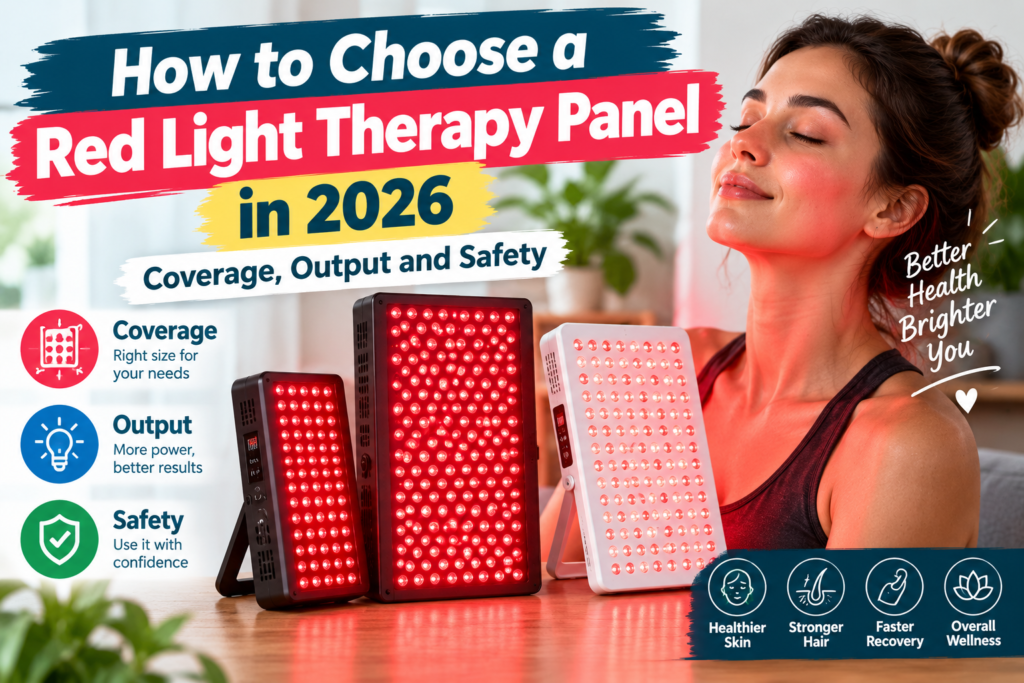
Learn how to choose a red light therapy panel in 2026. Compare wavelengths, irradiance, coverage, safety features, and testing claims before buying.
LifeCareBalance.com is reader-supported. When you buy through links on our site, we may earn an affiliate commission at no extra cost to you. As an Amazon Associate, we earn from qualifying purchases.
Red light therapy panels have become increasingly popular among people exploring at-home wellness technology. These devices use light-emitting diodes (LEDs) to deliver red light and, in many cases, near-infrared light to selected areas of the body. They are available in compact tabletop models, medium-sized panels, and larger systems designed to cover more of the body.
But choosing a panel is not as simple as comparing wattage or buying the device with the most LEDs. Manufacturers may report different measurements, use different testing methods, and advertise benefits that are not equally supported by clinical evidence. A panel that looks powerful on paper may not necessarily be the best fit for your intended use.
This guide explains the specifications that matter, how to evaluate manufacturer claims, what safety information to look for, and how to decide whether a small, medium, or large panel makes sense for your home.
The goal is not to promise a particular health outcome. It is to help you make a better-informed purchasing decision before spending money on a device.

- RED & NEAR-INFRARED LIGHT FOR DAILY WELLNESS – The Hooga HG300 features 60 LEDs delivering 660nm red light and 850nm nea…
- COMPACT PANEL, TARGETED SESSIONS – Designed for convenient, targeted use on smaller areas of the body. The HG300 is idea…
- HIGH-OUTPUT PERFORMANCE IN A SMALL FOOTPRINT – Delivers over 73 mW/cm² irradiance at 6 inches, with high-quality 5W LEDs…
Quick Answer: What Should You Look for in a Red Light Therapy Panel?
When comparing red light therapy panels, start with five factors:
- Wavelengths: Check which wavelengths the device emits and whether they match the intended application.
- Irradiance: Look for output measurements that specify the testing method and distance from the panel.
- Coverage: Choose a panel that suits the body area you want to expose without requiring an impractical setup.
- Safety and documentation: Review the manufacturer’s instructions, eye-safety information, electrical safety details, and applicable regulatory status.
- Total value: Compare the price, warranty, return policy, mounting requirements, and documented specifications.
Do not select a panel based on advertised wattage alone. Electrical power consumption, LED count, and irradiance are different measurements, and none independently proves that a device will deliver a particular health benefit.
There is also no universal specification that guarantees a successful result for every person or condition. The appropriate device depends on the intended use, available evidence, and manufacturer’s instructions.
What Is a Red Light Therapy Panel?
A red light therapy panel is a device that emits selected wavelengths of visible red light, near-infrared light, or a combination of both. The technique is commonly discussed under the broader term photobiomodulation.
Photobiomodulation has been studied in different clinical settings, including selected skin-related applications, pain conditions, wound care, and certain forms of hair loss. The amount and quality of evidence vary by condition, device, treatment protocol, and patient population.
A consumer panel is not automatically equivalent to a clinical device used in a controlled study. Differences in wavelength, output, treatment distance, exposure time, and the area being treated can all affect how the device is used.
This distinction matters because a manufacturer may describe a technology using research from a specific clinical application without demonstrating that its own product produces the same results.
Before purchasing, identify your main reason for considering a panel. A device intended for general wellness is not necessarily an appropriate substitute for a medically indicated treatment.
1. Understand the Wavelengths
Wavelength is measured in nanometers (nm). It describes the color or spectral position of the emitted light.
Many consumer red light therapy panels advertise red light in the approximate 630–660 nm range and near-infrared light around 810–850 nm. Other devices use different wavelengths or include additional spectral bands.
Red light
Visible red light is commonly included in devices marketed for skin-focused applications. Research has investigated photobiomodulation for certain skin outcomes, but findings from one device or protocol cannot automatically be transferred to every panel.
Check the actual wavelength specifications rather than relying on phrases such as “medical-grade light” or “advanced red technology.”
Near-infrared light
Near-infrared light is not visible in the same way as red light. Some panels combine red and near-infrared LEDs, while others allow the user to switch between different modes.
The inclusion of near-infrared light does not prove that a panel is more effective for every purpose. The appropriate wavelength depends on the application and the supporting evidence.
Are more wavelengths always better?
No. A panel with four, five, or seven advertised wavelengths is not automatically better than a simpler model.
Additional wavelengths can make a device more versatile in some circumstances, but the number of wavelengths does not establish the accuracy of the output, the quality of the design, or the clinical effectiveness of the device.
Buying tip: Look for clearly stated wavelengths and documentation that supports the manufacturer’s specifications. Avoid paying a premium solely because a product lists more wavelengths than its competitors.
2. Learn What Irradiance Actually Means
Irradiance describes the optical power reaching a particular surface area. It is commonly expressed in milliwatts per square centimeter (mW/cm²).
For shoppers, the important question is not simply whether a manufacturer advertises a high number. It is how that number was obtained.
Why measurement distance matters
Light intensity at the treatment position can differ from a measurement taken very close to the LEDs. As the distance changes, the light distribution and intensity at the target area may change too.
This is why an irradiance figure without a stated measurement distance is difficult to interpret.
When comparing two panels, try to obtain measurements recorded at the same distance and using comparable methods. Otherwise, you may be comparing numbers that do not describe equivalent conditions.
Why measurement methods matter
Different instruments and measurement approaches can produce different readings. A manufacturer may report its own measurements, commission independent testing, or provide a report from a particular laboratory.
These approaches should not be treated as interchangeable without understanding their methods.
Useful questions include:
- What instrument was used?
- At what distance was the measurement taken?
- Was the measurement taken at the center or across several points?
- Does the report identify the exact panel model?
- Does it explain the testing method?
- Can the report be accessed and reviewed?
A single center-point measurement may not describe the output across the entire treatment area.
Should you buy the panel with the highest irradiance?
Not automatically.
Higher irradiance does not establish better clinical results, and it does not mean a user should increase exposure or shorten treatment time without evidence-based instructions.
Output, wavelength, exposure duration, distance, and treatment area all matter. The manufacturer’s recommended protocol should be followed rather than improvising a session from a headline specification.
3. Do Not Confuse Wattage With Therapeutic Output
One of the easiest mistakes is assuming that a panel advertised as “300W,” “600W,” or “1000W” delivers that amount of optical power to the body.
A wattage figure may describe electrical power consumption, a marketing category, or another manufacturer-defined measure. It should not be assumed to represent the light energy reaching the user.
When comparing products, separate these concepts:
| Specification | What it tells you | What it does not prove |
|---|---|---|
| Electrical wattage | Electrical power used under stated conditions | Clinical effectiveness |
| LED count | Number of listed light-emitting components | Accurate output or uniform coverage |
| Wavelength | Spectral characteristics of emitted light | A guaranteed treatment result |
| Irradiance | Optical power per unit area under stated conditions | Superior outcomes by itself |
| Panel dimensions | Physical size of the device | Actual effective treatment coverage |
A useful buying guide should make these differences clear rather than treating every specification as evidence of effectiveness.
4. Choose the Right Panel Size and Coverage Area
Panel size affects convenience, setup, and the area you can expose during a session. It should be selected according to your available space and intended use.
Small panels
Small panels can be useful when you want a compact device for a limited treatment area. They usually take up less space and may be easier to store or move.
However, a small panel may require repositioning if you want to expose several body areas. Check its dimensions and the manufacturer’s recommended treatment distance before deciding that it meets your needs.
Medium panels
Medium-sized panels can offer a balance between footprint and coverage. They may be worth considering when a tabletop unit is too small for your planned use but a large standing system would be impractical.
Check the mounting system, stability, and space needed for safe positioning.
Large and full-body panels
Larger panels are designed to cover more area, but they can cost more, take up more space, and require sturdier mounting arrangements.
Do not assume that a full-body label means every part of the body receives identical output in a single position. Review the manufacturer’s coverage diagrams and instructions.
A simple coverage checklist
Before buying, answer these questions:
- Which body area do I intend to expose?
- How large is the treatment area?
- Will I need to reposition the panel?
- Is there enough room to use it at the recommended distance?
- Can I mount or support it securely?
- Will I realistically use it as directed?
A smaller panel that fits your routine may be more practical than a large device that is difficult to set up or store.
5. Evaluate Safety Features and Documentation
Safety should be part of the buying decision, not an afterthought.
Review the manufacturer’s user manual before purchasing. It should provide clear instructions for positioning the device, recommended exposure, precautions, cleaning, and any restrictions relevant to the product.
Eye safety
Do not assume that red light or near-infrared light is harmless to the eyes simply because it is non-ionizing.
Follow the device’s eye-safety instructions. Use protective eyewear when specified by the manufacturer, and do not stare directly into bright LEDs. Near-infrared light may not be visibly apparent, so visible brightness alone is not a reliable indication of eye exposure.
People with eye conditions or particular light sensitivities should seek professional advice when appropriate.
Photosensitivity and medical conditions
Some medications and medical conditions can affect sensitivity to light. If you take a photosensitizing medication, have a relevant medical condition, or are uncertain whether a device is suitable for you, consult a qualified healthcare professional before use.
Do not use a consumer panel to delay evaluation or treatment of a persistent medical problem.
Heat and electrical safety
Review the manufacturer’s instructions for ventilation, operating environment, mounting, power supply, and cleaning. Inspect the device for damaged cables, unstable supports, or other visible problems.
A device should not be used if its power components, housing, or electrical connections appear damaged.
FDA terminology: cleared, approved, and registered
These terms have different meanings in the United States.
A device may be FDA-cleared for a particular intended use, FDA-approved through an applicable approval pathway, or listed or registered in a particular regulatory context. These terms are not interchangeable.
A company registration or device listing alone does not mean that the FDA has independently verified every marketing claim or determined that a product is effective for all advertised purposes.
If a seller claims that a panel is FDA-cleared, ask for the exact model, the relevant clearance information, and the intended use. Confirm that the documentation corresponds to the device being sold.
6. Check Independent Testing Claims
Independent testing can help shoppers evaluate whether a product’s specifications and selected safety characteristics have been documented.
However, the words “third-party tested” are not sufficient on their own.
Look for information about the testing organization, the model or batch tested, the date of testing, and the measurements or safety characteristics evaluated.
A useful report might address wavelength accuracy, irradiance under specified conditions, or selected electrical and electromagnetic characteristics. But a report covering one characteristic should not be interpreted as certification of every aspect of the device.
For example, an output measurement does not establish clinical effectiveness. An electromagnetic-field measurement does not prove that a panel treats a health condition. A report for one model should not automatically be assumed to cover an entire product range.
If a manufacturer publishes a test report, read the scope and limitations instead of relying solely on a badge or headline claim.
7. Compare Total Cost, Warranty, and Return Policy
The initial price is only one part of a panel’s value.
Before purchasing, compare:
- The device price and any additional shipping charges.
- The cost of a stand, mounting brackets, or other required accessories.
- The warranty period and what it covers.
- The return window and any restocking fees.
- Availability of customer support and replacement parts.
- The manufacturer’s published technical information.
- Whether the product can be used comfortably in your available space.
A more expensive panel may offer a larger treatment area or more convenient controls, but those features matter only if they are useful to you.
Likewise, a lower-cost panel is not automatically a poor choice. Its suitability depends on the intended use, documented specifications, safety information, and practical limitations.
Avoid deciding based on an advertised discount or an unsupported claim that the device is “professional grade.”
8. What Does the Research Say About Red Light Therapy?
Photobiomodulation has been studied in several medical and wellness contexts. However, evidence must be considered separately for each intended use.
An evidence-based consensus review published in 2025 evaluated the clinical application of photobiomodulation and reported support for selected uses. That does not establish that every consumer panel works for every condition.
Read the clinical consensus review on photobiomodulation for a broader view of the evidence and its clinical context.
Research into home-use light devices for androgenetic alopecia also illustrates why the specific device and intended use matter. A clinician’s guide reviewed FDA-cleared devices for this particular type of hair loss and discussed differences in design and supporting evidence. It did not establish that all red light panels are interchangeable.
See the PubMed review of home-use photobiomodulation devices for androgenetic alopecia for additional context.
When interpreting research, ask:
- Was the study conducted in humans?
- What condition or outcome was evaluated?
- Was the exact device or a comparable protocol used?
- How many participants were included?
- What was the comparison group?
- Were the outcomes clinically meaningful?
- Do independent studies support the findings?
A study showing a change in a particular outcome does not guarantee the same result for every user.
9. Common Red Light Panel Buying Mistakes
Buying by wattage alone
A large wattage number does not establish the amount of light reaching your skin. Compare clearly defined measurements instead.
Assuming every wavelength has the same purpose
Different wavelengths have different characteristics. A longer list of wavelengths does not automatically make a device more effective.
Ignoring the measurement distance
Irradiance figures should be interpreted alongside their testing distance and method. Comparing measurements taken under different conditions can be misleading.
Treating marketing claims as clinical proof
Words such as “medical-grade,” “clinically proven,” and “professional strength” need context. Look for evidence that applies to the exact intended use.
Assuming FDA registration means approval
Registration, listing, clearance, and approval have distinct meanings. Verify the precise regulatory status rather than relying on vague advertising.
Buying a panel that does not fit your home
A large device can be inconvenient if you lack suitable floor space, mounting options, or storage. Choose a format that you can use according to the instructions.
Expecting guaranteed results
Individual outcomes can vary, and research findings for one condition cannot automatically be generalized to another. A panel should not be presented as a guaranteed cure or a substitute for appropriate medical care.
10. A Practical Checklist Before You Buy
Use this checklist to compare two or three candidate panels side by side.
| Question | What to look for |
|---|---|
| Are the wavelengths stated? | Specific values in nanometers |
| Is irradiance documented? | Measurement distance, instrument, and method |
| Is coverage explained? | Panel dimensions and manufacturer guidance |
| Is the intended use clear? | Claims supported by relevant evidence |
| Is eye safety addressed? | Clear precautions and instructions |
| Is regulatory status explained? | Exact device and intended-use documentation |
| Is independent testing available? | Identifiable report and testing scope |
| Is installation practical? | Stable mounting and adequate space |
| Is the warranty clear? | Written terms and support information |
| Is the price reasonable for my needs? | Total cost and useful features, not marketing alone |
If important specifications are missing, contact the manufacturer before purchasing. If the company cannot explain how its main performance claims were measured, consider another product with clearer documentation.
Frequently Asked Questions
What is the most important specification in a red light therapy panel?
There is no single specification that establishes overall quality. Wavelength, irradiance, measurement distance, coverage, safety documentation, and intended use all matter. Start with the intended application and compare products using equivalent information.
Is a higher irradiance number always better?
No. A higher number does not guarantee better outcomes. Measurements must be interpreted in context, and users should follow the device’s instructions rather than changing exposure based on an advertised output figure.
Is a full-body panel better than a small panel?
Not necessarily. A large panel may cover more area, while a smaller panel may be easier to store and position. The better option depends on the intended treatment area, available space, budget, and documented specifications.
Are red light and near-infrared light the same?
No. Red light is visible, while near-infrared light is generally outside the visible range. Panels may use one or both, and the suitability of a wavelength depends on the intended application and supporting evidence.
Does FDA registration prove a panel is effective?
No. Registration or listing should not be interpreted as proof that every advertised claim has been evaluated or established. Verify the exact regulatory status and intended use of the device.
How often should I use a red light therapy panel?
Follow the manufacturer’s instructions for the specific device and intended use. There is no single exposure schedule that is appropriate for every panel, condition, and user. Do not increase exposure or use frequency simply because a device advertises high output.
Can a red light panel replace medical treatment?
No. A consumer wellness panel should not be used as a substitute for diagnosis or appropriate treatment. Seek professional advice for persistent symptoms, unexplained hair loss, skin changes, or other medical concerns.
Is an expensive panel automatically better?
No. Price may reflect size, controls, materials, warranty, or brand positioning, but it does not independently establish clinical effectiveness. Compare documentation, practical usability, total cost, and the evidence for your intended use.
Final Verdict
Choosing a red light therapy panel in 2026 is easier when you separate measurable specifications from marketing claims.
Start with your intended use, then compare wavelengths, irradiance at a stated distance, coverage, safety instructions, testing documentation, and total ownership cost. Do not rely on wattage, LED count, price, or the number of wavelengths as standalone indicators of quality.
A small panel may suit a limited space and targeted use, while a larger system may be more practical when broader coverage is important. Neither format guarantees a particular health outcome.
Most importantly, look for transparent documentation and realistic claims. If a manufacturer cannot explain its specifications or provide clear safety guidance, keep comparing before spending your money.
For further product comparisons, explore LifeCareBalance’s guides to red light therapy panels on a budget and our Hooga HG300 panel review.
Affiliate disclosure: LifeCareBalance may earn a commission from qualifying purchases at no additional cost to the reader. Product availability and specifications may change. This article is for educational purposes and is not medical advice.