
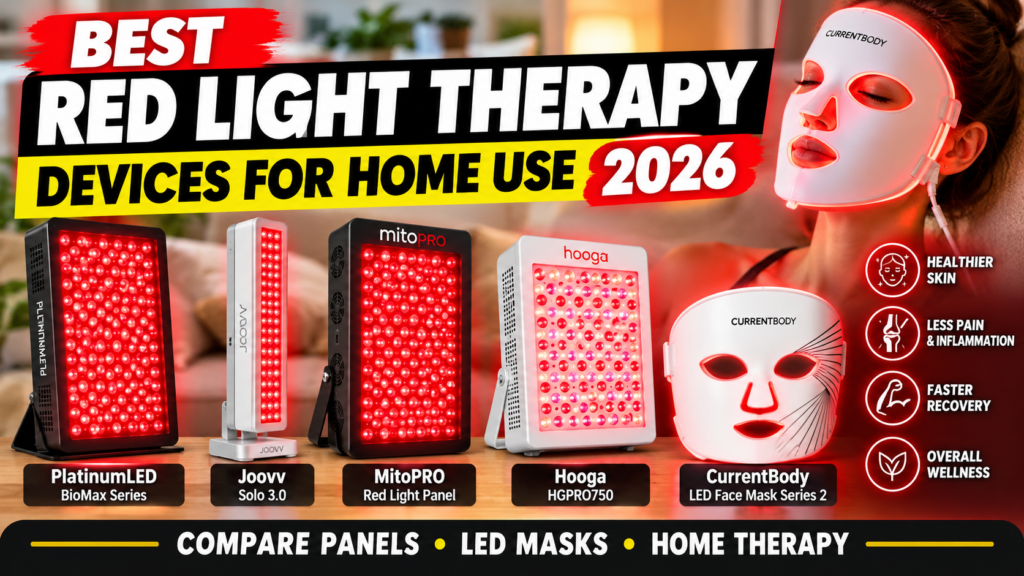
Compare the best red light therapy devices for home use in 2026. Explore LED panels and face masks, key features, safety tips, and buying advice.
LifeCareBalance.com is reader-supported. When you buy through links on our site, we may earn an affiliate commission at no extra cost to you. As an Amazon Associate, we earn from qualifying purchases.
Red light therapy devices have become increasingly popular among Americans looking for at-home skincare and wellness options. From LED face masks designed for facial skincare to larger red and near-infrared light panels, today’s market offers products for different treatment goals, budgets, and lifestyles.
However, choosing the best red light therapy device is not simply about buying the most expensive model or selecting the product with the highest advertised power output. Wavelengths, irradiance, treatment distance, coverage area, safety instructions, and evidence for the intended use all matter.
In this guide, we compare popular device categories, explain what buyers should look for, and show you how to evaluate specific products before purchasing. Our goal is to help you make an informed decision without relying on exaggerated health claims or unverified product specifications.
Affiliate Disclosure: LifeCareBalance is reader-supported. We may earn a commission when you purchase through qualifying links on our website, at no additional cost to you. As an Amazon Associate, we earn from qualifying purchases.
Quick Answer: What Is the Best Red Light Therapy Device for Home Use?
The best device depends on your primary goal.
- For larger treatment areas: Compare full-size red and near-infrared light panels.
- For facial skincare: Consider an LED face mask designed specifically for facial use.
- For a smaller budget: Compare compact panels or targeted devices, but verify their specifications before buying.
- For a specific medical concern: Look for evidence supporting the exact intended use and consult a qualified healthcare professional when appropriate.
Popular product families to investigate include PlatinumLED BioMax, Joovv Solo 3.0, Mito Red Light MitoPRO, and Hooga HGPRO panels. For facial skincare, the CurrentBody Skin LED Face Mask Series 2 is another product to compare.
These are products to research, not independently tested winners. LifeCareBalance has not performed a laboratory test or head-to-head clinical trial establishing that one of these devices is superior to all the others.
Best Red Light Therapy Devices: What to Compare
1. PlatinumLED BioMax Series: For Buyers Comparing Premium Panels
The PlatinumLED BioMax family is designed for people interested in panel-based red and near-infrared light therapy.
A panel may be suitable when you want to treat a larger area rather than use a wearable facial mask. However, different models may offer different dimensions, wavelength configurations, and output specifications.
Before purchasing, verify the exact BioMax model, its current manufacturer specifications, the treatment distance used for irradiance measurements, the warranty, and the total cost of any mounting accessories.
Best suited for: Buyers researching premium panel systems for home use.
What to remember: A higher advertised output does not automatically mean better clinical results. Consider the measurement method, intended use, and available evidence rather than relying on marketing claims alone.
2. Joovv Solo 3.0: For Comparing Premium Panel Systems
Joovv offers a Solo 3.0 panel system through its official website. The product is part of the brand’s panel-based red and near-infrared light therapy range.
Official product page: https://joovv.com/products/joovv-solo-3-0
Review the exact configuration before purchasing. Check the wavelengths, dimensions, mounting options, controls, warranty, and current availability.
Best suited for: Buyers who prefer a dedicated panel system and want to compare premium options.
What to remember: An established brand and premium price do not guarantee better results for every treatment goal. Compare the actual specifications and ownership costs with competing devices.
3. Mito Red Light MitoPRO: For Technical Specification Comparisons
Mito Red Light offers panel-based products under its MitoPRO family. Buyers should compare the exact model rather than assume that all versions share identical features.
Important details include the wavelength combination, irradiance at a stated distance, treatment area, mounting requirements, warranty, and instructions for use.
Best suited for: Buyers who want to evaluate panel specifications carefully before choosing a model.
What to remember: More wavelengths or LEDs do not automatically establish greater effectiveness. A useful comparison focuses on the intended use and the quality of the evidence supporting it.
4. Hooga HGPRO: For Buyers Comparing Panel Value

- DUAL-CHIP RED & NEAR-INFRARED LIGHT: Features 150 dual-chip LEDs, with each LED delivering both 660nm red light and 850n…
- LARGER HIGH-OUTPUT LED PANEL: The expanded 150-LED design provides substantially more coverage than smaller tabletop pan…
- SUPPORTS DAILY WELLNESS: A convenient way to incorporate red and near-infrared light into your routine for relaxation, p…
Hooga offers red light therapy panels in different sizes and configurations. Its HGPRO family can be included in a comparison of panel features and costs.
Be careful to distinguish the HGPRO models from other products, including the Hooga HG300. Different models may have different dimensions, controls, specifications, and prices.
Best suited for: Buyers comparing panel size, features, and overall cost.
What to remember: Do not choose a panel based on price alone. Review the manufacturer’s documentation, safety instructions, warranty, and the exact model being sold.
5. CurrentBody Skin LED Face Mask Series 2: For Facial Skincare

- Enhanced collagen production capability significantly reduces fine lines, wrinkles and redness, for younger-looking skin…
- Upgraded light coverage provides our famous instant glow, for a healthier, brighter and smoother complexion.
- An all-new, exclusive layout of 236 LED bulbs emits three clinically recognised wavelengths: red (633nm), near-infrared …
The CurrentBody Skin LED Face Mask Series 2 is a facial device rather than a full-body panel. That difference matters when deciding which product is appropriate for your needs.
Before buying, confirm the mask generation, wavelength specifications, treatment schedule, fit, eye-safety guidance, warranty, and current price.
Best suited for: Buyers whose primary goal is facial skincare.
What to remember: A face mask is not a replacement for a panel when your goal is broader body coverage. Results may vary, and a mask should not be expected to eliminate wrinkles or permanently reverse aging.
Amazon listing status: The exact Amazon US ASIN for each product above must be confirmed against the specific model. Do not insert an unverified ASIN or substitute a similar product’s code.
Red Light Therapy Panels vs. LED Face Masks
Choosing the correct device format is one of the most important buying decisions.
| Feature | Red light therapy panel | LED face mask |
|---|---|---|
| Main format | Standing, mounted, or tabletop panel | Wearable facial device |
| Intended coverage | Depends on panel dimensions and positioning | Primarily the face |
| Space requirements | Often needs a suitable setup area | Usually compact |
| Best starting point | Buyers interested in larger treatment areas | Buyers focused on facial skincare |
| Main checks | Wavelengths, irradiance, distance, coverage | Wavelengths, fit, treatment time, eye safety |
Neither format is universally better. Select a device based on your intended use, not simply the number of LEDs or the advertised power.
For more facial-device comparisons, see our Best LED Face Masks of 2026.
What Is Red Light Therapy?
Red light therapy uses specific wavelengths of visible red light and, in some devices, near-infrared light. The scientific term photobiomodulation is commonly used when discussing the biological effects of these light-based treatments.
Researchers are studying potential applications involving skin appearance, certain types of pain, wound healing, and other conditions. However, the evidence differs between applications, and results from one device or clinical protocol cannot automatically be applied to every consumer product.
The Cleveland Clinic provides an overview of the potential uses, safety considerations, and limitations of the evidence:
Red light therapy is different from ultraviolet tanning. Nevertheless, a device still needs to be used correctly, and eye protection or other precautions may be necessary.
Potential Benefits of Red Light Therapy
Skin Appearance and Fine Lines
Some research suggests that specific red-light treatments may improve aspects of skin appearance, including fine lines and texture. Results depend on the treatment protocol, device, and individual.
An at-home LED mask should not be expected to reproduce the results of every professional dermatological treatment.
Acne-Prone Skin
Some LED devices combine red and blue light for acne-related skincare. Blue light has a different role from red light, so a red-only panel should not automatically be treated as an equivalent acne device.
If acne is persistent, painful, or causing scarring, seek advice from a qualified healthcare professional.
Muscle Recovery
Photobiomodulation has been studied for exercise-related recovery and muscle performance, but the evidence is not uniform across protocols. It is not appropriate to promise that every red light panel will speed recovery or eliminate soreness.
Adequate sleep, nutrition, rest, and sensible training remain essential parts of recovery.
Joint Discomfort
Research has examined photobiomodulation for several musculoskeletal conditions. Findings vary, and a consumer panel should not be presented as a proven treatment for every type of joint pain.
Persistent pain, swelling, or an unexplained injury should be evaluated by a healthcare professional.
Hair Growth
Some purpose-built low-level light devices have been studied for certain forms of hair loss. This does not mean that a general-purpose panel or facial mask will produce the same result.
People considering light therapy for hair loss should investigate devices intended for scalp use and seek advice about persistent or unexplained hair loss.
A 2025 umbrella review of randomized clinical trials found evidence of potential benefit for some outcomes, while the certainty of evidence varied across conditions.
Research: https://pubmed.ncbi.nlm.nih.gov/40770824/
How to Choose the Best Red Light Therapy Device
1. Identify Your Primary Goal
Start with the area you want to treat.
- For facial skincare, compare dedicated LED masks.
- For larger treatment areas, compare panels with appropriate coverage.
- For a targeted concern, verify whether the device is intended for that use.
- For a diagnosed medical condition, discuss treatment options with a qualified healthcare professional.
One product does not necessarily meet every need.
2. Check the Wavelength Specifications
Consumer devices commonly advertise red wavelengths around 630–660 nm and near-infrared wavelengths around 810–850 nm. These are common ranges, not a universal prescription for every condition.
Look for documentation that identifies the wavelengths used by the exact model. Do not assume a product has a particular wavelength simply because another product from the same brand does.
3. Understand Irradiance and Treatment Distance
Irradiance describes optical power delivered per unit area and is commonly expressed in milliwatts per square centimeter (mW/cm²).
When comparing products, check the distance at which the measurement was taken and whether the manufacturer explains its measurement method.
Figures obtained at different distances or with different instruments may not be directly comparable. A higher number on a specification sheet does not independently prove better clinical performance.
4. Review Treatment Coverage
Panel dimensions and positioning influence the area exposed during a session. A mask is designed for facial coverage, while a panel may be positioned to target a larger area.
Think about the space you have available and whether you can comfortably follow the recommended instructions.
5. Compare the Total Cost
The purchase price is only one part of the cost. Check for:
- Mounting hardware and stands
- Shipping and return costs
- Warranty coverage
- Customer support
- Required safety accessories
- Any applicable replacement parts
Before choosing a panel, our Best Budget Red Light Therapy Panels for 2026 guide can help you compare the factors that matter for a lower-cost purchase.
6. Verify the Exact Product and Seller
A product family may include multiple sizes, generations, or configurations. Before purchasing, compare the listing title, model number, specifications, seller, warranty, and return policy.
If purchasing through Amazon, confirm that the ASIN belongs to the exact product you intend to promote. An ASIN for a different model or bundle should not be used as a substitute.
7. Check Regulatory Claims
FDA registration, listing, clearance, and approval are not interchangeable terms. Regulatory status depends on the exact device and its intended use.
Use official FDA resources when checking a manufacturer’s regulatory claim:
Do not describe a device as FDA-approved or FDA-cleared unless the specific claim has been verified through reliable regulatory records.
Are Red Light Therapy Devices Safe?
Red light therapy may be relatively low-risk when an appropriate device is used according to its instructions. However, the safety of one product does not automatically establish the safety of every device or treatment schedule.
Potential problems can include skin irritation, discomfort, or eye-related risks if the device is misused.
Follow these precautions:
- Follow the manufacturer’s recommended session duration and treatment distance.
- Avoid staring directly into bright LEDs.
- Use protective eyewear when required.
- Stop use if you experience unusual irritation or discomfort.
- Ask a healthcare professional about use if you have a photosensitivity condition or take medication that increases sensitivity to light.
- Seek appropriate medical advice for persistent pain, unexplained hair loss, or significant skin problems.
The FDA provides guidance on photobiomodulation devices and the regulatory considerations that may apply:
How Often Should You Use Red Light Therapy?
There is no single treatment schedule that applies to every device. Recommended session duration and frequency depend on the product, its output, the intended use, and its instructions.
Follow the directions for your exact model rather than applying a generic schedule to all devices. Longer or more frequent sessions are not automatically better.
If you experience unusual redness, irritation, or discomfort, stop using the device and seek advice if symptoms persist.
Common Buying Mistakes to Avoid
Buying the Most Expensive Device
A premium price does not guarantee superior results. Compare the product’s specifications, coverage, safety information, and intended use.
Confusing Different Product Formats
A facial mask and a full-size panel have different coverage areas and should not be compared as though they are interchangeable.
Trusting Every Health Claim
Be cautious of claims that a consumer device cures disease, guarantees pain relief, or permanently reverses aging. Evidence varies by application.
Ignoring Model Differences
Specifications can differ across generations and configurations. Always verify the exact model before purchasing or adding a product link.
Using an Unverified Amazon ASIN
A code belonging to a similar product is not sufficient. Confirm the exact Amazon US listing and model before adding the ASIN to your affiliate article.
Final Verdict: Which Red Light Therapy Device Should You Choose?
The best red light therapy device for home use in 2026 depends on your treatment goal, budget, available space, and the quality of the evidence supporting its intended use.
PlatinumLED BioMax, Joovv Solo 3.0, Mito Red Light MitoPRO, and Hooga HGPRO are panel families worth comparing. The CurrentBody Skin LED Face Mask Series 2 is a separate option for buyers focused on facial skincare.
Before buying, verify current product specifications, the exact model, warranty terms, safety instructions, and regulatory claims. If you plan to promote a product through Amazon, verify the precise Amazon US listing and ASIN rather than guessing.
Red light therapy may be a useful option for certain purposes, but it is not a guaranteed solution for every skin, pain, or recovery concern. Informed product selection and realistic expectations are more valuable than marketing promises.
Frequently Asked Questions
Do red light therapy devices work?
Research suggests that certain photobiomodulation protocols may help with some skin and medical concerns. However, results vary by condition, device, and treatment protocol, and not every advertised benefit is supported by strong evidence.
What is the best red light therapy device for home use?
The best choice depends on your goal. Compare panels for larger treatment areas and dedicated LED masks for facial skincare. Verify the exact product’s specifications before purchasing.
Are red light panels better than LED face masks?
Neither format is universally better. Panels can cover larger areas, while masks are designed for facial use.
Can I use red light therapy every day?
Only if the instructions for your specific device recommend daily use. There is no universal schedule for all products.
How long does it take to see results?
Some users may notice gradual changes after several weeks, but results are not guaranteed and depend on the treatment and individual.
Is red light therapy FDA-approved?
Regulatory status depends on the exact device and intended use. FDA registration or listing alone does not establish FDA clearance or approval.
Can red light therapy replace medical treatment?
No. It should not replace appropriate medical evaluation or prescribed treatment for persistent pain, significant skin conditions, hair loss, or other health problems.
What should I check before buying a device?
Review the exact model, wavelengths, irradiance measurement distance, coverage, treatment instructions, eye-safety guidance, warranty, return policy, and regulatory status.
Medical Disclaimer: This article is for educational and informational purposes only. It is not a substitute for professional medical advice, diagnosis, or treatment. Research continues to develop, and individual results may vary.