
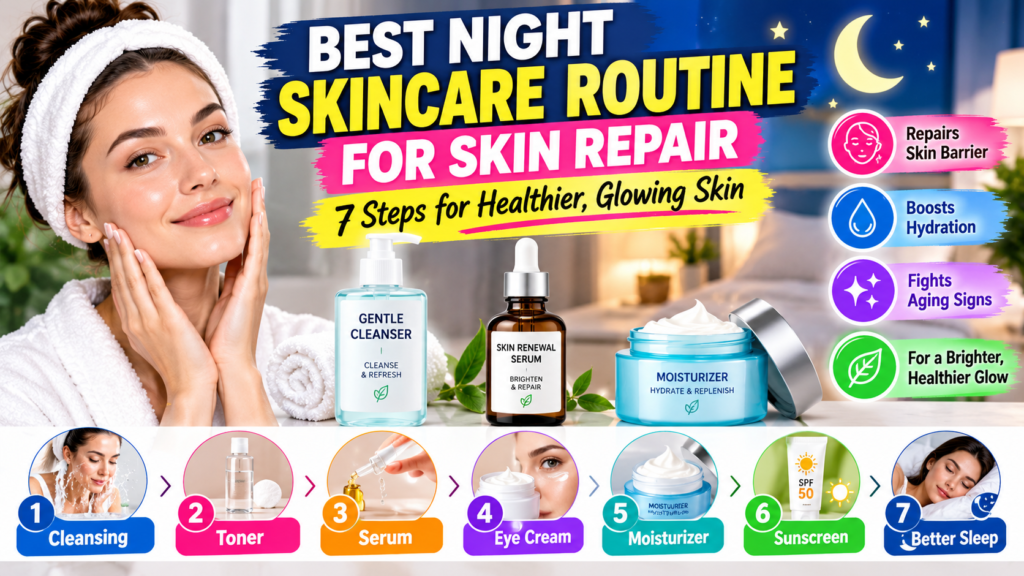
Learn the best night skincare routine for skin repair, with simple steps, dermatologist-informed ingredient tips, and advice for dry, oily, sensitive, and acne-prone skin.
LifeCareBalance.com is reader-supported. When you buy through links on our site, we may earn an affiliate commission at no extra cost to you. As an Amazon Associate, we earn from qualifying purchases.
A healthy-looking complexion does not require a complicated 10-step skincare routine. The best night skincare routine for skin repair focuses on removing daily buildup, maintaining moisture, supporting the skin barrier, and using targeted ingredients when necessary.
Your skin continues its natural renewal and protective functions while you sleep. The right skincare products can help manage dryness, improve the appearance of uneven texture, and address concerns such as fine lines, clogged pores, and uneven skin tone. However, results depend on your skin type, the products you use, and how consistently you follow your routine.
Many people make nighttime skincare more complicated than it needs to be. They combine multiple serums, exfoliating acids, facial oils, and anti-aging creams without understanding which products are necessary. This can waste money and increase the risk of irritation.
In this guide, we explain how to build a practical nighttime skincare routine, which ingredients are worth considering, how to choose products for different skin types, and which common mistakes to avoid.
Quick Answer: What Is the Best Night Skincare Routine for Skin Repair?
For most people, an effective nighttime skincare routine includes these steps:
- Remove makeup and sunscreen when necessary.
- Wash your face with a gentle cleanser.
- Apply one suitable treatment or serum if you have a specific concern.
- Use eye cream if needed.
- Apply a moisturizer that suits your skin type.
- Add a facial oil or protective ointment only if extra moisture is needed.
- Maintain a consistent routine and use sunscreen during the day.
You do not need all seven steps every night. A gentle cleanser, moisturizer, and one appropriate treatment may be sufficient.
If your skin is irritated, peeling, or unusually sensitive, temporarily simplify your routine to gentle cleansing and moisturizing. Avoid introducing strong active ingredients until your skin is comfortable again.
Why Is Nighttime Skincare Important?
Your skin barrier helps keep moisture inside the skin while protecting it from external irritants. Throughout the day, your skin encounters ultraviolet radiation, sweat, excess oil, makeup, sunscreen, and environmental particles.
A nighttime routine helps remove accumulated residue and provides an opportunity to apply products designed for hydration or specific skin concerns.
A consistent routine may help:
- Reduce dryness and uncomfortable tightness.
- Maintain the skin’s moisture barrier.
- Improve the appearance of rough or uneven texture.
- Manage certain types of acne when appropriate treatments are used.
- Soften the appearance of some fine lines.
- Improve the appearance of uneven pigmentation.
- Keep the skin feeling smoother and more comfortable.
These benefits are not guaranteed, and skincare products do not repair every form of skin damage. Persistent acne, eczema, rosacea, and other skin conditions may require professional treatment.
The Best Night Skincare Routine: Step by Step
Step 1: Remove Makeup and Sunscreen
If you wear makeup or water-resistant sunscreen, remove it before or as part of cleansing.
You can use micellar water, a cleansing balm, or a gentle makeup remover. Choose a product that removes your particular makeup without requiring excessive rubbing.
If you wear heavy makeup or long-wearing sunscreen, a two-step cleansing routine may be helpful. Otherwise, one effective, gentle cleanse may be enough.
Avoid harsh rubbing around the eyes, and follow the remover’s instructions about rinsing.
What to avoid: Do not assume that every natural oil is suitable for facial cleansing. Coconut oil, for example, may not work well for everyone, particularly people prone to clogged pores or irritation.
Step 2: Cleanse Your Face With a Gentle Cleanser
Cleansing removes remaining residue, sweat, excess oil, and dirt. The goal is to clean your face without stripping away too much of its natural moisture.
Choose a cleanser according to your skin type.
Dry skin: A cream or lotion cleanser may help reduce the tight feeling associated with washing.
Oily skin: A gentle gel cleanser can remove excess oil without aggressive scrubbing.
Sensitive skin: A fragrance-free cleanser with a simple formulation is often a sensible starting point.
Acne-prone skin: A gentle cleanser may be sufficient. A salicylic acid cleanser is another option for some people with clogged pores, provided it does not cause excessive dryness.
Use lukewarm water and your fingertips. Pat your face dry with a clean towel rather than rubbing vigorously.
For more guidance, consult the American Academy of Dermatology’s skincare resources.
Step 3: Apply a Targeted Serum or Treatment
A serum is optional. It is most useful when it addresses a specific concern rather than simply adding another product to your routine.
Choose one main treatment to start, and follow its instructions.
Hyaluronic Acid for Hydration
Hyaluronic acid is a humectant that helps attract water to the skin’s outer layers. It can improve the feeling of hydration and make the skin appear temporarily plumper.
It may be useful if your skin feels dehydrated or looks dull because of dryness. Apply the product according to its directions and follow with moisturizer.
Niacinamide for Skin Barrier Support
Niacinamide, a form of vitamin B3, is used to support the skin barrier and improve the appearance of uneven tone. Some formulations may also help manage excess oil.
It can be a reasonable option for people who want a treatment focused on barrier support and overall skin appearance.
Retinol for Fine Lines and Uneven Texture
Retinol is a topical retinoid used to improve the appearance of fine lines, uneven texture, and certain acne-related concerns.
It may cause redness, dryness, peeling, or irritation, particularly when first introduced.
If you decide to use retinol:
- Start with a low-strength product suitable for beginners.
- Follow the product label and begin with infrequent use.
- Avoid introducing several strong active ingredients at the same time.
- Use moisturizer to help manage dryness.
- Wear broad-spectrum sunscreen during the day.
Topical retinoids should generally be avoided during pregnancy or when trying to become pregnant. Seek professional advice if you are breastfeeding or unsure whether a product is appropriate for you.
Read the AAD guide to retinoids and retinol before adding a retinoid to your routine.
Vitamin C for Uneven Skin Tone
Vitamin C is an antioxidant used in skincare products to help improve the appearance of uneven pigmentation and protect against oxidative stress.
It is commonly used in the morning, although some formulations can be used at night according to their instructions. It is not a mandatory part of nighttime skincare.
Daily sun protection remains essential when managing dark spots or other signs of sun-related skin changes.
Important: Retinol, exfoliating acids, and acne treatments should not automatically be layered together. The right combination depends on the individual products and your skin’s tolerance.
Step 4: Use Eye Cream Only If You Need It
Eye cream is an optional step. A suitable moisturizer may be sufficient for some people, while others prefer a separate product for their under-eye area.
Common ingredients include:
- Glycerin and hyaluronic acid: Help hydrate the skin.
- Ceramides: Support the skin barrier.
- Caffeine: May temporarily improve the appearance of puffiness.
- Retinol: Certain formulations target fine lines but may irritate sensitive skin.
Apply a small amount according to the product instructions and avoid direct contact with your eyes.
Dark circles may be caused by genetics, pigmentation, allergies, or facial structure. A topical cream cannot necessarily address every cause.
Step 5: Apply a Moisturizer
Moisturizer is one of the most useful parts of a basic nighttime routine. It helps reduce moisture loss and supports the skin’s protective barrier.
Choose a formulation based on your skin’s needs.
For dry skin: Look for creams containing glycerin, ceramides, or petrolatum.
For oily skin: Consider a lightweight lotion or gel-cream that feels comfortable and does not leave an excessively greasy finish.
For sensitive skin: Choose a fragrance-free product and avoid ingredients that have previously caused irritation.
For combination skin: Use a balanced moisturizer across your face, adding a richer cream to dry areas if needed.
You do not necessarily need a separate product labeled as a night cream. A suitable moisturizer can work well in the evening regardless of whether it is marketed for daytime or nighttime use.
For additional guidance, see the AAD’s advice on choosing a moisturizer.
Step 6: Use Facial Oil Only If Necessary
Facial oil is an optional addition for people who need extra softness or help reducing moisture loss.
Some facial oils can improve the feel of dry skin, but they do not replace a complete moisturizer in every routine.
If you want to try an oil, introduce it gradually and monitor your skin. People who are prone to clogged pores or irritation should be particularly cautious.
You can skip this step entirely if your moisturizer already keeps your skin comfortable.
Step 7: Protect Your Lips Before Bed
Dry lips may benefit from a fragrance-free lip balm or a simple ointment containing petrolatum.
Apply it before bed to help reduce moisture loss and protect against cracking.
Avoid flavored or fragranced products if they irritate your lips. If persistent cracking, swelling, or inflammation develops, seek professional advice.
Best Night Skincare Ingredients for Different Concerns
The most useful ingredient is the one that addresses your primary concern without irritating your skin.
| Skin concern | Ingredients to consider | Main purpose |
|---|---|---|
| Dryness | Glycerin, ceramides, petrolatum | Hydration and moisture retention |
| Dehydrated skin | Hyaluronic acid, glycerin | Attracting and retaining water |
| Uneven texture | Retinol, when appropriate | Improving the appearance of texture |
| Clogged pores | Salicylic acid | Helping unclog pores |
| Uneven skin tone | Niacinamide, vitamin C | Improving the appearance of discoloration |
| Fine lines | Retinol, moisturizers | Improving the appearance of lines and dryness |
| Sensitive skin | Fragrance-free moisturizer, ceramides | Supporting the skin barrier |
No ingredient works equally well for everyone. Formulation, concentration, frequency of use, and individual sensitivity all affect the outcome.
Night Skincare Routine for Every Skin Type
For Dry Skin
Dry skin often benefits from fewer irritating products and a greater focus on moisture retention.
A practical routine is:
- Gentle cream cleanser.
- Optional hydrating serum.
- Moisturizer containing barrier-supporting ingredients.
- Optional protective ointment on particularly dry areas.
Avoid frequent exfoliation, harsh cleansers, and products that leave your skin tight or uncomfortable.
If dryness is persistent or accompanied by cracking, intense itching, or a rash, consult a healthcare professional.
For Oily Skin
Oily skin still needs hydration. Aggressively removing oil does not necessarily resolve oil production and may worsen irritation.
Try this routine:
- Gentle gel cleanser.
- One suitable treatment, such as niacinamide or salicylic acid, if needed.
- Lightweight moisturizer.
Toner and facial oil are optional. Add them only if they provide a clear benefit for your skin.
For Sensitive Skin
Sensitive skin often responds best to a simple routine with minimal fragrance and fewer active ingredients.
Try:
- Gentle, fragrance-free cleanser.
- Basic moisturizer.
- Targeted treatment only when appropriate and tolerated.
Introduce new products one at a time. Stop using a product if it causes persistent burning, swelling, or a rash.
For Acne-Prone Skin
Acne-prone skin may benefit from specific treatments, but aggressive cleansing and excessive exfoliation can make irritation worse.
A practical routine includes:
- Gentle cleanser.
- One appropriate acne treatment.
- Non-comedogenic moisturizer.
Salicylic acid, benzoyl peroxide, and topical retinoids address different acne concerns. They are not interchangeable, and the best option depends on your skin and the type of acne.
For persistent, painful, or scarring acne, seek professional treatment rather than relying exclusively on cosmetic products.
For Combination Skin
Combination skin may be oily in some areas and dry in others.
Try a gentle cleanser, an optional targeted treatment, and a balanced moisturizer. Apply additional moisturizer to dry areas if needed.
There is no requirement to use a separate product for every part of your face.
Common Night Skincare Mistakes That Can Harm Your Routine
Using Too Many Active Ingredients
Combining multiple exfoliating acids, retinol, and acne treatments may increase the likelihood of irritation. Some combinations can be appropriate, but they should be chosen carefully.
Start with one treatment and introduce additional ingredients gradually.
Over-Exfoliating
Frequent scrubbing and excessive use of acids may disrupt the skin barrier.
Redness, peeling, burning, and increased sensitivity are signs that your routine may be too harsh.
Pause irritating products and focus on gentle cleansing and moisturizing.
Skipping Moisturizer
Even oily skin may benefit from a suitable moisturizer. Choose a lighter formulation if heavy creams feel uncomfortable.
Expecting Overnight Results
Hydration may improve quickly, but changes in acne, pigmentation, and fine lines usually require more time. Results vary from person to person.
Be skeptical of claims that a product can dramatically reverse skin damage in just one night.
Forgetting Sunscreen
Nighttime skincare cannot replace daytime sun protection. Use broad-spectrum sunscreen with SPF 30 or higher on exposed skin and reapply as directed.
Sunscreen is especially important when managing uneven pigmentation or using treatments that may increase sun sensitivity.
Trying Too Many Products at Once
Adding several new products simultaneously makes it difficult to identify the cause of a reaction.
Introduce one product at a time and monitor your skin before making further changes.
Do Natural Remedies Help With Overnight Skin Repair?
Natural ingredients are not automatically safer or more effective than formulated skincare products.
Aloe vera: Some formulations may soothe minor irritation, but allergies are possible.
Honey: It appears in certain skincare products, but household honey is not a proven replacement for established acne treatment.
Cucumber: It may provide a temporary cooling sensation, but it does not repair significant skin damage.
Green tea: It contains antioxidant compounds, although the benefits of a specific product depend on its formulation and supporting evidence.
Avoid applying lemon juice, undiluted essential oils, or harsh homemade scrubs to your face. These may irritate the skin.
If your skin barrier is already irritated, a simple routine is generally a better starting point than experimenting with several home remedies.
How Long Does Night Skincare Take to Work?
The timeline depends on the product, the concern being addressed, and your skin’s response.
- Hydration: A suitable moisturizer may improve skin comfort soon after application.
- Texture and uneven tone: Noticeable changes may require several weeks of consistent use.
- Acne: Many treatments require several weeks or longer to show meaningful improvement.
- Fine lines and pigmentation: Changes often develop gradually over weeks to months.
These are general expectations, not guaranteed deadlines. If a product causes persistent irritation or worsens your skin, stop using it and seek appropriate advice.
Frequently Asked Questions
What is the correct order for nighttime skincare?
Remove makeup if necessary, cleanse, apply a targeted treatment or serum, use optional eye cream, and moisturize. Facial oil is optional.
Is toner necessary at night?
No. Toner is optional and is not required for an effective routine.
Can I use retinol every night?
Some people tolerate frequent use, but beginners should start gradually and follow the product instructions. Avoid topical retinoids during pregnancy.
What is the best moisturizer for skin repair?
The best moisturizer is one that suits your skin type and supports hydration. Glycerin and ceramides can be useful ingredients, while petrolatum may help reduce moisture loss in very dry areas.
Can oily skin use facial oil?
Some people with oily skin tolerate particular facial oils, while others may experience clogged pores or irritation. Facial oil is not an essential step.
Should I use vitamin C or retinol at night?
Either may be appropriate depending on your goals and the formulation. Vitamin C is often used in the morning, while retinol is commonly used at night.
How can I support a damaged skin barrier?
Simplify your routine, use gentle cleansing and moisturizing products, and avoid irritating treatments until your skin settles. Persistent inflammation or cracking warrants professional advice.
Do expensive night creams work better?
Not necessarily. Price alone does not determine effectiveness. Look for a suitable formulation, useful ingredients, clear directions, and compatibility with your skin.
Final Thoughts
The best night skincare routine for skin repair is simple, consistent, and tailored to your skin type. Start with gentle cleansing and moisturizing, then add a targeted treatment if you have a specific concern.
You do not need every serum, toner, eye cream, or facial oil available. Focus on maintaining the skin barrier, introducing active ingredients carefully, and protecting your skin from the sun during the day.
Give your routine time to work, monitor how your skin responds, and seek professional guidance when persistent skin concerns require more than basic skincare.
Healthy-looking skin is not about using the most products. It is about choosing appropriate products and using them consistently.
Affiliate Disclosure
LifeCareBalance may earn a commission when readers purchase through qualifying affiliate links, at no additional cost to them. As an Amazon Associate, we earn from qualifying purchases.
Medical Disclaimer
This article is for informational purposes only and is not a substitute for professional medical advice, diagnosis, or treatment. Consult a qualified healthcare professional about persistent skin problems or questions concerning active skincare ingredients.