
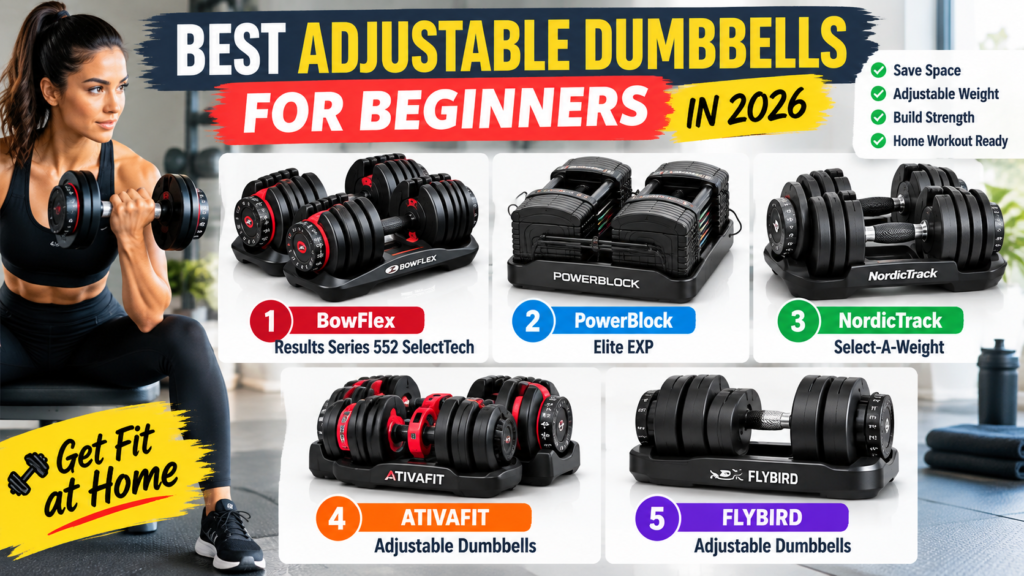
Find the best adjustable dumbbells for beginners in 2026. Compare 5 top options, weight ranges, features, safety tips, and home workout advice.
LifeCareBalance.com is reader-supported. When you buy through links on our site, we may earn an affiliate commission at no extra cost to you. As an Amazon Associate, we earn from qualifying purchases.
Starting a home strength-training routine does not require a large gym, an expensive equipment rack, or years of lifting experience. For many beginners, adjustable dumbbells are a practical way to build strength, learn basic exercises, and progress gradually without filling an entire room with weights.
The challenge is choosing the right set. Some adjustable dumbbells use dials, others use selector pins, and traditional plate-loaded models require manual adjustments. Each design has different advantages for convenience, cost, storage, and long-term use.
In this guide, we compare five adjustable dumbbell options for beginners: BowFlex SelectTech 552, PowerBlock Elite EXP, NordicTrack Select-A-Weight, Ativafit, and FLYBIRD. We explain what to consider before buying, how to compare weight settings, and how to begin a simple home workout routine.
Quick answer: For beginners who prioritize easy weight changes, a dial-based adjustable dumbbell set may be a convenient choice. PowerBlock Elite EXP is worth considering if you want a compact system with expansion options. NordicTrack may suit buyers comparing a higher maximum weight, while Ativafit and FLYBIRD are options to investigate when comparing different price points and adjustment designs. Always confirm the exact model, current specifications, package contents, warranty, and safety notices before purchasing.
Quick Comparison: Best Adjustable Dumbbells for Beginners
| Product | Best for | Main consideration |
|---|---|---|
| BowFlex SelectTech 552 | Convenient dial adjustment | Check the exact current model and recall status |
| PowerBlock Elite EXP | Long-term progression | The block-shaped design may feel unfamiliar |
| NordicTrack Select-A-Weight | Buyers comparing a higher weight ceiling | Check the minimum setting and increments |
| Ativafit Adjustable Dumbbells | Comparing alternative adjustment systems | Specifications vary by model |
| FLYBIRD Adjustable Dumbbells | Buyers comparing compact home-training options | Verify the weight settings and whether a pair is included |
These are category-based comparisons, not claims that every product has been independently tested. Specifications can differ between generations and product listings.
Why Adjustable Dumbbells Make Sense for Beginners
Traditional dumbbells are available in fixed weights. To move from a lighter pair to a heavier pair, you need to purchase and store additional equipment.
Adjustable dumbbells combine several weight settings in a single system. Depending on the design, you can change the resistance using a dial, selector pin, or plate-loading mechanism.
This arrangement can be useful if you live in an apartment, have limited storage space, or want to establish a home workout routine without purchasing a full dumbbell rack.
1. They save space
A pair of adjustable dumbbells and their storage trays can take up considerably less room than multiple pairs of fixed weights. You still need sufficient floor space to exercise safely, but you may not need a dedicated gym room.
2. They allow gradual progression
As exercises become easier, you can increase the resistance when the available weight increments suit your training needs. Smaller increases can be especially useful for exercises such as curls, lateral raises, and shoulder presses.
3. They support full-body workouts
With an appropriate weight range, adjustable dumbbells can be used for squats, rows, chest presses, Romanian deadlifts, curls, and several other exercises. A single set can therefore support a broad range of beginner workouts.
4. They can offer long-term value
The initial purchase price may be higher than that of a basic pair of fixed dumbbells. However, a well-chosen adjustable system can reduce the need to purchase many separate pairs as your training develops.
The best value depends on how frequently you exercise, how much weight you need, and whether replacement parts or expansion kits are available.
1. BowFlex SelectTech 552 — Best for Dial-Based Adjustment

- QUICK ADJUSTMENT DIALS: Switch between weight settings with a quick twist of the dials, from 5 to 52.5 pounds per dumbbe…
- SPACE-SAVING DESIGN: Get more workout in less space by replacing 15 separate weights with a single, all-in-one set.
- PREMIUM METAL COMPONENTS: Reinforced with durable metal plates and a locking system to keep weights in-place.
The BowFlex SelectTech 552 is a well-known adjustable dumbbell design that uses selector dials to change the selected resistance while the dumbbell is positioned in its tray.
The current BowFlex Results Series 552 listing specifies 15 weight settings from 5 to 52.5 pounds per dumbbell. The manufacturer lists a two-year parts warranty, although availability and terms may depend on the purchase location.
Key features
- Dial-based weight selection
- Multiple weight settings in one dumbbell
- Storage trays
- A maximum listed weight of 52.5 pounds per dumbbell for the current Results Series model
Advantages
The dial system can make changing weights between exercises straightforward. You do not need to manually remove and replace individual plates for each adjustment.
The available range may be sufficient for many beginner and intermediate exercises, although some users will need heavier weights for particular movements as their strength increases.
Limitations
Adjustable dumbbells with moving components need careful handling. They should be placed in their trays for weight changes and used according to the manufacturer’s instructions.
Important safety check: Certain older BowFlex 552 and 1090 adjustable dumbbells were included in a 2025 CPSC recall because weight plates could detach from the handle. Before using an older unit, check the official recall notice and its serial-number information. Do not assume that an older recalled product is equivalent to a current model.
Best for: Beginners who prioritize convenient dial-based adjustment and want a familiar dumbbell-style design.
2. PowerBlock Elite EXP — Best for Long-Term Progression

- ADJUSTABLE DUMBBELLS SET: Elevate your fitness and performance with strength-training equipment that adjusts with you. T…
- COMPACT & PORTABLE: The adjustable, convenient, and compact dumbbells provide innovative strength training for an easy-t…
- EASY & QUICK ADJUSTABILITY: Quickly adjust the weight set up or down for your exercise with the secure magnetic polyprop…
PowerBlock Elite EXP dumbbells use a selector-pin system and a compact, block-shaped design. The Stage 1 system is designed to provide a 5–50-pound range per hand, with expansion options available for compatible configurations.
Key features
- Selector-pin weight adjustment
- Compact storage footprint
- Expandable system on compatible versions
- A substantial range of resistance for many home exercises
Advantages
A selector pin can make changing weights quick once you understand how the system works. The compact structure is useful when storage space is limited.
The expansion system is also worth considering if you would rather upgrade a compatible setup later than replace the entire set.
Limitations
The shape differs from a conventional round dumbbell. Some beginners may need time to become comfortable with the hand position and the way the weights sit around the grip.
Check the precise version before purchasing because expansion compatibility, maximum weight, and included components can differ.
Best for: Buyers who value compact storage and want the option to expand their training equipment in the future.
3. NordicTrack Select-A-Weight — Best for Comparing Higher Weight Settings

- [Smooth Weight Selector] – Adjust each Select-A-Weight dumbbell in 2.5, 5, and 10 lb increments to dial in the perfect r…
- [10 Lb. Handlebars] – Each 55 lb. Select-A-Weight adjustable dumbbell features a 10 lb. handlebar that can be used indiv…
- [Replace 30 Dumbbells] – Each Select-A-Weight dumbbell features 15 possible assortments, meaning that this innovative se…
NordicTrack Select-A-Weight is another adjustable dumbbell system aimed at home workouts. The exact weight range and adjustment increments should be checked against the specific version being sold.
Key features to compare
- Available weight settings
- Minimum and maximum resistance
- Selector mechanism
- Handle comfort
- Storage tray dimensions
- Warranty and replacement-part availability
Advantages
A system with a higher maximum setting can be useful if you expect to progress to heavier rows, presses, or lower-body movements.
The key is choosing a model that also provides suitable lighter settings. A high maximum weight does not automatically make a dumbbell better for a beginner.
Limitations
Some versions may have relatively large jumps between selected weights. That can make progression less convenient for smaller muscle groups or exercises where a small increase is preferable.
Do not rely on a generic product description to establish the exact specifications. Verify the model number and the settings shown on the current manufacturer’s listing.
Best for: Beginners comparing adjustable dumbbells with a higher advertised maximum weight and a selector-based design.
4. Ativafit Adjustable Dumbbells — Best for Comparing Alternative Designs

- Note: We sell one pair of ATIVAFIT 25kg adjustable dumbbells for one person.
- SPACE SAVING – All-in-one design combines 10 packs of weights in one on the free plastic tray.
- COMPLETE BODY EXERCISE – With Ativafit adjustable dumbbells, you can work all areas of your body such as blanks, lungs, …
Ativafit offers adjustable dumbbells in different configurations. Depending on the model, the design and adjustment mechanism may differ, so it is important to identify the exact product before comparing it with other brands.
What to check
- The precise model and weight range
- Whether the price includes one dumbbell or a pair
- The available weight increments
- How the locking or adjustment system works
- Handle dimensions and grip comfort
- Tray design and storage requirements
- Warranty and return conditions
Advantages
Ativafit gives buyers another brand to compare when shopping for adjustable home-training equipment. If a particular model offers the weight range and adjustment system you need, it may be worth evaluating alongside more established alternatives.
Limitations
Specifications should not be generalized across the entire brand. A feature listed for one model may not apply to another.
Before purchasing, confirm the exact product variation and look for clear instructions about changing weights and securing the plates.
Best for: Buyers who want to compare alternative adjustable dumbbell designs and prices before making a decision.
5. FLYBIRD Adjustable Dumbbells — Best for Comparing Compact Options

- 【FLYBIRD】Design and produce fitness equipment for 20 years. Especially in WEIGHT BENCH, the bench was designed with advi…
- 【2021 High Quality Bench】Made of commercial thickness steel, past thousands of weight test to ensure safety for workout …
- ASTM-Certified & 800lbs Heavy-Duty Support: Its elongated thickened steel frame, dual-triangle structure, and double-loc…
FLYBIRD is another brand to consider when researching adjustable equipment for home workouts. The product name alone does not establish the precise weight range, adjustment increments, or package contents.
Key features to investigate
- Minimum and maximum weight per dumbbell
- Number of weight settings
- Adjustment speed and mechanism
- Handle material and comfort
- Included trays or accessories
- Whether the listing is for a single dumbbell or a pair
Advantages
A compact adjustable design can be practical for people who train in bedrooms, apartments, or multipurpose spaces. Quick weight changes can also make a routine easier to manage when several exercises require different resistance levels.
Limitations
A compact appearance does not guarantee that a dumbbell is easy to handle or appropriate for every exercise. Weight increments, grip dimensions, and locking instructions matter just as much as overall size.
Compare the precise FLYBIRD model against other options instead of assuming that all models have the same adjustment system.
Best for: Buyers comparing compact adjustable dumbbells and checking which configuration best fits their available space and training needs.
How to Choose the Right Adjustable Dumbbells
The right choice depends on your current strength, intended exercises, budget, and storage space. Use the following factors to narrow the options.
1. Choose a suitable weight range
There is no single weight range that is ideal for every beginner. A person may need light dumbbells for lateral raises but substantially more resistance for squats or Romanian deadlifts.
Think about the exercises you plan to perform. For each one, choose a weight that allows you to maintain control and use good technique throughout the set.
A system starting at approximately 5 pounds may be useful for some beginners, but others may need lighter resistance for certain movements. Likewise, a maximum of 50 pounds per hand may be sufficient for many starting routines but not for every person or long-term goal.
2. Pay attention to weight increments
The amount by which resistance increases can be as important as the maximum weight.
Smaller increments make it easier to progress gradually. Large jumps may be manageable for some exercises but too challenging for others.
Before purchasing, review the complete list of available settings. Do not assume that every adjustable dumbbell increases by the same amount throughout its range.
3. Understand the adjustment mechanism
There are three common approaches:
Dial systems: Turn a selector to choose a weight. These are convenient when you frequently change resistance, but the manufacturer’s handling instructions must be followed.
Selector-pin systems: Insert a pin into the correct position. These can provide quick adjustments and compact storage.
Spin-lock systems: Add or remove plates and secure them using collars. These are often worth comparing when cost is the main concern, although changing weights may take longer.
Choose the system you can use correctly and consistently.
4. Check the grip
A handle should feel comfortable and allow you to maintain a secure grip without forcing your wrist into an awkward position.
If possible, review the handle dimensions and product photographs before buying. Pay particular attention to the grip if you have small hands or find thick handles uncomfortable.
5. Consider the dumbbell’s shape
Traditional-shaped adjustable dumbbells may feel more familiar to new lifters. Block-shaped systems can be compact and practical, but their shape may affect how certain exercises feel.
Think about the movements you plan to perform and whether the dumbbell’s dimensions will interfere with your wrists, forearms, or range of motion.
6. Measure your storage area
Check the product dimensions and measure the space where you plan to keep the equipment. Allow room to remove the dumbbells from their trays and place them back securely.
Also make sure that the workout area has enough clearance for lunges, rows, presses, and other movements.
7. Review warranty and safety information
Read the manufacturer’s instructions before using any adjustable dumbbell. Check the locking mechanism, weight-selection procedure, warranty terms, and availability of replacement parts.
Avoid using damaged equipment. Never assume that adjustable dumbbells are designed to be dropped onto the floor.
8. Compare the complete package
Confirm whether the listing includes one dumbbell or two, storage trays, expansion kits, or other accessories.
A low advertised price may refer to a single unit or a different configuration. Compare the cost of the package you actually need rather than the headline price alone.
Adjustable Dumbbells vs. Traditional Dumbbells
| Feature | Adjustable dumbbells | Traditional dumbbells |
|---|---|---|
| Storage | Usually compact | Multiple pairs need more space |
| Weight selection | Changes between settings | Each dumbbell has a fixed weight |
| Exercise transitions | May require adjustment | Quick if each weight is available |
| Initial cost | Varies by system | One pair can be inexpensive |
| Expansion | Depends on compatibility | Additional pairs can be purchased |
| Handling | Requires following adjustment instructions | No weight-selection mechanism |
| Best use case | Space-conscious home gyms | Dedicated gyms with multiple weights |
For a beginner who needs several resistance levels in a small room, adjustable dumbbells can be a practical choice. Traditional dumbbells may be more convenient when you already have several pairs and want to change weights instantly.
Neither option is automatically better for every user.
A Beginner-Friendly Dumbbell Workout
Adjustable dumbbells can support a simple full-body routine. Start with manageable resistance, learn the movements, and increase the difficulty gradually.
The following routine is an example for generally healthy adults who can perform these movements comfortably. It is not a personalized exercise prescription.
Warm-up
Spend about five minutes moving gently before lifting. You might walk in place, perform controlled bodyweight squats, or move your shoulders through a comfortable range of motion.
Use light or no weights during your first practice repetitions.
1. Dumbbell Goblet Squat
- Sets: 1–2
- Repetitions: 8–12
- Main muscles: Legs and glutes
Hold one dumbbell close to your chest. Keep your feet in a comfortable position, move your hips back, and lower yourself only as far as you can control comfortably. Stand up without bouncing or rushing.
2. Dumbbell Romanian Deadlift
- Sets: 1–2
- Repetitions: 8–12
- Main muscles: Glutes and hamstrings
Hold the dumbbells in front of your thighs. Bend at the hips while keeping your back in a comfortable neutral position. Lower the weights along your legs and return to standing with control.
Start with a light load and practice the hip-hinge movement before increasing resistance.
3. Supported One-Arm Dumbbell Row
- Sets: 1–2
- Repetitions: 8–12 per side
- Main muscles: Back and arms
Support one hand on a stable bench or other suitable surface. Keep your torso steady and pull the dumbbell toward your hip without twisting your body. Lower it slowly.
4. Dumbbell Floor Press
- Sets: 1–2
- Repetitions: 8–12
- Main muscles: Chest and triceps
Lie on the floor with your knees bent. Hold the dumbbells above your chest and lower them under control until your upper arms gently meet the floor. Press the weights upward without bouncing.
Use a weight you can safely control when getting into and out of position.
5. Dumbbell Biceps Curl
- Sets: 1–2
- Repetitions: 8–12
- Main muscles: Biceps
Stand or sit upright and hold the dumbbells at your sides. Bend your elbows to lift the weights without swinging your torso. Lower them slowly and keep your wrists comfortable.
6. Standing Dumbbell Shoulder Press
- Sets: 1–2
- Repetitions: 8–10
- Main muscles: Shoulders and triceps
Begin with very light dumbbells. Press upward only through a comfortable range of motion while keeping your torso steady. If overhead movement causes discomfort or you cannot maintain control, skip the exercise and choose an appropriate alternative.
Rest between sets as needed. You do not need to complete the routine quickly, lift to exhaustion, or use heavy weights to make a beginning routine worthwhile.
For additional exercise guidance, the American Council on Exercise’s beginner strength-training workout provides examples of basic movements and technique considerations.
How Often Should Beginners Train?
A simple starting schedule is two nonconsecutive days of full-body strength training each week. This gives you an opportunity to practice the movements while allowing time for recovery.
The American College of Sports Medicine’s 2026 resistance-training guidance emphasizes consistency and individualized programming rather than unnecessarily complicated routines. It also highlights training the major muscle groups at least twice per week for generally healthy adults.
Read the ACSM resistance-training guidance for more detail.
For general physical activity, the CDC recommends that adults work toward at least 150 minutes of moderate-intensity aerobic activity each week, alongside muscle-strengthening activity on at least two days. Your individual needs and abilities may differ.
See the CDC’s adult physical activity guidance for the broader recommendations.
Common Mistakes to Avoid
Buying the heaviest set available
The maximum weight is only one part of the decision. A beginner also needs suitable lighter settings, manageable increments, and an adjustment system that is easy to operate correctly.
Ignoring the minimum weight
Some exercises require less resistance than others. Check whether the lowest available setting is appropriate for the movements you plan to perform.
Increasing weight too quickly
Do not increase resistance just because a particular number of repetitions is listed in a routine. First make sure you can perform the movement with control and good technique.
Forgetting to check the package contents
Confirm whether you are buying one dumbbell or a pair. Check whether the trays and any advertised accessories are included.
Ignoring safety notices
Inspect the equipment regularly, follow the adjustment instructions, and verify whether any recall applies to the exact model you own or intend to purchase.
Treating every model as identical
Two dumbbells with similar maximum weights may differ substantially in their adjustment mechanism, grip, dimensions, weight increments, and warranty.
Compare the complete specifications rather than relying on a product name or a single headline feature.
Related LifeCareBalance Guides
If you need a different kind of comparison, these guides cover related but distinct buying decisions:
- Best Adjustable Dumbbells for Home Gyms in 2026 — for a broader home-gym comparison.
- Best Adjustable Dumbbells Under $100 in 2026 — for budget-focused shopping.
- Compact Adjustable Dumbbells for Small Spaces — for limited storage areas.
- Best Adjustable Dumbbells Under $500 — for comparing options within a defined budget.
- Beginner Adjustable Dumbbells for Women — for a more specific beginner buying perspective.
Before publishing these links, confirm that each URL loads correctly and that its destination provides the intended content.
Frequently Asked Questions
Are adjustable dumbbells good for beginners?
Yes. They can provide several resistance levels in a compact system, making them useful for people who want to start strength training at home.
What weight should a beginner choose?
There is no universal starting weight. Choose resistance that allows you to complete your planned repetitions with control and good technique. The appropriate load varies by exercise and individual strength.
Are 50-pound adjustable dumbbells enough?
A 50-pound maximum per dumbbell may be sufficient for many beginners and some intermediate trainees. However, some exercises and stronger users may eventually require more resistance.
Which adjustment mechanism is easiest?
Dial and selector-pin systems can make weight changes convenient. Spin-lock systems require more manual work but may be worth considering when budget is the priority. Ease of use depends on the exact model and the user’s preferences.
Can adjustable dumbbells build muscle?
Yes. Adjustable dumbbells can provide resistance for effective strength-training exercises. Progress depends on consistent training, appropriate resistance, technique, recovery, and other individual factors.
Are adjustable dumbbells better than fixed dumbbells?
They can be more space-efficient when you need multiple weight levels. Fixed dumbbells can be more convenient when you already have a rack of weights and want to switch between them immediately.
Are adjustable dumbbells safe?
They can be used safely when the user follows the manufacturer’s instructions, checks that weights are secured, and avoids using damaged equipment. Recall notices should be checked for relevant models.
How many days a week should a beginner lift weights?
Two nonconsecutive strength-training days each week is a practical starting schedule for many generally healthy adults. Adjust the routine to your experience, recovery, and individual needs.
Do I need a bench to use adjustable dumbbells?
No. Many movements, including goblet squats, Romanian deadlifts, curls, and certain rows, can be performed without a bench. A stable bench can make additional exercises, such as chest presses, more convenient.
How should I increase the weight?
Increase resistance when you can complete your planned repetitions with good technique and feel ready for a manageable challenge. Use smaller increments when possible, particularly for exercises where a large increase would be difficult to control.
Final Verdict
The best adjustable dumbbells for beginners are those that match your current strength, provide useful weight increments, feel comfortable in your hands, and fit your budget and available space.
BowFlex SelectTech 552 is worth considering for dial-based adjustment, while PowerBlock Elite EXP stands out for its compact selector-pin design and expansion options. NordicTrack, Ativafit, and FLYBIRD can also be compared, provided you verify the exact model specifications rather than relying on generic product descriptions.
Before buying, check the complete weight range, package contents, warranty, and relevant safety notices. For BowFlex 552 and 1090 units in particular, verify whether the exact product is affected by the recall.
Start with manageable resistance, learn the basic movements, and build a routine you can maintain. Consistency and safe progression matter more than buying the heaviest equipment available.