
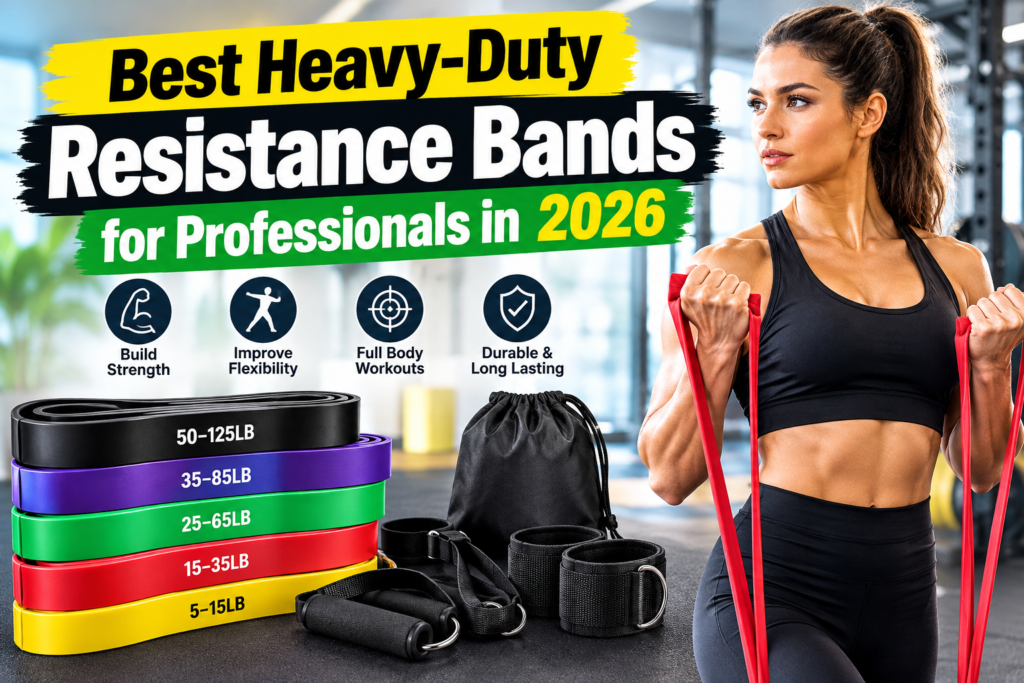
Compare the best heavy-duty resistance bands for professionals in 2026. Learn about resistance levels, durability, band types, safety, accessories, and how to choose the right set.
LifeCareBalance.com is reader-supported. When you buy through links on our site, we may earn an affiliate commission at no extra cost to you. As an Amazon Associate, we earn from qualifying purchases.
If you train seriously, coach clients, compete in sports, or want a compact home gym that can handle demanding workouts, the best heavy-duty resistance bands are not simply the bands with the biggest resistance number printed on the package.
The better choice depends on the band type, usable resistance, construction quality, attachment system, exercise selection, progression, portability, and safety.
For professionals and advanced users, resistance bands can be much more than a warm-up tool. A properly selected system can support strength training, athletic conditioning, assisted pull-ups, mobility work, home workouts, travel training, and cable-style exercises.
In 2026, there is also another factor worth considering: hardware safety. A strong band is only useful if the handles, clips, straps, anchors, and connection points are also designed and maintained properly.
For most advanced users, there are two main choices:
- Long-loop power bands for pull-ups, squats, deadlifts, presses, mobility, and athletic training.
- Stackable tube bands with handles for rows, presses, curls, triceps work, and cable-style exercises.
Flat resistance bands also have an important place in professional training, particularly when you need predictable progression for mobility, warm-ups, activation, and rehabilitation-style exercises.
Quick Answer
Best for a versatile home gym: Stackable tube bands with handles and multiple resistance levels.
Best for heavy compound movements: Long-loop power bands.
Best for assisted pull-ups and athletic training: Long-loop power bands.
Best for cable-style exercises: Stackable tube bands with handles and an appropriate anchor.
Best for mobility and progressive resistance: THERABAND-style flat resistance bands.
If you want a broader look at handle-based systems, see our Resistance Bands Set with Handles and Door Anchor.
What Makes a Resistance Band “Heavy-Duty”?
The term heavy-duty is often used as marketing language, so it should not be treated as a standardized performance rating.
A genuinely useful heavy-duty system should offer several things:
- Durable elastic material
- Appropriate resistance levels
- Reliable handles or loops
- Strong attachment points
- Quality carabiners and straps
- A secure anchor system when applicable
- Enough resistance for your main exercises
- Multiple progression options
- Clear safety instructions
- Replacement availability
The important point is that maximum advertised resistance is not the same thing as useful resistance.
A band may claim a very high maximum load but still be poorly suited to your exercises. Conversely, a lower-rated band can be more useful if it provides the right resistance through your working range.
For professional users, the complete system matters more than one number on the packaging.
Heavy-Duty Resistance Bands: Which Type Is Best?
| Type | Best For | Main Advantage | Main Limitation |
|---|---|---|---|
| Long-loop power band | Pull-ups, squats, deadlifts, presses | High resistance and versatility | No built-in handle |
| Tube bands with handles | Rows, presses, curls | Cable-style training | More connection points |
| Flat bands | Mobility, warm-ups, graded resistance | Simple and progressive | Less suitable for very heavy compounds |
| Mini loop bands | Glutes, activation, warm-ups | Compact and convenient | Limited for heavy full-body work |
There is no universal winner. The best type depends on how you train.
A strength coach working with athletes may prioritize long-loop bands, while someone building a compact home gym may prefer a stackable tube system with handles and attachments.
1. Stackable Tube Bands
Stackable tube bands are among the most practical options for people who want resistance bands to replicate some of the movements normally performed with a cable machine.
Depending on the system, you can perform:
- Chest presses
- Standing rows
- Lat-style pulls
- Biceps curls
- Triceps extensions
- Shoulder presses
- Lateral raises
- Leg exercises
- Core movements
- Woodchops
- Mobility exercises
The biggest advantage is adjustability.
Instead of depending on one extremely heavy band, you can combine different resistance levels to create a more appropriate training load.
This is particularly useful when a professional trainer needs different resistance levels for different clients or exercises.
For users comparing compact strength equipment, our Best Adjustable Dumbbells for Home Gyms in 2026 guide is a useful alternative when you want more conventional loading.
What to Check Before Buying
Do not focus only on the resistance number. Inspect:
- Carabiners
- Handles
- Straps
- Door anchor
- Band-to-strap connection
- Stitching
- Replacement options
- Warranty
- Storage system
- Manufacturer safety instructions
These components become increasingly important as resistance increases.
Important 2026 Safety Note
The U.S. Consumer Product Safety Commission announced a 2026 recall involving certain HomeProGym resistance bands because the bands could separate from their handles during use, creating an impact hazard. The recall involved specific purple 60-pound and gray 70-pound bands, not every resistance band on the market.
You can check the CPSC 2026 resistance-band recall before purchasing or using recalled equipment.
2. Long-Loop Power Bands
If your priority is serious strength work rather than cable-style exercises, long-loop power bands are often the better choice.
They are especially useful for:
- Assisted pull-ups
- Banded squats
- Banded deadlifts
- Banded presses
- Hip-hinge work
- Athletic conditioning
- Mobility drills
- Warm-ups
- Powerlifting accessory work
- Travel workouts
One major advantage is simplicity.
A long-loop band does not necessarily require handles, carabiners, or a door anchor. That reduces the number of components involved in many exercises.
For athletes and coaches, this makes long-loop bands particularly convenient when training needs to move between a gym, field, training facility, and home.
Why Professionals Like Long-Loop Bands
Long-loop bands can also be used in different ways depending on how they are positioned.
You can:
- Stand on the band
- Hold the band directly
- Loop it around a bar
- Use it for assisted pull-ups
- Combine multiple bands
- Use it for dynamic warm-ups
- Add accommodating resistance to certain lifts
The resistance increases as the band stretches, so the exercise does not feel exactly like lifting a fixed-weight dumbbell.
That variable resistance is one of the characteristics that makes elastic resistance different from conventional weights.
3. THERABAND-Style Flat Resistance Bands
Flat resistance bands are different from heavy power bands.
Their main strength is not necessarily maximum resistance. Instead, they are useful when you want:
- Clearly differentiated resistance levels
- Warm-up work
- Mobility exercises
- Shoulder exercises
- Activation drills
- Progressive exercise
- Trainer-led sessions
- Rehabilitation-style movements
For a professional trainer, having lighter bands available can be just as important as owning extremely heavy bands.
A complete resistance-band setup should therefore not automatically consist of only the heaviest options.
Heavy-Duty Resistance Bands vs Adjustable Dumbbells
| Feature | Heavy-Duty Bands | Adjustable Dumbbells |
|---|---|---|
| Portability | Excellent | Good |
| Storage | Excellent | Good |
| Assisted pull-ups | Excellent | Not suitable |
| Cable-style exercises | Excellent with anchor | Limited |
| Traditional strength work | Good | Excellent |
| Resistance feel | Changes with stretch | More consistent |
| Travel workouts | Excellent | Poorer |
| Progressive loading | Good | Excellent |
| Setup flexibility | Excellent | Moderate |
| Space requirements | Very low | Low to moderate |
Bands have a major advantage when portability and space are priorities.
Dumbbells generally have an advantage when you want a more consistent external load and traditional strength-training movements.
If you want a more detailed comparison of conventional home-gym loading, read our Best Adjustable Dumbbells for Home Gyms in 2026.
How Much Resistance Do You Actually Need?
There is no universal resistance level that makes a band professional.
Your ideal resistance depends on:
- Current strength
- Exercise selection
- Starting position
- Band length
- Range of motion
- Stretch distance
- Training goal
- Number of bands used together
- Desired repetitions
- Your ability to maintain proper technique
Instead of asking:
“What is the heaviest band available?”
Ask:
“What resistance levels do I need for my main exercises?”
For example, a band that feels extremely heavy during a standing curl may not provide the same challenge during a squat or deadlift.
That is because band tension depends heavily on how far the band is stretched.
This is why professional users should evaluate a resistance system across their actual exercise list rather than buying based on one maximum number.
Are Resistance Bands Good for Strength Training?
Yes. Research supports elastic resistance as a legitimate resistance-training method.
A systematic review and meta-analysis published in SAGE Open Medicine found no significant superiority of elastic resistance or conventional resistance training for upper- or lower-limb strength in the included studies. The authors concluded that elastic resistance can produce similar strength gains to conventional resistance training across different populations and protocols.
Another systematic review found that elastic resistance exercise can improve muscle strength and functional performance compared with passive control, while not being clearly superior to other resistance-training methods.
More recent 2026 research also highlights that elastic resistance is useful across sports medicine, rehabilitation, and athletic conditioning, while emphasizing that band color alone is not an adequate way to quantify training load.
The practical takeaway is simple:
Resistance bands can provide an effective training stimulus when the resistance is appropriately challenging and the training program progresses over time.
They are not automatically better than free weights, but they can be an extremely useful training tool.
Heavy-Duty Resistance Bands for Athletes
Athletes can use resistance bands for more than basic strength exercises.
Depending on the sport and training program, bands can support:
- Dynamic warm-ups
- Acceleration drills
- Change-of-direction preparation
- Lower-body strength work
- Upper-body accessory training
- Assisted movements
- Mobility
- Activation
- Sport-specific conditioning
Recent systematic-review evidence in team-sport athletes has reported positive effects of elastic-band training on measures including lower-limb explosive power, sprint performance, and change-of-direction performance.
That does not mean resistance bands automatically make an athlete faster or stronger. Training quality, programming, recovery, technique, and sport-specific work still matter.
The value of bands is their flexibility and ability to add resistance without requiring a large amount of equipment.
What Makes a Resistance Band Truly Heavy-Duty?
1. Useful Resistance Range
A good system should offer enough resistance for:
- Warm-ups
- Moderate exercises
- Strength exercises
- Heavy compound movements
- Progressive training
A single extremely heavy band is rarely enough for a complete system.
2. Construction Quality
Check the:
- Band thickness
- Band width
- Material
- Stitching
- Handles
- Straps
- Carabiners
- Connection points
The weakest component can determine the safety of the entire system.
3. Attachment Quality
If a band uses handles or anchors, inspect how the elastic material connects to the hardware.
This is particularly important for high-resistance training.
4. Door Anchor Quality
A door anchor can dramatically increase the number of exercises available, but it should only be used according to the manufacturer’s instructions.
The door, anchor position, band direction, and attachment system all need to be appropriate for the exercise.
5. Replacement Support
Professionals often use equipment more frequently than casual users.
Look for systems where replacement bands or accessories are reasonably easy to obtain.
How to Choose Resistance Bands for Professional Training
Before buying, ask five questions.
What exercises will I perform most?
If your program focuses on pull-ups, squats, deadlifts, and athletic work, long-loop bands may be the better choice.
If your workouts are dominated by rows, presses, curls, and triceps movements, a tube system with handles may be more practical.
Do I need different resistance levels?
If several people will use the equipment, multiple resistance levels are more important than one extremely heavy band.
Do I need portability?
For coaches, athletes, and people who travel, bands are difficult to beat for portability.
Do I need an anchor?
If you want cable-style movements, an anchor can significantly increase exercise variety.
Will I use the bands frequently?
Frequent use makes construction quality, replacement availability, and safety inspection more important.
Heavy-Duty Resistance Bands Safety Checklist
Before every demanding workout, inspect your equipment.
- Check the band for cuts.
- Look for cracks or thinning.
- Inspect areas showing abrasion.
- Check handles and connection points.
- Inspect carabiners.
- Check straps and stitching.
- Make sure the anchor is correctly positioned.
- Keep the band away from sharp edges.
- Do not exceed manufacturer instructions.
- Stop using damaged equipment immediately.
Do not continue using a band simply because the damage appears small.
Elastic material can deteriorate over time, particularly with frequent use, improper storage, heat, sunlight, chemicals, or repeated abrasion.
For official U.S. product-safety information, review the CPSC 2026 resistance-band recall.
Best Exercises for Heavy-Duty Resistance Bands
A strong resistance-band system should allow you to train multiple movement patterns.
Upper Body
- Band chest press
- Standing row
- Biceps curl
- Triceps pressdown
- Shoulder press
- Lateral raise
- Face pull
Lower Body
- Banded squat
- Romanian deadlift variation
- Hip hinge
- Glute bridge
- Lateral band walk
- Split squat
Full Body
- Band thruster
- Squat to press
- Resistance-band deadlift
- Rotational movements
- Band-resisted carries
Athletic Training
- Assisted pull-ups
- Dynamic warm-ups
- Band-resisted movement drills
- Shoulder activation
- Hip activation
- Mobility work
The best exercise selection depends on the individual training program rather than simply trying to use every attachment in the package.
Resistance Bands and Weight Loss
Resistance bands can be part of a muscle-strengthening and active lifestyle routine, but they should not be presented as a guaranteed fat-loss product.
The CDC adult physical activity guidelines recommend muscle-strengthening activity on at least two days each week for adults.
For weight management, resistance training works best as part of a broader approach that includes appropriate nutrition, regular physical activity, recovery, and sustainable habits.
If you also want a compact way to add more daily movement, our Best Walking Pads for Home in 2026 guide covers another home-fitness category.
7 Buying Mistakes to Avoid
1. Buying the Biggest Advertised Number
A higher number does not automatically mean a better band.
2. Buying the Wrong Band Type
A power band and a tube system serve different purposes.
3. Ignoring Hardware
A strong elastic band paired with weak hardware is not a good professional system.
4. Buying Too Few Resistance Levels
Progressive training is easier when you can increase resistance gradually.
5. Choosing Based Only on Color
Colors are not universal resistance standards across brands.
Always check the manufacturer’s actual specifications.
6. Ignoring Your Exercise Selection
Choose equipment based on what you actually train.
7. Trusting Marketing Claims Without Checking Specifications
Words such as “unbreakable,” “commercial grade,” or “professional” should not replace inspection of actual construction and safety information.
Professional Buying Checklist
Before purchasing, compare:
- Band type
- Resistance range
- Band dimensions
- Material
- Handles
- Carabiners
- Door anchor
- Ankle straps
- Bar or other attachments
- Warranty
- Replacement availability
- Safety instructions
- Storage
- Exercise compatibility
- Current product variant
If space is your main constraint, our Affordable Adjustable Dumbbells for Small Spaces guide shows another compact strength-training option.
For beginners who are building a home gym, our Best Adjustable Dumbbells for Beginners in 2026 guide explains how resistance range, increments, adjustment type, and space should affect the decision.
Who Should Buy Heavy-Duty Resistance Bands?
Heavy-duty resistance bands can make sense for several types of users.
Professional Trainers
Trainers can benefit from having multiple resistance levels available for different clients and exercises.
Athletes
Athletes can use bands for warm-ups, accessory exercises, conditioning, mobility, and certain strength applications.
Advanced Home-Gym Users
People with limited space can use bands to expand their exercise selection without adding a large cable machine.
Travelers
A complete resistance-band system can fit into a small bag and provide useful training away from a traditional gym.
Beginners
Beginners can also use resistance bands, but they do not necessarily need the heaviest bands available.
In many cases, a moderate multi-level set is more useful than an extreme heavy-duty package.
How to Progress With Resistance Bands
Progression is one of the most important parts of effective resistance training.
You can progress by:
- Increasing band resistance.
- Combining compatible bands.
- Increasing repetitions.
- Increasing sets.
- Increasing range of motion.
- Improving exercise control.
- Reducing rest when appropriate.
- Moving to a more difficult exercise variation.
However, simply adding more resistance is not always the best progression strategy.
If additional resistance causes poor technique, reduced range of motion, or uncontrolled movement, the heavier band may actually reduce the quality of the exercise.
For professionals, controlled progression is more valuable than chasing the biggest resistance number.
Final Verdict
There is no single best heavy-duty resistance band for every professional user.
Choose a stackable tube system if you want a compact cable-style home gym with handles, multiple resistance levels, and attachments.
Choose long-loop power bands if your priorities are assisted pull-ups, heavy compound movements, athletic training, and simple setup.
Choose graded flat bands if you need predictable resistance for mobility, warm-ups, activation, or professional exercise applications.
The strongest purchase is not necessarily the band with the biggest advertised resistance number.
It is the system that gives you:
- The right resistance
- Useful progression
- Durable construction
- Secure attachments
- Appropriate exercise options
- Good portability
- Clear safety information
Resistance bands can be an excellent complement to adjustable dumbbells and other home-gym equipment rather than a replacement for everything.
For many professionals and serious home users, the ideal setup is not bands versus weights. It is bands plus the right complementary equipment.
Frequently Asked Questions
Are heavy-duty resistance bands good for building muscle?
Yes. They can provide an effective resistance-training stimulus when the resistance is appropriately challenging and the training program progresses over time. Research comparing elastic and conventional resistance has found broadly similar strength outcomes in the included studies.
What is the best resistance band for professionals?
It depends on the training goal. Long-loop bands are generally better for assisted pull-ups and many compound movements, while tube bands with handles are better for rows, presses, curls, triceps exercises, and cable-style training.
Are 300-pound resistance bands really 300 pounds?
Not in exactly the same way as a 300-pound barbell. Band tension changes with stretch length, setup, band properties, and starting position.
A maximum resistance number should therefore be treated as a specification rather than a direct equivalent to a fixed-weight dumbbell or barbell.
Are resistance bands safe?
They can be used safely when they are in good condition, correctly positioned, and used according to manufacturer instructions.
Regular inspection is particularly important for high-resistance systems.
Can resistance bands replace dumbbells?
For some exercises, yes.
But the loading characteristics are different. Dumbbells provide a relatively consistent external load, while bands increase tension as they stretch.
Many home users can therefore benefit from having both.
Should I buy loop bands or bands with handles?
Choose loop bands for pull-ups, many compound movements, mobility work, and athletic applications.
Choose tube bands with handles for rows, presses, curls, triceps exercises, and cable-style training.
Do professional resistance bands need a door anchor?
No.
Door anchors are useful for certain tube-band exercises, but many long-loop exercises can be performed without an anchor.
How often should resistance bands be replaced?
There is no universal replacement schedule.
Replace a band when you see significant cracking, tearing, thinning, severe abrasion, or damaged attachment components.
Frequency of use, storage conditions, and material quality can all affect how long a band remains suitable for training.
Are heavy resistance bands better than light bands?
Not necessarily.
Heavy bands are useful when you need greater resistance, but lighter bands are valuable for warm-ups, mobility, activation, technique work, and exercises involving smaller muscle groups.
A complete resistance system should provide an appropriate range rather than only maximum resistance.
What should professionals look for first when buying resistance bands?
Start with the training purpose.
Identify the exercises you need to perform, then choose the band type, resistance range, attachments, and accessories that support those exercises.
For serious users, usable resistance and reliable construction are more important than impressive marketing numbers.