
LifeCareBalance.com is reader-supported. When you buy through links on our site, we may earn an affiliate commission at no extra cost to you. As an Amazon Associate, we earn from qualifying purchases.
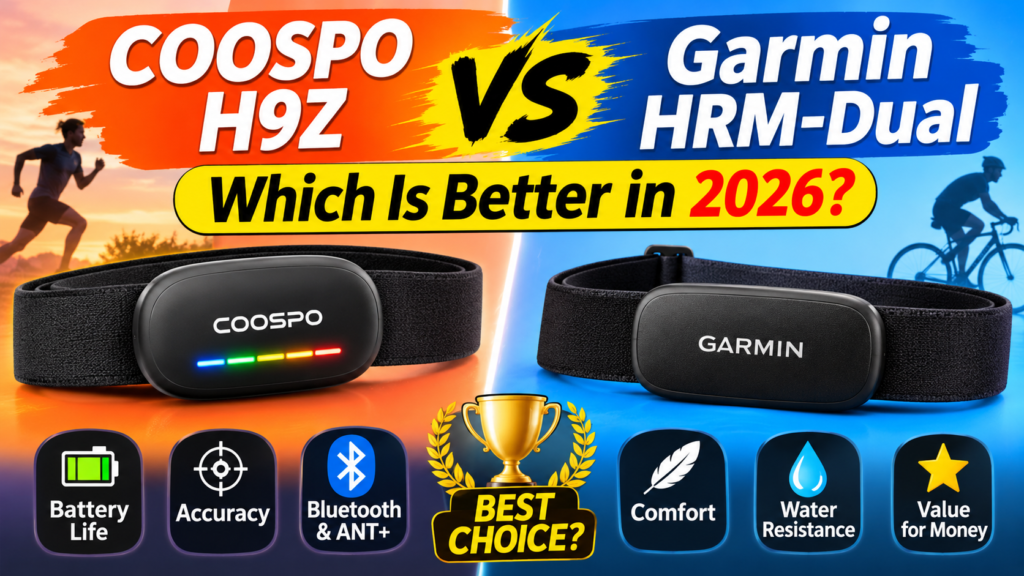
Choosing between the COOSPO H9Z and Garmin HRM-Dual in 2026 comes down to battery preference, training features, connectivity, and long-term convenience.
Both are chest-strap heart rate monitors designed to transmit real-time heart rate data to compatible smartphones, sports watches, cycling computers, and fitness equipment.
The COOSPO H9Z is the better option if you want a rechargeable battery, five-color LED heart rate zone indicators, and modern Bluetooth 5.0 connectivity.
The Garmin HRM-Dual is the better option if you prefer a replaceable CR2032 battery, a simple design, a soft adjustable strap, and long battery life between replacements.
Neither monitor is automatically more accurate in every situation. Proper strap placement, electrode contact, and device compatibility are important for both.
COOSPO H9Z vs Garmin HRM-Dual: Comparison Table
| Feature | COOSPO H9Z | Garmin HRM-Dual |
|---|---|---|
| Monitor type | Chest strap | Chest strap |
| Heart rate tracking | Yes | Yes |
| Bluetooth | Bluetooth 5.0 | Bluetooth Low Energy |
| ANT+ | Yes | Yes |
| Battery | Rechargeable lithium | Replaceable CR2032 |
| Battery life | Up to 50 hours | Up to 3.5 years |
| Charging | Magnetic USB charging | No charging required |
| Heart rate zone indicator | Five-color LED | No built-in LED zone indicator |
| Water resistance | IP67 | 1 ATM |
| Swimming | Not recommended | Does not transmit while swimming |
| Smartphone compatibility | Compatible iPhone and Android devices | Compatible Bluetooth devices |
| Adjustable strap | Yes | Yes |
| Internal workout storage | No | No |
| Best for | Rechargeable convenience | Long battery life and simple operation |
Specifications are based on manufacturer information. Battery estimates depend on usage, and compatibility varies by receiving device.
1. COOSPO H9Z: What Makes It Different?
The COOSPO H9Z is designed for people who want a straightforward chest-strap heart rate monitor with rechargeable power and useful workout feedback.
Unlike a smartwatch, it does not have a screen for displaying complete workout statistics. Instead, it transmits heart rate information to a compatible phone, sports watch, bike computer, or fitness application.
One of its most noticeable features is the five-color LED indicator. This provides a visual reference for heart rate zones without requiring you to check a connected screen every time.
Main COOSPO H9Z Features
- Bluetooth 5.0 connectivity.
- ANT+ wireless transmission.
- Rechargeable 70 mAh battery.
- Manufacturer-rated battery life of up to 50 hours.
- Five-color LED heart rate zone indicator.
- Adjustable chest strap.
- IP67 water-resistance rating.
- Compatibility with supported iPhone and Android applications.
The H9Z is particularly interesting for runners, cyclists, indoor fitness users, and people who prefer rechargeable fitness accessories.
COOSPO H9Z Rechargeable Battery
One advantage of the H9Z is that you do not need to purchase a replacement coin-cell battery whenever its power runs out.
It uses a rechargeable lithium battery and magnetic charging connection.
COOSPO lists approximately 50 hours of battery life and recommends a charging time of around 1.5–2 hours.
Actual battery performance can vary depending on usage and operating conditions.
For someone who exercises several times per week, rechargeable power can be convenient. However, you need to remember to charge the sensor before longer workouts.
Five-Color LED Heart Rate Zone Indicator
The H9Z includes five LED colors that provide visual heart rate zone feedback.
This can be useful during running, cycling, and indoor workouts when you want a quick indication of exercise intensity.
The LED indicator does not replace a full training display. For detailed heart rate graphs, workout history, and training analysis, you will still need a compatible application or device.
COOSPO H9Z Compatibility
The H9Z supports Bluetooth 5.0 and ANT+.
It can connect with compatible:
- Smartphones.
- Fitness watches.
- Cycling computers.
- Indoor cycling equipment.
- Third-party fitness applications.
Before purchasing, check that your particular device supports external Bluetooth or ANT+ heart rate sensors.
You can also read our detailed COOSPO H9Z Review 2026 for more information about its features, battery, and everyday workout use.
2. Garmin HRM-Dual: What Makes It Different?
The Garmin HRM-Dual is a chest-strap heart rate monitor designed for people who want consistent heart rate transmission without regularly charging their sensor.
Its biggest advantage is its replaceable CR2032 coin-cell battery, which Garmin rates for up to 3.5 years when used for approximately one hour per day.
This makes it particularly convenient for people who prefer a low-maintenance training accessory.
The HRM-Dual also supports Bluetooth Low Energy and ANT+ connectivity, allowing it to work with compatible Garmin devices, smartphones, training applications, and fitness equipment.
Main Garmin HRM-Dual Features
- Bluetooth Low Energy connectivity.
- ANT+ wireless transmission.
- Replaceable CR2032 battery.
- Up to 3.5 years of stated battery life.
- Soft adjustable chest strap.
- Removable sensor module.
- Washable strap.
- Heart rate and HRV support through compatible devices.
- Compatibility with supported Garmin and third-party equipment.
Garmin HRM-Dual Battery Life
Battery life is one of the strongest reasons to consider the Garmin HRM-Dual.
Unlike the rechargeable COOSPO H9Z, the Garmin uses a replaceable CR2032 coin-cell battery.
Garmin specifies up to 3.5 years of battery life based on approximately one hour of daily use.
This is a manufacturer estimate, not a guarantee that every user will get the same lifespan.
For people who train frequently, the ability to avoid regular charging can be a significant convenience.
Eventually, you will need to replace the battery, but you do not need to connect the monitor to a charger after every group of workouts.
Garmin HRM-Dual Comfort and Strap Design
Garmin uses a soft, adjustable chest strap designed to remain securely positioned during exercise.
The strap can be separated from the electronic module for washing.
This is important because sweat and salt can accumulate during repeated workouts and affect the strap’s performance.
Garmin recommends rinsing the strap after use and washing it after every seven uses. The electronic module must be removed before washing.
Garmin HRM-Dual Compatibility
The HRM-Dual supports Bluetooth Low Energy and ANT+.
It can transmit heart rate data to compatible:
- Garmin sports watches.
- Cycling computers.
- Smartphones.
- Fitness applications.
- Indoor exercise equipment.
Garmin also documents support for two simultaneous Bluetooth Low Energy connections.
This can be helpful if you want to use two compatible receiving devices during a workout.
For a complete overview, visit the official Garmin HRM-Dual product page.
3. Heart Rate Accuracy: Which Monitor Is Better?
Accuracy is one of the most important considerations when purchasing a chest-strap heart rate monitor.
Both the COOSPO H9Z and Garmin HRM-Dual are designed to measure heart rate through chest-strap electrodes rather than relying on optical wrist sensors.
Chest straps can be useful during activities that involve rapid changes in exercise intensity.
However, neither product should be assumed to provide perfect readings under every condition.
COOSPO H9Z Accuracy
COOSPO advertises an accuracy specification of approximately ±1 bpm for the H9Z under its stated conditions.
This is a manufacturer claim and should not be interpreted as independent proof that the H9Z is more accurate than Garmin.
Correct placement and electrode contact are important.
If the strap is too loose or the electrodes are dry, the monitor may produce inconsistent readings.
Garmin HRM-Dual Accuracy
The Garmin HRM-Dual is designed to transmit real-time heart rate information to compatible devices.
Its performance also depends on correct positioning, good electrode contact, and a secure strap fit.
Garmin recommends wetting the electrode areas before exercise to help establish a reliable connection with your skin.
Which One Should You Choose for Accuracy?
There is insufficient directly comparable independent testing to declare either monitor universally more accurate.
For the best possible readings:
- Wear the strap directly against your skin.
- Moisten the electrode areas before exercising.
- Make sure the strap fits securely.
- Clean the strap regularly.
- Check the receiving device and application for connection problems.
Our recommendation is to choose based on your training requirements and device compatibility rather than an unverified accuracy comparison.
4. Battery Life: COOSPO H9Z vs Garmin HRM-Dual
Battery design creates one of the biggest differences between these two products.
The COOSPO H9Z uses rechargeable power, while the Garmin HRM-Dual uses a replaceable coin-cell battery.
COOSPO H9Z Battery
The H9Z provides up to 50 hours of stated battery life.
Its magnetic charging connection makes recharging straightforward.
However, you need to monitor the remaining charge and plan charging around your workout schedule.
Garmin HRM-Dual Battery
Garmin specifies up to 3.5 years of battery life with one hour of daily use.
The CR2032 battery can be replaced when necessary.
This approach is convenient for people who do not want another electronic accessory requiring regular charging.
Battery Comparison
| Battery Feature | COOSPO H9Z | Garmin HRM-Dual |
|---|---|---|
| Battery type | Rechargeable lithium | CR2032 coin cell |
| Stated battery life | Up to 50 hours | Up to 3.5 years |
| Charging required | Yes | No |
| Battery replacement | Not routine | Required eventually |
| Best advantage | Rechargeable convenience | Long operating time |
Winner: Garmin HRM-Dual
Garmin has a clear advantage for users who prioritize long battery life between replacements.
However, the H9Z may be more convenient if you prefer rechargeable accessories and do not want to purchase coin-cell batteries.
5. Bluetooth and ANT+ Connectivity
Wireless compatibility is important because a heart rate monitor needs a compatible device to display or record its measurements.
Both products support ANT+ and Bluetooth.
COOSPO H9Z Connectivity
The H9Z supports Bluetooth 5.0 and ANT+.
It can work with supported smartphones, cycling computers, watches, and fitness applications.
Its Bluetooth connectivity is useful for people who prefer connecting their heart rate monitor to a smartphone application.
ANT+ is another option for compatible sports watches and cycling computers.
Garmin HRM-Dual Connectivity
The HRM-Dual supports Bluetooth Low Energy and ANT+.
Garmin documents two simultaneous Bluetooth Low Energy connections, which provides useful flexibility for compatible training setups.
For example, you may be able to connect the sensor to a compatible watch and another Bluetooth training device at the same time.
However, the actual connection arrangement depends on the receiving devices.
Which Has Better Connectivity?
Both monitors offer useful connectivity.
Garmin has a documented advantage when you specifically need two simultaneous Bluetooth connections.
The H9Z offers modern Bluetooth 5.0 connectivity and ANT+ support.
For most buyers, compatibility with their existing watch, phone, or cycling computer should matter more than the Bluetooth version alone.
6. Comfort During Running and Cycling
A chest strap needs to remain securely positioned during movement.
An uncomfortable or poorly fitted strap can distract you and affect the quality of the readings.
COOSPO H9Z Comfort
The H9Z uses an adjustable fabric chest strap.
Its sensor is compact, and the complete monitor is designed for workout use.
It may suit runners and cyclists who want a rechargeable heart rate sensor without a large wearable display.
Garmin HRM-Dual Comfort
The Garmin HRM-Dual also uses an adjustable fabric strap.
Garmin emphasizes its soft and comfortable design.
The removable electronic module is useful because you can separate it from the strap before cleaning.
Which Is More Comfortable?
Comfort is subjective.
Chest size, body shape, strap adjustment, clothing, and workout intensity can all affect how a chest strap feels.
Neither monitor can be declared universally more comfortable without testing both on the same person.
If possible, check the adjustable strap dimensions before ordering.
7. Water Resistance: Can You Swim With Them?
Water resistance is another important difference.
The COOSPO H9Z carries an IP67 rating. However, COOSPO explicitly states that it should not be used for swimming.
The Garmin HRM-Dual has a 1 ATM water rating, but Garmin also states that it does not transmit heart rate data while swimming.
Therefore, neither monitor should be purchased as a dedicated swimming heart rate sensor.
For running, cycling, and gym workouts, both can be considered when used according to their respective instructions.
Do not confuse water resistance with suitability for underwater heart rate tracking.
8. Which Is Better for Running?
Both monitors can be useful for runners who want chest-strap heart rate data during training.
The COOSPO H9Z may be appealing if you like the idea of visual LED heart rate zone feedback and rechargeable power.
The Garmin HRM-Dual may suit runners who already use compatible Garmin equipment and prefer a sensor that does not need regular charging.
For interval training, both can transmit real-time heart rate information to compatible receiving devices.
The best option depends on which features you actually use.
Running recommendation: Choose the H9Z for rechargeable convenience and LED feedback. Choose the HRM-Dual for longer battery life and a straightforward training setup.
9. Which Is Better for Cycling?
Cyclists often use chest straps with bike computers and indoor cycling applications.
Both the H9Z and HRM-Dual support ANT+ and Bluetooth, making them useful options for compatible cycling equipment.
The H9Z offers a rechargeable design and visual heart rate zone indicator.
The Garmin HRM-Dual offers long battery life and support for two simultaneous Bluetooth connections.
Before buying either product, check whether your bike computer supports external Bluetooth or ANT+ heart rate sensors.
Also confirm whether your preferred indoor cycling application supports the monitor.
Cycling recommendation: Both are suitable options when compatibility is confirmed. Garmin has an advantage if you prefer its longer battery life.
10. COOSPO H9Z vs Garmin HRM-Dual: Pros and Cons
COOSPO H9Z Pros
- Rechargeable lithium battery.
- Up to 50 hours of stated battery life.
- Bluetooth 5.0 and ANT+ support.
- Five-color LED heart rate zone indicators.
- Compatible with supported fitness applications.
- Useful for running, cycling, and gym workouts.
COOSPO H9Z Cons
- Requires periodic charging.
- Shorter stated operating time than Garmin.
- Not designed for swimming.
- Requires a compatible receiving device for detailed workout data.
Garmin HRM-Dual Pros
- Replaceable CR2032 battery.
- Up to 3.5 years of stated battery life.
- Bluetooth Low Energy and ANT+ support.
- Two simultaneous Bluetooth connections.
- Soft adjustable strap.
- Removable sensor module for washing.
- Suitable for compatible Garmin and third-party devices.
Garmin HRM-Dual Cons
- Does not have the H9Z’s five-color LED indicator.
- Requires battery replacement eventually.
- Does not transmit heart rate data while swimming.
- Some functions depend on compatible receiving devices.
11. Which Heart Rate Monitor Offers Better Value in 2026?
Price should be considered alongside features and long-term convenience.
The COOSPO H9Z may appeal to budget-conscious buyers who want a rechargeable chest strap with additional visual feedback.
The Garmin HRM-Dual may justify its price for people who value its battery life, adjustable strap, and compatibility with their existing Garmin equipment.
Before purchasing, compare current US retailer prices rather than relying on old promotional prices.
Also consider the cost of replacement batteries, potential replacement straps, and any accessories you may need.
A cheaper product is not always the better value if it does not work with your existing training equipment.
12. Final Verdict: COOSPO H9Z vs Garmin HRM-Dual
Both the COOSPO H9Z and Garmin HRM-Dual are useful chest-strap heart rate monitors, but they are designed around different priorities.
The COOSPO H9Z is a strong option for people who want rechargeable power, five-color LED heart rate zone indicators, and Bluetooth 5.0 connectivity.
The Garmin HRM-Dual is a strong option for people who prefer a replaceable battery, long battery life, a soft adjustable strap, and straightforward wireless heart rate transmission.
Our overall recommendation is the Garmin HRM-Dual for users who prioritize battery life and a simple, low-maintenance training accessory.
However, the COOSPO H9Z is worth considering if rechargeable convenience and built-in LED zone feedback are more important.
Before purchasing, confirm that your preferred watch, phone, cycling computer, or training application supports the monitor.
The best choice is the one that fits your training routine rather than the one with the longest feature list.
Frequently Asked Questions
1. Is COOSPO H9Z better than Garmin HRM-Dual?
The COOSPO H9Z is better for people who want rechargeable power and LED heart rate zone indicators. The Garmin HRM-Dual is better for people who prefer a replaceable battery and longer operating time between battery changes.
2. Which has better battery life, COOSPO H9Z or Garmin HRM-Dual?
Garmin has the longer stated battery life. Its HRM-Dual is rated for up to 3.5 years at one hour of daily use, while COOSPO specifies up to 50 hours for the rechargeable H9Z.
3. Does Garmin HRM-Dual work with iPhone?
The Garmin HRM-Dual supports Bluetooth Low Energy and can connect to compatible iPhones and applications that support external Bluetooth heart rate sensors.
4. Does COOSPO H9Z work with Garmin watches?
The H9Z supports ANT+ and Bluetooth. It can work with compatible Garmin watches that support external heart rate sensors. Always check your specific watch model’s compatibility.
5. Can I use the Garmin HRM-Dual without a Garmin watch?
Yes. It can connect to compatible smartphones, fitness applications, and exercise equipment through Bluetooth or ANT+.
6. Does COOSPO H9Z require charging?
Yes. The H9Z uses a rechargeable lithium battery and magnetic charging connection.
7. Does Garmin HRM-Dual have a rechargeable battery?
No. It uses a replaceable CR2032 coin-cell battery.
8. Can I use either monitor for indoor cycling?
Yes. Both support ANT+ and Bluetooth connectivity for compatible indoor cycling equipment and applications.
9. Can I swim with Garmin HRM-Dual or COOSPO H9Z?
Neither is the ideal choice for swimming heart rate tracking. COOSPO advises against swimming with the H9Z, and Garmin states that the HRM-Dual does not transmit heart rate data while swimming.
10. Which is better for beginners?
Both are suitable for beginners who want to monitor workout heart rate. The H9Z offers rechargeable convenience and visual zone indicators, while the Garmin HRM-Dual provides longer battery life and a simple operating experience.
Related LifeCareBalance Guides
If you are comparing chest-strap heart rate monitors, these additional guides can help:
- COOSPO H9Z Review 2026: Features, Battery Life & Accuracy
- How to Use the COOSPO H9Z: Setup, Pairing and Troubleshooting
- Polar H10 vs COOSPO H9Z: Which Heart Rate Monitor Is Better?
- Chest Strap vs Smartwatch Heart Rate Tracking
- COOSPO H9Z vs Polar H10: Which Is Better?
Official Product and Support Sources
- COOSPO H9Z Official Product Page
- Garmin HRM-Dual Official Product Page
- Garmin HRM-Dual Official Specifications
- Garmin HRM-Dual Setup and Installation Instructions
- Garmin Heart Rate Monitor Care Instructions
Affiliate Disclosure: LifeCareBalance participates in the Amazon Associates Program. We may earn commissions from qualifying purchases made through affiliate links, at no additional cost to readers.
Medical Disclaimer: The information in this article is for general fitness and educational purposes. Heart rate monitors are not substitutes for medical diagnosis, emergency assessment, or professional medical advice.