
LifeCareBalance.com is reader-supported. When you buy through links on our site, we may earn an affiliate commission at no extra cost to you. As an Amazon Associate, we earn from qualifying purchases.
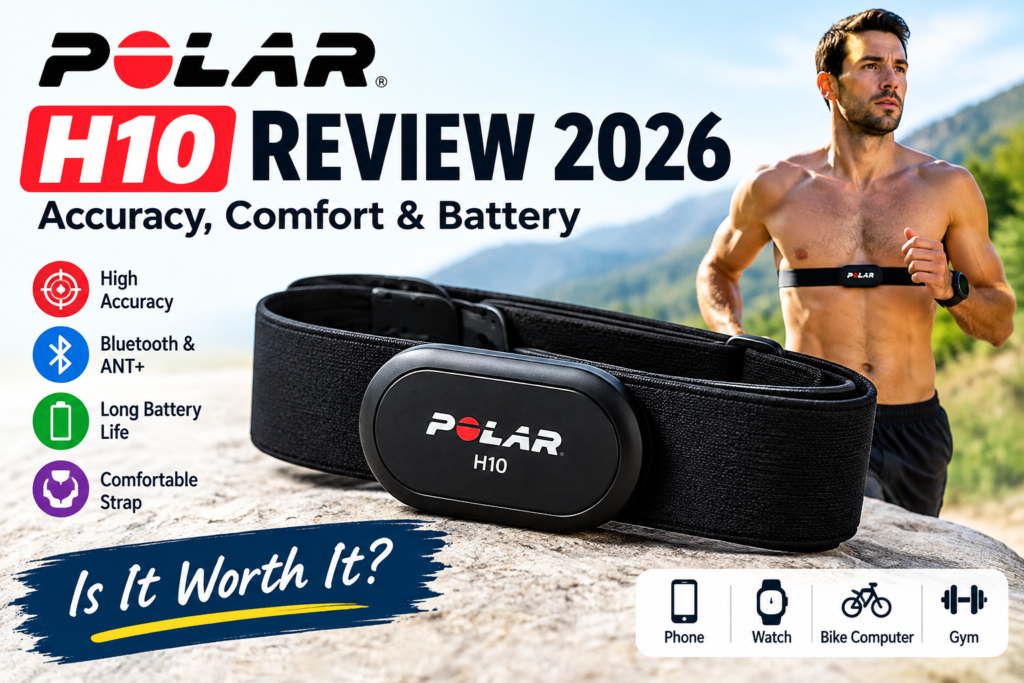
If you want a reliable chest-strap heart rate monitor for running, cycling, or gym workouts, the Polar H10 is worth considering. It combines Bluetooth and ANT+ connectivity, a comfortable chest strap, and onboard memory for recording one training session.
But is the Polar H10 worth its price in 2026, especially when less expensive heart rate monitors are available?
This review covers its accuracy, battery life, comfort, compatibility, limitations, and value to help you decide whether it fits your training needs.
Quick Answer: Is the Polar H10 Worth Buying?
The Polar H10 is a strong choice for athletes who prioritize workout heart rate tracking, broad device compatibility, and flexible connectivity.
Its main advantages are dual Bluetooth connections, ANT+ support, a replaceable battery rated for up to 400 hours, and internal memory for one training session of up to 30 hours.
Its main drawbacks are the non-rechargeable battery, the need for a compatible device or app for most workout data, and the extra effort of wearing a chest strap.
Best for: Runners, cyclists, gym users, and fitness enthusiasts who want a dedicated heart rate sensor.

- 38% Polyamide, 29% Polyurethane, 20% Elastane, 13% Polyester
- Made in the USA or Imported
- WORKS WITH EVERYTHING: Polar HRM works with ALL HRM compatible Equipment.
Polar H10 Key Specifications
| Feature | Details |
|---|---|
| Monitor type | Chest-strap heart rate sensor |
| Measurement method | Electrical heart rate measurement |
| Connectivity | Bluetooth Low Energy and ANT+ |
| Simultaneous Bluetooth connections | Two |
| Battery | Replaceable CR2025 coin cell |
| Advertised battery life | Up to 400 hours |
| Internal memory | One training session, up to 30 hours |
| Water resistance | Up to 30 meters |
| Strap | Polar Pro Strap |
| Display | No built-in screen |
Specifications are based on Polar’s published information. Check the current product listing and manual for the latest details.
1. Accuracy: How Reliable Is the Polar H10?
Accuracy is one of the biggest reasons people consider a chest-strap monitor instead of relying only on a smartwatch.
The Polar H10 uses electrical signals associated with heartbeats to measure heart rate. A wrist-based optical sensor estimates pulse rate using changes in blood volume beneath the skin.
Chest straps can be particularly useful during interval training, cycling, and workouts where heart rate changes quickly. However, performance depends on the individual device, correct fit, electrode contact, and exercise conditions.
An independent review by Cyclingnews reported accurate readings and a secure, comfortable strap during testing. This provides useful third-party evidence, but it does not guarantee identical results for every user or activity.
For reliable readings, moisten the electrodes as instructed, position the strap correctly, and ensure it fits securely against your skin.
Accuracy verdict: The Polar H10 is a strong option for dedicated workout heart rate monitoring, but it should not be treated as infallible or as a medical diagnostic device.
2. Battery Life: Up to 400 Hours
The Polar H10 uses a replaceable CR2025 coin-cell battery rather than a rechargeable battery.
Polar advertises up to 400 hours of operating time. For someone who trains regularly, that can mean fewer battery changes and less charging maintenance than rechargeable alternatives.
The trade-off is that you must replace the battery when it runs out. Follow the manufacturer’s instructions when opening the battery compartment, and inspect the sealing ring before closing it again.
Check the official Polar H10 technical specifications for battery and operating details.
Battery verdict: A good fit for buyers who prefer long stated battery life and do not mind replacing a coin cell.
3. Comfort and Strap Design
The Polar H10 comes with the Polar Pro Strap, designed to fit securely during exercise. Its textile material and silicone grip elements help the strap stay in place.
Comfort still depends on your body shape, strap adjustment, skin sensitivity, and workout duration. Some people prefer chest straps for intensive training, while others find wrist-based wearables easier to wear.
The strap is washable according to Polar’s instructions, but the electronic sensor should be handled separately and cared for as directed.
Before buying, consider whether you are comfortable wearing a band around your chest during longer workouts.
4. Bluetooth, ANT+ and Device Compatibility
The Polar H10 supports Bluetooth Low Energy and ANT+, allowing it to connect with compatible smartphones, sports watches, cycling computers, and fitness applications.
One useful feature is its support for two simultaneous Bluetooth connections. This can help if you want to connect the sensor to two compatible devices at the same time.
However, compatibility is not universal. Check that your preferred watch, app, or cycling computer supports an external heart rate sensor and the connection method you intend to use.
For official feature comparisons, consult Polar’s heart rate sensor guide.
The H10 does not have a built-in display. You generally need a compatible receiver or app to view your heart rate and access workout data.
5. Internal Memory: Can It Record Without Your Phone?
Yes. The Polar H10 can store heart rate data for one training session, with recording lasting up to 30 hours.
You start the recording through the Polar Beat app. After the workout, the stored data can be transferred back to the app when the sensor reconnects.
This is useful when you cannot carry your phone or wrist device during a workout. However, internal memory is limited to a single session, and the recording process requires the supported setup.
Follow Polar’s official sensor-memory instructions before relying on this feature.
Memory verdict: A useful advantage over basic chest straps that transmit heart rate but do not record a session internally.
Polar H10 Pros and Cons
Pros
- Dual Bluetooth connections and ANT+ support.
- Advertised battery life of up to 400 hours.
- Internal recording for one training session.
- A secure chest strap designed for exercise.
- Compatible with a range of supported third-party devices and apps.
Cons
- Uses a replaceable rather than rechargeable battery.
- No built-in screen.
- Requires correct strap fit and electrode contact.
- Compatibility varies between devices and applications.
- A chest strap may be less convenient than a smartwatch for everyday wear.
Polar H10 vs. COOSPO H9Z: Which Should You Choose?
The COOSPO H9Z is a relevant alternative if you want a rechargeable chest strap with five-color heart rate zone indicators.
The Polar H10 may be a better fit if you want two simultaneous Bluetooth connections and internal memory for a training session.
| Feature | Polar H10 | COOSPO H9Z |
|---|---|---|
| Battery | Replaceable CR2025 | Rechargeable |
| Advertised battery life | Up to 400 hours | Up to 50 hours |
| Bluetooth and ANT+ | Yes | Yes |
| Two simultaneous Bluetooth connections | Yes | Verify your required setup |
| Internal workout memory | One session | No |
| Built-in five-color zone indicator | No equivalent feature | Yes |
Choose based on the features you will actually use, not battery figures alone. The two battery-life claims come from different designs and usage conditions.
For a more detailed head-to-head comparison, read our COOSPO H9Z vs Polar H10 guide.
Who Should Buy the Polar H10?
The Polar H10 is worth considering if you:
- Run or cycle and want dedicated heart rate data.
- Follow structured workouts or interval training.
- Need Bluetooth and ANT+ compatibility.
- Want to connect to two Bluetooth devices simultaneously.
- Prefer a replaceable battery.
- Want the option to record a workout without carrying your phone throughout the session.
It may not be the best choice if you want an all-in-one smartwatch, GPS tracking from the sensor itself, or a rechargeable battery.
If you mainly need basic workout monitoring, compare the H10’s features with your current wearable before spending money on another device.
Price and Buying Advice
Polar’s US website lists the H10 at $104.95 at the time of writing. Prices and availability can change, so confirm the current price before purchasing.
Check the exact strap size and color, seller reputation, return policy, and warranty terms. If buying through Amazon US, make sure the selected listing is for the Polar H10 and that the variant matches your needs.
For buyers comparing dedicated sensors, our COOSPO H9Z review explains the alternative’s features and limitations.
If you are new to chest-strap monitors, our guide to chest straps vs. smartwatch heart rate tracking can help you decide whether you need a separate sensor at all.
For additional context on a competing chest strap, see our COOSPO H9Z vs. Garmin HRM-Dual comparison.
Frequently Asked Questions
Is the Polar H10 accurate?
Independent testing has reported strong performance, and the H10 is designed for dedicated heart rate measurement. Results still depend on fit, electrode contact, activity, and the receiving device.
How long does the Polar H10 battery last?
Polar advertises up to 400 hours of operating time using a replaceable CR2025 battery. Actual battery life varies with use and conditions.
Can the Polar H10 connect to two devices?
Yes. It supports two simultaneous Bluetooth connections, provided both receiving devices support the required connection.
Does the Polar H10 work without a smartwatch?
Yes, it can connect to a compatible smartphone app or another supported receiver. The sensor itself does not have a screen.
Can the Polar H10 store workouts?
Yes. It can store heart rate data for one training session, lasting up to 30 hours, when recording is started through the supported Polar Beat setup.
Is the Polar H10 suitable for swimming?
Polar specifies water resistance up to 30 meters, and the sensor supports 5 kHz transmission for compatible equipment. However, water resistance and underwater heart rate transmission are different things. Check the manufacturer’s instructions and your receiver’s capabilities before relying on it for swimming.
Is the Polar H10 a medical device?
It is intended for fitness and exercise heart rate monitoring, not for diagnosing or treating medical conditions. Consult a healthcare professional if you need heart rate monitoring for a medical reason.
Final Verdict: Is the Polar H10 Worth Buying in 2026?
The Polar H10 remains a compelling choice for people who want a dedicated chest-strap heart rate monitor with broad connectivity, long stated battery life, and limited onboard workout recording.
Its strongest advantages are two simultaneous Bluetooth connections, ANT+ support, and memory for one training session. Its main compromises are the replaceable battery, lack of a screen, and the need to wear a chest strap.
Our recommendation: Consider the Polar H10 if accurate, responsive workout heart rate data and flexible connectivity matter more to you than rechargeable convenience or smartwatch features. If you prefer a rechargeable alternative, compare it with the COOSPO H9Z before making your decision.
Product details and prices may change. Verify current specifications and compatibility before purchasing.
Affiliate disclosure: LifeCareBalance may earn a commission from qualifying purchases made through affiliate links, at no additional cost to you.
Health disclaimer: This product is intended for fitness monitoring and is not a substitute for medical diagnosis, treatment, or professional medical advice.