
LifeCareBalance.com is reader-supported. When you buy through links on our site, we may earn an affiliate commission at no extra cost to you. As an Amazon Associate, we earn from qualifying purchases.
Oura Ring 5 is Oura’s current-generation smart ring, and as of September 2026 it has replaced the Oura Ring 4 as the company’s flagship wearable. If you’re comparing smart rings for sleep, recovery, and daily wellness tracking, this guide walks through what Oura Ring 5 actually tracks, how its scores work, what it costs to own (including the subscription), and who it’s realistically a good fit for. Along the way, we’ll separate verified Oura specifications from marketing claims, and flag where independent research still has open questions about consumer sleep-tracking accuracy.

- THE WORLD’S SMALLEST SMART RING – 40% smaller than the previous generation, Oura Ring 5 is thinner, lighter and smaller …
- SIZING IS ESSENTIAL – Oura Ring 5 uses unique sizing different from standard jewelry rings and other Oura Ring generatio…
- EVERYDAY HEALTH SENSING – Oura tracks over 50 health metrics, including sleep, activity, stress, heart health, metabolic…

- ACCURACY – SMART SENSING – Oura tracks over 50 health metrics, including sleep, activity, stress, heart health, and wome…
- ACCURATE SIZING ESSENTIAL – Oura Ring 4 uses unique sizing different from standard jewelry rings; use the Oura Ring 4 Si…
- LONG LASTING BATTERY – With up to 8 days of battery life, no screens and no vibrations, Oura Ring 4 allows you to focus …
If you’re still deciding whether a ring-style tracker is the right category for you at all, our Sleep Tracker Buying Guide 2026 covers how rings compare with wrist-based wearables before you commit to hardware.
Oura Ring 5 at a Glance
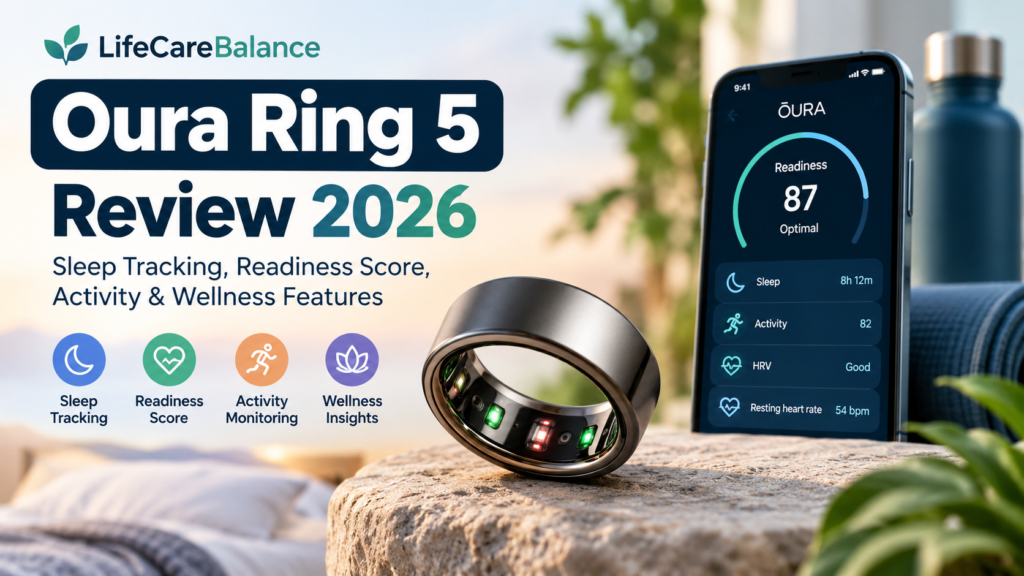
Oura Ring 5 is described by the company as its most advanced and comfortable smart ring yet, with a thinner design than Oura Ring 4 and 40% less volume. ouraring
| Spec | Oura Ring 5 |
|---|---|
| Starting price (hardware) | $399 (Silver, Black); $499 (Gold, Deep Rose, Stealth, Brushed Silver) |
| Membership | $5.99/month or $69.99/year (first month included) |
| Sizes | 6–13 |
| Dimensions | Width 6.09mm, thickness 2.28mm, sensor dome height 0.7mm |
| Battery life | Typically 6–9 days, varying by size, settings, and usage |
| Charging time | About 80 minutes depending on battery level |
| Water resistance | 100m / 328ft, suitable for sauna and water sports but not diving |
| Connectivity | Bluetooth 5.0, EMF-safe, airplane-mode compatible |
| Data storage on ring | Up to three days without syncing |
| Main health metrics | Sleep stages, Readiness, Activity, HRV, resting heart rate, SpO2, body temperature, daytime stress |
Pricing and membership figures are confirmed directly from Oura’s own documentation and press coverage as of this writing; always check Oura’s official store for the current price before buying, since wearable pricing shifts with promotions.
What Is Oura Ring 5?
Oura Ring 5 is a titanium smart ring worn on the finger that continuously tracks sleep, recovery, and daily activity using optical sensors, a temperature sensor, and an accelerometer — with no screen, no notifications, and a battery that lasts closer to a week than a day. It’s built from a fully titanium design with super-hard PVD coating for scratch resistance, available in six finishes: Black, Silver, Stealth, Brushed Silver, Gold, and Deep Rose. ouraring
Unlike a smartwatch, Oura Ring 5 isn’t designed for at-a-glance notifications or on-device workout tracking. Its entire value proposition is passive, overnight-friendly biometric tracking delivered through a companion phone app — which is why comfort and unobtrusiveness matter more here than on a typical fitness watch.
Oura Ring 5 Sleep Tracking
Oura Ring 5 estimates a range of sleep metrics each night, including total sleep time, sleep timing (when you fell asleep and woke up), sleep efficiency, time spent in each sleep stage (light, deep, and REM), naps, resting heart rate, HRV, breathing rate, temperature trends, and blood oxygen (SpO2) data.
It’s important to understand what this data actually represents. Oura Ring 5, like every consumer sleep tracker, estimates sleep using heart rate patterns, movement, and physiological signals — it does not directly measure brain activity the way clinical polysomnography (PSG) does in a sleep lab. PSG uses EEG electrodes to directly record brain waves, which is why it remains the clinical gold standard for diagnosing sleep disorders. A ring can infer sleep stages from indirect signals, but that’s a fundamentally different, and less precise, method.
How Accurate Is Oura Ring 5 for Sleep Tracking?
Independent research on consumer sleep wearables generally shows a consistent pattern: sleep/wake detection (whether you were asleep or awake at a given time) tends to be reasonably reliable, while sleep-stage breakdowns (light vs. deep vs. REM) are less precise than PSG. Earlier validation studies on other consumer trackers found meaningful discrepancies versus lab measurements — for example, one study comparing a popular wrist tracker to PSG found a mean difference of roughly 20 minutes in estimated total sleep duration. Findings like this vary by device generation and algorithm, so they shouldn’t be read as a verdict on Oura Ring 5 specifically, but they illustrate why sleep-stage percentages from any ring or watch should be treated as directional estimates rather than exact measurements.
The American Academy of Sleep Medicine has stated that consumer sleep technologies lack the validation and FDA clearance needed to diagnose or treat sleep disorders, though they can still be useful for enhancing patient-clinician conversations when used alongside a proper clinical evaluation. That’s the right frame for Oura Ring 5 too: useful for spotting patterns over time, not a diagnostic tool. aasm
Because night-to-night algorithm outputs can vary with things like alcohol, illness, or a restless night, the real value of Oura’s sleep data comes from trends across weeks and months rather than obsessing over any single night’s numbers.
Oura Sleep Score Explained
The Sleep Score is a 0–100 daily summary that reflects how your night’s sleep compares against your own baseline across contributors like total sleep, efficiency, REM and deep sleep amounts, sleep timing, and restfulness. It uses the same tiered interpretation Oura applies across all three of its daily scores (more below): higher numbers indicate you’re closer to your personal sleep needs being met, while a lower score flags one or more contributors worth addressing — for instance, a late bedtime or fragmented sleep.
Oura Readiness Score Explained
The Readiness Score reflects how balanced your recovery and activity are, looking at sleep quality, body signals, and activity levels to show how prepared you are to take on the day. ouraring
It draws on two kinds of inputs:
- Overnight metrics: lowest resting heart rate and its timing, average body temperature, sleep quality, and physical movement from the previous day. ouraring
- Long-term metrics: HRV, sleep, and activity balance, each comparing your recent 14-day average against your longer-term average over the past two months. ouraring
Scoring scale (used for Readiness, Sleep, and Activity Scores alike): 85–100 is Optimal, 70–84 is Good, 60–69 is Fair, and 0–59 is Pay Attention. A score of 85 or higher may signal you’re ready for new challenges, while scores below 70 suggest prioritizing rest and recovery.
A few things commonly lower Readiness: unusually high or low resting heart rate or body temperature, insufficient sleep relative to the 7–9 hours recommended for adults by the American Academy of Sleep Medicine, an imbalanced Activity Balance (either overtraining or being too sedentary), and heart rate that stabilizes late in the night rather than early. Some day-to-day variation in Readiness is normal and even healthy — it reflects your body being appropriately challenged and then recovering.
Oura Activity Score and Fitness Tracking
The Activity Score is measured using daily activity, step count, training frequency, and training volume, captured via a 3D accelerometer that registers both step-based movement like walking or running and non-step-based movement like light housework. It uses the same 0–100 scale described above. ouraring
Oura’s activity guidance is oriented around balance rather than pure volume: keeping total inactive time below eight hours a day helps the score, while more than ten hours of daily inactivity hurts it. Oura recommends aiming for two to three sessions per week where heart rate and breathing rate reach an elevated zone, and getting roughly 2,000–3,000 calories of medium-to-high-intensity activity per week — equivalent to about two hours of jogging or 4.5 hours of brisk walking.
Where Oura Ring 5 falls short of a dedicated sports watch: it has no built-in GPS, no screen for real-time pace or route data mid-workout, and it relies on accelerometer-based movement detection rather than a chest strap or multi-band GPS for high-intensity interval or trail-running precision. If your priority is granular running or cycling metrics during the activity itself, a GPS sports watch remains the better-suited tool; Oura is stronger at capturing the recovery side of the training equation.
Oura Health and Wellness Features
With an active membership, Oura Ring 5 includes the same software feature set as Oura Ring 4: detailed sleep analysis, 24/7 heart rate tracking, third-party app integrations like Strava, advanced temperature monitoring, Blood Oxygen Sensing (SpO2), Daytime Stress, dynamic activity goals with automatic activity detection, Heart Health metrics (Cardiovascular Age and Cardio Capacity/VO2 Max), Metabolic Health features (Glucose Tracking and Meals), Oura Labs, Resilience, periodic reports, and Women’s Health features (Cycle Insights and Pregnancy Insights).
Oura Ring 5 also introduces newer software experiences, including expanded live activity tracking and additional health-signal features the company has grouped under a “Health Radar” umbrella; some of these newer capabilities are rolling out region by region rather than everywhere at once, so availability can vary.
It’s worth being precise about what these features are and aren’t. Metrics like Cardiovascular Age, SpO2, and Resilience are wellness indicators derived from sensor data and Oura’s internal models — they are not medical diagnostics, and none of them are a substitute for a clinical evaluation, blood test, or physician visit.
Oura Ring 5 Design, Comfort and Sizing
Oura Ring 5 is 40% smaller by volume than Ring 4, and its sizing differs from the previous generation, so Oura recommends using the correct updated sizing kit for an accurate fit rather than assuming your old Ring 4 size will carry over. The inner surface uses a non-allergenic, BPA-free titanium shell, and the ring is rated for sauna use and water sports (though not diving) at up to 100 meters. ouraringouraring
The slimmer, lighter profile matters more than it might sound like on paper: because Oura Ring 5 is meant to be worn overnight every night, a bulkier or heavier ring is more likely to feel intrusive during sleep, which can undermine the very tracking it’s meant to enable. A smaller, jewelry-like form factor is part of why ring-style trackers have become popular with people who dislike wearing a watch or band to bed.
One trade-off worth flagging: available sizes for Ring 5 run 6–13, a narrower range than Ring 4’s 4–15, which means people at the smaller or larger end of the finger-size spectrum should confirm their size is available before ordering. ouraring
Oura Ring 5 Battery Life and Charging
Oura states Ring 5 typically delivers 6 to 9 days of battery life, a figure the company attributes to a chemical and mechanical battery redesign paired with specialized firmware optimization, since fitting a battery into a 40%-smaller ring is a nontrivial engineering trade-off. A full charge takes about 80 minutes depending on starting battery level. As with any battery claim, actual results will vary based on ring size, feature usage, and app settings, so treat the 6–9 day figure as a real-world range rather than a guarantee. ouraringouraring
Oura also sells an optional charging case accessory that provides extended power for travel, useful if you don’t want to carry a charging dock separately.
Oura Ring 5 Subscription Cost
This is the part of ownership that’s easy to underestimate if you only look at the sticker price of the ring.
- Hardware: $399 (Silver, Black) or $499 (Gold, Deep Rose, Stealth, Brushed Silver)
- Membership: $5.99 per month or $69.99 per year in the US, with one complimentary month included for new members. ouraring
- What requires membership: Without an active membership, you can only see your three daily scores (Readiness, Activity, Sleep), ring battery level, basic profile info, app settings, and Explore content — detailed insights, trend reports, and the Oura API all require an active membership.
Estimated one-year cost: $399–$499 (hardware) + roughly $69.99 (annual membership, after the free month) ≈ $460–$560 in year one.
Estimated three-year cost: Assuming the ring is kept for three years and membership is paid annually, that’s hardware ($399–$499) plus about $70/year × ~2.9 remaining years ≈ $600–$700 total, before accounting for any price changes to membership over that period.
Don’t treat the subscription as a footnote: if you’re not comfortable paying an ongoing fee indefinitely to keep full access to your own health data insights, that’s a legitimate reason to weigh alternatives.
Oura Ring 5 vs Oura Ring 4
| Oura Ring 5 | Oura Ring 4 | |
|---|---|---|
| Design & material | Full titanium exterior and interior with super-hard PVD coating | Full titanium exterior and interior with PVD or DLC coating depending on finish |
| Sensors | 2x photodetectors, 2x tri-LED (red, green, IR), temperature sensor, accelerometer | 3x photodetectors, 2x tri-LED (red, green, IR), temperature sensor, accelerometer |
| Dimensions | Width 6.09mm, thickness 2.28mm, sensor dome height 0.7mm | Width 7.9mm, thickness ~2.88mm, sensor dome height 0.3mm |
| On-ring memory | Up to three days of data storage | Up to seven days of data storage |
| Available sizes | 6–13 | 4–15 |
| Starting price | $399 / $499 | Originally $349 (now discounted as a legacy model) |
Who may prefer Ring 5: buyers who want the smallest, lightest ring available, the newest sensor and software features, and don’t need the widest size range.
Who may prefer Ring 4: buyers who need a size outside the 6–13 range, want longer on-ring data storage before syncing, or want a similar core feature set at a lower price while it remains available at retailers.
Neither is a universal upgrade — Ring 4’s wider sizing and longer offline storage window are genuine practical advantages for some users, even though Ring 5 is the newer hardware.
Oura Ring 5 vs WHOOP
Oura and WHOOP take genuinely different design approaches, so this isn’t a simple better/worse comparison.
| Oura Ring 5 | WHOOP (5.0 generation) | |
|---|---|---|
| Form factor | Ring, worn on finger | Band, worn on wrist or bicep |
| Screen | None | None (screenless design) |
| Sleep tracking | Ring-based optical + temperature sensing | Wrist-based optical + temperature sensing |
| Battery life | 6–9 days | 14+ days on many WHOOP 5.0 configurations |
| Subscription | $5.99/mo or $69.99/yr | Membership-inclusive pricing, tiered plans that bundle hardware and software (varies by tier) |
| Activity/GPS | No built-in GPS | No built-in GPS |
| Ecosystem | Ring-first, minimalist app | Strap-first, with heavier emphasis on training load (“Strain”) and coaching |
Both platforms lean on estimated, algorithm-driven sleep and recovery scoring rather than clinical-grade measurement, and both require an ongoing subscription to unlock full insights — WHOOP simply folds that cost into its hardware/membership bundles rather than selling the device and subscription separately in every case. Oura’s ring format tends to appeal more to people who dislike wearing anything on the wrist overnight; WHOOP’s band format and training-load framing tend to appeal more to structured-training athletes who want strain/recovery balancing front and center. Independent testing consistently notes that WHOOP’s longer battery life comes at the cost of a screenless, phone-dependent interface — a trade-off similar in spirit to Oura’s design philosophy.
Who Should Buy Oura Ring 5?
- People primarily focused on sleep quality and want a comfortable, unobtrusive overnight tracker
- Those focused on recovery and want a single daily Readiness Score to guide training and rest decisions
- General wellness users who want long-term trend data on HRV, resting heart rate, and temperature
- People who actively dislike wearing a smartwatch, especially to bed
- Anyone who wants discreet, continuous tracking that doesn’t require checking a screen throughout the day
Who Should Not Buy Oura Ring 5?
- People who don’t want an ongoing subscription cost layered onto the hardware price
- Anyone who wants at-a-glance data on a screen without opening a phone app
- Athletes who need dedicated multi-band GPS tracking for running, cycling, or trail sports
- Anyone expecting medical-grade sleep-disorder diagnosis (Oura Ring 5 cannot diagnose sleep apnea or any other condition)
- People who are already invested in a smartwatch ecosystem (Apple Watch, Garmin, etc.) and don’t want a second wearable
Oura Ring 5 Pros and Cons
Pros
- Smaller, lighter, more comfortable for overnight wear than previous generations
- Broad wellness feature set: sleep, HRV, temperature, SpO2, activity, stress, cardiovascular and metabolic indicators
- Long battery life relative to smartwatches
- Discreet, screen-free form factor
- Membership carries over automatically if you upgrade rings later
Cons
- Requires an ongoing paid membership for full functionality
- Narrower size range (6–13) than Ring 4
- Less on-ring data storage than Ring 4 before syncing
- No GPS or dedicated sports-tracking screen
- Sleep-stage estimates, like all consumer wearables, are not clinically validated
Common Oura Ring Buying Mistakes
- Ignoring the recurring membership cost when comparing the hardware price to alternatives
- Buying without ordering an official sizing kit first, especially given the sizing change from Ring 4
- Expecting a medical-grade sleep-disorder diagnosis from a consumer ring
- Treating a single night’s Sleep or Readiness Score as a definitive verdict rather than watching trends
- Assuming that more tracked metrics automatically means better health insight, rather than checking whether the metrics are actionable for your goals
- Overlooking smartwatch alternatives if you actually want on-device notifications or built-in GPS
- Underestimating total ownership cost across multiple years of membership
Is Oura Ring 5 Worth It in 2026?
Oura Ring 5 is a strong option if your priority is comfortable, continuous sleep and recovery tracking and you’re willing to pay an ongoing membership fee for the full experience. Its smaller size is a real, tangible improvement for overnight comfort, and its Readiness Score remains one of the more intuitive daily recovery signals on the wearable market.
It’s a weaker fit if you want a display, built-in GPS, or you’re unwilling to commit to a subscription indefinitely. It’s also not the right tool if you’re seeking a diagnosis for a suspected sleep disorder — that requires a clinical sleep evaluation, not a consumer ring. Whether it’s “worth it” ultimately depends on how much you value sleep and recovery data specifically, how comfortable you are with recurring costs, and whether you already have a training-focused wearable covering the fitness side of the equation.
Frequently Asked Questions
Is Oura Ring 5 worth it in 2026?
It’s worth considering if sleep and recovery tracking are your priority and you’re comfortable with an ongoing membership fee. It’s less compelling if you want GPS sports tracking or a screen-based interface.
What does Oura Ring 5 track?
Sleep stages and timing, Readiness, Activity, heart rate, HRV, body temperature trends, SpO2, and daytime stress, among other wellness metrics.
How accurate is Oura Ring 5 for sleep?
It performs reasonably well at detecting sleep versus wake, but like all consumer wearables, its sleep-stage estimates are less precise than clinical polysomnography and should be read as trends rather than exact measurements.
What is a good Oura Readiness Score?
85–100 is considered Optimal, 70–84 Good, 60–69 Fair, and 0–59 signals you should pay attention to recovery.
What is the Oura Sleep Score?
A 0–100 daily score reflecting how your night’s sleep compares to your personal baseline across contributors like total sleep, efficiency, and sleep timing.
Does Oura Ring 5 track workouts?
It detects activity automatically and tracks heart rate, duration, and intensity, but it lacks built-in GPS and a screen for real-time workout metrics.
Does Oura Ring 5 track heart rate?
Yes — 24/7 heart rate tracking across daytime, nighttime, and activity is included with an active membership.
Does Oura Ring 5 measure HRV?
Yes, HRV is tracked continuously and factors into both the Readiness Score and longer-term trend reports.
Does Oura Ring 5 track body temperature?
Yes, via a digital temperature sensor that measures average body temperature variations. ouraring
Does Oura Ring 5 require a subscription?
You can use it without a membership, but you’ll only see your three daily scores and basic info — detailed insights and the API require an active membership.
How long does Oura Ring 5 battery last?
Typically 6 to 9 days, depending on ring size, settings, and usage. ouraring
Is Oura Ring 5 waterproof?
It’s rated for 100m/328ft water resistance, suitable for showers, sauna, and water sports, but not for diving. ouraring
What is the difference between Oura Ring 4 and Ring 5?
Ring 5 is thinner and 40% smaller by volume, uses two photodetectors instead of three, stores up to three days of data instead of seven, and is available in sizes 6–13 versus Ring 4’s 4–15.
Is Oura Ring better than WHOOP?
Neither is universally better — Oura’s ring format suits people who want a screen-free, finger-worn device, while WHOOP’s band suits people who want longer battery life and training-load-focused metrics. The right choice depends on form-factor preference and which metrics matter most to you.
Can Oura Ring diagnose sleep apnea?
No. Consumer sleep technologies, per the American Academy of Sleep Medicine, lack the validation and FDA clearance required to diagnose or treat sleep disorders. If you suspect sleep apnea or another sleep disorder, consult a physician or sleep specialist