
LifeCareBalance.com is reader-supported. When you buy through links on our site, we may earn an affiliate commission at no extra cost to you. As an Amazon Associate, we earn from qualifying purchases.
Recovery boots used to be something you’d only see on the sidelines of a professional sports team. Now they show up in gym bags, living rooms, and post-marathon selfies everywhere. As pneumatic compression boots have become more affordable and more widely marketed, more beginners are asking a very reasonable question: are these actually worth buying, and if so, which ones?
The problem is that most product pages are written for people who already understand the terminology. mmHg, chambers, sequential compression, full-leg coverage, wireless systems, session timers — the specs pile up fast, and it’s easy to end up choosing a pair of recovery boots based on which box has the most bullet points rather than which one actually fits your needs.
This guide is built specifically for beginners who are trying to make sense of it all before spending money. It walks through what recovery boots actually do, what the research says (and doesn’t say), and the ten features that matter most when comparing recovery compression boots.
What Are Recovery Boots?
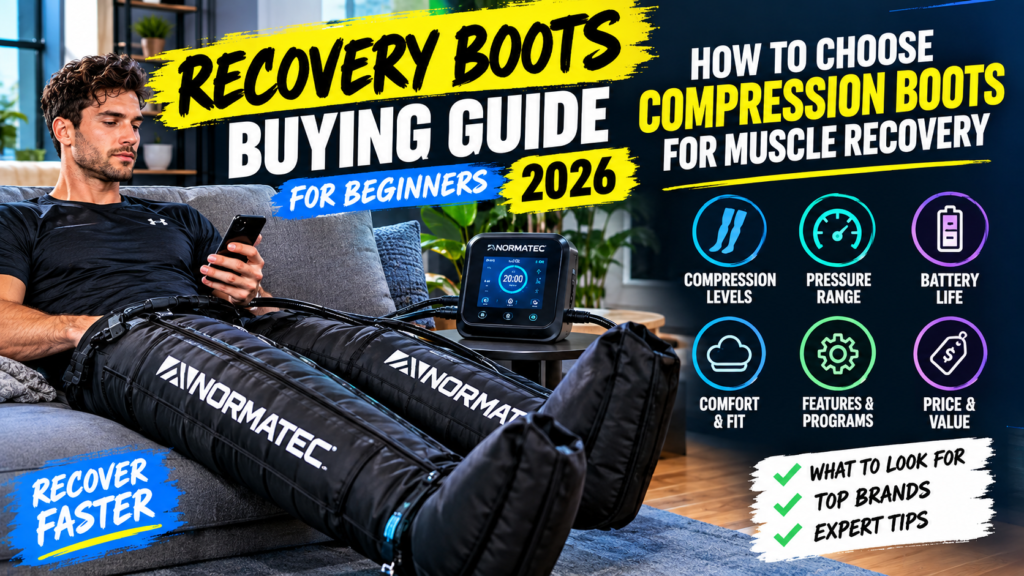
Recovery boots are inflatable leg sleeves connected to a pump that rhythmically fills with air and then releases. This general category of device is known clinically as pneumatic compression, or more specifically intermittent pneumatic compression (IPC) when it’s applied in cycles rather than as constant pressure.
The boots wrap around the feet, calves, and sometimes the thighs and hips. When switched on, the pump inflates a series of internal air chambers in sequence, squeezing the leg and then releasing, over and over, for a set session length. The idea is to mimic the natural pumping action of leg muscles and the venous system, which normally helps move blood and fluid back up toward the heart during movement.
This isn’t a new invention dressed up for athletes. Pneumatic compression devices have been used in medical settings since the 1970s, primarily to help prevent blood clots and manage swelling in patients who are less mobile. Sports and fitness recovery is a newer, separate application of the same underlying technology.
How Do Compression Recovery Boots Work?
Most recovery boots use what’s called sequential compression. Instead of squeezing the entire leg at once, the boot is divided into separate chambers — starting at the foot and moving upward through the calf and, on full-leg models, the thigh.
The chambers inflate one after another, starting at the foot, so the compression wave travels up the leg. Once the sequence finishes, the chambers deflate, and the cycle repeats for the length of the session. Some devices use overlapping zones so there’s no gap in pressure as the wave moves upward, which manufacturers often describe as “gapless” compression.
A smaller number of devices use a simpler peristaltic pattern, where the chambers inflate together and hold pressure for the cycle rather than sequencing individually. Either way, the basic goal is the same: apply rhythmic external pressure to encourage blood flow and reduce the feeling of heavy, swollen, or fatigued legs after exercise.
Are Recovery Boots Actually Worth It?
This is the most important question in this entire guide, and the honest answer is: it depends on what you’re hoping to get out of them.
A 2024 systematic review and meta-analysis in the journal Biology of Sport pooled data from 17 studies and 319 participants to examine the effects of lower-limb intermittent pneumatic compression on sports recovery. The findings were measured, not dramatic. nih
The review found a trivial to small benefit for muscular function, a trivial to moderate effect for pain and soreness measurements, and a highly variable effect on muscle damage markers such as creatine kinase. In plain terms: the research doesn’t support the idea that recovery boots dramatically speed up muscle repair or restore performance faster than rest alone. The subjective experience of soreness was where users tended to notice the most consistent benefit, with the strongest effect showing up around 48 hours after exercise, which lines up with when delayed onset muscle soreness (DOMS) typically peaks. nihnih
The reviewers also noted that most of the studies could not blind participants to which treatment they received, which raises the risk that some of the reported improvement in soreness reflects expectation rather than a purely physiological effect. A second review, published in 2025 and also examining IPC as a post-exercise recovery method, reaches similarly cautious conclusions: the technology shows promise, especially for perceived recovery, but the evidence base is still developing and results vary considerably between studies and protocols. nih
The practical takeaway for a beginner: recovery boots are a reasonable, low-risk recovery tool that many people find genuinely helpful for how their legs feel — but they are not a proven way to accelerate physiological healing, and they shouldn’t be marketed or purchased as one.
Who Should Consider Recovery Boots?
Recovery boots tend to appeal most to:
- Runners, especially those training for long distances or recovering from long runs
- Lifters, particularly after heavy leg days or high-volume training blocks
- Cyclists, who put sustained, repetitive load on the legs
- Team-sport athletes managing back-to-back training sessions or games
- Active adults who exercise regularly and want a passive recovery routine
- People on their feet for long periods — retail workers, healthcare workers, and travelers, for example
If your main goal is reducing the subjective feeling of heavy, tired legs after activity, recovery boots are a reasonable option to explore. If you’re expecting a guaranteed reduction in muscle damage or a measurable performance boost, it’s worth adjusting those expectations based on the research above.
Recovery Boots vs Compression Boots: What’s the Difference?
In everyday use, “recovery boots” and “compression boots” refer to the same general category of product. Both terms describe pneumatic compression devices worn on the legs for post-exercise recovery. Manufacturers and retailers use the terms somewhat interchangeably, along with “leg recovery boots” and “recovery compression boots.”
The only distinction worth knowing is that “compression boots” is sometimes used more broadly to include medical-grade IPC devices designed for circulation issues, while “recovery boots” almost always refers specifically to the fitness and sports recovery market. For a beginner shopping for muscle soreness relief, the terms describe the same product category.
How to Choose Recovery Boots: 10 Features That Matter
1. Pressure Range and mmHg
Pressure is measured in millimeters of mercury (mmHg) — the same unit used for blood pressure. Recovery boots typically offer an adjustable range, often somewhere between 20 mmHg and 150+ mmHg depending on the model.
Research protocols in the sports recovery literature commonly used pressures around 80 mmHg, sustained for 20 to 30 minutes. That doesn’t mean 80 mmHg is a required or optimal number for every person — it simply reflects what researchers most often tested. Marketing copy that emphasizes a very high maximum pressure as a selling point should be treated cautiously; a higher ceiling doesn’t necessarily translate to a better recovery outcome, and higher pressure isn’t automatically more comfortable or more effective for a beginner. nih
2. Compression Levels and Intensity Adjustment
Look for boots with several selectable intensity levels rather than a single fixed setting. This lets you start low and adjust upward as you get comfortable with how the compression feels. Most consumer models offer somewhere between 3 and 7 adjustable levels.
3. Number of Chambers or Zones
Chambers (also called zones) are the individual sections of the boot that inflate separately to create the sequential compression wave. Common configurations include 4, 5, and 6 chambers. More chambers can allow a smoother, more gradual compression wave, but chamber count alone is not a reliable measure of effectiveness — see the dedicated section below.
4. Sequential Compression Pattern
Confirm whether the device uses sequential compression (chambers inflate one at a time, moving up the leg) versus a simpler pattern. Sequential compression is generally considered the standard for recovery-focused products because it mimics the natural direction of venous blood flow.
5. Full-Leg vs Calf-Only Coverage
Some boots cover just the foot and calf; others extend up through the thigh and hip. This affects both cost and which muscle groups get treated — see the full comparison table below.
6. Fit and Sizing
Recovery boots are sized (often small/medium/large or by height and inseam), and an ill-fitting boot can be uncomfortable or compress unevenly. Always check the manufacturer’s sizing chart rather than guessing, and check the retailer’s return policy in case the size doesn’t work out.
7. Wired vs Wireless Design
Wired systems use a separate control unit connected to the boots by hoses. Wireless systems build the pump directly into each boot. This is a significant factor in daily usability — covered in detail further down.
8. Battery Life
For wireless models, battery life determines how many sessions you get per charge. Published battery life for current consumer models generally falls in the 3-hour range, though this varies by brand and should always be confirmed on the manufacturer’s current product page before buying.
9. Programs and Session Timers
Most boots let you select a session length (commonly in the 15–60 minute range) and, on some models, preset programs. A visible timer or auto shut-off is a helpful beginner feature since it removes the guesswork.
10. Weight, Noise, Portability, Warranty, and Build Quality
Wireless boots are heavier per boot since they house their own pump; wired systems keep the boots lighter but add a separate unit to carry. Noise level, boot material durability, zipper quality, and warranty length are all worth comparing — and none of them should be assumed based on price alone.
What Pressure Should Beginners Start With?
There’s no single “correct” pressure that applies to everyone, and any source that gives you a universal number to aim for is oversimplifying. Published recovery protocols in the research vary widely, from roughly 60 mmHg up to over 200 mmHg, with around 80 mmHg being the most commonly used pressure in sports recovery studies. nih
For a beginner, the safest approach is to start at the lowest available setting on your device, follow the manufacturer’s instructions for your specific model, and increase gradually only if the sensation is comfortable. Compression should feel firm and rhythmic, not painful, numbing, or restrictive. If a session feels uncomfortable at any setting, that’s a signal to lower the pressure or stop, not to push through it.
4-Chamber vs 5-Chamber vs 6-Chamber Recovery Boots
Chamber count is one of the most heavily marketed specs, and also one of the most misunderstood.
More chambers generally allow a more gradual, granular compression wave as it moves up the leg, since each chamber controls a smaller section. A 4-chamber boot compresses in bigger sequential steps; a 6-chamber boot breaks that same leg length into smaller segments.
What the research does not support is the idea that a higher chamber count produces meaningfully better clinical results. The reviewed studies used a range of devices with varying chamber designs, and outcomes were driven more by pressure, duration, and consistency of use than by chamber count specifically. Treat chamber count as a comfort and smoothness factor, not a proxy for effectiveness.
Full-Leg vs Calf Compression Boots
| Feature | Full-Leg Boots | Calf-Only Boots |
|---|---|---|
| Coverage | Feet, calves, thighs (sometimes hips) | Feet and calves only |
| Best for | Runners, cyclists, lifters targeting quads/hamstrings | Calf-focused soreness, standing jobs |
| Typical price | Higher | Lower |
| Portability | Bulkier, heavier | Lighter, easier to pack |
| Setup time | Slightly longer | Faster |
Full-leg coverage makes sense if your soreness regularly extends above the calf — think squats, lunges, cycling, or long runs. Calf-only boots are a lighter, more affordable option if your soreness is concentrated in the lower leg, or if portability and price are bigger priorities than full coverage.
Wireless vs Wired Recovery Boots
| Factor | Wireless Boots | Wired Boots |
|---|---|---|
| Portability | Higher — no separate control unit | Lower — control unit adds bulk |
| Setup | Fast, minimal cables | Requires connecting hoses |
| Battery life | Limited by built-in battery | Often plug-in, unlimited runtime |
| Boot weight | Heavier per boot (built-in pump) | Lighter boots, weight in control unit |
| Home use | Convenient | Very convenient if space isn’t an issue |
| Travel use | Better suited to travel | Bulkier for travel |
If you plan to travel with your boots or use them somewhere other than a fixed spot at home, wireless designs are usually more practical. If you mainly plan to use them in one place and want to avoid battery management altogether, a wired system plugged into an outlet removes that concern entirely.
How Much Should You Spend on Recovery Boots?
Recovery boot pricing spans a wide range, and prices change often, so always verify current pricing directly with the retailer or manufacturer before buying. As a general framework:
- Entry-level: Basic calf or full-leg coverage, fewer intensity levels, simpler programs. Good for beginners testing whether recovery boots fit their routine.
- Mid-range: More adjustable levels, additional chambers, often wireless, better build quality and app connectivity.
- Premium: Advanced zone customization, longer battery life, more refined materials, and established brand support and warranty coverage.
A higher price does not guarantee a better recovery outcome. It typically buys convenience features — app control, portability, refinement, warranty support — rather than a fundamentally different physiological effect. Spend based on the features you’ll actually use, not on the assumption that expensive automatically means more effective.
Common Recovery Boot Buying Mistakes
- Buying based only on the highest advertised maximum pressure
- Ignoring sizing charts and guessing at fit
- Assuming more chambers automatically means better results
- Overlooking whether coverage (full-leg vs calf-only) matches your actual needs
- Not checking battery life or power requirements before buying a wireless model
- Assuming a higher price guarantees better recovery outcomes
- Skipping the fine print on return policy and warranty length
- Expecting recovery boots to replace sleep, hydration, or a sound training plan
How to Use Recovery Boots as a Beginner
A simple starting routine:
- Put the boots on after your workout, once you’ve cooled down.
- Start at the lowest pressure setting available on your device.
- Select a shorter session length first (often around 15–20 minutes) to see how your legs respond.
- Follow your specific manufacturer’s instructions for setup, sizing, and recommended session length.
- Increase pressure or duration gradually over future sessions only if it remains comfortable.
- Use recovery boots as one part of a broader recovery routine — alongside adequate sleep, hydration, and proper training load — not as a replacement for any of them.
Recovery Boots Safety
Pneumatic compression devices are not appropriate for everyone. Because they affect blood flow and pressure in the legs, certain circulation-related conditions warrant caution.
If you have a diagnosed circulatory condition, a history of blood clots or deep vein thrombosis, unexplained leg swelling or pain, a bleeding disorder, or any other relevant medical condition, talk to a qualified healthcare professional before using recovery boots. This also applies if you’re pregnant or recovering from recent surgery on the legs.
This guide cannot evaluate your individual health situation, and recovery boots should never be treated as a substitute for medical care, diagnosis, or treatment of an underlying condition.
Recovery Boots vs Massage Guns
Both are popular recovery tools, but they work differently and aren’t perfect substitutes for each other.
| Factor | Recovery Boots | Massage Guns |
|---|---|---|
| Mechanism | Compression (inflation/deflation) | Percussion (rapid tapping) |
| Coverage | Full leg passively, all at once | Targeted, one muscle area at a time |
| Hands-free use | Yes | No — requires active use |
| Best for | General leg fatigue, passive recovery | Specific tight spots, trigger points |
| Portability | Bulkier | Very portable |
Recovery boots are better suited to passive, hands-free, whole-leg sessions — put them on and relax. Massage guns are better for targeting a specific sore spot with more direct pressure. If you want to compare specific models, our guides on how to choose a massage gun and massage guns for leg and calf recovery cover the same beginner-first approach as this guide. Many people end up using both tools for different purposes rather than choosing one over the other — our breakdown of benefits of massage guns for athletes goes deeper into that use case.
Recovery Boots vs Other Recovery Tools
Recovery boots are one option among several, and none of them is a universal replacement for the others:
- Massage guns: Better for targeted, localized muscle tension (see best massage guns and full-body recovery massage guns)
- Stretching and mobility work: Addresses range of motion and movement quality in ways passive compression can’t
- Red light therapy: A separate recovery category with its own evidence base — see our red light therapy buying guide
- Rest and sleep: The foundation of recovery that no device replaces
- Active recovery: Light movement, which supports circulation through natural muscle activity
Recovery boots fit best as one addition to this broader toolkit, not a stand-alone recovery strategy.
Beginner Recovery Boot Buying Checklist
| Checklist Item | Why It Matters |
|---|---|
| ☐ Correct size confirmed | Poor fit means uneven or uncomfortable compression |
| ☐ Coverage matches your needs (full-leg vs calf) | Avoid paying for coverage you won’t use, or under-buying |
| ☐ Adjustable pressure available | Lets you start low and build comfort |
| ☐ Sequential compression confirmed | Standard, well-supported compression pattern |
| ☐ Chamber design reviewed (not overrated) | More chambers ≠ automatically better |
| ☐ Comfortable fit verified | Compression should never be painful |
| ☐ Battery or power setup understood | Wireless vs wired affects daily convenience |
| ☐ Session timer present | Simplifies beginner use |
| ☐ Warranty length checked | Protects your purchase |
| ☐ Return policy reviewed | Important given sizing variability |
| ☐ Realistic expectations set | Evidence supports modest, mainly perceptual benefits |
Frequently Asked Questions
Are recovery boots good for beginners?
Yes, with realistic expectations. They’re generally easy to use and low-risk for healthy adults, and many beginners find them helpful for the subjective feeling of leg soreness after exercise, though the research on objective performance benefits is mixed.
How do recovery boots work?
They use pneumatic (air-based) compression, inflating and deflating chambers in sequence from the foot upward, to apply rhythmic pressure to the legs and encourage blood flow.
What pressure should a beginner use in this recovery boots buying guide’s recommendation?
Start at the lowest available setting and follow your device’s manufacturer instructions. Research protocols commonly used around 80 mmHg, but no single number is universally “correct,” and comfort should guide your intensity choice. nih
Are 5-chamber recovery boots better than 4-chamber boots?
Not necessarily. More chambers can create a smoother compression wave, but the research doesn’t show that chamber count alone determines effectiveness. Fit, pressure, and consistent use matter more.
Are wireless recovery boots worth it?
For most people who want portability and simple setup, yes. If you’ll only use them in one fixed location and don’t mind hoses, a wired system is a reasonable alternative with fewer battery concerns.
How long should you use recovery boots?
Follow your specific model’s instructions. Commonly studied session lengths in the research range from about 15 to 60 minutes, with 20–30 minutes being a frequently used duration. nih
Can recovery boots help sore legs?
Research suggests they can provide a trivial-to-moderate benefit for perceived pain and soreness, particularly around 48 hours after exercise, though effects on measurable muscle damage markers are inconsistent. nih
What is the difference between recovery boots and compression boots?
In practice, none — the terms are used interchangeably to describe pneumatic compression devices for post-exercise leg recovery.
Are recovery boots safe for everyone?
No. People with circulation issues, a history of blood clots, unexplained leg swelling, or certain other medical conditions should consult a healthcare professional before use.
Do expensive recovery boots work better than cheap ones?
Not automatically. Higher prices generally buy convenience, build quality, and features like app control — not a proven difference in recovery outcomes.
Conclusion
If you are buying your first pair, focus first on fit, coverage, adjustable compression, ease of use, and warranty. Then compare chamber design, battery, portability, and extra features. Do not choose solely because one model advertises the highest pressure or the most features.