
LifeCareBalance.com is reader-supported. When you buy through links on our site, we may earn an affiliate commission at no extra cost to you. As an Amazon Associate, we earn from qualifying purchases.
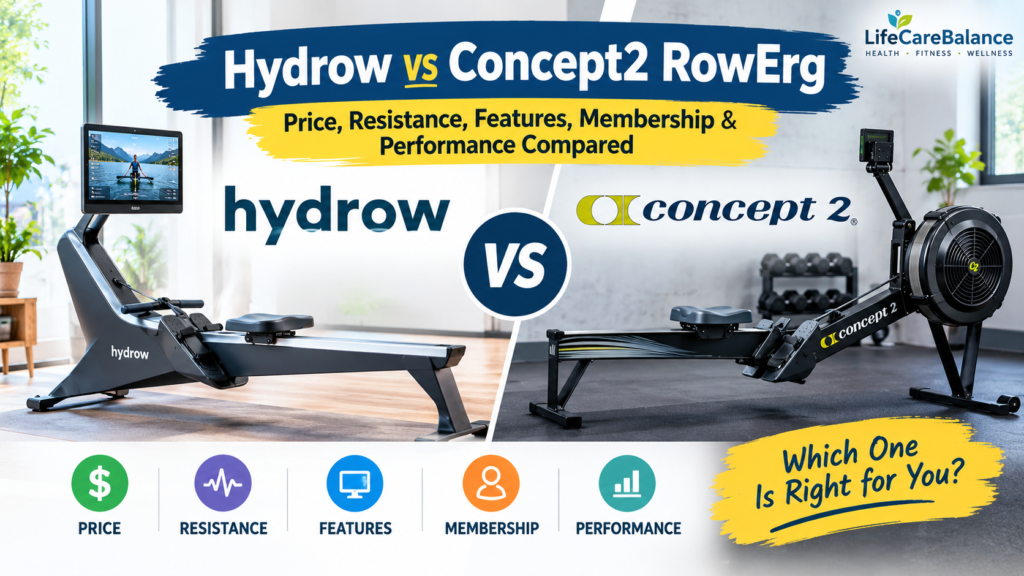
If you’ve narrowed your rowing machine search to these two, you’re comparing two genuinely different philosophies of indoor rowing rather than two versions of the same product. The Concept2 RowErg is a no-frills, subscription-free air rower built for durability and data comparability. Hydrow is a connected, screen-based machine built around live and on-demand coached workouts, powered by a monthly membership. Neither is objectively “better” — the right choice depends on your budget, your motivation style, and whether you want a training tool or a guided fitness experience.
Hydrow vs Concept2 RowErg at a Glance
| Concept2 RowErg | Hydrow (Origin / Wave / Arc) | |
|---|---|---|
| Current price | $990 (standard legs) / $1,155 (tall legs) The RowErg is available for $990.00 USD | $1,995 (Wave) / $2,195 (Origin) / $2,295 (Arc) The Hydrow Wave costs $1,995, the Hydrow Origin is priced at $2,195, and the Hydrow Arc costs $2,295 (MSRP, may change with sales and promotions) |
| Resistance | Air (fanned flywheel, adjustable damper) | Electromagnetic (computer-controlled drag) |
| Monitor/display | PM5 performance monitor PM5 and Device Holder included | 16″–24″ HD touchscreen depending on model Origin has a 22″ HD pivoting screen, Wave a 16″ fixed HD screen, and Arc a 24″ HD pivoting screen |
| Membership | None required, ever | $50/month or $600/year (optional but needed for content) Monthly subscription is $50/mo plus applicable tax, or a prepaid annual subscription of $600/year plus applicable tax |
| Machine weight | 57 lb (standard) / 68 lb (tall) Machine weight with standard legs is 57 lb (26 kg), with tall legs 68 lb (31 kg) | 102–147 lb depending on model Origin weighs 145 lbs, Wave 102 lbs, and Arc about 147 lbs |
| Max user weight | 500 lb (Concept2 test standard) Maximum user weight is 500 lb (227 kg) as tested by Concept2 | 375 lb across all models The Hydrow Arc has a weight limit of 375 lbs |
| Dimensions (assembled) | 96″L x 24″W, 14″or 20″ seat height Overall length is 96 in (244cm), width 24 in (61cm), and seat height from floor is 14in with standard legs or 20in with tall legs | 80″–86″L x 19″–25″W x 43″–48″H Origin measures 86″ × 25″ × 47″, Wave measures 80″ × 19″ × 43″, and Arc measures 86″ × 25″ × 48″ |
| Storage | Separates into 2 pieces, no tools The RowErg can be quickly separated into two pieces for storage (no tools required) and has caster wheels to allow it to be moved around easily | Rolls; vertical storage needs an add-on kit on Origin/Arc Vertical storage on the Origin and Arc requires a roughly $80 kit; the Wave has built-in vertical storage |
| Warranty | 5-year frame, 2-year parts Two years on moving parts and on the monitor; five years on frame parts | 5-year frame, 12-month components/screen/electronics Structural frame is covered for five years; components, screen and other electronics for twelve months |
| Connectivity | Bluetooth, ANT+, free ErgData app The Performance Monitor has Bluetooth and ANT+ wireless connectivity, and ErgData is Concept2’s free app for iOS and Android | Wi-Fi (required for streaming), Bluetooth, ANT+ The Arc supports Bluetooth and ANT+ connection and recommends Wi-Fi at 10mbps |
| Workout content | None built-in; open platform for 40+ third-party apps With Concept2’s open-platform monitor, you have plenty of apps to choose from, offering live and on-demand classes, virtual racing, and training programs | 5,000+ live/on-demand videos with membership The membership includes over 5,000 on-demand rowing workouts plus On the Mat yoga, pilates, strength, and mobility training |
Hydrow vs Concept2: Key Differences
The single biggest difference is what you’re actually paying for. Concept2 sells you a machine — a precision instrument with a monitor that measures pace, watts, and stroke rate identically on every unit worldwide, and nothing more. Hydrow sells you an experience: a screen, a camera-filmed library of rowing routes, and instructor-led classes, but that experience is gated behind a recurring membership fee.
The second difference is resistance type, which shapes how the stroke feels and sounds. Concept2 uses air resistance you generate yourself; Hydrow uses electromagnetic resistance that’s software-controlled and largely silent. The third is price positioning: even the cheapest Hydrow model costs roughly double the Concept2, before any membership fees are added.
Price and Total Cost of Ownership
The figures below are LifeCareBalance calculations based on manufacturer pricing verified in September 2026. Actual costs will vary with taxes, shipping, sales, and financing terms.
Upfront cost
- Concept2 RowErg (standard legs): $990
- Hydrow Wave: $1,995 | Hydrow Origin: $2,195 | Hydrow Arc: $2,295
Membership
- Concept2: $0, always
- Hydrow: $600/year if prepaid annually, or $50/month if billed monthly the monthly subscription is $50/mo plus applicable tax, or the prepaid annual subscription is $600/year plus applicable tax Hydrow
Calculated ownership cost (using Hydrow Origin at $2,195 and Concept2 at $990, membership prepaid annually):
| Timeframe | Concept2 RowErg | Hydrow Origin |
|---|---|---|
| Year 1 | $990 | $2,195 + $600 = $2,795 |
| Year 3 | $990 | $2,195 + ($600 × 3) = $3,995 |
| Year 5 | $990 | $2,195 + ($600 × 5) = $5,195 |
Over five years, a fully-subscribed Hydrow Origin costs roughly five times more than a Concept2 RowErg. That gap narrows somewhat with the Hydrow Wave ($1,995 machine) but never closes, because the membership — not the machine — is the larger long-term cost driver. If you stop paying for Hydrow membership, the machine still functions, just without the content that’s the reason most people buy it (more on that below).
Resistance and Rowing Feel
Air resistance (Concept2): A flywheel with fan blades spins as you pull; the harder and faster you row, the more air resistance you create. A damper lever (1–10) adjusts how much air can enter the flywheel housing, changing how “heavy” each stroke feels — similar in concept to shifting gears on a bike. This makes the resistance curve fully proportional to your own effort, which is why competitive rowers use it: two athletes rowing the exact same pace on two different RowErgs generate directly comparable numbers.
Electromagnetic resistance (Hydrow): A motor and magnet system creates drag that’s set electronically rather than by your effort alone. Hydrow’s system targets a resistance range roughly equivalent to a 50–300 “drag factor” scale designed to mimic on-water rowing, and it’s adjusted by software rather than a mechanical damper.
In practice, Concept2 feels more raw and self-driven — you hear and feel your own effort in the flywheel. Hydrow feels smoother and more consistent stroke-to-stroke, closer to the sensation of a boat gliding rather than a machine resisting. Neither feel is “correct”; it comes down to preference and whether you’re training for on-water rowing comparability (Concept2’s strength) or want a quieter, more cinematic workout (Hydrow’s strength).
Performance Tracking and Technology
Concept2’s PM5 monitor is a dedicated, no-frills computer: it displays pace, split time, watts, calories, stroke rate, and heart rate (with a compatible strap), and syncs to the free ErgData app and the Concept2 Online Logbook. ErgData lets you erg together with the community on the Real Time Loop, set up workouts as favorites, take part in the Concept2 Workout of the Day, and track and analyze your progress over time. Its biggest strength is standardization — a 2k score means the same thing on any RowErg anywhere in the world. Concept2
Hydrow’s touchscreen is a full tablet-like interface running its own app ecosystem. On models with HydroMetrics (Wave and Arc), the system scores your stroke across Power, Precision, and Endurance in real time and gives post-workout feedback. Both platforms sync with third-party fitness trackers: Concept2 supports 40+ apps through its open Bluetooth/ANT+ protocol, while Hydrow syncs with Strava, Apple Health, Fitbit, and Garmin.
Hydrow Membership vs Concept2 Without a Subscription
This is the decision point for most buyers, so it’s worth spelling out exactly what each dollar buys.
With a Hydrow membership ($50/month or $600/year), you get live and on-demand rowing classes filmed on real waterways, plus non-rowing content (yoga, strength, mobility), instructor coaching, leaderboards, and multiple user profiles for the household. The membership includes live workouts with Hydrow athletes including Olympians and world-class rowers, over 5,000 on-demand rowing workouts, On the Mat yoga, pilates, strength, and mobility training, progress incentives, multiple user profiles, and a community of fellow rowers. Hydrow
Without a membership, a Hydrow drops into “Just Row” mode, which strips out nearly everything that makes the screen useful. Just Row mode allows adjustable drag and resistance settings, but using a Hydrow in this mode prohibits access to all live and recorded workout videos, the ability to play music or audio, storage of workouts or progress, saved statistics, leaderboard ranking, and streaming workouts. Practically, an unsubscribed Hydrow becomes an expensive basic ergometer — you’re paying for a touchscreen you can no longer use for its intended purpose. There’s also a cheaper Digital Basic tier at $19.99/month for app-only content without owning a Hydrow rower at all, useful if you want to try the workout library on a phone before buying, or if you want Hydrow-style coaching alongside a Concept2. Hydrow
Concept2, by contrast, never gates functionality behind a fee. Every metric on the PM5 — pace, watts, calories, splits — is available from day one and forever, with no account or subscription required. If you want guided content, you add a free app like ErgData or a third-party app of your choosing; the base machine is never crippled.
Noise and Home/Apartment Use
Air resistance is inherently louder than electromagnetic resistance because you’re moving air through a fan, and the sound scales with effort — a light recovery row is quiet, but sprinting generates a noticeable “whoosh” that most reviewers describe as similar to a box fan on high. Hydrow’s electromagnetic system produces mechanical drag electronically rather than through moving air, so it stays close to silent regardless of intensity, with most of the audible sound coming from the seat rollers and strap rather than the resistance mechanism itself.
We won’t cite specific decibel figures here since independently verified lab measurements for both machines under standardized conditions aren’t publicly available from either manufacturer — but the mechanism-level difference (air displacement vs. electromagnetic drag) is well-documented and is the primary reason Hydrow is generally the safer pick for apartments, shared walls, or early-morning/late-night sessions.
Size, Storage and Portability
Both machines are similar in footprint but different in storage approach. The Concept2 is longer when assembled (96″) but separates into two lightweight pieces in seconds with no tools, and at 57–68 lb it’s easy for one person to lift and move. The Concept2 measures 96″ L x 24″ W x 14″ H, while the Hydrow Arc and Origin measure about 86″L x 25″W x 47″H (48″H for Arc) and the more compact Hydrow Wave measures 80″L x 19″W x 43″H. Hydrow
Hydrow is shorter but considerably heavier — 102 to 147 lb depending on the model — which makes it harder to reposition solo, though it rolls on built-in wheels. Vertical storage works differently too: the Wave has built-in vertical storage, but the Origin and Arc need a roughly $80 Upright Storage Kit to store vertically, an added cost to factor into your budget if floor space is tight. If you’re weighing rowers against other space-efficient cardio options, our guide to compact home cardio equipment covers machines that store even smaller. Rowingrelated
Warranty and Long-Term Ownership
Both companies split their warranty into frame coverage and parts/electronics coverage, but the terms differ meaningfully.
Concept2: Two years on moving parts and on the monitor; five years on frame parts, backed by a 30-day money-back guarantee on factory-direct US and Canada purchases. Given the RowErg’s simple mechanical design (a chain, a flywheel, and a handful of moving parts), replacement components are inexpensive and widely stocked, and many machines from the 1990s are still in service today. concept2
Hydrow: Structural frame is covered for five years, while components, screen, and other electronics — including handles, ropes, touchscreen, monitor arm, and motors — are covered for twelve months. That one-year window on the touchscreen and electronics is the part to note: it’s the most expensive and most failure-prone part of the machine, and coverage lapses well before the frame warranty does. Hydrow also offers paid extended warranty and accidental damage protection at checkout for buyers who want longer electronics coverage. Hydrow
Which Is Better for Beginners?
Neither machine is objectively easier to learn on, but they suit different kinds of beginners. If you’re new to rowing and benefit from structured guidance — cues on form, pacing, and motivation to show up — Hydrow’s coached classes can shorten the learning curve and keep you consistent in the first few months, when dropout risk is highest.
If you’re a self-directed beginner who’s comfortable following a written plan or YouTube tutorial, the PM5’s real-time feedback (split time, stroke rate) is enough to self-correct technique, and you avoid paying for content you may not stick with. Concept2’s lower upfront cost also lowers the stakes if you’re not sure rowing will become a long-term habit.
Which Is Better for Experienced or Performance-Focused Rowers?
For anyone training for a 2k test, CrossFit competition, or comparing scores against teammates or a national ranking, the Concept2 is the standard equipment, not just a personal preference. Its resistance is proportional to your own effort and its damper settings and drag factor produce results that are directly comparable machine to machine, which is why USRowing, the NCAA, and CrossFit competitions use it for testing and scoring. Hydrow’s electromagnetic system, filmed content, and gamified scoring are built for engagement rather than standardized testing, and its numbers don’t translate to Concept2-style drag-factor comparisons.
Which Is Better for Apartment Living?
For noise-sensitive environments, Hydrow’s electromagnetic resistance has a real practical edge, especially for sprint intervals that would otherwise generate significant air-rush noise on a Concept2. The Concept2’s lighter weight and quick-disassembly storage are advantages if you need to move it in and out of a closet between uses, while Hydrow’s rolling wheels help but its added weight makes it more of a “leave it in place” machine unless you buy the upright storage kit.
Hydrow vs Concept2 for Home Gyms
In a dedicated home gym where noise and floor space are less constrained, the calculus shifts toward function over footprint. Concept2 pairs naturally with a broader strength-and-cardio setup — it’s inexpensive enough to sit alongside best strength equipment for a home gym without dominating the budget, and its simplicity means it won’t need troubleshooting between sessions. Hydrow works well as an anchor piece for a home gym built around guided training, particularly for households where multiple people will use the coached content and share the single membership across profiles.
Either way, don’t overlook recovery: a rowing session is demanding on the posterior chain, and home workout recovery equipment is a reasonable complement regardless of which rower you choose.
Pros and Cons
Hydrow Pros
- Quiet electromagnetic resistance, good for shared walls
- Large content library with real instructors and filmed locations
- HydroMetrics (Wave/Arc) gives structured performance feedback
Hydrow Cons
- $50/month (or $600/year) recurring cost on top of a $1,995–$2,295 machine
- Most functionality disappears without an active membership
- Heavier machine; vertical storage on Origin/Arc requires an extra accessory
- Electronics warranty is only 12 months
Concept2 Pros
- No subscription, ever — every feature works on day one and forever
- Lower upfront cost, decades-long track record, strong resale value
- Industry-standard for competitive testing, CrossFit, and rowing clubs
- Lightweight, quick to disassemble and store
Concept2 Cons
- Air resistance is noticeably louder, especially at higher intensity
- No built-in workout content or instructor guidance
- Basic PM5 display lacks the visual polish of a touchscreen
Hydrow vs Concept2 — Which One Fits Your Needs?
- Choose Concept2 if your priority is lifetime cost, durability, and standardized training data, and you’re comfortable self-programming your workouts.
- Consider Hydrow if structured, instructor-led motivation is what actually gets you to exercise consistently, and the membership fee fits comfortably in your budget.
- For apartment users: Hydrow’s quieter resistance is the more apartment-friendly choice; Concept2 is manageable but noticeably louder during hard efforts.
- For competitive or data-focused training: Concept2 is the standard — its numbers are directly comparable to any other RowErg, worldwide.
- For guided workouts: Hydrow’s library and live classes are purpose-built for this; Concept2 requires pairing with a third-party app.
- For buyers avoiding recurring fees: Concept2 is the clear choice — there’s no ongoing cost after purchase.
Frequently Asked Questions
Is Hydrow better than Concept2?
Neither is universally “better.” Hydrow offers a more guided, quieter experience for an ongoing fee; Concept2 offers a cheaper, subscription-free machine with industry-standard data.
Is Concept2 worth it compared with Hydrow?
For buyers who want a durable, low-cost machine and are comfortable self-motivating, yes — especially given the five-year frame warranty and near-zero ongoing costs.
Does Hydrow require a membership?
No, but functionality is very limited without one. Without membership, Hydrow runs in “Just Row” mode, which strips out video content, music, progress tracking, and leaderboards.
Can you use Hydrow without a subscription?
Yes, in Just Row mode, but you’ll only get adjustable resistance and basic on-screen metrics — not the coached content most buyers purchase Hydrow for.
Does Concept2 require electricity?
No. The PM5 monitor runs on two D-cell batteries and draws supplemental power from the spinning flywheel during your workout.
Which rower is quieter?
Hydrow’s electromagnetic resistance is quieter overall, particularly at higher effort levels, since it doesn’t rely on moving air through a flywheel.
Which rower is better for beginners?
It depends on learning style: Hydrow suits beginners who benefit from coached guidance; Concept2 suits self-directed beginners who want real-time data feedback without a subscription.
Which has the lower long-term cost?
Concept2, by a wide margin, once Hydrow’s membership fees are factored over multiple years of ownership.
Can Hydrow and Concept2 be used with fitness apps?
Yes. Concept2’s PM5 connects via Bluetooth/ANT+ to 40+ third-party apps through ErgData; Hydrow syncs with Strava, Apple Health, Fitbit, and Garmin.
Related reading: best cardio equipment for home use | home workout recovery guide | budget home gym equipment
Official sources: Concept2 RowErg specifications | Concept2 warranty | Hydrow membership pricing | Hydrow FAQs & warranty