
LifeCareBalance.com is reader-supported. When you buy through links on our site, we may earn an affiliate commission at no extra cost to you. As an Amazon Associate, we earn from qualifying purchases.
If you’re considering the Oura Ring 4 in 2026, the question is no longer simply what the ring can track. Oura now also offers the newer Oura Ring 4, so buyers need to consider whether the Ring 4’s current price, features, and subscription model still make sense.
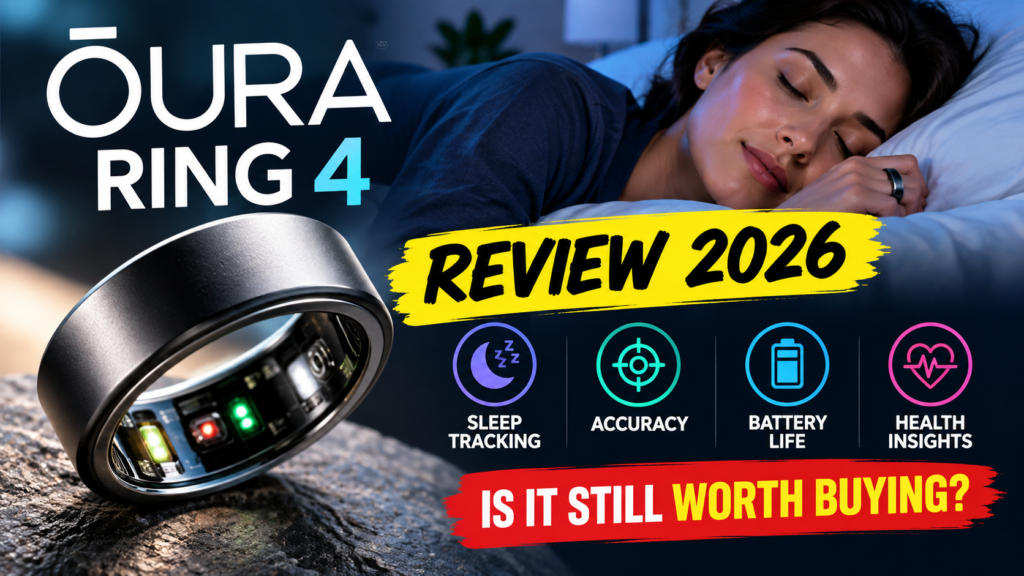
The Oura Ring 4 is a screen-free smart ring designed primarily around sleep, recovery, activity, stress, and long-term health trends. Unlike a smartwatch, it has no display, notifications, or built-in GPS. Instead, it continuously collects sensor data and presents the results through the Oura smartphone app.
This review focuses specifically on the Oura Ring 4: what it measures, how useful its data is, what it costs to own, where it performs well, where it falls short, and which types of users may want to consider it in 2026.

- ACCURACY – SMART SENSING – Oura tracks over 50 health metrics, including sleep, activity, stress, heart health, and wome…
- ACCURATE SIZING ESSENTIAL – Oura Ring 4 uses unique sizing different from standard jewelry rings; use the Oura Ring 4 Si…
- LONG LASTING BATTERY – With up to 8 days of battery life, no screens and no vibrations, Oura Ring 4 allows you to focus …
Oura Ring 4: Quick Overview
- Best suited for: Sleep, recovery, passive health and wellness tracking
- Less suitable for: Serious athletes needing detailed workout metrics and built-in GPS
- Starting price: $349, depending on finish and current promotions
- Membership: $5.99/month or $69.99/year in the U.S.
- Battery life: Up to 5–8 days, depending on use
- Display: None
- Built-in GPS: No
- Material: Titanium
- Sizes: 4–15
- Water resistance: Up to 100 meters
- Compatibility: iOS and Android
Oura continues to sell the Ring 4 while also offering the newer Ring 5, so current buyers should compare both generations before making a purchase.
Affiliate product placement:
Check the current Oura Ring 4 price and available finishes before buying.
Oura Ring 4 Price and Membership
The Oura Ring 4 starts at $349 in the U.S., although the exact price can vary by finish and temporary promotions. Higher-priced finishes can cost more.
The hardware price is only part of the long-term cost. Oura Membership costs $5.99 per month or $69.99 per year for U.S. members. New members currently receive a free first month, although Oura’s pricing and promotional terms can change.
The membership is important because many of the features that make Oura different from a basic activity tracker are tied to the subscription. These include detailed sleep information, readiness insights, stress features, health trends, cardiovascular information, and other deeper analysis.
Over three years, a $69.99 annual membership adds roughly $210 to the ownership cost. That means a buyer considering Oura should evaluate the total cost of ownership rather than looking only at the initial ring price.
If you want a smart ring without a mandatory recurring membership, alternatives such as Samsung Galaxy Ring, RingConn, and Ultrahuman are worth researching separately.
Oura Ring 4 Quick Specs
| Specification | Oura Ring 4 |
|---|---|
| Starting price | $349 |
| Membership | $5.99/month or $69.99/year |
| Material | Titanium |
| Sizes | 4–15 |
| Width | 7.9mm |
| Thickness | 2.88mm |
| Weight | About 3.3–5.2g |
| Battery | Up to 5–8 days |
| Charging | Approximately 20–80 minutes |
| Water resistance | Up to 100m / 328ft |
| Display | None |
| Built-in GPS | None |
| Compatibility | iOS and Android |
Oura’s current Ring 4 specifications confirm the titanium construction, 4–15 sizing, 5–8-day battery claim, 100-meter water resistance, and screen-free design.
What Is the Oura Ring 4?
The Oura Ring 4 is a titanium smart ring made by Oura. It is designed to be worn continuously rather than interacted with throughout the day.
The ring uses multiple sensors to collect information about movement, heart rate, heart rate variability, temperature trends, blood oxygen, and other physiological signals. The companion Oura app then turns that information into scores, trends, and insights.
The three main areas are:
- Sleep
- Readiness and recovery
- Activity
Additional features include stress and resilience tracking, cardiovascular information, temperature trends, blood oxygen measurements, and cycle-related insights.
Because there is no screen, the ring itself remains relatively unobtrusive. You check your information through the smartphone app instead of looking at your wrist throughout the day.
Oura Ring 4 Features
Sleep Tracking
Sleep is one of the main reasons people consider Oura.
The ring estimates:
- Total sleep
- Time in bed
- Sleep timing
- Sleep efficiency
- Sleep latency
- Light sleep
- Deep sleep
- REM sleep
- Naps
- Overnight heart rate
- HRV
- Blood oxygen
- Nighttime breathing patterns
The Sleep Score combines several measurements into an easier-to-understand daily summary.
However, sleep stages should be understood as algorithmic estimates, not direct measurements of brain activity. A clinical polysomnography test uses additional measurements, including EEG, to assess sleep stages.
For everyday users, the bigger benefit may be identifying patterns over time. For example, you might notice that your sleep changes after late workouts, alcohol consumption, irregular bedtimes, travel, or periods of stress.
How Accurate Is Oura Ring 4 Sleep Tracking?
Accuracy is one of the most important questions when considering a sleep tracker.
There is an important distinction between detecting sleep and estimating sleep stages.
Detecting whether someone is generally asleep or awake is easier for a wearable because it can use movement and cardiovascular signals.
Estimating whether someone is in light, deep, or REM sleep is more difficult because consumer wearables do not directly measure brain activity in the same way as clinical polysomnography.
Independent reviews have generally found Oura’s sleep tracking to be strong for a consumer wearable. Sleep Foundation, NBC Select, and Wareable have all reported positive observations about its sleep-tracking performance, although independent testing should not be interpreted as proof of clinical-grade accuracy.
Oura has also published research comparing its sleep staging with polysomnography. That research provides useful evidence about the performance of the algorithm, but it should still be viewed in the context of the difference between a consumer wearable and a clinical sleep study.
The practical takeaway is simple: Oura can be useful for monitoring sleep patterns and trends, but it should not replace a professional sleep evaluation.
Oura Sleep Score Explained
The Oura Sleep Score gives you a single daily summary of your sleep based on several factors.
Rather than focusing only on the score, it is more useful to examine the individual measurements and trends behind it.
For example, a change in your Sleep Score may be related to:
- Shorter total sleep
- Later bedtime
- More nighttime movement
- Changes in sleep regularity
- Changes in resting heart rate
- Changes in HRV
This makes the score more useful as a starting point rather than a complete assessment of sleep quality.
Oura Readiness Score and Recovery Tracking
Readiness is one of the features that makes Oura particularly relevant to people interested in recovery.
The Readiness Score uses multiple signals, including:
- Resting heart rate
- HRV
- Temperature trends
- Sleep quality
- Sleep duration
- Previous activity
- Longer-term recovery patterns
The goal is to give you a general indication of how recovered your body appears to be based on your recent data.
A lower score does not diagnose illness or mean that you cannot exercise. Likewise, a high score does not guarantee that you are physically ready for maximum performance.
It is better understood as a wellness and trend-tracking tool.
Oura also provides Rest Mode, which can reduce activity-oriented prompts when you need to prioritize recovery.
Heart Rate and HRV Tracking
Oura continuously monitors heart rate in the background and tracks heart rate variability, particularly during rest and sleep.
HRV is the variation in time between heartbeats. It can change with factors such as stress, sleep, physical activity, illness, and recovery.
Oura uses HRV as one input into its sleep and readiness calculations.
The ring also provides features such as Cardiovascular Age and Cardio Capacity, which are algorithmic estimates rather than direct clinical measurements.
These metrics can be useful for observing longer-term changes, but they should not be interpreted as medical diagnoses.
Stress and Resilience Tracking
Oura also monitors physiological signals associated with daytime stress and recovery.
The app can show periods of higher stress and periods when your body appears to be recovering.
Its Resilience feature looks at patterns between stress and recovery over time.
This can be useful for people who want to understand how work, exercise, travel, sleep, and daily routines affect their overall recovery pattern.
The important point is that these features are wellness indicators. They should not be treated as a clinical measurement of mental health or a diagnosis of burnout.
Blood Oxygen and Breathing Metrics
Oura Ring 4 uses its sensors to measure overnight blood oxygen information and identify changes in nighttime breathing patterns.
This can provide useful information about your sleep environment and overnight trends.
However, Oura is not a replacement for a clinical sleep study and should not be relied on to diagnose sleep apnea or another breathing disorder.
If you regularly experience loud snoring, gasping during sleep, breathing interruptions, or significant daytime sleepiness, a medical evaluation is more appropriate than relying only on wearable data.
Activity and Workout Tracking
Workout tracking is one of the areas where Oura has more limitations.
The ring can automatically recognize many activities and can provide general movement and activity information throughout the day.
It can work well for users who primarily want passive activity tracking.
However, structured workout tracking is not the main strength of the device.
Independent testing has reported limitations involving activities such as strength training and class-based workouts. GPS-based workout information also depends on a connected smartphone because the ring does not contain its own GPS.
If your priority is detailed running metrics, route tracking, pace splits, advanced heart-rate zones, or structured sports training, a dedicated fitness watch may be more appropriate.
Oura Ring 4 Battery Life
Oura claims up to 5–8 days of battery life depending on factors such as ring size, feature usage, and battery condition.
Real-world battery life can be lower than the maximum advertised figure.
Blood oxygen tracking and other sensor activity can affect battery consumption, so users who want continuous tracking should not assume that every charge will last the full eight days.
Charging generally takes around 20–80 minutes depending on the battery level.
For a screen-free device designed to be worn overnight, this is one of the more convenient aspects of the Ring 4.
Design, Comfort and Sizing
The Oura Ring 4 is made from titanium and weighs approximately 3.3–5.2 grams depending on size.
It is available in sizes 4 through 15.
One important design change from earlier generations is the recessed sensor design, which makes the inside of the ring smoother and more comfortable for continuous wear.
Oura recommends using a sizing kit before purchasing because smart-ring fit is more important than ordinary jewelry sizing.
The ring is designed for fingers such as the index, middle, or ring finger, depending on personal fit and comfort.
It is water-resistant to 100 meters, making it suitable for everyday activities such as showering and swimming.
However, people who regularly perform activities involving heavy gripping, such as weightlifting or rowing, may find a rigid ring less comfortable.
Oura Ring App
The Oura app is where almost all of the useful information appears.
The ring itself has no screen, so the app provides access to:
- Sleep
- Readiness
- Activity
- Stress
- Recovery trends
- Cardiovascular information
- Personalized insights
- Long-term health trends
The amount of information can initially feel overwhelming.
For new users, it is usually more useful to focus on a small number of metrics rather than checking every available measurement every day.
What Oura Ring 4 Does Well
The main strengths of the Oura Ring 4 include:
- Detailed sleep tracking
- Sleep and recovery-focused insights
- Readiness scoring
- Screen-free design
- Comfortable overnight wear
- Long battery life compared with many smartwatches
- Long-term trend tracking
- Automatic activity detection
- Heart rate and HRV tracking
- No constant notifications on your finger
Oura Ring 4 Limitations
Before buying, consider these limitations:
- No built-in display
- No built-in GPS
- Full functionality requires a membership
- Sleep stages are estimates
- Workout tracking is less comprehensive than a dedicated sports watch
- Battery life varies by usage
- Sizing requires more care than ordinary rings
- Not a medical diagnostic device
- Ring 5 is now available as a newer generation
Oura Ring 4 vs Apple Watch
The Oura Ring 4 and Apple Watch are designed around different priorities.
| Feature | Oura Ring 4 | Apple Watch |
|---|---|---|
| Sleep tracking | Major focus | Available |
| Recovery | Central feature | Health and fitness data available |
| Workout tracking | Basic to moderate | Extensive |
| GPS | Phone-dependent | Built-in on supported models |
| Display | None | Yes |
| Notifications | None | Yes |
| Battery | 5–8 days claimed | Typically much shorter |
| Form factor | Ring | Wrist |
| Membership | Required for full Oura experience | No required subscription for core device features |
| Best suited to | Sleep/recovery tracking | Smartwatch + fitness |
The choice depends largely on what you want from the device. Oura focuses heavily on passive sleep and recovery tracking, while Apple Watch combines health tracking with smartwatch, communication, and workout features.
Internal link: Add your Oura Ring 4 vs Apple Watch Series 12 2026 article here.
Oura Ring 4 vs Other Smart Rings
Oura is competing with several other smart-ring platforms.
Samsung Galaxy Ring
Samsung Galaxy Ring is particularly relevant for users already invested in Samsung’s ecosystem. It does not use the same membership model as Oura for its core experience, although the overall value depends on the user’s Samsung devices and features.
Internal link: Add your Oura Ring 5 vs Samsung Galaxy Ring 2026 article here.
RingConn
RingConn focuses heavily on sleep and health tracking while competing on the subscription-free model.
For buyers who dislike recurring membership fees, it is worth comparing the total ownership cost with Oura.
Ultrahuman
Ultrahuman’s smart-ring products also emphasize health, recovery, activity, and metabolic or lifestyle insights without requiring the same mandatory Oura membership model for core functionality.
The right comparison depends on the features you actually use rather than simply comparing the number of tracked metrics.
Oura Ring 4 vs Oura Ring 5: Should You Still Buy Ring 4?
This is one of the most important questions for a 2026 buyer.
Oura now sells the newer Oura Ring 5, while Ring 4 remains available. That means Ring 4 should no longer be evaluated in isolation.
The Ring 4 can still make sense when:
- Its current price is substantially lower
- You are comfortable buying the previous generation
- Its existing feature set meets your needs
- You do not need the newest generation’s improvements
Ring 5 becomes more relevant if you specifically want the newer hardware generation and are willing to pay the additional upfront cost.
For a buyer choosing between generations, compare current pricing, battery claims, sensor improvements, sizes, and the features you actually plan to use.
Internal link: Add your Oura Ring 5 Review 2026 article here.
Who Should Buy Oura Ring 4?
The Ring 4 may be worth considering if you:
- Prioritize sleep tracking
- Want recovery and readiness information
- Prefer a screen-free wearable
- Want passive 24/7 tracking
- Do not need built-in GPS
- Are comfortable with the membership cost
- Prefer a ring over a smartwatch
Who May Not Be a Good Fit for Oura Ring 4?
The Ring 4 may not be the right choice if you:
- Do not want a recurring subscription
- Need detailed sports tracking
- Want built-in GPS
- Want smartwatch notifications and apps
- Need a large display
- Want clinical sleep diagnosis
- Regularly perform workouts where wearing a ring is uncomfortable
Is Oura Ring 4 Worth It in 2026?
There is no universal answer because the value depends on what you want from a wearable.
The Oura Ring 4 remains focused on sleep, recovery, passive activity tracking, and longer-term health trends. Its screen-free design and long battery life also make it different from a traditional smartwatch.
However, the 2026 buying decision is more complicated because Oura now offers the Ring 5.
If you are considering Ring 4, compare its current price with the Ring 5 rather than automatically assuming that the older generation is the better value.
The membership is another major factor. A lower upfront price does not eliminate the ongoing annual cost if you want Oura’s full set of insights.
For users who prioritize sleep and recovery and are comfortable with that ownership model, Ring 4 can still be relevant. For users who prioritize sports tracking, smartwatch functions, or avoiding subscriptions, other wearable categories may make more sense.
Pros and Cons
| Pros | Cons |
|---|---|
| Detailed sleep tracking | Membership required for full functionality |
| Strong sleep and recovery focus | No built-in GPS |
| Screen-free design | No display |
| Comfortable for overnight tracking | Workout tracking is less comprehensive than sports watches |
| Long battery life | Actual battery life varies |
| Wide range of sizes | Requires careful sizing |
| Long-term health trends | Sleep stages remain algorithmic estimates |
| Ring 4 remains available at a lower starting price | Ring 5 is now the newer generation |
Frequently Asked Questions
Is Oura Ring 4 still worth buying in 2026?
It can be worth considering for buyers focused on sleep, recovery, and passive health tracking, particularly if the Ring 4 is available at a meaningful discount compared with the newer Ring 5.
Is Oura Ring 4 accurate for sleep tracking?
Independent testing suggests that Oura performs well among consumer sleep wearables, particularly for broader sleep and wake tracking. However, its sleep stages are algorithmic estimates and should not be considered equivalent to clinical polysomnography.
Does Oura Ring 4 track REM and deep sleep?
Yes. Oura estimates light, deep, and REM sleep along with other sleep measurements.
Does Oura Ring 4 track HRV?
Yes. HRV is one of the important measurements used in Oura’s sleep and readiness insights.
How long does Oura Ring 4 battery last?
Oura states that Ring 4 can last approximately 5–8 days per charge, depending on usage and other factors.
How much does Oura Membership cost?
Oura Membership currently costs $5.99 per month or $69.99 per year for U.S. members.
Can you use Oura Ring 4 without a subscription?
Yes, but the available functionality is significantly more limited without an active membership.
Does Oura Ring 4 have GPS?
No. The Ring 4 does not have built-in GPS and relies on a connected smartphone for location-based workout information.
Does Oura Ring 4 track workouts?
Yes. It can automatically detect many activities and allows workouts to be logged, but dedicated fitness watches generally provide more detailed workout metrics.
Can Oura Ring 4 diagnose sleep apnea?
No. Oura can provide overnight blood oxygen and breathing-related information, but it is not a substitute for clinical testing or diagnosis.
Is Oura Ring 4 a medical device?
Oura Ring is a consumer wellness wearable. Its measurements and scores should not be treated as a substitute for professional medical diagnosis.
What is the difference between Oura Ring 4 and Oura Ring 5?
Ring 5 is the newer generation, so buyers should compare current prices, hardware changes, battery claims, and feature differences before deciding which generation fits their needs.
Internal link: Add your Oura Ring 5 Review 2026 article here.
Final Takeaway
The Oura Ring 4 remains a specialized wearable built around sleep, recovery, activity, and long-term health tracking.
Its strongest appeal is the combination of a screen-free design, continuous tracking, detailed sleep information, readiness insights, and relatively long battery life.
Its main trade-offs are equally clear: there is no display or built-in GPS, structured workout tracking is not its strongest area, and full functionality requires an ongoing membership.
In 2026, there is one additional question that previous Oura Ring 4 reviews did not have to address: how does the Ring 4 compare with the newer Oura Ring 5?
That makes current pricing especially important. If Ring 4 is significantly cheaper and its features meet your needs, it remains a relevant option. If the price difference is small, comparing the newer generation before purchasing makes more sense.
For buyers primarily interested in sleep and recovery, the Oura platform remains highly relevant. For buyers focused on sports performance, smartwatch features, or avoiding recurring subscriptions, it is worth comparing other wearable options before making a purchase.
Related LifeCareBalance Guides
- Oura Ring 5 Review 2026
- Oura Ring 5 vs Samsung Galaxy Ring 2026
- Oura Ring 4 vs Apple Watch Series 12 2026
- Sleep Tracker Buying Guide 2026
- Best Smart Rings for Sleep Tracking 2026
Affiliate disclosure: If you purchase through links on LifeCareBalance, we may earn a commission at no additional cost to you.https://lifecarebalance.com/