
LifeCareBalance.com is reader-supported. When you buy through links on our site, we may earn an affiliate commission at no extra cost to you. As an Amazon Associate, we earn from qualifying purchases.
If you’ve shopped for an air purifier for a large bedroom, an open-concept living room, or a finished basement, you’ve probably noticed something strange: two purifiers with nearly identical Clean Air Delivery Rate (CADR) numbers can claim wildly different “coverage areas.” One says 500 square feet. Another says 1,500. That’s not a testing error — it’s a difference in assumptions.
This guide focuses on the question that actually matters when you’re buying an air purifier for a large room: what will realistically clean the air in your space fast enough, quietly enough, and without turning filter replacements into a recurring headache? We’ll walk through CADR, air changes per hour (ACH), ceiling height, and open floor plans before getting into specific product picks, so you can shop with a realistic number in mind instead of the biggest one on the box.
If you’re still building your foundational knowledge, our air purifier buying guide covers the basics in more depth than we can here.
Quick Comparison Table
| Product | Best For | CADR (smoke/dust/pollen) | Advertised Coverage | Practical Large-Room Use | Filtration | Noise (low–high) | Typical Price |
|---|---|---|---|---|---|---|---|
| Coway Airmega 400 | Largest open-plan spaces, single-unit coverage | 328 / 328 / 400 | Up to 1,560 sq ft (at 2 ACH) | About 500–575 sq ft at 4.8 ACH | True HEPA + activated carbon | ~32–60 dB | About $400–$650 |
| Levoit Core 600S | Best value for large bedrooms/living rooms | ~398–410 / — / — (dust CADR) | Up to 635 sq ft | About 565–600 sq ft | HEPA-grade filter + carbon | ~38–62 dB | About $230–$300 |
| Blueair Blue Pure 211+ Auto | Quiet operation, smoke/allergy season | 350 / 350 / 350 | About 550 sq ft | About 525–540 sq ft | HEPASilent (electrostatic + mechanical) + carbon | ~18–56 dB | About $300–$460 |
| Honeywell HPA300 | Budget-friendly large room | 300 / 320 / 300 | Up to 465 sq ft (also marketed as 2,250 sq ft at 1 ACH) | About 450–465 sq ft | True HEPA + carbon pre-filter | ~44–60 dB | About $180–$250 |
| Coway Airmega 250 | Mid-size rooms marketed as “large room” units | 249 / 261 / 230 | Up to 930 sq ft (at 2 ACH) | About 375–390 sq ft | True HEPA + activated carbon | Manufacturer specs only | About $250–$400 |
Prices change frequently — always check the current listing before buying. CADR and coverage figures above come from manufacturer specifications and, where noted, independent test data from RTINGS and HouseFresh.
Best Air Purifiers for Large Rooms in 2026
Coway Airmega 400 — Best for the Largest Single-Room Coverage

- [Coverage] Designed to clean spaces up to 3,120 sq. ft. in 60 minutes
- [HyperCaptive Filtration System] Combination of a pre-filter, active carbon filter, and HEPA Filter reduces 99.97% of 0….
- [APP and Voice Control] IoCare mobile app includes indoor and outdoor air quality monitoring, filter notification, sched…
Coway advertises the Airmega 400 as suitable for spaces up to 1,560 square feet, but that number assumes only two air changes per hour — a much lower bar than the industry’s usual recommendation. Coway’s own published CADR figures are 328 (smoke), 328 (dust), and 400 (pollen). Independent testing from RTINGS measured a recommended room size of about 575 square feet at maximum fan speed, which lines up closely with the AHAM two-thirds guideline described below.
- Who it’s for: People with one genuinely large room — a great room, an open kitchen-to-living space, or a finished basement — who want a single, powerful unit rather than two smaller ones.
- Room-size suitability: Realistically, expect strong performance up to roughly 500–575 sq ft on higher fan speeds; larger open-plan spaces will see reduced effectiveness, especially on quieter settings.
- Noise: Runs relatively quiet at low speeds (around 32 dB) but climbs noticeably at max speed.
- Filter cost/life: Combines a washable pre-filter with a Green True HEPA-style Max2 filter that’s typically replaced around once a year, which helps offset the higher upfront price.
- Strengths: High raw CADR, real-time air quality monitoring, strong build quality.
- Limitations: Large, heavy unit; not Wi-Fi enabled on the base model; the advertised 1,560 sq ft figure is not something most owners will experience in practice.
Levoit Core 600S — Best Value for Large Bedrooms and Living Rooms

- 𝐖𝐇𝐘 𝐂𝐇𝐎𝐎𝐒𝐄 𝐀𝐇𝐀𝐌 𝐕𝐄𝐑𝐈𝐅𝐈𝐃𝐄 𝐀𝐈𝐑 𝐏𝐔𝐑𝐈𝐅𝐈𝐄𝐑𝐒: AHAM (Association of Home Appliance Manufacturers) is an ANSI-accredited organiz…
- 𝐋𝐄𝐕𝐎𝐈𝐓’𝐒 𝐌𝐎𝐒𝐓 𝐏𝐎𝐖𝐄𝐑𝐅𝐔𝐋 𝐀𝐈𝐑 𝐏𝐔𝐑𝐈𝐅𝐈𝐄𝐑: A juggernaut at purifying your air in any room. It scans the tiny contaminants and …
- 𝐔𝐋𝐓𝐑𝐀-𝐏𝐎𝐖𝐄𝐑𝐅𝐔𝐋 𝐏𝐔𝐑𝐈𝐅𝐈𝐂𝐀𝐓𝐈𝐎𝐍 𝐅𝐎𝐑 𝐄𝐗𝐓𝐑𝐀-𝐋𝐀𝐑𝐆𝐄 𝐒𝐏𝐀𝐂𝐄𝐒: The LEVOIT Core 600S-P Air Purifier is built for extra-large rooms, …
The Core 600S is the largest model in Levoit’s Core lineup, with a manufacturer-advertised coverage of 635 square feet and a dust CADR in the high-300s to low-400s CFM depending on the testing source. Independent testing from RTINGS put its recommended room size at max fan speed at about 567 square feet, and HouseFresh’s lab measured a similar figure — both notably close to Levoit’s own claim, which is refreshing in a category full of inflated numbers.
- Who it’s for: Shoppers who want strong large-room performance, smart app control, and a lower price than Coway or Blueair.
- Room-size suitability: A strong fit for large bedrooms, family rooms, and living rooms in the 500–600 sq ft range.
- Noise: Whisper-quiet on sleep mode (under 40 dB) but noticeably loud on its top “turbo” setting.
- Filter cost/life: Filters are generally rated for 6–12 months, and Levoit’s replacement filters tend to be less expensive than Coway’s or Blueair’s.
- Strengths: Excellent CADR-to-price ratio, VeSync app control, relatively low running cost.
- Limitations: Pre-filter isn’t removable for cleaning; the sensor’s rear placement means it needs a few inches of clearance from the wall to read accurately.
See how it stacks up directly against a smaller Coway model in our Levoit Core 400S vs Coway Airmega 250 comparison.
Blueair Blue Pure 211+ Auto — Best for Quiet, Consistent Performance
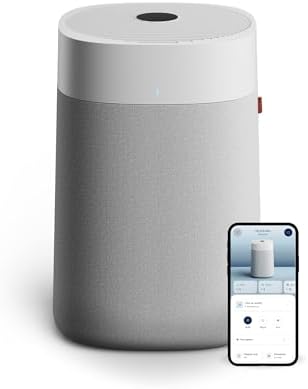
- Powerful Air Purification for Large Rooms: The Blue Pure 211i Max cleans large living rooms, open floor plans, apartme…
- Removes Dust, Smoke, Pet Dander & Allergens: Blueair’s HEPASilent dual filtration technology captures airborne particl…
- Smart Air Purifier with App Control: Built-in air quality sensors automatically adjust fan speed when pollution levels…
Blueair’s HEPASilent technology combines mechanical filtration with an electrostatic charge to capture particles, which the company says allows for higher airflow at lower noise than a traditional dense HEPA filter alone. The 211+ Auto is AHAM-certified with a CADR of 350 across smoke, dust, and pollen, and Blueair states it fully filters a 550-square-foot room roughly every 12.5 minutes — a claim based on the higher 4.8 ACH standard, which is more conservative and more trustworthy than the “2,640 sq ft in 60 minutes” figure also listed in some of its marketing (a 1-ACH claim).
- Who it’s for: Allergy and smoke-sensitive households that want quiet, consistent filtration without a manual carbon add-on.
- Room-size suitability: A solid match for large bedrooms and living rooms up to about 525–540 sq ft.
- Noise: Among the quietest units in this class on low speed; louder on high.
- Filter cost/life: Combined particle-and-carbon filters typically last 6–8 months; replacement cost runs a bit higher than Levoit’s per HouseFresh’s cost-per-CADR analysis.
- Strengths: Strong independent test results, Energy Star rated, effective at capturing very fine particles.
- Limitations: The 211+ line uses an electrostatic charge as part of its HEPASilent process and, per HouseFresh’s testing, this cannot be switched off — worth knowing if you specifically want a purely mechanical, ionization-free filter (see the ozone/ionizer section below).
Honeywell HPA300 — Best Budget Option for a Large Room

- 100%
- Effective air cleaning and circulation: Honeywell HPA304 Air Purifiers are large air purifiers for home that filter and …
- Compatible does not mean comparable: For best performance in your air filtration system, use only Genuine Honeywell air …
The HPA300 is one of the most widely available “large room” purifiers in the U.S., commonly sold at big-box retailers. Honeywell’s own AHAM-certified CADR figures are 300 (smoke), 320 (dust), and 300 (pollen), with a recommended room size of 465 square feet at 4.8 air changes per hour. You’ll also see it marketed as covering “2,250 sq ft,” which reflects the same 1-ACH marketing approach discussed throughout this guide rather than a different capability.
- Who it’s for: Budget-conscious shoppers who still want a true HEPA filter and nationwide filter availability.
- Room-size suitability: Comfortable for large bedrooms and mid-size living rooms up to about 450–465 sq ft.
- Noise: Runs louder than the Levoit or Blueair models at comparable speeds, particularly on its Turbo setting.
- Filter cost/life: HEPA filter typically lasts about 12 months; carbon pre-filters need replacing roughly every 3 months, which adds up over a year.
- Strengths: Lower upfront cost, 5-year warranty, filters sold everywhere.
- Limitations: Higher energy draw and noise at top speed than newer competitors; fewer smart features.
Coway Airmega 250 — A Case Study in Advertised vs. Practical Coverage

- [Coverage] Optimized to clean spaces up to 930 sq. ft. in 30 minutes or up to 1,860 sq. ft. in 60 minutes.
- [HyperCaptive Filtration System] Dynamic combination of a washable pre-filter, activated carbon filter, and HEPA Filter …
- [Air Quality Indicator] 24/7 pollution monitor air quality throughout the day, adjusting purification to the necessary l…
We’re including the Airmega 250 not just as a recommendation but as an instructive example. Coway lists this compact unit as suitable for rooms “up to 930 square feet,” based on completing two air changes per hour. Its actual AHAM-certified CADR numbers — 249 (smoke), 261 (dust), 230 (pollen) — put its practical coverage, using the standard two-thirds rule explained below, closer to 375–390 square feet. That’s a large gap between the marketing headline and what most owners should expect in daily use.
- Who it’s for: Medium-to-large bedrooms or home offices, not true open-plan great rooms.
- Room-size suitability: Best treated as a ~375–400 sq ft unit despite the “large room” branding.
- Filtration: True HEPA-style Max2 filter with activated carbon, similar filter technology to the Airmega 400.
- Strengths: Compact footprint for its output, relatively affordable, energy-efficient (Energy Star certified).
- Limitations: The advertised coverage figure significantly overstates real-world large-room performance; better suited to rooms in the 400 sq ft range than to true open-plan spaces.
Read our full Coway Airmega 250 review for a deeper breakdown of its performance and running costs.
How We Chose the Best Air Purifiers for Large Rooms
We prioritized units with independently verified AHAM CADR ratings, True HEPA or HEPA-equivalent filtration, and coverage claims that hold up reasonably well against the AHAM two-thirds guideline — not just the largest number on the box. We also weighed noise at various fan speeds, real-world filter replacement cost, and whether smart features (app control, auto mode, air quality sensors) add genuine value. LifeCareBalance has not personally lab-tested the units in this guide; specifications and independent test results are drawn from manufacturer data and from testing organizations such as RTINGS and HouseFresh, cited throughout.
Why CADR Matters More Than Advertised Square-Foot Coverage
CADR — Clean Air Delivery Rate — measures how many cubic feet of filtered air a purifier delivers per minute for smoke, dust, and pollen particles, tested under the ANSI/AHAM AC-1 standard. It’s the closest thing this category has to an apples-to-apples performance number.
“Coverage area,” on the other hand, is a marketing calculation manufacturers derive from CADR using an assumption about how many times per hour the air should be exchanged (ACH). As the AHAM-based examples above show, a brand that assumes 2 ACH will publish a much larger square-footage number than a brand that assumes 4.8 ACH — even with an identical CADR. Neither number is “fake,” but only one of them reflects genuinely fast, thorough air cleaning.
According to the U.S. EPA’s guidance on air cleaners in the home, a higher CADR generally means faster particle removal for a given room size, and a portable air cleaner’s actual performance depends heavily on fan speed — a unit run on a quiet setting will clean far more slowly than the same unit at full blast.
How Much CADR Do You Need for a Large Room?
AHAM’s widely used rule of thumb is that a purifier’s smoke CADR should be at least two-thirds of your room’s square footage, assuming a standard 8-foot ceiling and roughly 4.8 air changes per hour. Using that guideline:
| Room Size | Approximate Minimum Smoke CADR Needed (8-ft ceiling) |
|---|---|
| 400 sq ft | About 270 CFM |
| 500 sq ft | About 335 CFM |
| 600 sq ft | About 400 CFM |
| 700 sq ft | About 470 CFM |
| 800 sq ft | About 535 CFM |
| 1,000 sq ft | About 670 CFM |
These are planning estimates, not laboratory measurements — treat them as a floor, not a guarantee. If you want faster air changes (useful during wildfire smoke events, discussed below), you’ll want a CADR closer to or above your full room’s square footage rather than two-thirds of it.
Best Air Purifiers for 500–600 Sq Ft Rooms
For a large bedroom, a standard living room, or a home office combined with a sitting area, the Levoit Core 600S and Blueair Blue Pure 211+ Auto are both strong fits. The Core 600S offers a better price-to-performance ratio and smart app control, while the 211+ Auto trades a slightly smaller practical footprint for very quiet low-speed operation — a meaningful difference if the room doubles as a bedroom.
Best Air Purifiers for 700–800 Sq Ft Rooms
This is where single consumer air purifiers start to strain. The Coway Airmega 400, run near its higher fan speeds, is one of the few single units with a CADR high enough to make a meaningful dent in a room this size — but expect to run it louder and more often than you would in a smaller space. For rooms firmly in the 700–800 sq ft range, many households get better, quieter results from two mid-size purifiers (see the two-unit section below) than from pushing one unit to its limit.
Best Air Purifiers for 1,000+ Sq Ft Open Spaces
Realistically, very few single residential air purifiers deliver a true, AHAM-standard 1,000+ sq ft of coverage without running loudly around the clock. The Airmega 400’s own 1,560 sq ft claim is based on just 2 air changes per hour, not the 4.8 ACH most efficacy guidance is built around. For open kitchen-living-dining spaces at this scale, plan on either an Airmega 400 supplemented by a second, smaller unit in the far zone of the room, or two similarly sized purifiers positioned at opposite ends of the space — covered in more detail below.
Best Large-Room Air Purifiers for Smoke and Wildfire Season
Smoke particles are extremely fine, so smoke CADR — rather than dust or pollen CADR — is the number to prioritize during wildfire season. The EPA’s guidance on indoor air filtration during wildfires notes that portable air cleaners with a high CADR relative to room size, run continuously, can help reduce indoor particle levels, but filtration is only one part of managing indoor air during a smoke event — sealing windows and reducing outdoor air infiltration also matter.
For large rooms during smoke events, the Blueair Blue Pure 211+ Auto and Coway Airmega 400 are reasonable picks given their smoke-specific CADR ratings, but consider sizing up: running a unit rated for your exact square footage at max speed continuously, rather than a unit sized only for “normal” conditions, gives you a better margin during heavy smoke days. Filtration does not eliminate every pollutant in wildfire smoke, and it isn’t a substitute for evacuation guidance from local authorities when air quality reaches hazardous levels.
HEPA vs Activated Carbon for Large Rooms
True HEPA filters (or HEPA-equivalent designs like Blueair’s HEPASilent) capture particulate matter — dust, pollen, pet dander, and smoke particles. Activated carbon layers are a separate technology that adsorbs gases and odors, such as cooking smells, light VOCs, or pet odor, which HEPA media doesn’t meaningfully remove on its own. Every product in this guide combines both, which matters more in large, multi-use rooms (open kitchens, family rooms) where odor and particulate sources are both present. Carbon filters saturate faster than HEPA filters and typically need replacing more often — factor this into your ongoing cost estimate, not just the sticker price.
How to Choose an Air Purifier for a Large Room
- CADR relative to your actual square footage, not the advertised “coverage” number.
- HEPA or HEPA-equivalent filtration for particulate matter, plus activated carbon if odors or VOCs matter to you.
- Room size and ceiling height together — a bigger footprint on paper doesn’t tell you the full story (see below).
- Noise at the speed you’ll actually run it, especially for bedrooms.
- Filter replacement cost over a year, not just the unit’s purchase price.
- Energy use, particularly if you plan to run the unit continuously.
- Smart controls and air-quality sensors, which can automate fan speed but shouldn’t be the deciding factor over raw CADR.
- Placement — central, unobstructed placement with a few feet of clearance on all sides generally performs better than a corner or behind furniture.
What If Your Large Room Has High Ceilings?
Most CADR-based coverage claims assume an 8-foot ceiling. Since air purifiers clean a volume of air, not just a floor area, a taller ceiling means more total air to filter — and a “large room” purifier sized correctly for 8-foot ceilings can fall short in a room with vaulted or 10–12-foot ceilings.
As a rough estimate (not a lab measurement), you can approximate the added demand using room volume: CADR requirement scales with (ceiling height ÷ 8 ft). That means, compared with an 8-foot ceiling:
- 10-foot ceilings: plan on roughly 25% more CADR than the standard 8-ft recommendation.
- 12-foot ceilings: plan on roughly 50% more CADR than the standard 8-ft recommendation.
In practical terms, a 600 sq ft room with a 12-foot ceiling behaves, from an air-volume standpoint, more like a 900 sq ft room with an 8-foot ceiling when sizing a purifier.
One Large Air Purifier vs Two Smaller Air Purifiers
For genuinely open floor plans — a kitchen that flows into a living room and dining area, or a basement with multiple zones — a single purifier, however powerful, has to pull air from across the whole space, and airflow gets weaker the farther it travels from the unit. Two moderately sized purifiers placed at opposite ends of the space often distribute clean air more evenly than one large unit working overtime in a single corner, and running two units on lower, quieter settings can be less disruptive than running one unit at maximum speed continuously.
As a general framework: if your open-plan space is under roughly 700 sq ft with a standard ceiling height, one high-CADR unit like the Airmega 400 is often enough. Beyond that — or in L-shaped or multi-zone layouts — two strategically placed units (for example, a Core 600S in each zone) tend to outperform a single unit stretched past its realistic coverage.
Common Large-Room Air Purifier Buying Mistakes
- Trusting the largest advertised square-footage number instead of checking the CADR behind it.
- Ignoring CADR entirely and shopping on brand recognition or Amazon star ratings alone.
- Forgetting that ceiling height changes how much air actually needs to be cleaned.
- Choosing purely on upfront price without checking filter replacement costs.
- Buying an undersized unit for a large or open-plan room, then running it loudly around the clock to compensate.
- Overlooking noise levels at the fan speed you’ll realistically use, especially in a bedroom.
- Assuming a HEPA filter handles gases and VOCs the same way it handles particles.
- Not checking whether a unit’s ionizer or plasma feature can be switched off, if that matters to you.
Ozone / Ionizer Considerations
Some air purifiers include an ionizer or electrostatic component as part of their filtration process, distinct from purely mechanical HEPA filtration. Blueair’s HEPASilent technology, used in the 211+ Auto, applies an electrostatic charge to particles as part of its filtration method; per HouseFresh’s testing, this cannot be disabled on the 211+ line without reducing the unit’s cleaning performance. This is different from standalone ozone-generating “air purifiers,” which intentionally produce ozone as their primary cleaning mechanism — the EPA advises against ozone generators marketed as air cleaners, since ozone itself is a lung irritant at the concentrations needed to meaningfully affect indoor air. None of the purifiers recommended in this guide are ozone generators, and Blueair states its products produce no measurable ozone output. If you specifically want a purely mechanical filter with zero electrostatic component, the Levoit Core 600S and Honeywell HPA300 are straightforward True HEPA designs without an ionization stage.
Frequently Asked Questions
What is the best air purifier for a large room? It depends on your exact square footage, ceiling height, and whether the space is a closed room or open-plan. For most large bedrooms and living rooms up to about 600 sq ft, the Levoit Core 600S offers the strongest value; for larger single rooms, the Coway Airmega 400 has the highest realistic CADR in this guide.
What CADR do I need for 500 sq ft? Using AHAM’s two-thirds rule at a standard 8-foot ceiling, aim for a smoke CADR of roughly 335 CFM or higher.
What CADR do I need for 1,000 sq ft? Under the same guideline, aim for roughly 670 CFM or higher — a level few single consumer units reliably deliver, which is why open spaces this size often call for two units.
Is one air purifier enough for a large open-plan room? Sometimes, up to about 700 sq ft with a standard ceiling. Beyond that, or in multi-zone layouts, two units placed in different areas usually perform better than one unit working at maximum capacity.
Are HEPA air purifiers good for large rooms? Yes — True HEPA or HEPA-equivalent filtration is the standard for capturing particulate matter in any room size. The key variable for large rooms is CADR and fan capacity, not the filter type itself.
What is the best air purifier for a large living room? For a living room in the 500–800 sq ft range, the Coway Airmega 400 or Levoit Core 600S are strong starting points, depending on your budget and whether you need smart app controls.
Do large rooms need two air purifiers? Not always, but open-plan spaces over roughly 700–800 sq ft, rooms with high ceilings, or irregularly shaped layouts often benefit from two moderately sized units rather than one oversized unit.
Does ceiling height affect air purifier coverage? Yes. Most coverage claims assume an 8-foot ceiling. Taller ceilings increase the total air volume in the room, so the same purifier covers less effective floor area under 10- or 12-foot ceilings.
Are high-CADR air purifiers louder? Generally, yes, at their highest fan speeds — CADR figures are measured at max speed. Many large-room purifiers, including several in this guide, run considerably quieter on lower settings, which reduces their effective coverage.
How often should I replace the filter? It varies by product and usage, but True HEPA filters commonly last 6–12 months, while carbon pre-filters often need replacement every 3–6 months. Check your specific model’s filter change indicator rather than relying solely on a calendar.
Final Buying Advice
There’s no single “best” large-room air purifier — the right choice depends on your room’s actual square footage, ceiling height, layout, and how much noise you’re willing to tolerate day to day. If you take away one thing from this guide, let it be this: check the CADR, apply the two-thirds rule (or account for a taller ceiling), and treat the manufacturer’s advertised square footage as a marketing figure to verify, not a spec to trust outright.
Air filtration can meaningfully reduce airborne particulate matter in your home, but it’s one part of a broader approach to indoor air quality — alongside source control and ventilation — and it isn’t a substitute for medical care. For more on that distinction, see our article on whether air purifiers really improve health. For general ventilation questions beyond filtration, the CDC’s ventilation FAQ and AHAM’s consumer guidance on CADR and air cleaners are useful additional resources, as is the EPA’s more technical residential air cleaners summary if you want to go deeper on the underlying science.