
LifeCareBalance.com is reader-supported. When you buy through links on our site, we may earn an affiliate commission at no extra cost to you. As an Amazon Associate, we earn from qualifying purchases.
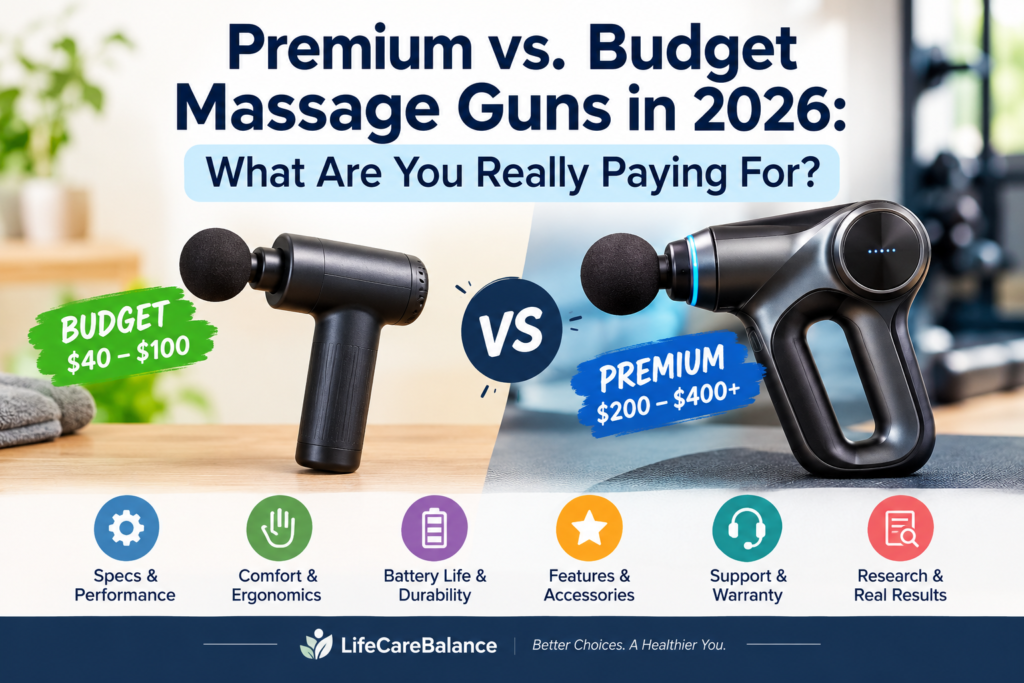
Spending $400 on a massage gun feels different when a $60 model has similar buttons, interchangeable heads, and promises of muscle relief. So what does the extra money actually buy, and is it worth paying for?
The answer depends on how often you use the device, which muscles you target, and which features make a meaningful difference to your experience. Premium massage guns may offer more comfortable handles, refined construction, pressure feedback, replaceable batteries, or better customer support. However, a higher price does not automatically mean better recovery results.
This guide compares premium vs. budget massage guns by examining specifications, ergonomics, battery life, noise, attachments, durability, and available research. It is a practical buying framework, not a ranking based on hands-on LifeCareBalance testing.
Affiliate disclosure: LifeCareBalance.com is reader-supported. When you buy through links on our site, we may earn an affiliate commission at no extra cost to you. As an Amazon Associate, we earn from qualifying purchases.
Quick Answer: Are Expensive Massage Guns Worth It?
For many beginners and occasional users, a budget massage gun is a sensible starting point. Someone who uses a device for a few minutes after a workout may not need premium materials, connected apps, pressure sensors, or specialized attachments.
A premium model may be worth considering if you use a massage gun frequently and value better ergonomics, easier self-reach, replaceable batteries, verified noise performance, or additional features you will actually use.
The main distinction is this: premium pricing may buy a better user experience, but it does not guarantee better muscle recovery.
Before comparing products, consider these general price categories:
| Price range | What to expect | Best suited for |
|---|---|---|
| $40–$100 | Basic percussion, multiple speeds on many models, and a simple attachment set | Beginners and occasional users |
| $100–$200 | More options for grip, weight, battery capacity, and build quality | Regular home users |
| $200–$400 | More premium designs, specialized features, and expanded support options on some models | Frequent users and comfort-focused buyers |
| $400+ | Flagship positioning, advanced features, and premium accessories on selected models | Heavy users who need specific features |
These are broad shopping categories, not guarantees about performance. Products can fall outside these ranges, and sale prices frequently change.
What Makes a Massage Gun Premium?
There is no universal definition of a premium massage gun. The label generally reflects a combination of design, materials, engineering, features, and brand positioning.
1. Build quality and materials
More expensive devices may use refined housing materials, better-finished components, or attachment systems designed for repeated use. However, price alone does not establish durability.
A budget device can work reliably, while an expensive device can still develop battery, charging, motor, or attachment problems. Independent long-term testing and warranty terms provide more useful information than marketing language.
2. Ergonomics and handle design
Ergonomics can be one of the most practical reasons to pay more.
Massage guns can be awkward to hold, particularly when you are trying to reach your calves, shoulders, or back. An angled handle, adjustable arm, or alternative grip position may improve control and reduce the effort needed to reach a muscle.
These advantages depend on the individual device and the user’s mobility, hand strength, and preferred treatment areas.
3. Motor performance
Manufacturers often promote powerful motors, high speeds, and the ability to maintain performance under pressure.
These specifications can be useful, but published numbers do not always come from standardized testing. A claim of high motor power does not independently establish quieter operation, better durability, or superior recovery outcomes.
4. Additional features
Premium models may include pressure indicators, Bluetooth connectivity, guided routines, specialized attachments, heated heads, or replaceable batteries.
These features can improve convenience. They should not be confused with proof that the device produces better clinical results.
For a practical comparison of specifications, see our Massage Gun Buying Guide 2026.
What Budget Massage Guns Do Well
Budget massage guns deserve a fair comparison. The basic purpose of these devices is to deliver repeated percussion to soft tissue, and a more affordable model can meet that need.
They reduce the cost of trying percussion massage
If you have never owned a massage gun, spending less makes sense when you are unsure whether you will use one regularly.
You can learn whether you prefer gentle or stronger percussion, which attachments feel comfortable, and whether a handheld device fits your recovery routine.
They can handle simple routines
Someone who occasionally uses a massage gun on the calves or quadriceps after exercise may not benefit much from an expensive app or an extensive attachment kit.
A basic model with comfortable handling, suitable intensity settings, and a reliable return policy may be sufficient.
They can offer useful specifications
Some budget models advertise multiple speed settings, several attachments, and substantial battery life. Those specifications deserve consideration, but they should be checked against the exact model and seller listing.
The potential trade-offs include uncomfortable grips, excessive weight, inconsistent quality, limited repair options, and less accessible customer support.
A low price is not automatically good value if the device becomes uncomfortable or unreliable after a short period.
Amplitude: Does a Longer Stroke Mean a Better Massage?
Amplitude describes how far the massage head travels with each percussion stroke, usually measured in millimeters.
A longer stroke may appeal to someone who prefers stronger-feeling percussion on larger muscle groups. A shorter stroke may feel more comfortable for a person who prefers a gentler experience.
However, amplitude is only one part of how a massage gun feels. Speed, attachment shape, applied pressure, and individual sensitivity also matter.
Two devices with the same published amplitude may not feel identical. Likewise, a budget model with a longer advertised stroke is not automatically better than a premium model with a shorter one.
Buying advice: Match amplitude to your preferences rather than chasing the highest number. Check whether the manufacturer publishes the specification and avoid treating unverified retailer claims as established facts.
Stall Force: Should You Pay More for a Stronger Motor?
Stall force describes the resistance a massage gun can tolerate before its motor slows substantially or stops. Manufacturers commonly express it in pounds.
It is tempting to assume that a higher stall-force number means a better massage. That conclusion is too simplistic.
Testing methods may differ between brands, making direct comparisons unreliable. A published figure may also be a manufacturer claim rather than an independently measured result.
More importantly, pressing harder is not necessarily better. Cleveland Clinic’s overview of percussive therapy discusses appropriate use and cautions around excessive pressure.
For most casual users, comfortable handling and controllable intensity deserve at least as much attention as stall force. You should not need to lean aggressively into a muscle to justify purchasing a powerful device.
Motor Consistency and Noise
Motor consistency describes how well a device maintains its operating behavior under normal use. Noise describes how loud it is during operation.
Both factors can affect whether a massage gun is pleasant to use regularly, but neither should be judged from price alone.
What to look for
- Independent noise measurements taken under comparable conditions.
- Reviews that explain how the device behaves under ordinary use.
- Evidence that the device maintains consistent operation without excessive heating.
- Clear information about speed settings and operating instructions.
A premium model may be designed to run more quietly, but a higher price does not prove that it will be quieter than every budget alternative.
Similarly, terms such as “ultra-quiet” and “professional-grade” should be treated as marketing unless supported by useful evidence.
If you live with other people, use a massage gun in an apartment, or plan to use it while watching television, noise may be more important to you than maximum advertised power.
Battery Life and Charging
Battery performance is another area where assumptions can lead to poor purchases.
An expensive massage gun does not necessarily last longer on a charge than an affordable one. Compare the manufacturer’s stated runtime, charging method, charging time, and battery design for the specific models you are considering.
Built-in versus replaceable batteries
A built-in battery keeps the design simple, but battery degradation may eventually reduce the device’s usefulness.
A replaceable battery can offer more flexibility, especially for frequent users. However, replacement availability, price, and compatibility should be verified rather than assumed.
Realistic runtime expectations
Published battery life may depend on the selected speed, pressure, and usage conditions. A maximum-runtime claim should not automatically be interpreted as typical runtime during a full session.
Look for clear testing conditions where available, and consider whether you can easily charge the device when needed.
For occasional use, a simple charging arrangement may be sufficient. For frequent use, battery replacement options and dependable support may justify additional spending.
Ergonomics, Weight, and Reach
Comfort can matter more than an impressive specification sheet.
A massage gun may feel manageable for a short session but become tiring when you use it frequently. Weight distribution, handle shape, vibration transmitted to the hand, and ease of reaching different muscles all influence the experience.
UCLA Health’s guide to choosing and using a massage gun discusses weight, noise, speeds, and battery considerations when choosing a device.
Before buying, consider:
- Weight: Can you hold and control it comfortably?
- Grip: Can you maintain a secure hold without straining your wrist?
- Reach: Can you comfortably access the areas you intend to target?
- Controls: Are the buttons easy to operate during use?
- Intensity: Can you select a comfortable setting without excessive pressure?
Premium handles may make some movements easier, but an expensive design is not automatically the right fit for every person.
If possible, try holding a device before purchasing. Otherwise, check the return policy carefully.
Attachments: Do You Need More Massage Heads?
Many massage guns include a ball head, flat head, fork-shaped attachment, or smaller targeted head. The exact options vary by model.
A larger attachment collection may look impressive, but most users do not need every shape for ordinary use.
What matters is whether the included heads are suitable for your intended muscles, attach securely, and can be replaced if lost or damaged.
Avoid using pointed or aggressive attachments on bony areas, the front of the neck, or other sensitive structures. Follow the device instructions and do not assume that an attachment advertised for targeted use is appropriate for every body area.
A smaller set of comfortable, useful attachments can be better value than a large collection you rarely use.
Apps, Bluetooth, Pressure Sensors, and Heat
Smart features are among the most visible differences between certain premium and budget models.
Apps and guided routines
An app may provide instructions, suggested routines, or device controls. These features can help users who prefer structured guidance.
However, an app is a convenience feature, not proof that a massage gun improves recovery more than a simpler model.
Pressure feedback
Some devices display or indicate how much pressure the user applies. This may help a beginner recognize when they are pressing too hard.
Pressure feedback is not a medical measurement and does not guarantee safe use.
Heated or cooled attachments
Specialized attachments may change the sensation of a session. Whether that additional sensation is worth the cost depends on personal preference.
Do not assume that heat or cooling automatically improves recovery outcomes. Evaluate the feature as a comfort option unless stronger evidence supports a specific claim.
Build Quality, Warranty, and Customer Support
Warranty terms can be a more meaningful reason to pay extra than a minor difference in motor specifications.
Compare the duration of coverage, battery exclusions, repair arrangements, and availability of replacement attachments. Check whether the warranty applies to your country and whether the retailer or manufacturer handles claims.
A longer warranty does not guarantee that a product will last longer, but clear coverage and accessible support can reduce ownership risk.
Also consider the return window. Comfort is difficult to judge from photographs, and the ability to return an unsuitable device can be valuable.
Before purchasing, verify the exact model name, seller, warranty conditions, and current US price. Do not assume that different generations of the same product have identical specifications or accessories.
What Does the Research Say About Recovery?
This is the most important distinction in the premium-versus-budget debate.
There are two separate questions:
- Can percussion massage help with some short-term recovery outcomes?
- Does an expensive massage gun produce better recovery outcomes than a budget model?
The first question has some encouraging but limited evidence. The second has not been established by direct comparative evidence showing that premium pricing itself improves recovery.
A 2025 randomized controlled trial published in Frontiers in Public Health examined percussion massage in 30 physically active male college students. The researchers compared static stretching with two percussion-massage durations. Some outcomes favored the longer-duration percussion group at the 48-hour assessment.
The trial is informative, but it involved a small, specific population and a particular intervention protocol. It does not establish the best treatment duration for everyone, and it did not compare expensive massage guns against budget devices.
Read the 2025 randomized controlled trial for the study details.
A broader systematic review and meta-analysis of post-exercise recovery techniques found that massage may help reduce delayed-onset muscle soreness and perceived fatigue. However, the review examined massage and other recovery methods generally, not whether premium percussion devices outperform inexpensive ones.
The practical conclusion is straightforward: a massage gun may help some people feel less sore or more comfortable, but the available evidence does not justify paying more solely because a manufacturer promises superior recovery.
If an expensive device is easier to hold, quieter in your environment, or more convenient to use, those advantages may still make it a worthwhile personal purchase.
Premium vs. Budget Massage Guns by User Type

- Simplified Smart Percussive Massage Therapy: Prioritizes the essential massage gun features you need while maintaining t…
- 4 High-Quality Foam Attachments: The Thumb for trigger points and lower back pain relief, and Cone as a foot and hand ma…
- Ergonomic Design with Patented Triangle Handle: Handheld massager with flexible positioning for reduced stress on the wr…

- The original Hypervolt with some serious upgrades – lighter, more powerful, and a newly designed ergonomic handle. Give …
- The Hypervolt 2 has an improved ergonomic design, reduced weight, and three speeds of powerful percussion to help you ge…
- Don’t pause your favorite song or your favorite show. Our patented QuietGlide technology will have you saying ahhh, not …

- Developed by Famous Physical Therapists – Trust your recovery to the experts. Designed by Bob and Brad, the "Most Famous…
- Lightweight Portability for On-The-Go Relief – Weighing just 0.95lbs, this mini massager is engineered for ultimate trav…
- Compact Size, Uncompromised Power – Don’t let the mini size fool you; this device delivers a "Compact but Powerful" expe…
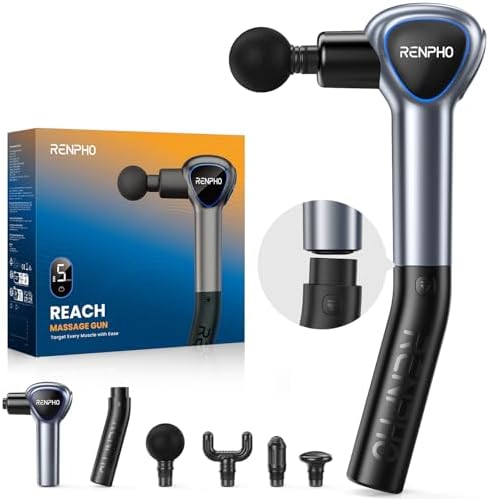
- Detachable Massager: Get full-body relief with four handle options. Attach the extension handle for hard-to-reach areas …
| User type | Sensible starting point | Main priority |
|---|---|---|
| First-time buyer | Budget | Affordable way to try percussion |
| Occasional exerciser | Budget | Comfortable handling and simple controls |
| Desk worker | Budget to mid-range | Weight, grip, and manageable noise |
| Runner | Budget to mid-range | Portability and controllable intensity |
| Strength-training enthusiast | Mid-range to premium | Comfort and preferences for larger muscle groups |
| Frequent user | Mid-range to premium | Ergonomics, durability, and battery options |
| Frequent traveler | Compact model at an appropriate price | Size, weight, and charging |
| Feature-focused buyer | Premium | Useful sensors, guided routines, or specialized attachments |
These are starting points rather than strict rules. Individual comfort, budget, intended use, and health considerations should guide the final choice.
For more product-specific comparisons, see our Best Massage Guns for Muscle Recovery in 2026 roundup and our Best Deep Tissue Massage Guns in 2026 guide. They address product selection, while this article focuses on whether paying more is worthwhile.
When a Budget Massage Gun Makes More Sense
A budget model may be the better choice if:
- You are unsure whether you will use a massage gun regularly.
- You want occasional relief from ordinary post-exercise muscle soreness.
- You do not need app integration or specialized attachments.
- You can find a suitable model with clear specifications and a reasonable return policy.
- You would rather spend the difference on other priorities, such as exercise equipment or recovery essentials.
There is little reason to pay for features that do not solve a problem you actually have.
When Paying More May Be Worth It
A premium device deserves consideration if:
- You use a massage gun frequently and value comfort over long-term use.
- An adjustable handle or different grip position would make reaching your target muscles easier.
- You have verified that a particular model meets your noise requirements.
- You want a replaceable battery and confirmed replacement availability.
- You value specific features such as pressure feedback or guided routines.
- The manufacturer offers warranty coverage and support that matter to you.
The key is to identify the feature that justifies the price before buying. A premium label on its own is not a reason to upgrade.
When a Premium Massage Gun Is Probably Overkill
An expensive model may not be worth the cost if you use a massage gun only occasionally, prefer a simple routine, or are primarily attracted by impressive-looking numbers.
It may also be unnecessary if you expect a higher price to cure an injury, eliminate chronic pain, or guarantee faster athletic recovery.
Massage guns are optional recovery tools. They do not replace appropriate training, sleep, professional assessment, or treatment for an underlying medical problem.
How Much Should You Actually Spend?
There is no universally correct budget. Start by answering five questions:
- How often will you use it? Occasional use usually makes a simpler device easier to justify.
- Which areas will you target? Consider comfort, reach, and suitable intensity rather than maximum power alone.
- Will you carry it around? Portability and weight may matter more than advanced features.
- Which ownership features matter? Warranty coverage, replacement batteries, and customer support can affect long-term value.
- Will you use the extras? Pay for an app, sensor, or specialized attachment only if you expect it to improve your experience.
For many people, beginning with a suitable budget or mid-range device is reasonable. If regular use reveals a specific limitation, such as uncomfortable handling or inadequate reach, upgrading becomes a more informed decision.
Massage Gun Safety: What to Know Before Using One
Massage guns are not medical treatments and should not be used to diagnose or treat the underlying cause of persistent pain.
Follow the manufacturer’s instructions, start at a low intensity, and use gentle pressure. Move the device over appropriate soft tissue rather than pressing aggressively into one spot.
Avoid direct application to bones, joints, the spine, and the front of the neck. Do not use a massage gun over open wounds, significant bruising, or areas of unexplained pain. Stop if the device causes sharp pain, unusual discomfort, or worsening symptoms.
If you have a medical condition, a recent injury, a history of blood clots, or take blood-thinning medication, ask a qualified healthcare professional whether percussion massage is appropriate for you.
Back pain can have many causes, and temporary changes in muscle sensation do not establish that an underlying problem has resolved. The Mayo Clinic’s guidance on back pain symptoms and causes explains when medical assessment is important.
Seek prompt medical care for severe or concerning symptoms. Back pain associated with new bowel or bladder control problems, significant trauma, or other emergency warning signs should not be treated with a massage gun.
Frequently Asked Questions
Are expensive massage guns actually better?
They may offer better ergonomics, construction, support, or additional features. However, price alone does not establish superior performance or recovery outcomes.
Is a $50 massage gun worth buying?
It can be a reasonable choice for beginners and occasional users, provided the exact model has suitable controls, reliable seller information, and a clear return policy.
What is the biggest difference between cheap and expensive massage guns?
Common differences include handle design, materials, weight distribution, battery options, support, and specialized features. The actual differences depend on the specific models being compared.
Does higher stall force mean a better massage?
Not necessarily. Stall-force measurements are not consistently standardized across brands, and applying excessive pressure is not a good way to judge massage quality.
Is 16 mm amplitude necessary?
No. A longer stroke is not a universal requirement. Comfort, speed, attachment shape, and intended use also affect how a device feels.
Are premium massage guns quieter?
Some are designed for quieter operation, but price does not guarantee low noise. Look for reliable measurements made under comparable conditions.
Do massage guns improve athletic performance?
Some studies suggest potential benefits for short-term soreness or range of motion, but the evidence remains limited. Better recovery or athletic performance is not guaranteed, and there is no established rule that expensive devices produce better results.
How long should a massage gun last?
There is no reliable lifespan that applies to every model. Battery health, usage, construction, maintenance, and repair options all matter. Check the warranty and availability of replacement parts.
Can a budget massage gun work for athletes?
Yes, it may be sufficient for some athletes, particularly for occasional use. Frequent users may place more value on comfort, durability, and specialized features.
Can a massage gun replace professional massage or medical care?
No. It can be a convenient self-care tool for some people, but it cannot assess an injury or replace appropriate medical evaluation and treatment.
Final Verdict: Choose Value, Not the Highest Price
The best premium-versus-budget decision depends on what you will actually use.
Choose a budget massage gun if you are new to percussion massage, use it occasionally, or want a straightforward device without unnecessary extras.
Consider the mid-range if you use it regularly and want a more comfortable design, better reach, or specific battery features.
Pay for a premium model when its verified advantages solve a real problem for you. Specialized features, better ergonomics, or useful support may justify the extra cost, but only if they matter to your routine.
Most importantly, do not assume that a more expensive massage gun guarantees better recovery. Compare the exact specifications, warranty, return policy, and independent evidence before purchasing.
Your goal is not to own the most expensive device. It is to choose a comfortable, suitable, and dependable tool that fits your needs and budget.
This article is for general informational purposes only and is not medical advice. Consult a qualified healthcare professional about persistent pain, injuries, or medical conditions before using a massage gun.