
LifeCareBalance.com is reader-supported. When you buy through links on our site, we may earn an affiliate commission at no extra cost to you. As an Amazon Associate, we earn from qualifying purchases.
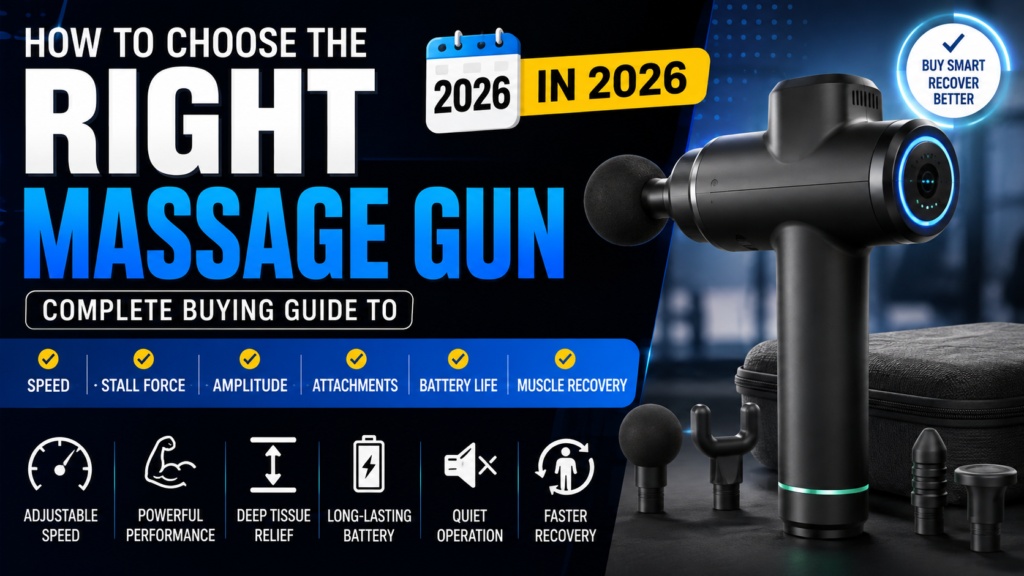
Massage gun product pages are full of impressive numbers: 3,200 percussions per minute, 16 mm of amplitude, 60 pounds of stall force, multiple attachments, and several hours of battery life. But the biggest number on the box does not automatically make a device the right choice for you.
A runner, a strength-training athlete, an office worker, and someone who occasionally feels tight after a long walk may need very different features.
The smarter approach is to start with your routine, identify the muscle groups you want to target, and then compare the specifications that matter for that use. Weight, grip comfort, speed control, and portability can be just as important as motor power.
This guide explains how to choose a massage gun based on your needs, budget, and intended use. It also covers the limitations of manufacturer specifications, common buying mistakes, and important safety considerations.

- Our gentlest level of percussive massage therapy – perfect for those who prefer a milder, soothing massage that still pr…
- With 3 speeds and simple one-button control, Theragun Relief is our easiest model yet. Lightweight and effective, it del…
- Includes 3 scientifically designed massage attachments to target different areas of the body: Dampener – for tender or s…
Quick Answer: How Do You Choose a Massage Gun?
Choose a massage gun by answering five questions first:
- Which areas will you target most? Large muscles such as the quads and glutes have different needs from smaller or more sensitive areas.
- How often will you use it? Occasional users may not need the power, accessories, or price of a professional-style model.
- How much intensity do you prefer? Look for useful low-speed settings and comfortable control rather than maximum speed alone.
- Can you hold and maneuver it comfortably? Weight, balance, handle shape, and reach influence how practical a device is.
- Will you use it at home, at the gym, or while traveling? Portability, charging, and noise may change your decision.
For most people, a sensible starting point is a massage gun with adjustable speed, a comfortable handle, manageable weight, useful attachments, and sufficient battery life for normal sessions.
You do not automatically need the deepest stroke, strongest advertised motor, or highest percussions-per-minute figure.
Step 1: Identify Your Main Reason for Buying
Your main use case should determine which features deserve priority. Avoid comparing specifications until you know what you want the device to do.
For General Everyday Muscle Tightness
If you want a massage gun for occasional tightness after sitting, walking, or exercising, look for a straightforward model that is comfortable and easy to control.
Prioritize:
- Adjustable speed settings, including a comfortable low setting
- A grip that feels secure in your hand
- Moderate weight
- A general-purpose ball attachment
- A softer attachment for sensitive muscle areas
- Convenient charging and adequate battery life
You may not benefit much from paying extra for advanced app features, a high-force motor, or a large collection of attachments you rarely use.
For Runners and Walkers
Runners and frequent walkers often focus on their calves, quads, and hamstrings. A massage gun for this routine should be manageable to hold while treating the legs.
Look for adjustable intensity, a comfortable grip, and attachments that suit larger muscle groups. A lighter model may be more practical if you also want to use it on your shoulders or carry it in a gym bag.
For a more focused comparison of devices for leg-focused routines, see our Best Massage Gun for Leg and Calf Recovery.
For Strength Training
People who regularly train their legs, glutes, and other large muscle groups may prefer a device that maintains consistent percussion under reasonable pressure.
Motor capability and stroke length may matter more for this use case, but they should not be the only criteria. The device should still allow you to use comfortable intensity without leaning your body weight into it.
Also consider durability, grip, battery performance, and how often you will use it. Stronger percussion is not automatically more effective, and excessive pressure can make a session uncomfortable.
For Desk Workers
If you spend long hours sitting at a desk, you may be looking for a device to use briefly on appropriate shoulder or upper-back muscles.
Prioritize:
- Lightweight handling
- Low-speed control
- Quiet operation
- Comfortable grip
- Easy one-handed use
Do not treat neck pain as automatically muscular. Avoid using a massage gun directly on the front or sides of the neck, over the spine, or over other bony structures. Persistent, unexplained, or worsening symptoms deserve appropriate medical assessment.
Our Best Massage Guns for Neck and Shoulder Tension in 2026 guide covers this more specific use case.
For Full-Body Use
If you want one device for your quads, hamstrings, calves, glutes, and shoulders, versatility becomes important.
Look for a comfortable handle, more than one useful speed, attachments suited to different muscle groups, and a weight you can manage during self-treatment. Battery life matters more if you routinely move between several areas in one session.
A model that feels comfortable in several hand positions may be more useful than a heavier device with a stronger motor but an awkward grip.
For a more detailed look at whole-body versatility, see our Best Massage Gun for Full-Body Recovery.
Step 2: Understand Speed and PPM
Massage guns often advertise speed in percussions per minute, commonly abbreviated as PPM. Some product listings use RPM instead, so check the manufacturer’s terminology before comparing figures.
You may see advertised speeds such as 1,800, 2,400, or 3,200 percussions per minute. A higher number indicates a faster percussion rate, but it does not tell you everything about the massage sensation or overall quality.
Speed is only one part of the experience. Stroke length, motor behavior under pressure, attachment design, and the amount of force you apply also affect how the device feels.
What Should Beginners Look For?
Beginners should prioritize control over maximum speed.
A device with a comfortable starting setting and useful steps between lower and higher intensity may be easier to use than one with a very fast top setting and limited control.
Start at the lowest comfortable setting. Increase it only if the sensation remains comfortable, and do not assume that a faster setting is necessary for better results.
There is no single PPM number that is right for every person or muscle group.
Step 3: Understand Amplitude
Amplitude describes the distance the massage head travels during a stroke. Manufacturers generally express this measurement in millimeters.
A product might advertise 8 mm, 10 mm, 12 mm, or 16 mm of amplitude. These figures describe different stroke lengths, not a universal ranking of quality.
When a Shorter Stroke May Be Suitable
A shorter stroke may be sufficient for someone who prefers a gentler sensation, wants a compact device, or plans to use it mainly for occasional sessions.
The overall experience still depends on speed control, attachment shape, applied pressure, and personal comfort.
When a Longer Stroke May Appeal
Some users prefer a longer stroke when working on large muscle groups such as the quads, hamstrings, or glutes. A deeper-feeling percussion pattern may suit their preferences.
However, a longer stroke can feel too aggressive for some users and areas. It does not guarantee better recovery, and it should not be used as a reason to apply more pressure.
Buying rule: Compare amplitude as one specification, not as proof that a massage gun is more effective than another.
Step 4: Understand Stall Force Without Overvaluing It
Stall force describes how much resistance a device can tolerate before its motor slows significantly or stops. Manufacturers may publish this figure in pounds.
A higher advertised number can suggest that a motor is designed to tolerate more resistance. But consumers should be careful when comparing figures across different brands.
Testing methods, measurement conditions, and how manufacturers present their claims may differ. Two products with similar published numbers may not feel identical in use.
If you regularly use a massage gun on large muscle groups, motor consistency may be worth considering. For occasional use, comfortable handling and controllable intensity may matter more than the highest advertised stall force.
Do not compensate for a device that feels weak by pressing harder against your body. Use a setting and amount of pressure that remain comfortable.
Step 5: Choose Attachments You Will Actually Use
A massage gun may come with several interchangeable heads. More attachments can provide options, but a larger count does not automatically mean greater value.
The useful question is whether the included heads match your intended use.
Ball Head
A rounded head is a common general-purpose option for larger muscle groups, such as the quads, glutes, hamstrings, and calves.
Flat Head
A flat head provides a broader contact surface. Some users prefer it when they want a more distributed sensation.
Soft or Dampener Head
A softer head may be more comfortable for people who find firmer attachments too intense. It can be a useful option for more sensitive muscle areas.
Bullet or Cone Head
A narrow head concentrates contact into a smaller area. This can make the sensation more intense and requires extra caution.
Avoid aggressive use over bones, joints, the spine, the front or sides of the neck, or other vulnerable structures.
Fork Head
A fork-shaped head is designed to fit around certain muscle areas. Its shape does not make it appropriate for pressing directly onto the spine or neck bones.
For most general users, a few practical attachments are often enough. Consider the shape, material, and intended use of each head rather than buying based on attachment count alone.
Step 6: Check Weight, Balance, and Grip
Weight is one of the easiest specifications to overlook.
A massage gun may look impressive on a product page but feel tiring when held away from your body or maneuvered around your shoulders. A device that is difficult to control may end up being used less often.
Before choosing a model, consider:
- Total weight: Can you hold it comfortably for your intended session?
- Balance: Does the device feel front-heavy?
- Handle shape: Can you maintain a secure grip?
- Reach: Can you comfortably reach the muscle groups you want to target?
- Controls: Can you change settings without struggling to hold the device?
These details can matter more than small differences in advertised motor specifications.
If possible, try the device in person or check return conditions before purchasing. Product photos alone cannot establish whether a handle will suit your hand.
Step 7: Decide Between a Mini and Full-Size Massage Gun
Mini and full-size models serve different priorities.
| Feature | Mini Massage Gun | Full-Size Massage Gun |
|---|---|---|
| Portability | Usually easier to pack | Usually bulkier |
| Handling | Often easier for travel and quick use | Can feel heavier during extended self-use |
| Large muscle groups | May take more time or feel less suitable for some users | Often offers more options for frequent whole-body use |
| Motor capability | Varies by model | Often offers more powerful configurations |
| Battery and charging | Depends on the design | Depends on the design |
| Best reason to choose it | Size and convenience | Versatility and frequent use |
These are general tendencies, not rules for every model. Some compact devices are capable, and some full-size models are designed primarily for comfort rather than maximum power.
Choose a mini if you prioritize travel, office use, portability, or quick sessions. Consider a full-size model if you expect frequent use across several large muscle groups and can comfortably manage its weight.
The best choice is the one you will realistically use.
Step 8: Consider Noise and Your Environment
Noise may not matter much when you use a massage gun alone in a gym, but it can become important in a shared bedroom, apartment, office, or hotel room.
A manufacturer’s decibel rating can be useful when available, but do not assume that figures from different brands were measured under identical conditions.
Think about your actual environment:
| Where You Will Use It | What to Prioritize |
|---|---|
| Home alone | Comfort and value |
| Shared apartment | Quieter operation |
| Office | Low noise and compact size |
| Hotel room | Quietness and portability |
| Gym | Handling and motor performance |
| Shared bedroom | Low noise and short, convenient sessions |
If you are sensitive to noise, look for independent reviews that describe sound at different speeds. A quiet setting is only useful if it also provides a comfortable massage sensation.
Step 9: Match Battery Life to Your Routine
Battery life is important, but it should match how you plan to use the device.
If you use a massage gun for short sessions a few times each week, a very large battery may not be necessary. Frequent users may value longer runtime, particularly when treating several muscle groups.
Check the following before buying:
- Advertised runtime and the conditions under which it was measured
- Charging time
- Charging connector and charger type
- Whether the battery is replaceable
- Availability of replacement batteries or chargers
- Whether charging accessories are included
Actual battery performance can vary with speed, pressure, temperature, battery age, and usage patterns. Treat manufacturer runtime as an estimate rather than a guarantee.
Step 10: Set a Budget Before Comparing Brands
Massage guns range from inexpensive compact devices to premium models that cost several hundred dollars. Set a realistic budget before you start comparing products.
Budget Models
A budget model may suit occasional users, beginners, and people who mainly want a simple device for short sessions.
Check that it offers comfortable speed control, a secure grip, suitable attachments, and clear warranty information. A low price is less attractive if the device is difficult to handle or support is unavailable.
Mid-Range Models
Mid-range models may offer a practical balance of motor performance, handling, battery life, attachments, and build quality.
For many regular home users, this category is worth comparing closely before spending more on advanced features.
Premium Models
Premium devices may offer more refined ergonomics, stronger motor performance, pressure guidance, app-connected routines, additional accessories, or other convenience features.
Those features can be valuable to frequent users, but a higher price does not guarantee proportionally better recovery results.
When deciding whether to spend more, ask which specific improvement you will notice during normal use. If the answer is unclear, the premium may not be worth it.
For a deeper discussion of price and feature trade-offs, see our Premium vs. Budget Massage Guns in 2026.
Step 11: Check Warranty, Returns, and Support
Specifications tell only part of the story. A massage gun is a powered device with a battery, motor, charger, and moving parts, so after-sales support is worth considering.
Before purchasing, check:
- Length and scope of the warranty
- Whether the warranty covers the battery
- Return window and return shipping conditions
- Availability of customer support
- Replacement attachment and charger availability
- Whether the seller is authorized
- Whether the model is current or discontinued
A longer warranty may provide additional peace of mind, but read its actual terms. Coverage, exclusions, and service options matter more than the headline duration alone.
Also check the exact model and generation. Product names can be similar, and listings may combine details from different versions.
What Does Research Say About Massage Guns?
Research on percussive massage devices suggests possible short-term benefits for flexibility and range of motion, but the evidence has limitations.
A systematic review of massage guns and performance or recovery included 11 studies. The authors reported potential benefits for flexibility, range of motion, and some recovery-related outcomes, while noting that most included studies had a moderate risk of bias and one had a high risk of bias. The review did not establish consistent improvements across all measures of athletic performance.
A second systematic review of percussive therapy included 13 studies and also identified limitations in study quality and reporting. Its findings suggest potential benefits, but they do not justify treating every advertised product or protocol as proven.
For practical context, the Cleveland Clinic’s guide to massage guns discusses their possible uses, limitations, and basic precautions.
The sensible takeaway is that a massage gun may be a useful supplementary tool for temporary muscle tightness or mobility routines. It is not a guaranteed way to prevent injury, accelerate every aspect of recovery, or improve athletic performance.
Sleep, nutrition, appropriate training loads, and a well-designed exercise routine remain important parts of recovery.
How to Use a Massage Gun More Safely
Choosing the right device is only part of the decision. How you use it also matters.
Basic precautions include:
- Start at a low speed and increase only if comfortable.
- Keep the device on appropriate soft muscle tissue.
- Move it slowly rather than pressing aggressively into one spot.
- Avoid bones, joints, the spine, and the front or sides of the neck.
- Do not use it over open wounds, irritated skin, or areas with unexplained swelling or bruising.
- Stop if you experience sharp pain, unusual numbness, or significant discomfort.
- Do not assume that pain means the device is working.
The Healthline guide to massage-gun use and risks provides additional practical precautions.
If you have a recent injury, recent surgery, a bleeding disorder, reduced sensation, unexplained pain, or another relevant medical concern, consult an appropriate healthcare professional before using a percussion device. Do not use a massage gun as a substitute for assessment or treatment of an unresolved medical problem.
Seven Common Massage Gun Buying Mistakes
1. Choosing the Highest Advertised Speed
A higher PPM figure does not automatically mean a better massage. Look for comfortable, useful speed control.
2. Treating Amplitude as a Quality Score
A longer stroke may suit some users, but it does not prove that a device will provide better results for everyone.
3. Comparing Stall Force Without Checking the Method
Manufacturer figures may not be directly comparable. Treat them as one part of the specification sheet.
4. Buying Too Many Attachments
A handful of useful heads may be more practical than a large collection you never use.
5. Ignoring Weight and Balance
A heavy or awkward device may be difficult to use on your own shoulders and back.
6. Paying for Features You Will Not Use
App integration, advanced sensors, and extra accessories may be useful to some people but unnecessary for occasional users.
7. Ignoring Warranty and Model Details
A discounted older model may still suit your needs, but check the exact generation, warranty, seller, and availability of accessories.
A Simple Decision Framework
Use this table to narrow your options before comparing individual products.
| Your Main Priority | Features to Prioritize |
|---|---|
| Occasional everyday use | Comfortable grip, adjustable speed, practical attachments |
| Running and walking | Manageable weight, leg-friendly attachments, useful intensity range |
| Frequent strength training | Consistent motor performance, suitable stroke length, durability |
| Desk breaks | Low noise, easy handling, lower-speed control |
| Travel | Compact size, charging convenience, manageable weight |
| Full-body sessions | Versatile attachments, comfortable grip positions, adequate battery |
| Tight budget | Essential controls, return policy, warranty, seller reliability |
| Premium experience | Ergonomics, support, useful accessories, features you will actually use |
If you are still uncertain, compare only two or three models that match your main use case. A short list makes it easier to evaluate meaningful differences instead of getting distracted by every feature in the market.
For a broader comparison of massage gun types and their specifications, see our Massage Gun Buying Guide for 2026.
Frequently Asked Questions
What is the most important feature in a massage gun?
There is no single feature that matters most to everyone. For many buyers, comfortable weight, useful speed control, grip, and appropriate attachments are practical starting points. People who frequently treat large muscle groups may also pay closer attention to motor performance and amplitude.
Is a higher amplitude always better?
No. A longer stroke can create a deeper-feeling percussion pattern, but that may not suit every person or body area. Comfort, control, and intended use should guide your decision.
Does a higher stall-force rating mean a better massage gun?
Not necessarily. Stall-force figures may be measured or reported differently across brands. Use the number as one clue about motor capability, not as a universal ranking.
Should beginners buy a premium massage gun?
Not automatically. Beginners may be better served by a device that is comfortable, easy to control, and reasonably priced. Premium features are worth paying for only if they address needs you actually have.
Is a mini massage gun powerful enough?
It depends on the model and your intended use. A mini may be practical for travel, quick sessions, and smaller areas. Someone who frequently treats large muscle groups may prefer a full-size model.
How many attachments do I need?
Many users can cover their routine with a few suitable attachments. Choose based on the muscle groups you plan to treat and the comfort of each head rather than the number included in the box.
Can a massage gun improve athletic performance?
Research does not establish that massage guns consistently improve all aspects of athletic performance. Some studies suggest short-term improvements in flexibility or range of motion, but results vary and the evidence has limitations.
Can I use a massage gun on my neck or spine?
Avoid using a massage gun directly over the spine, neck bones, or the front and sides of the neck. Do not assume that neck pain is caused by muscle tightness. Seek professional advice when symptoms are persistent, unexplained, or worsening.
How much should I spend on a massage gun?
Spend according to your routine and the features you will use. Occasional users may not need an expensive flagship device. Frequent users may value better handling, support, or useful accessories, but a higher price does not guarantee better recovery.
Final Verdict
The right massage gun is not necessarily the fastest, strongest, or most expensive model. It is the device that fits your muscle groups, preferred intensity, routine, budget, and ability to use it comfortably.
Start with your main use case. Then compare weight, grip, speed control, amplitude, motor performance, attachments, noise, battery life, warranty, and price—in that order of practical importance for your situation.
Do not let one impressive number make the decision for you. A comfortable device with the right features for your routine is more likely to be useful than a premium model that is too heavy, too aggressive, or unnecessarily complicated.
Choose for the way you will actually use it, and treat percussion massage as a supplementary tool rather than a replacement for sound training, recovery habits, or appropriate medical care.