
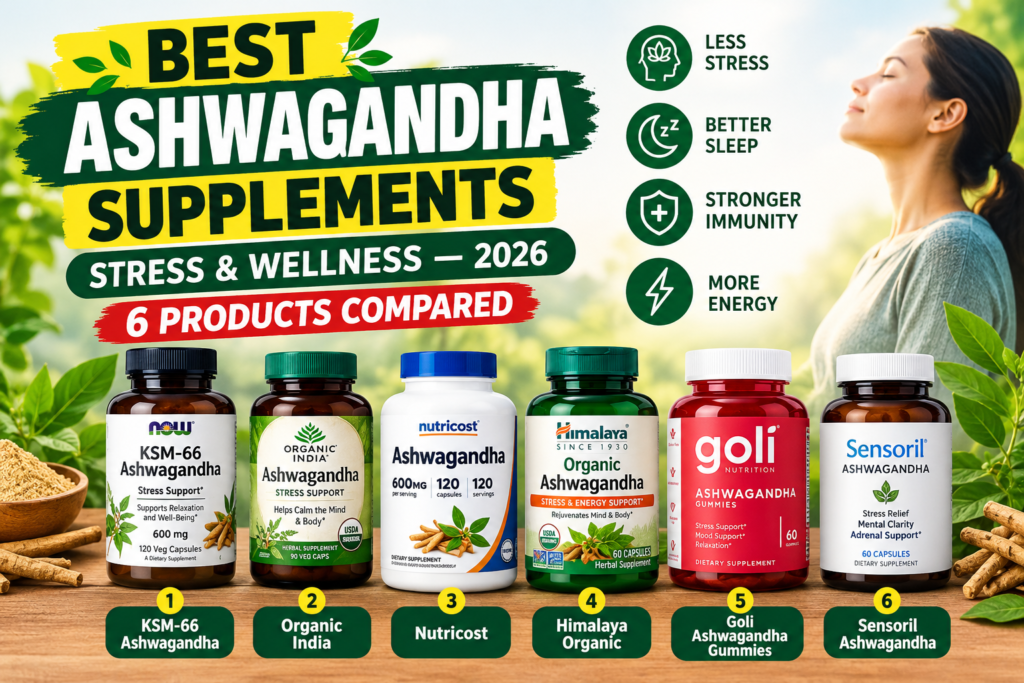
Compare 6 ashwagandha supplements in 2026. Explore capsules, gummies, extract types, buying tips, research limits, and important safety warnings.
LifeCareBalance.com is reader-supported. When you buy through links on our site, we may earn an affiliate commission at no extra cost to you. As an Amazon Associate, we earn from qualifying purchases.
Ashwagandha supplements have become popular among adults looking for practical ways to manage everyday stress, support relaxation, and build a more consistent wellness routine. Available in capsules and gummies, these products come in different formulations, extract strengths, and ingredient combinations.
However, choosing an ashwagandha supplement is not simply a matter of picking the highest milligram number or the most popular brand. Different products may use root powder, concentrated extracts, branded ingredients such as KSM-66 or Sensoril, or formulas with additional vitamins and sweeteners. These differences affect how shoppers should compare labels and evaluate value.
This guide compares six ashwagandha options: KSM-66 Ashwagandha Capsules, Organic India Ashwagandha Capsules, Nutricost Ashwagandha Capsules, Himalaya Organic Ashwagandha, Goli Ashwagandha Gummies, and Sensoril Ashwagandha Capsules.
The goal is to help U.S. shoppers understand what to check before buying—not to promise that any supplement will eliminate anxiety, guarantee better sleep, or provide a noticeable energy boost.
Important: Ashwagandha is not suitable for everyone. It may interact with medicines, affect thyroid function, and has been linked to rare cases of liver injury. Review the safety information below and consult a qualified healthcare professional before using it.
Quick Answer: Which Ashwagandha Supplement Should You Compare?
The right choice depends on the exact formula, ingredient transparency, serving instructions, dietary preferences, and your health circumstances.
- KSM-66 Ashwagandha Capsules: Worth comparing if you specifically want a product that identifies KSM-66 as its extract.
- Organic India Ashwagandha Capsules: An option for shoppers who prefer to examine an herbal supplement from an established botanical brand.
- Nutricost Ashwagandha Capsules: Worth checking if you want to compare serving size, extract details, and cost per serving.
- Himalaya Organic Ashwagandha: An option for shoppers interested in an herbal formula and its ingredient and quality information.
- Goli Ashwagandha Gummies: Worth considering if you prefer a chewable format instead of swallowing capsules.
- Sensoril Ashwagandha Capsules: An option to compare if the product specifically lists Sensoril extract and clearly identifies its full formulation.
These are comparison options, not a clinical ranking. The exact product label matters: two supplements using the same branded extract can still differ in dose, added ingredients, serving size, and quality documentation.
What Is Ashwagandha?
Ashwagandha, scientifically known as Withania somnifera, is a plant traditionally used in Ayurvedic medicine. Its roots and, in some formulations, leaves are used to make powders and concentrated extracts.
The herb is often described as an adaptogen—a term used for substances believed to help the body respond to stress. That label does not mean every product has the same effects or that the benefits are established for every health condition.
Research has investigated ashwagandha for perceived stress, anxiety symptoms, and sleep. Some findings are promising, but studies vary in their design, participants, extract types, and doses. Results from one standardized extract should not automatically be applied to every product on a store shelf.
For a general overview of supplement choices, visit the LifeCareBalance home page.
What Does the Research Say About Stress, Sleep, and Energy?
Stress
Some small clinical studies suggest that particular ashwagandha extracts may help reduce perceived stress. Researchers have also investigated changes in cortisol, a hormone involved in the body’s stress response.
However, a change in cortisol does not automatically mean that a person will feel calmer, become more productive, or experience relief from a diagnosed anxiety disorder. Individual results may differ, and stronger evidence is still needed to establish the most appropriate preparations and duration of use.
Read the NIH Office of Dietary Supplements fact sheet on ashwagandha for a detailed overview of the research and its limitations.
Sleep
Some research suggests that certain ashwagandha extracts may offer modest improvements in sleep for some people. The evidence is not strong enough to guarantee that a particular capsule or gummy will help you fall asleep faster or stay asleep throughout the night.
Persistent insomnia, loud snoring, breathing interruptions during sleep, or significant daytime tiredness deserves professional assessment rather than relying only on a supplement.
For broader sleep-routine ideas, read the LifeCareBalance guide to products for better sleep habits.
Energy and Fatigue
Some studies have examined fatigue and related outcomes, but ashwagandha should not be treated as a proven energy booster. It is not a substitute for adequate sleep, balanced nutrition, hydration, or medical assessment of ongoing fatigue.
Persistent low energy can have many causes, including sleep problems, stress, medication effects, and underlying health conditions. A supplement may not address the actual cause.
Immunity and Other Health Claims
Ashwagandha is sometimes marketed for immunity, athletic performance, hormonal balance, and broad wellness benefits. Evidence is insufficient to treat these marketing statements as guaranteed outcomes.
Do not choose a product simply because its packaging lists many possible benefits. Focus on the ingredient label, quality information, suitability, and the specific reason you are considering it.
6 Ashwagandha Supplements to Compare in 2026
The products below are presented as options to investigate, not as independently laboratory-tested or clinically ranked winners. Before publishing a purchase recommendation, check the current U.S. listing, Supplement Facts panel, seller, serving size, and available quality documentation.
1. KSM-66 Ashwagandha Capsules

- UNIVED VEGAN ORGANIC KSM-66: KSM-66 Ashwagandha is a root-only extract standardized to 5% withanolides by HPLC, which is…
- FOR ATHLETES: KSM-66 Ashwagandha supports energy and promotes endurance.
- KSM-66 ASHWAGANDHA: is extracted by a water-based “Green-Chemistry” process, using no alcohol or solvents.
Best for: Shoppers who specifically want to compare a product containing the KSM-66 branded extract.
KSM-66 is a branded ashwagandha extract, not the name of one single retail supplement. Products using this ingredient may be sold by different manufacturers, and their full formulas may not be identical.
When considering KSM-66 capsules, check whether the label clearly names the extract, identifies the amount per serving, and provides a complete ingredient list. Also review the serving directions and any available independent quality-testing information.
Potential advantages
- Allows shoppers to look specifically for a named extract.
- Capsule format may suit people who prefer not to use gummies.
- A clearly labeled product makes it easier to compare the extract amount and serving size.
What to watch for
- The KSM-66 name alone does not prove that the finished product is independently tested.
- Products may differ in serving instructions and additional ingredients.
- A higher amount is not automatically more appropriate or more effective.
Buying tip: Verify the manufacturer’s name and complete formula rather than purchasing the first result that contains the words “KSM-66.”
Compare KSM-66 ashwagandha products on Amazon US
2. Organic India Ashwagandha Capsules

- STRESS RELIEVING ADAPTOGEN: Experience profound relief from physical, energetic, and spiritual stress with Ashwagandha, …
- ENHANCED SLEEP QUALITY: Enjoy restful sleep without sedation, as Ashwagandha capsules for men and women promote healthy …
- SUSTAINED ENERGY AND VITALITY: Maintain balanced energy levels throughout the day with extra strength Ashwagandha root, …
Best for: Shoppers who want to compare an herbal supplement from Organic India.
Organic India sells herbal products, including ashwagandha options. The precise formulation, serving size, and ingredient details should be checked on the current product label.
When comparing this product, look at whether the label describes root powder, extract, or another preparation. These forms are not automatically interchangeable. Also check the number of capsules per container, recommended serving, and whether the product meets your dietary preferences.
Potential advantages
- A capsule format may fit easily into an existing supplement routine.
- Shoppers can evaluate the product’s stated plant ingredients and sourcing information.
- The format may be convenient for people who do not want sweetened gummies.
What to watch for
- Do not assume an organic label establishes superior clinical effectiveness.
- Confirm the exact formula and serving instructions.
- Check for interactions and personal contraindications before use.
Buying tip: Compare the full label and cost per serving instead of relying only on the brand name or the word “organic.”
Compare Organic India Ashwagandha Capsules on Amazon US
3. Nutricost Ashwagandha Capsules

- 600mg of KSM-66 Ashwagandha Root Extract Per Serving (60 Servings)
- 60 Veggie Caps Per Bottle
- 5% Withanolides (30mg Per Cap)
Best for: Shoppers comparing capsule supplements by serving size, extract information, and price.
Nutricost offers ashwagandha supplements, but shoppers should confirm the exact product version and current label before comparing it with other options. A product marketed with a high milligram amount is not necessarily equivalent to a product using a different extract or plant preparation.
Check whether the product label identifies root powder or extract, whether any standardization information is provided, and how much is included in the suggested serving. If a quality certificate or independent test is mentioned, verify what it actually covers.
Potential advantages
- A useful option to include in a price-per-serving comparison.
- Capsule format is familiar to many supplement users.
- The label can be assessed for extract details and additional ingredients.
What to watch for
- Do not compare milligrams alone across different formulations.
- A lower price does not prove poor quality, and a higher price does not prove better results.
- Confirm the seller and exact version before placing an order.
Buying tip: Calculate the cost per suggested serving and compare it with the amount and type of ashwagandha actually listed.
Compare Nutricost Ashwagandha Capsules on Amazon US
4. Himalaya Organic Ashwagandha
Best for: Shoppers who want to compare an herbal ashwagandha product from Himalaya.
Himalaya markets herbal supplements, including ashwagandha products. Exact ingredient composition and serving instructions can vary by product and market, so the current U.S. label should guide your decision.
Review the botanical ingredients, amount per serving, recommended use, and any warnings. If the product uses the word “organic,” check what the packaging or manufacturer documentation actually certifies rather than assuming that the term guarantees purity or a particular health outcome.
Potential advantages
- A capsule option for people who prefer traditional supplement formats.
- An opportunity to compare ingredient information from another herbal brand.
- May suit shoppers who prioritize a simple formula, depending on the exact version.
What to watch for
- The brand name alone does not establish that the formula is right for your health needs.
- Do not assume that different Himalaya products have identical ingredients.
- Ask a healthcare professional about use if you take prescription medication or have a relevant medical condition.
Buying tip: Check the current Supplement Facts panel and make sure the product sold matches the formulation you intended to buy.
Compare Himalaya Organic Ashwagandha on Amazon US
5. Goli Ashwagandha Gummies

- Vegan, Non-GMO, Gluten-free & Gelatin-free: Each bottle of Goli Ashwagandha contains 60 delicious vegan, non-gmo, gluten…
- America’s #1 Ashwagandha Vitamin Brand! (Source: SPINS MULO (powered by IRI) 52 weeks ending 2/20/22.)
- KSM-66 Ashwagandha Gummies. Ashwagandha is an herb that provides an array of benefits. Goli Ashwa Gummies use KSM-66 Ash…
Best for: Adults who prefer a chewable supplement format.
Goli Ashwagandha Gummies offer an alternative to capsules. Gummies can be convenient for people who dislike swallowing pills, but the full ingredient list deserves attention. Some gummy formulas contain sweeteners, flavorings, or additional nutrients, so they should not automatically be considered simpler than capsules.
Check the number of gummies in the suggested serving, the amount of ashwagandha per serving, added ingredients, and total sugar or sweetener information. If you have dietary restrictions, review the complete label rather than relying on front-of-package claims.
Potential advantages
- Chewable format may be easier for some people to take consistently.
- Convenient for shoppers who dislike capsules.
- The ingredient list allows buyers to assess added ingredients and serving size.
What to watch for
- Gummies may contain added sugars or sweeteners.
- A serving may require multiple gummies.
- Taste and convenience do not demonstrate better effectiveness or safety.
Buying tip: Compare the complete serving—not just one gummy—with the capsule products you are considering. Follow the current package directions.
Compare Goli Ashwagandha Gummies on Amazon US
6. Sensoril Ashwagandha Capsules
Best for: Shoppers specifically interested in comparing a product that lists Sensoril extract.
Sensoril is another branded ashwagandha extract. As with KSM-66, it is important to distinguish the extract name from the company selling the finished supplement. Different finished products may use different combinations, serving sizes, or other ingredients.
Read the label to confirm that Sensoril is actually listed, note the amount per serving, and review whether the product includes additional active ingredients. If a formula combines multiple ingredients, do not assume that all advertised effects come from ashwagandha alone.
Potential advantages
- Useful for shoppers comparing different named extracts.
- Capsule format may be convenient.
- Provides another option for evaluating extract transparency and quality documentation.
What to watch for
- The extract name alone does not prove that a finished product is better than alternatives.
- Do not assume that the dose or research for one extract applies to all ashwagandha formulas.
- Check the full ingredient list and consult a clinician about potential interactions.
Buying tip: If a product claims to use Sensoril, verify that the exact ingredient is listed on the current label and that the seller identifies the manufacturer.
Compare Sensoril Ashwagandha Capsules on Amazon US
Ashwagandha Supplement Comparison Table
| Product | Format or feature to compare | What to check before buying |
|---|---|---|
| KSM-66 Ashwagandha Capsules | Named branded extract | Extract amount, full formula, quality information |
| Organic India Ashwagandha Capsules | Herbal capsule option | Plant preparation, serving size, label details |
| Nutricost Ashwagandha Capsules | Capsule and value comparison | Amount per serving, extract details, cost per serving |
| Himalaya Organic Ashwagandha | Herbal supplement option | Exact version, ingredients, warnings |
| Goli Ashwagandha Gummies | Chewable format | Sugar, serving size, added ingredients |
| Sensoril Ashwagandha Capsules | Named branded extract | Exact extract, amount, additional ingredients |
No single option is best for everyone. Product suitability depends on your health, medication use, ingredient preferences, budget, and the quality information available for the exact product.
How to Choose an Ashwagandha Supplement
1. Identify the Form of Ashwagandha
Products may contain root powder, concentrated extracts, or other preparations. The label should make clear what the supplement contains.
Do not assume that a 600 mg product using one type of preparation is equivalent to a 600 mg product using another. Extract concentration, standardization, and plant parts can differ.
2. Read the Complete Supplement Facts Panel
Check the amount per serving, serving size, other active ingredients, and any warnings. A large number printed on the front of a bottle may not represent the amount of a specific standardized extract in the recommended serving.
If the label is unclear or makes unusually broad promises, consider choosing a product with more transparent information.
3. Look for Credible Quality Information
Independent testing may help consumers assess identity, purity, or ingredient content, depending on the scope of the testing. Look for clear documentation rather than assuming that terms such as “premium,” “natural,” or “high potency” prove quality.
A certification or test result should be checked for what it covers. It does not guarantee that a supplement will produce a specific health benefit.
4. Compare the Cost Per Serving
Divide the container price by the number of servings according to the label. Then compare the actual formula and serving amount.
A bottle with more capsules is not necessarily better value if the recommended serving uses several capsules or the formulation differs substantially from the alternative.
5. Consider Your Existing Wellness Routine
Supplements work best as a considered part of a broader health plan, not as replacements for sleep, nutrition, exercise, or appropriate medical care.
If stress is affecting your routine, the LifeCareBalance personalized wellness guide can help you think about practical lifestyle habits alongside other wellness choices.
For general supplement background, you can also explore the LifeCareBalance collagen powder comparison. Remember that evidence and safety considerations are ingredient-specific: information about collagen does not establish the effectiveness of ashwagandha.
Ashwagandha Safety: Who Should Be Careful?
Ashwagandha is not risk-free simply because it is plant-based. The National Center for Complementary and Integrative Health notes that short-term use may be tolerated by some adults, but long-term safety remains uncertain.
Review the following cautions before considering any product.
Pregnancy and Breastfeeding
Ashwagandha should be avoided during pregnancy and should not be used while breastfeeding, according to the NCCIH. Do not start an herbal supplement during pregnancy or breastfeeding without appropriate professional guidance.
Thyroid and Autoimmune Conditions
Ashwagandha may affect thyroid function, and it is not recommended for people with thyroid disorders or autoimmune conditions without appropriate medical guidance. If you have one of these conditions, do not assume that a lower dose or a different brand eliminates the concern.
Medication Interactions
Ashwagandha may interact with medicines used for diabetes or high blood pressure, thyroid medicines, sedatives, anticonvulsants, and medicines that suppress the immune system. If you take prescription medicines or multiple supplements, ask a pharmacist or healthcare professional to review the combination before use.
Liver Injury
Although reported cases are uncommon, ashwagandha supplements have been linked to liver injury. Stop taking the supplement and seek prompt medical care if you develop symptoms such as yellowing of the skin or eyes, dark urine, unusual itching, or significant abdominal discomfort.
People with existing liver problems should discuss the potential risks with a qualified clinician before considering ashwagandha.
Surgery and Other Health Conditions
NCCIH advises against ashwagandha use for people who are about to have surgery. People with hormone-sensitive prostate cancer should also avoid it because it may affect testosterone levels.
For current safety information, read the NCCIH ashwagandha safety guidance.
Common Side Effects
Reported side effects can include stomach upset, nausea, loose stools, vomiting, and drowsiness. If you experience a concerning reaction, stop taking the product and seek appropriate medical advice.
Do not use a supplement to delay evaluation of persistent anxiety, low mood, fatigue, or sleep problems.
How Much Ashwagandha Should You Take?
There is no single dose that is appropriate for every ashwagandha product or person. Research has used different preparations, extract strengths, and schedules, making it difficult to establish one universal recommendation.
The safest approach is to avoid creating your own high-dose routine. Follow the product label only if the supplement is appropriate for you, and ask a healthcare professional whether it is suitable given your medications and medical history.
Do not combine multiple ashwagandha supplements to increase the dose. Combining products may increase exposure and make it harder to identify the cause of a side effect.
More is not necessarily better, and taking a supplement for longer does not guarantee better results.
When Might You Notice Results?
There is no reliable timeline that applies to everyone. Some studies have evaluated particular extracts over several weeks, but those findings cannot guarantee a specific result for a different product or individual.
Be cautious of advertisements promising immediate calm, guaranteed anxiety relief, improved energy in a few days, or perfect sleep. Individual experiences vary, and some people may not notice a benefit.
If you decide to try a supplement after discussing it with a healthcare professional, define a realistic reason for using it and review whether it is helping without causing unwanted effects. Do not continue taking it simply because you have already paid for the bottle.
Ashwagandha vs. Lifestyle Changes for Stress
A supplement is only one possible consideration in a wider stress-management plan. Basic habits may be more practical starting points and do not carry the same supplement-specific interaction risks.
Consider the following steps:
- Keep a consistent sleep and wake schedule.
- Include regular physical activity suited to your abilities.
- Eat balanced meals and stay adequately hydrated.
- Set boundaries around work and screen time when possible.
- Try a relaxation practice, such as slow breathing or mindfulness.
- Seek professional support if stress or anxiety is persistent or interferes with daily life.
A wearable can help some people observe sleep patterns, but it cannot diagnose or treat a mental health condition. Read the LifeCareBalance Oura Ring review if you are interested in sleep and recovery tracking tools.
If you experience ongoing anxiety, panic attacks, persistent low mood, or substantial sleep disruption, consult a qualified healthcare professional rather than relying on a supplement alone.
Are Ashwagandha Supplements FDA-Approved?
In the United States, dietary supplements are not approved by the FDA for safety and effectiveness before they are marketed in the same way as prescription medicines. Manufacturers are responsible for ensuring their products comply with applicable requirements, and FDA oversight can include action against products that violate the law.
A product’s presence on a retail website does not prove that the FDA has approved it or verified its health claims. Be wary of claims that a supplement cures anxiety, treats insomnia, or guarantees a medical result.
You can read the FDA’s information for consumers on dietary supplements to understand the regulatory distinction.
Final Verdict: Which Ashwagandha Supplement Should You Choose?
The best ashwagandha supplement to compare in 2026 is the one with a clear label, an appropriate formulation, transparent quality information, and a serving format that suits your preferences—provided a healthcare professional considers it suitable for you.
KSM-66 and Sensoril are worth comparing if you specifically want a product using those branded extracts. Organic India, Nutricost, and Himalaya provide additional capsule options to investigate. Goli may appeal to shoppers who prefer gummies, but sugar, serving size, and added ingredients deserve attention.
None of these products should be treated as a guaranteed solution for stress, anxiety, sleep, or low energy. Before buying, verify the exact product version and current ingredients. Before using it, consider potential interactions and personal health risks.
A thoughtful supplement decision starts with realistic expectations, careful label reading, and professional advice when needed—not with the biggest health claim on the bottle.
Frequently Asked Questions
Is ashwagandha proven to relieve stress?
Some studies suggest that particular ashwagandha preparations may reduce perceived stress, but evidence varies by extract and study design. It is not a guaranteed treatment for stress or an anxiety disorder.
Can ashwagandha improve sleep?
Some research suggests modest sleep benefits for certain preparations. Results are not guaranteed, and ongoing insomnia should be assessed by a healthcare professional.
Does ashwagandha increase energy?
Evidence does not establish that every ashwagandha supplement boosts energy. Persistent fatigue can have many causes and may require medical evaluation.
Are KSM-66 and Sensoril the same ashwagandha product?
No. KSM-66 and Sensoril are names of branded extracts. Finished supplements using them can differ in serving size, additional ingredients, and manufacturer. Check the exact product label.
Are ashwagandha gummies better than capsules?
Neither format is universally better. Gummies may be more convenient for some people, but they can contain sweeteners and require multiple pieces per serving. Capsules may offer a different ingredient profile. Compare the full label.
Can I take ashwagandha every day?
Daily use is not appropriate for everyone. Short-term studies do not establish long-term safety, and the herb may interact with medicines or be unsuitable for certain health conditions. Seek professional advice before starting regular use.
Who should avoid ashwagandha?
It should be avoided during pregnancy and not used while breastfeeding. People with thyroid or autoimmune disorders, those approaching surgery, people with hormone-sensitive prostate cancer, and those taking potentially interacting medicines should seek medical guidance or avoid use as advised by their clinician.
Is ashwagandha FDA-approved?
No dietary supplement should be described as FDA-approved for safety and effectiveness in the same way as an approved prescription medicine. Check the product label and avoid claims promising to cure or treat disease.
Can ashwagandha cause liver problems?
Rare cases of liver injury have been linked to ashwagandha supplements. Seek medical care if you develop symptoms such as yellowing skin or eyes, dark urine, unusual itching, or significant abdominal discomfort.
Should I use ashwagandha instead of treatment for anxiety?
No. Ashwagandha should not replace professional assessment or evidence-based treatment for anxiety or other mental health concerns. Talk with a qualified healthcare professional about the most appropriate approach for your circumstances.