

Learn how resistance bands can support weight loss and strength at home. Compare band types, best exercises, a 30-minute workout and buying tips for 2026.
LifeCareBalance.com is reader-supported. When you buy through links on our site, we may earn an affiliate commission at no extra cost to you. As an Amazon Associate, we earn from qualifying purchases.
If you want to lose weight, build strength, and exercise at home without filling your room with bulky equipment, resistance bands can be a practical addition to your routine.
But resistance bands are not a magic fat-burning tool. They work best as part of a broader weight-management plan that includes appropriate nutrition, regular physical activity, resistance training, recovery, and consistency.
The biggest advantage is convenience. A good resistance band set can support squats, rows, presses, hinges, curls, lateral movements, and core exercises while taking up very little storage space.
The U.S. Centers for Disease Control and Prevention (CDC) recommends that adults get at least 150 minutes of moderate-intensity aerobic activity each week and muscle-strengthening activity on at least two days per week. Physical activity can contribute to weight management by increasing energy expenditure, but nutrition and total energy balance also matter. [CDC]
This guide explains how to use resistance bands for weight loss at home, which exercises are worth doing, what type of band to buy, how to progress, and which features matter before you spend your money.
Quick Answer: Are Resistance Bands Good for Weight Loss?
Yes. Resistance bands can support a weight-loss program by providing a convenient way to perform resistance training and full-body workouts at home.
They can help you:
- Build and maintain muscular strength
- Train major muscle groups
- Add resistance to bodyweight movements
- Perform full-body circuits
- Increase training variety
- Exercise in a small space
- Make strength training easier to perform consistently
However, resistance bands do not selectively burn fat from your stomach, thighs, arms, or another body part.
Weight loss occurs when your overall energy balance results in a calorie deficit. Physical activity increases energy expenditure, while nutrition affects calorie intake. The CDC notes that combining physical activity with appropriate dietary changes can create the calorie deficit needed for weight loss.
So the best way to think about resistance bands is simple:
They are a training tool that can support weight loss—not a standalone weight-loss solution.
How Resistance Bands Work
Resistance bands use elastic tension rather than gravity-based weight.
As you stretch the band, it provides resistance against your movement. Depending on the band and exercise, you can use that tension to train your legs, chest, back, shoulders, arms, hips and core.
A systematic review and meta-analysis published in PubMed found that elastic resistance training can produce strength gains similar to conventional resistance training in several populations and training situations.
That does not mean bands are automatically better than dumbbells or machines.
It means they can be a legitimate resistance-training option when used appropriately.
For someone exercising at home, that can be valuable because the equipment is lightweight, portable and relatively inexpensive.
Can Resistance Bands Burn Belly Fat?
Not specifically.
This is one of the most important corrections to make when discussing resistance bands and weight loss.
Doing band crunches, rows, kickbacks or leg exercises does not force your body to remove fat from that particular area.
The concept of selectively reducing fat from one body part through exercise is commonly called spot reduction. ACE notes that spot reduction is not supported by the available evidence.
Resistance band exercises can strengthen your abdominal muscles, glutes, legs, chest or arms. Over time, losing overall body fat may make those muscles more visible.
The practical approach is therefore:
Strength training + regular movement + appropriate nutrition + consistency.
Why Resistance Bands Make Sense for Home Weight Loss
One of the biggest barriers to exercise is convenience.
A person may know that strength training is useful but still skip workouts because getting to a gym requires transportation, changing clothes, equipment access or a large block of free time.
Resistance bands reduce some of those barriers.
1. They Need Very Little Space
A complete band set can usually fit in a drawer, closet or small storage bag.
That makes bands particularly useful for:
- Apartments
- Bedrooms
- Home offices
- Small workout areas
- Dorm rooms
- Travel
2. They Are Portable
Unlike a rack of dumbbells, resistance bands can easily travel with you.
You can use them at home, while traveling, outdoors or in another location where conventional equipment is unavailable.
3. They Support Full-Body Training
Depending on the band style and accessories, you can train:
- Legs
- Glutes
- Back
- Chest
- Shoulders
- Biceps
- Triceps
- Core
4. They Make Short Workouts Practical
You do not need a 90-minute gym session.
A well-designed 20- to 30-minute full-body workout can be enough to provide a useful training stimulus.
5. They Can Support Progressive Training
As you become stronger, you can increase difficulty by:
- Using a stronger band
- Combining bands when appropriate
- Increasing repetitions
- Adding sets
- Slowing the movement
- Increasing range of motion
- Reducing rest between selected exercises
- Choosing a more challenging exercise variation
Progression is more important than simply owning a large number of bands.
Types of Resistance Bands
Not every resistance band set is designed for the same job.
Loop Bands
Loop bands are continuous circles of elastic material.
They are useful for:
- Squats
- Lateral walks
- Glute bridges
- Hip abduction
- Warm-ups
- Lower-body workouts
They are especially useful when your priority is lower-body training.
Tube Bands With Handles
Tube bands usually attach to handles.
They are useful for:
- Chest presses
- Rows
- Curls
- Shoulder presses
- Triceps exercises
- Squats
- Full-body workouts
For someone buying one set to replace several pieces of home-gym equipment, a tube system can be a practical choice.
Long Loop Bands
Long bands are useful for:
- Assisted pull-ups
- Rows
- Deadlift variations
- Mobility exercises
- Strength training
- Athletic drills
They are less convenient for some traditional pressing movements unless you have a suitable anchor point.
Fabric Bands
Fabric bands are commonly used around the thighs or legs.
They can be comfortable for:
- Glute bridges
- Lateral walks
- Squats
- Hip-abduction exercises
They are not necessarily the best choice if you want a complete upper- and lower-body home-gym system.
Best Resistance Band Exercises for Weight Loss
The goal is not to find a magical “fat-burning” exercise.
Instead, prioritize movements that train large muscle groups and allow you to perform controlled, repeatable workouts.
1. Banded Squat
Primary muscles: quadriceps, glutes and hamstrings
Place the band according to the manufacturer’s instructions. Keep your feet stable and lower into a controlled squat.
Start with:
2–3 sets × 8–15 repetitions
Avoid allowing the knees to collapse inward.
2. Resistance Band Row
Primary muscles: upper back, lats, rear shoulders and biceps
Anchor the band securely or use a suitable setup.
Pull your elbows back while keeping your torso controlled.
Start with:
2–3 sets × 8–15 repetitions
3. Resistance Band Chest Press
Primary muscles: chest, shoulders and triceps
A secure anchor behind you can allow a band to reproduce a pressing movement.
Keep the movement controlled rather than allowing the band to pull your arms rapidly backward.
Start with:
2–3 sets × 8–15 repetitions
4. Banded Romanian Deadlift
Primary muscles: hamstrings, glutes and posterior chain
Stand on the band and hold the handles or ends according to the band’s design.
Push your hips backward while maintaining a controlled spine position.
Start with:
2–3 sets × 8–12 repetitions
5. Resistance Band Shoulder Press
Primary muscles: shoulders and triceps
Press upward while maintaining control over the band.
Use a lighter resistance if you cannot maintain stable shoulder positioning.
Start with:
2–3 sets × 8–12 repetitions
6. Biceps Curl
Primary muscles: biceps
Stand securely on the band and curl the handles upward without swinging.
Start with:
2–3 sets × 10–15 repetitions
7. Triceps Pressdown
Primary muscles: triceps
This works particularly well with a secure high anchor.
Keep your elbows relatively stable while extending the arms.
Start with:
2–3 sets × 10–15 repetitions
8. Lateral Band Walk
Primary muscles: glutes and hip muscles
Use a suitable loop band around the legs and take controlled side steps.
Avoid rushing through the movement.
Try:
2–3 sets × 10–15 steps per direction
9. Glute Bridge With Band
Primary muscles: glutes and hamstrings
Place the band where appropriate and raise your hips while maintaining control.
Try:
2–3 sets × 10–15 repetitions
10. Standing Band Pallof Press
Primary muscles: core and stabilizing muscles
This is a useful anti-rotation exercise when you have a secure anchor point.
Try:
2–3 sets × 8–12 repetitions per side
A 30-Minute Resistance Band Weight-Loss Workout
You do not need to perform every possible exercise.
A simple full-body circuit can be more practical.
Warm-Up — 5 Minutes
Perform easy movements such as:
- Marching in place
- Arm circles
- Bodyweight squats
- Hip hinges
- Shoulder movements
Main Circuit — 20 Minutes
Perform the following exercises:
| Exercise | Reps |
|---|---|
| Banded Squat | 12 |
| Band Row | 12 |
| Band Chest Press | 10–12 |
| Banded Romanian Deadlift | 12 |
| Shoulder Press | 10 |
| Biceps Curl | 12–15 |
| Lateral Band Walk | 10–12 each direction |
| Glute Bridge | 15 |
Rest about 30–60 seconds between exercises when needed.
Complete 2–3 rounds, depending on your fitness level.
Cooldown — 5 Minutes
Finish with easy walking and gentle mobility work.
The objective is not to finish exhausted every time.
The objective is to create a routine you can repeat consistently.
How Often Should You Use Resistance Bands?
For general adult fitness, U.S. guidelines recommend muscle-strengthening activity on at least two days per week.
A beginner could start with:
Monday: Full-body band workout
Tuesday: Walking or other aerobic activity
Wednesday: Rest or light movement
Thursday: Full-body band workout
Friday: Walking or other aerobic activity
Saturday: Optional band workout or recreational activity
Sunday: Rest
You do not have to train seven days a week.
If your goal includes weight management, combine resistance training with regular aerobic movement and an eating pattern you can maintain.
Resistance Bands vs. Dumbbells for Weight Loss
Both can work.
| Feature | Resistance Bands | Dumbbells |
|---|---|---|
| Storage | Excellent | Moderate |
| Portability | Excellent | Poor |
| Space required | Very low | Moderate |
| Resistance progression | Good | Excellent |
| Exercise variety | High | High |
| Travel use | Excellent | Poor |
| Best for small spaces | Excellent | Good |
| Heavy strength training | Depends on set | Usually better |
| Beginner home workouts | Excellent | Excellent |
The important question is not “Which one burns more fat?”
The better question is:
Which equipment will you use consistently and progress with safely?
For someone with limited space, bands can be an excellent starting point.
If you want heavier progressive loading and already have room for equipment, adjustable dumbbells may be a better complement.
For another home-fitness equipment comparison, see LifeCareBalance’s 2026 Fitness and Movement Products guide.
How to Choose the Best Resistance Band Set
1. Look for Multiple Resistance Levels
A single resistance level can become limiting quickly.
A multi-band set allows you to use lighter resistance for smaller exercises and stronger resistance for movements such as squats and rows.
2. Match the Band Style to Your Workout
If you primarily want glute and lower-body exercises, loop bands may be enough.
If you want rows, presses and curls, a tube set with handles is more versatile.
If you want pull-up assistance and athletic training, long-loop bands may be more useful.
3. Check the Attachment System
For tube sets, inspect:
- Carabiners
- Handles
- Ankle straps
- Door anchor
- Connection points
The attachment system matters because a strong band is not useful if its accessories are poorly designed.
4. Inspect the Material
Natural latex is common, but material alone does not guarantee durability.
Look for:
- Consistent construction
- Reinforced attachment points
- Good-quality handles
- Secure connectors
- Clear manufacturer instructions
5. Consider Door-Anchor Safety
Never assume every door anchor can be attached to every door.
Follow the manufacturer’s instructions.
Before using a door anchor, check that it is properly positioned and that the door is suitable for the attachment.
6. Choose Comfort Over Marketing Numbers
The highest advertised resistance is not automatically the best option.
For most beginners, a set that offers several manageable levels is more useful than a set designed primarily around extreme resistance.
Three Resistance Band Sets Worth Considering
These are examples of different formats rather than claims that one product is universally best.
Fit Simplify Resistance Loop Exercise Bands

- High End Exercise Bands. Our 12″³ By 2″³ Heavy Duty Loop Resistance Bands Come In 5 Varying Resistance Levels. This Make…
- Great With Any Workout. This Resistance Band Set Can Be Integrated Seamlessly With Various Popular Workout Program. Or U…
- Multiple Uses. While These Resistance Bands Are Often Used For Sports And Fitness, Physical Therapists Love These Physic…
Best for: Beginners, lower-body training, portability
This five-band loop set is a strong option for users who mainly want compact lower-body, mobility and warm-up training. Current Amazon-market data identifies B01AVDVHTI as the Fit Simplify five-band set.
WHATAFIT Resistance Bands With Handles

- 100% Natural Latex
- Imported
- 5 Adjustable Resistance Levels for Versatile Training: This resistance bands set includes 5 color-coded bands with indiv…
Best for: Full-body home workouts
This variant is listed as a five-level resistance-band system with handles, ankle straps and a door anchor. It is more suitable than a simple loop set if you want chest presses, rows, curls and other cable-style movements.
Bodylastics Patented Basic Series 5-Band Set
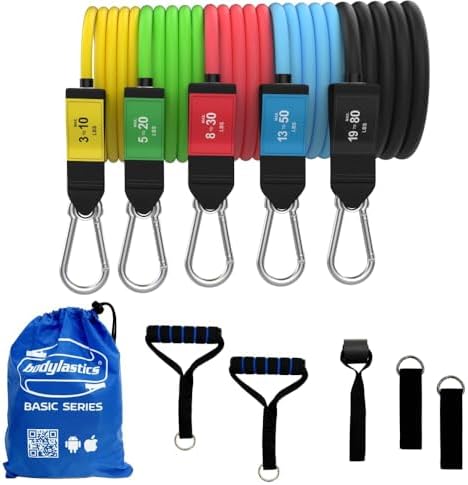
- ✅ BASIC SERIES – Get An Extra-Durable Exercise Band Set: Our exercise bands have a robust and patented Snap Reduction an…
- ✅ BASIC SERIES – Durable Clips For Safe Attachment: Our resistance bands have premium patented clips. Unlike other brand…
- ✅ BASIC SERIES – Workout With Comfortable And Wide Handles: These extra wide durable handles feature a soft foam coverin…
Best for: Users wanting a stackable tube system
The current product information identifies the set as a five-band Bodylastics Basic Series system with handles, ankle straps and a door anchor. Bodylastics’ current product information also describes five resistance bands and the included accessories.
Important: Amazon ASINs identify specific listings/variants. Amazon can change sellers, colors, bundles and availability, so verify that the ASIN matches the exact variant displayed before publishing a purchase link.
What Resistance Should Beginners Use?
There is no universal resistance level that is correct for everyone.
A better starting point is a resistance that allows you to complete the target repetitions with controlled technique while still making the final repetitions challenging.
For example, if your plan calls for 12 repetitions and you could comfortably perform 30, the band may be too light for that movement.
If you cannot perform 6–8 controlled repetitions, it may be too heavy.
Your starting point should be determined by:
- Exercise selection
- Current strength
- Technique
- Range of motion
- Training experience
- The specific band design
How to Progress With Resistance Bands
Progressive overload does not always mean immediately buying a stronger band.
You can progress by:
- Adding repetitions
- Adding a set
- Increasing band resistance
- Combining compatible bands
- Increasing range of motion
- Slowing the eccentric portion
- Reducing unnecessary rest
- Choosing a harder movement variation
For example:
Week 1: 2 sets × 10 reps
Week 2: 2 sets × 12 reps
Week 3: 3 sets × 10 reps
Week 4: 3 sets × 12 reps
Week 5: Increase resistance and return to 8–10 reps
This is only an example progression. Your actual progression should match your fitness level and exercise technique.
Resistance Bands and Nutrition
Exercise is only one part of weight management.
The National Institute of Diabetes and Digestive and Kidney Diseases explains that a sustainable eating plan combined with physical activity can support weight loss and weight maintenance.
Instead of relying on extreme diets, focus on an eating pattern you can maintain.
Useful habits may include:
- Eating adequate protein-rich foods
- Including vegetables and fruits
- Choosing mostly nutrient-dense foods
- Paying attention to portion sizes
- Limiting excess calories from highly processed foods and sugary drinks
- Staying consistent rather than pursuing short-term extremes
For another practical weight-management tool, see LifeCareBalance’s Best Portion Control Plates for Weight Loss in 2026.
Can Resistance Bands Replace a Gym?
For many general fitness goals, resistance bands can cover a surprisingly large range of movements.
However, they do not have to completely replace a gym.
A home setup might combine:
- Resistance bands
- Adjustable dumbbells
- Walking
- Bodyweight exercises
- A workout mat
If you are interested in adding adjustable weights, see LifeCareBalance’s Best Adjustable Dumbbells for Beginners in 2026.
A walking pad can also complement resistance training by making regular walking more convenient. See LifeCareBalance’s Resistance-Friendly Home Fitness and Walking Pad guide.
Common Resistance Band Mistakes
Using a Damaged Band
Do not use a band with:
- Cracks
- Cuts
- Severe wear
- Visible deterioration
- Damaged attachment points
Replace damaged equipment.
Using Too Much Resistance
More resistance is not automatically better.
If your technique breaks down, reduce the resistance.
Moving Too Quickly
Controlled repetitions are usually more useful than simply trying to complete as many repetitions as possible.
Ignoring the Anchor
If using a door anchor, follow the manufacturer’s instructions and make sure the setup is secure before applying significant force.
Expecting Instant Weight Loss
A resistance-band workout cannot guarantee a specific amount of weight loss in a specific number of days.
Weight change varies with energy intake, activity, body size, genetics, sleep, medications, health conditions and other factors.
Training Only One Body Part
If weight management is your goal, full-body training can be more practical than spending every session on abs, arms or glutes.
Who Should Be More Careful?
Resistance bands are accessible, but they are still exercise equipment.
If you have a significant injury, recent surgery, severe pain, dizziness during exercise, or a medical condition that affects your ability to exercise safely, speak with an appropriate healthcare professional before starting a new training program.
Stop an exercise if you experience sharp pain, unusual symptoms or loss of control.
Older adults, people returning from injury, and beginners should prioritize technique and gradual progression rather than trying to match advanced resistance levels.
Frequently Asked Questions
Can resistance bands help you lose weight?
Yes, resistance band training can support a weight-loss program by providing resistance exercise and increasing physical activity. However, weight loss depends on overall energy balance and lifestyle factors, not the bands alone.
How long should a resistance-band workout last?
There is no single required duration. A focused 20- to 30-minute workout can be practical for beginners, while more experienced users may train longer depending on their goals.
How many days per week should I use resistance bands?
Two or more strength-training sessions per week can fit within U.S. physical-activity recommendations. Beginners can start with two full-body sessions and increase gradually.
Can resistance bands reduce belly fat?
They can strengthen your abdominal muscles and contribute to an overall exercise routine, but they cannot selectively remove belly fat. Spot reduction is not a reliable weight-loss strategy.
Are resistance bands as effective as weights?
Elastic resistance can produce meaningful strength improvements, and research has found similar strength gains compared with conventional resistance training in some settings. However, the best equipment depends on your goals, exercise selection and ability to progressively increase training difficulty.
Are resistance bands good for beginners?
Yes. Beginners can start with lighter resistance and learn controlled movement before progressing to stronger bands.
Should I buy loop bands or bands with handles?
Choose loop bands if your main priority is lower-body exercises, mobility and glute work. Choose tube bands with handles if you want a broader full-body workout including presses, rows and curls.
Do I need a door anchor?
No. Many resistance-band exercises do not require one. But a door anchor can substantially expand exercise options when used correctly and according to the manufacturer’s instructions.
How quickly will I see weight-loss results?
There is no reliable universal timeline. Weight-loss progress varies substantially from person to person. A sustainable approach is more important than trying to force rapid results. The CDC notes that gradual, steady weight loss is generally more sustainable than very rapid loss.
Final Verdict
Resistance bands can be one of the most practical pieces of home fitness equipment for people who want to combine strength training with a weight-management routine.
They are inexpensive compared with many home-gym systems, easy to store, portable and versatile enough for full-body workouts.
But the key is using them correctly.
Do not buy a resistance band set because it promises to “burn belly fat.” Do not assume the heaviest band is the best band. And do not expect a particular number of pounds to disappear after a fixed number of workouts.
Instead, choose a set that matches your training style, learn the basic movements, progressively increase the challenge, and combine resistance training with regular aerobic activity and sustainable nutrition.
For many beginners, that simple approach is more valuable than owning a room full of expensive equipment.
Evidence & Further Reading
- CDC — Physical Activity and Your Weight and Health
- NIDDK — Eating & Physical Activity to Lose or Maintain Weight
- U.S. Physical Activity Guidelines for Americans
- PubMed — Elastic Resistance vs. Conventional Resistance Training Meta-Analysis
- ACE — Spot Reduction Evidence and Fitness Myths
Editorial note: Product prices, availability, Amazon sellers, colors, bundles and specifications can change. Verify the current Amazon US listing before publishing or updating a product recommendation.