
LifeCareBalance.com is reader-supported. When you buy through links on our site, we may earn an affiliate commission at no extra cost to you. As an Amazon Associate, we earn from qualifying purchases.
A reliable chest strap heart rate monitor can make cycling training more structured by helping you track exercise intensity, monitor heart rate zones, and understand how your body responds to different riding efforts.
Whether you ride a road bike, mountain bike, gravel bike, or indoor trainer, choosing the right heart rate monitor matters. A good cycling chest strap should provide responsive heart rate readings, stable ANT+ or Bluetooth connectivity, a comfortable fit beneath cycling clothing, and enough battery life for regular training.
For most cyclists, the Polar H10 is our leading overall recommendation because it offers electrical heart rate sensing, ANT+ connectivity, two simultaneous Bluetooth connections, and internal workout recording with a supported setup.
The Polar H9 is an excellent alternative for riders who want essential chest strap functionality without paying for additional features. The Wahoo TRACKR HEART RATE is worth considering if you prefer rechargeable power, while the Garmin HRM 200 is attractive for cyclists who use Garmin equipment.
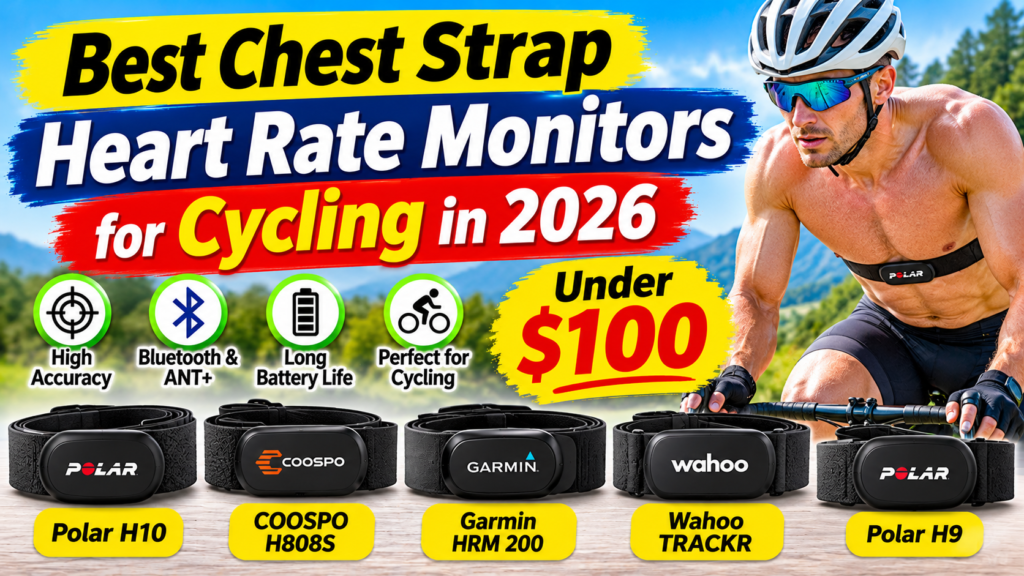
Our Top Picks for 2026
- Best Overall: Polar H10
- Best Value: Polar H9
- Best Rechargeable Chest Strap: Wahoo TRACKR HEART RATE
- Best for Garmin Users: Garmin HRM 200
- Best Budget Alternative: COOSPO H808S
This guide compares their specifications, connectivity, comfort, battery life, compatibility, and practical advantages to help you choose the right monitor for your cycling setup.
1. Polar H10 — Best Overall Chest Strap Heart Rate Monitor for Cycling

- 38% Polyamide, 29% Polyurethane, 20% Elastane, 13% Polyester
- Made in the USA or Imported
- WORKS WITH EVERYTHING: Polar HRM works with ALL HRM compatible Equipment.
The Polar H10 is one of the most established chest strap heart rate monitors for cyclists who want dependable workout data.
It uses electrical heart rate sensing rather than optical wrist-based measurement. This makes it particularly useful when your training includes climbing, sprint intervals, threshold sessions, and changes in riding intensity.
For cyclists who use a bike computer or indoor training application, the H10 offers a flexible combination of wireless connectivity and recording options.
Key Features
- Electrical chest strap heart rate sensing.
- Bluetooth Low Energy connectivity.
- ANT+ connectivity.
- Two simultaneous Bluetooth connections.
- Additional 5 kHz GymLink transmission.
- Replaceable CR2025 battery.
- Manufacturer-rated battery life of up to 400 hours.
- Internal memory for one training session with supported recording.
- Waterproof to 30 meters.
- Soft Polar Pro chest strap.
Why Cyclists Should Consider It
One of the H10’s biggest advantages is its connectivity.
You can pair it with compatible cycling computers, sports watches, smartphones, and indoor training applications. Its dual Bluetooth support is particularly useful when you want to send heart rate data to two compatible Bluetooth receivers.
ANT+ is another important advantage for cyclists who use compatible bike computers and training equipment.
The Polar H10 also supports internal recording for one training session through a compatible recording setup. This can be useful when you do not want to keep your phone connected throughout a workout.
Its replaceable battery is another practical benefit. Polar specifies up to 400 hours of battery life, although actual results depend on usage and conditions.
Potential Limitations
The H10 costs more than basic chest straps, and its battery must eventually be replaced.
It also does not measure cycling power, cadence, speed, or GPS distance. Those measurements require separate compatible sensors or equipment.
Best for: Road cyclists, indoor cyclists, serious fitness enthusiasts, and riders who want flexible connectivity.
Read our detailed Polar H10 Review 2026 for more information about its features and performance.
2. Polar H9 — Best Value Chest Strap for Cycling

- 38% Polyamide, 29% Polyurethane, 20% Elastane, 13% Polyester
- Made in the USA or Imported
- POLAR PRESENTS A NEW AFFORDABLE HRM: When you’re looking for a reliable high quality heart rate monitor for your everyda…
The Polar H9 is a strong option for cyclists who want reliable chest strap functionality without paying extra for advanced recording features.
It uses electrical heart rate sensing and supports Bluetooth, ANT+, and Polar GymLink.
For riders who simply want heart rate information displayed on a compatible cycling computer or smartphone, the H9 offers the essential features without unnecessary complexity.
Key Features
- Electrical heart rate sensing.
- Bluetooth Low Energy.
- ANT+ connectivity.
- Polar GymLink transmission.
- Replaceable CR2025 battery.
- Manufacturer-rated battery life of up to 400 hours.
- Adjustable chest strap.
- Water resistance up to 30 meters.
Why Cyclists Should Consider It
The H9 is particularly appealing if you use only one receiving device during your rides.
For example, you can pair it with a compatible bike computer and monitor your heart rate throughout outdoor cycling sessions.
It is also suitable for indoor training when paired with compatible equipment.
Its long advertised battery life reduces the need for frequent maintenance, while the replaceable battery makes long-term ownership straightforward.
Polar H9 vs Polar H10
The H9 and H10 share several important characteristics, including electrical sensing, Bluetooth, ANT+, and long stated battery life.
However, the H10 offers additional features:
- Two simultaneous Bluetooth connections.
- Internal recording for a supported training session.
- A different strap design with Polar Pro features.
The H9 is a sensible purchase if you do not need these additional functions.
Best for: Beginners, recreational cyclists, and riders looking for a dependable value-oriented chest strap.
3. Wahoo TRACKR HEART RATE — Best Rechargeable Chest Strap

- Precise Performance: Provides accurate real-time heart rate data to enhance training efficiency and support optimal perf…
- Powered to Endure: Equipped with a high-capacity rechargeable battery with over 100 hours of active battery life, TRACKR…
- Completely Connected: With ANT plus and Bluetooth connectivity, its simple to connect TRACKR HEART RATE to a smartphone,…
The Wahoo TRACKR HEART RATE is a modern chest strap designed for athletes who prefer rechargeable power.
Traditional chest straps often use replaceable coin-cell batteries. Wahoo takes a different approach with a rechargeable battery, making it convenient for people who want to avoid buying replacement batteries.
It is particularly appealing to cyclists who already use Wahoo training equipment and compatible applications.
Key Features
- Electrical chest strap heart rate sensing.
- Bluetooth connectivity.
- ANT+ connectivity.
- Rechargeable lithium-ion battery.
- Manufacturer-advertised battery life of up to 100 hours.
- LED status indicators.
- Adjustable chest strap.
- Compatible with supported cycling computers and training applications.
Why Cyclists Should Consider It
The rechargeable design is its biggest selling point.
You can recharge the monitor between training sessions instead of purchasing a replacement coin-cell battery.
Its ANT+ and Bluetooth support also make it suitable for different cycling setups.
For example, a rider may use a compatible Wahoo bike computer for outdoor rides and a supported indoor training application during winter sessions.
However, always verify the exact compatibility requirements of your equipment before purchasing.
Potential Limitations
The monitor requires regular charging, so you should check its battery level before longer rides.
It also does not replace a cycling power meter or cadence sensor.
Best for: Cyclists who prefer rechargeable equipment and want a chest strap that works with compatible Wahoo and third-party training systems.
4. Garmin HRM 200 — Best Chest Strap for Garmin Cycling Users

- The HRM 200 heart rate monitor transmits accurate real-time heart rate and heart rate variability data to compatible Gar…
- Comfortable strap is available in two sizes (XS–S and M–XL) for the most ideal fit for your body type
- Up to 1 year of battery life with a user-replaceable battery
The Garmin HRM 200 is an attractive choice for people who already use Garmin sports watches and cycling equipment.
It is designed to provide external heart rate information to compatible Garmin products and other supported Bluetooth and ANT+ devices.
For cyclists who want a straightforward heart rate sensor without paying for advanced running-focused features, the HRM 200 deserves consideration.
Key Features
- Electrical heart rate sensing.
- Bluetooth connectivity.
- ANT+ connectivity.
- Replaceable battery.
- Adjustable chest strap.
- Machine-washable strap when the sensor is removed.
- Compatibility with supported Garmin devices and applications.
Why Cyclists Should Consider It
Garmin users often prefer keeping their training equipment within one ecosystem.
The HRM 200 can send heart rate data to compatible Garmin watches and cycling computers, allowing you to view workout intensity while riding.
It is also useful for indoor training when paired with compatible equipment.
Its straightforward design makes it a practical option for people who primarily need heart rate data rather than additional running metrics.
Potential Limitations
The HRM 200 is not a cycling power meter and does not independently measure speed, cadence, or distance.
Its advanced functions depend on compatible Garmin products and software.
Before buying, check the exact Garmin device compatibility list.
Best for: Garmin cycling computer owners and riders who prefer Garmin-compatible training equipment.
5. COOSPO H808S — Best Budget Chest Strap for Cycling

- ±1BPM Accurate Heart Rate Monitor – The CooSpo HR sensor H808S can monitor high-performance real-time heart rate data du…
- Wireless HRM Dual Mode Connection: With Bluetooth4.0&ANT+ 2 transmission methods, Coospo heart rate chest monitor allows…
- Compatible Third Party Applications – H808S chest heart rate monitor with fitness devices such as sports watches and bik…
The COOSPO H808S is a budget-friendly chest strap for cyclists who want basic heart rate tracking without spending as much as they might on premium sensors.
It is designed for general fitness and endurance activities, including cycling and indoor exercise.
Its combination of Bluetooth and ANT+ connectivity makes it useful for riders who own compatible smartphones, cycling computers, and training applications.
Key Features
- Chest strap heart rate monitoring.
- Bluetooth connectivity.
- ANT+ connectivity.
- Replaceable battery.
- Adjustable chest strap.
- Water-resistant design.
- Compatible with supported fitness applications and devices.
Why Cyclists Should Consider It
The H808S focuses on essential heart rate transmission.
For someone starting structured cycling training, it can provide a more affordable way to monitor heart rate zones without purchasing a premium sensor.
Its ANT+ support is particularly useful when paired with compatible cycling computers.
However, you should check the exact model specifications and battery requirements before ordering because product versions and retailer listings can differ.
Potential Limitations
The H808S does not offer all the additional features found on premium chest straps.
Do not assume it supports simultaneous Bluetooth connections, internal workout recording, or advanced training analysis without confirming those features in the current manufacturer documentation.
Best for: Beginners, recreational cyclists, and budget-conscious riders who need basic heart rate transmission.
Best Cycling Chest Strap Heart Rate Monitors: Comparison Table
The following table summarizes the main differences between the five recommended monitors.
| Monitor | Connectivity | Battery Type | Best For |
|---|---|---|---|
| Polar H10 | Bluetooth, ANT+ | Replaceable | Overall performance |
| Polar H9 | Bluetooth, ANT+ | Replaceable | Value |
| Wahoo TRACKR | Bluetooth, ANT+ | Rechargeable | Charging convenience |
| Garmin HRM 200 | Bluetooth, ANT+ | Replaceable | Garmin users |
| COOSPO H808S | Bluetooth, ANT+ | Replaceable | Budget cycling |
Specifications, supported features, and battery performance can vary by model version and usage. Check the manufacturer’s current documentation before purchasing.
Why Do Cyclists Prefer Chest Strap Heart Rate Monitors?
Many cyclists use heart rate monitors to understand exercise intensity and follow structured training programs.
Although modern smartwatches offer optical heart rate tracking, chest straps remain popular among riders who want dedicated heart rate data during exercise.
1. Responsive Heart Rate Tracking
Chest straps use electrical sensing to detect signals associated with heartbeats.
This can be particularly useful during:
- High-intensity cycling intervals.
- Sprint training.
- Hill climbing.
- Threshold workouts.
- Indoor cycling sessions.
A properly fitted chest strap can respond more quickly to changing effort than many wrist-based optical sensors.
2. Better Wrist Comfort During Cycling
Cycling requires riders to maintain contact with handlebars for extended periods.
A wristwatch may move, experience pressure from a cycling glove, or have inconsistent skin contact.
A chest strap avoids these particular wrist-placement issues.
3. Useful Heart Rate Zone Information
Heart rate zones help cyclists organize workouts according to training intensity.
For example, a rider might use lower-intensity zones for endurance sessions and higher-intensity zones for harder intervals.
A compatible cycling computer can display real-time heart rate and zone information while riding.
4. Compatibility With Indoor Training
Chest straps are also useful for indoor cycling.
When paired with compatible software and equipment, they can send heart rate data to supported applications and help riders monitor their training intensity.
Remember that heart rate monitoring and cycling power measurement are different things. A heart rate strap does not measure watts.
Chest Strap vs Smartwatch: Which Is Better for Cycling?
Both devices have advantages, but they serve slightly different purposes.
Chest Strap Advantages
- Electrical heart rate sensing.
- Responsive readings during changing exercise intensity.
- No wrist placement issues.
- ANT+ support on many models.
- Useful for structured indoor and outdoor training.
Smartwatch Advantages
- Convenient everyday wear.
- GPS tracking on supported models.
- Notifications and activity tracking.
- Additional health and fitness features.
- No separate chest strap required.
Which Should Cyclists Choose?
If you mainly want convenient everyday activity tracking, a smartwatch may be sufficient.
If you regularly train using heart rate zones, complete interval sessions, or ride with a cycling computer, a chest strap is worth considering.
You can also use both together. A smartwatch can record your broader activity information while a compatible chest strap supplies external heart rate data.
For a more detailed explanation, read our Chest Strap vs Smartwatch Heart Rate Tracking guide.
ANT+ vs Bluetooth: What Should Cyclists Know?
Connectivity is one of the most important factors when selecting a cycling heart rate monitor.
Two common wireless technologies are Bluetooth Low Energy and ANT+.
Bluetooth
Bluetooth is widely used by smartphones, tablets, watches, and indoor training applications.
It is convenient if you want to connect your heart rate monitor to a phone or compatible training platform.
Some monitors also support multiple simultaneous Bluetooth connections, but this feature is not universal.
ANT+
ANT+ is widely used in cycling equipment.
Many compatible bike computers and sports watches can receive heart rate information from ANT+ sensors.
This is particularly useful if your cycling setup already includes several wireless sensors.
Which Is Better?
For cyclists, having both Bluetooth and ANT+ provides flexibility.
However, you should not purchase a monitor simply because it supports both technologies.
Check whether your specific bike computer, smartwatch, or indoor cycling application supports the protocol you plan to use.
If you need to connect two devices simultaneously, check the manufacturer’s exact connection limits.
How to Choose the Best Chest Strap for Cycling
Before purchasing, consider these important factors.
1. Accuracy and Sensor Technology
Choose a chest strap that uses electrical heart rate sensing.
A properly fitted monitor can provide useful heart rate readings during steady rides and high-intensity sessions.
However, no consumer monitor guarantees perfect results under every condition.
2. Bike Computer Compatibility
Your monitor should work with your existing cycling computer.
Check the supported Bluetooth and ANT+ heart rate sensor requirements before purchasing.
3. Battery Life
Long battery life is particularly useful for cyclists who train frequently.
A replaceable battery can offer long operating time between changes, while rechargeable models eliminate the need to buy coin-cell batteries.
Consider which option fits your routine.
4. Comfort
A chest strap should stay securely in position without restricting breathing.
Look for an adjustable strap with comfortable materials.
For longer rides, comfort becomes particularly important.
5. Water and Sweat Resistance
Cycling equipment is regularly exposed to sweat, rain, and changing weather.
Check the manufacturer’s water-resistance specifications.
Do not assume that a water-resistant monitor is automatically suitable for swimming.
6. Multiple Device Connections
If you use a bike computer and an indoor training application, multiple connections may be helpful.
The Polar H10 is particularly useful because it supports two simultaneous Bluetooth connections.
Other monitors have different connection limits, so check before buying.
How to Use a Chest Strap Heart Rate Monitor for Cycling
Setting up a chest strap is generally straightforward.
Follow these steps:
- Check the battery or charge your monitor.
- Read the manufacturer’s fitting instructions.
- Moisten the electrode areas if recommended.
- Position the strap around your chest.
- Adjust it so it stays secure without restricting breathing.
- Open your cycling computer or compatible fitness application.
- Search for an external heart rate sensor.
- Select your monitor and complete pairing.
- Start a short test ride to confirm that readings appear correctly.
If your monitor does not connect, check its battery, Bluetooth or ANT+ settings, and existing device pairings.
Also make sure the sensor is not connected to another device in a way that prevents the connection you need.
How Cyclists Can Use Heart Rate Zones
Heart rate zones can help organize cycling workouts by intensity.
A typical training structure includes five zones:
| Zone | General Intensity | Common Training Purpose |
|---|---|---|
| Zone 1 | Very Easy | Recovery |
| Zone 2 | Easy | Aerobic endurance |
| Zone 3 | Moderate | Tempo training |
| Zone 4 | Hard | Threshold training |
| Zone 5 | Very Hard | High-intensity intervals |
These are general training categories, not universal heart rate ranges.
Your actual zones should be based on an appropriate assessment of your maximum heart rate, lactate threshold, or other training method.
Age-based maximum heart rate estimates can be inaccurate for individuals.
A heart rate monitor can display your current heart rate, but it does not automatically determine the perfect training zones for every cyclist.
Common Mistakes to Avoid When Buying a Cycling Heart Rate Monitor
Choosing the wrong sensor can create unnecessary compatibility and maintenance problems.
Avoid these mistakes:
Ignoring ANT+ compatibility: Your bike computer may require ANT+ support, so check before ordering.
Assuming every Bluetooth monitor supports multiple devices: Simultaneous connection support differs between products.
Buying unnecessary advanced features: Running dynamics and other specialized functions may not be useful if you only cycle.
Ignoring strap comfort: A monitor that moves or irritates your skin can become difficult to use during long rides.
Expecting heart rate data to measure power: A chest strap measures heart rate, not cycling power in watts.
Forgetting maintenance: Clean the strap according to manufacturer instructions and check the electrodes and battery regularly.
Frequently Asked Questions
What is the best chest strap heart rate monitor for cycling in 2026?
The Polar H10 is our leading overall recommendation because it offers electrical sensing, ANT+, dual Bluetooth connectivity, long stated battery life, and supported internal workout recording.
Is a chest strap more accurate than a smartwatch for cycling?
A properly fitted electrical chest strap is often more responsive during changing exercise intensity than wrist-based optical tracking. However, results depend on the individual device, fit, and conditions.
Do cycling heart rate monitors work with Garmin bike computers?
Many Bluetooth and ANT+ chest straps work with compatible Garmin cycling computers. Check the compatibility specifications of your particular Garmin model.
Can I use a heart rate chest strap with Zwift?
Yes. Compatible Bluetooth and ANT+ heart rate monitors can connect to supported Zwift setups. Your computer, phone, tablet, or wireless adapter must support the connection method.
Is the Polar H10 worth buying for cycling?
Yes, particularly if you want flexible connectivity, two simultaneous Bluetooth connections, and a long stated battery life. However, the Polar H9 may offer better value if you only need basic heart rate transmission.
What is the difference between Polar H9 and Polar H10?
Both support Bluetooth and ANT+ connectivity. The H10 adds two simultaneous Bluetooth connections, supported internal workout recording, and a different strap design.
Are rechargeable chest strap heart rate monitors better?
Rechargeable models are convenient because you do not need replacement coin-cell batteries. Replaceable-battery models can provide longer operating time between battery changes. The better option depends on your preference.
Can I wear a heart rate monitor during indoor cycling?
Yes. A compatible chest strap can transmit heart rate information to supported indoor bikes, cycling computers, and training applications.
Does a heart rate monitor measure cycling power?
No. Heart rate monitors measure heart rate. Cycling power meters measure power output in watts. Both can provide useful but different training information.
How tight should a cycling chest strap be?
It should fit securely against your skin without restricting breathing. Follow the manufacturer’s fitting instructions and make sure the electrodes maintain proper contact.
Should I wear a chest strap over or under a cycling jersey?
Wear the strap directly against your skin, beneath your cycling jersey. This helps maintain electrode contact and keeps the sensor in the correct position.
Final Verdict: Which Cycling Chest Strap Should You Buy?
Choosing the best chest strap heart rate monitor depends on your cycling equipment, training goals, budget, and preferred battery design.
Here is our final recommendation:
- Polar H10: Best overall for cyclists who want flexible connectivity and additional recording features.
- Polar H9: Best value for riders who need essential heart rate monitoring.
- Wahoo TRACKR HEART RATE: Best for cyclists who prefer rechargeable operation.
- Garmin HRM 200: Best for people using compatible Garmin equipment.
- COOSPO H808S: Best budget-oriented alternative for basic cycling heart rate tracking.
For most cyclists, the Polar H10 is the strongest all-around choice. However, the Polar H9 can be a smarter purchase if you do not need the H10’s additional features.
Before buying, check the latest product specifications, current US pricing, compatibility, and included accessories.
A good cycling heart rate monitor should provide useful workout information, fit comfortably, connect reliably to your equipment, and support your training routine without unnecessary complications.
Sources and Further Reading
- Polar H10 Official Product Information
- BikeRadar: Best Heart Rate Monitors for Cycling
- Cyclingnews: Best Heart Rate Monitors for Cycling 2026
- Wareable: Best Heart Rate Monitors for Cycling
- Cycling Weekly: Best Heart Rate Monitors 2026
Affiliate Disclosure: LifeCareBalance may earn a commission from qualifying purchases made through affiliate links, at no additional cost to the reader.
Health Disclaimer: Heart rate monitors are fitness tools, not substitutes for medical diagnosis, professional medical monitoring, or treatment. Consult a qualified healthcare professional if you have concerns about your heart rate or exercise safety.