
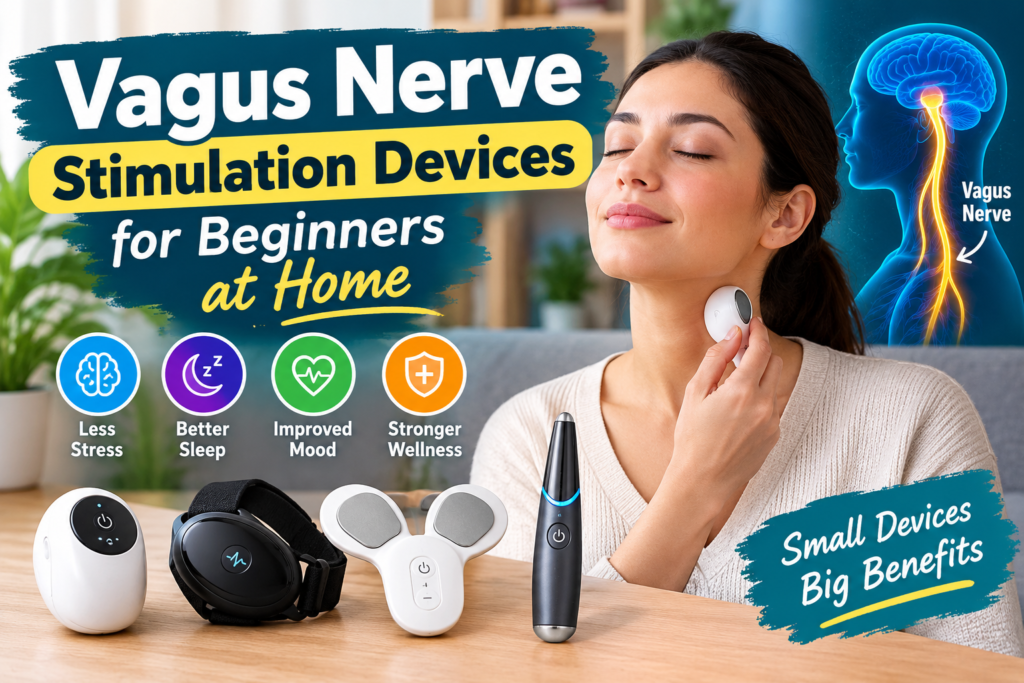
Compare home vagus nerve stimulation devices in 2026. Explore ear and neck stimulators, scientific evidence, safety considerations, and buying tips.
LifeCareBalance.com is reader-supported. When you buy through links on our site, we may earn an affiliate commission at no extra cost to you. As an Amazon Associate, we earn from qualifying purchases.
Vagus nerve stimulation devices are attracting attention among people looking for new ways to manage stress, explore relaxation technology, and support their wellness routines at home. From compact ear-based stimulators to wearable neck devices, the market offers several options with different designs, stimulation methods, and levels of scientific evidence.
However, not every product marketed as a vagus nerve stimulator works in the same way. Some devices deliver electrical stimulation to specific areas associated with vagal pathways, while others use vibration, sound, or relaxation techniques. Understanding these differences is essential before spending money on a home-use device.
This guide explains how home vagus nerve stimulation devices work, what the research actually shows, which features matter when comparing products, and what to consider before buying one in 2026.
What Is a Home Vagus Nerve Stimulation Device?
The vagus nerve is one of the major nerves connecting the brain with organs throughout the body. It plays an important role in autonomic functions, including heart rate regulation, digestion, and communication between the brain and internal organs.
Vagus nerve stimulation (VNS) is a technique that uses electrical signals to activate vagal pathways. Depending on the device, stimulation may be delivered through an implanted system or externally through the skin.
Home-use devices generally fall into the category of non-invasive stimulation technologies. However, their designs, intended uses, regulatory status, and supporting research vary considerably.
A consumer wellness device should not automatically be considered equivalent to a prescription medical device or an implanted VNS system.
For readers comparing different consumer options, our Safe and Effective Vagus Nerve Stimulators for Daily Use provides additional information about device types, daily-use considerations, and safety.
Types of Home Vagus Nerve Stimulation Devices
Before choosing a product, it helps to understand the major types available.
1. Ear-Based Vagus Nerve Stimulation Devices
Transcutaneous auricular vagus nerve stimulation, commonly called taVNS, delivers electrical stimulation through specific areas of the outer ear.
Certain regions of the ear receive sensory input from the auricular branch of the vagus nerve. Researchers have investigated these areas as possible targets for non-invasive neuromodulation.
Ear-based devices may include:
- Small ear clips with electrodes
- Specialized earphones or earpieces
- Devices with a separate stimulation controller
- Systems offering adjustable electrical stimulation settings
The main advantage is their compact design. However, electrode placement, comfort, stimulation settings, and device-specific research all matter.
An inexpensive ear clip or a generic electrical stimulator is not automatically a validated vagus nerve stimulation system. The combination of hardware, electrical output, placement, and instructions determines how a device operates.
Product to consider: Nurosym — Wearable Neuromodulation Device
Nurosym is an ear-based wearable neuromodulation device designed around non-invasive electrical stimulation. It can be considered when researching dedicated ear-based stimulation technology, but buyers should review the manufacturer’s intended use, regulatory information, instructions, and available clinical evidence before purchasing.
Amazon ASIN: Not verified for Amazon US.
2. Neck-Based Vagus Nerve Stimulation Devices
Transcutaneous cervical vagus nerve stimulation, or tcVNS, delivers stimulation through the skin around the neck.
Some devices are designed to be held against the neck, while others use a wearable collar or hands-free format.
Potential advantages include convenient positioning and a design that does not require an ear attachment.
Before purchasing a neck-based device, examine its intended use, stimulation technology, placement instructions, safety information, and available clinical evidence.
The presence of electrical stimulation does not, by itself, prove that a product effectively stimulates the vagus nerve or provides a particular health benefit.
The FDA’s device classification database includes non-invasive vagus nerve stimulators designed for specific medical indications, including headache-related uses. This illustrates why consumers should distinguish an authorized medical indication from broad wellness marketing.
1. Pulsetto Vagus Nerve Stimulator
Pulsetto is a wearable neck-based device marketed for non-invasive vagus nerve stimulation and relaxation-focused wellness use. Its design makes it relevant for shoppers comparing neck-based alternatives with ear-based devices.
Buyers should review the current product listing, manufacturer instructions, regulatory information, and intended-use claims before purchase.
For a lower-cost comparison, see our Budget-Friendly Vagus Nerve Stimulators Under $200.
3. Vibration-Based and Relaxation Devices
Some consumer wellness products use vibration, sound, or other sensory techniques and market themselves around nervous system relaxation.
These products should be evaluated separately from electrical taVNS or tcVNS devices.
A vibration-based relaxation product may be enjoyable or useful as part of a personal relaxation routine. However, it should not be described as an electrically stimulating VNS device unless its actual technology supports that description.
This distinction is especially important when comparing product specifications and reviewing scientific studies.
2: VeRelief Prime — Drug-Free Calm & Focus Device

- REPLACEABLE HYDROGEL TIPS: Soft, pre-hydrated gel tips provide direct skin contact without the need to apply separate co…
- FIVE STIMULATION MODES: Features five distinct modes – Worry, Sleep, Stress, Performance and Panic – with adjustable int…
- PORTABLE AND RECHARGEABLE: Compact, lightweight and pocket-sized design makes the device easy to carry and convenient fo…
VeRelief Prime is a compact relaxation-focused device designed around sensory stimulation rather than conventional ear-based or neck-based electrical VNS. It may be relevant to shoppers primarily interested in relaxation technology rather than a dedicated electrical vagus nerve stimulation system.
Because its mechanism differs from electrical taVNS and tcVNS devices, it should not be treated as equivalent to a dedicated electrical VNS system.
Readers interested in other relaxation-focused products can also explore our Best Stress Relief Products That Help You Relax.
What Does the Research Say About Home Vagus Nerve Stimulation?
Research into non-invasive vagus nerve stimulation is growing. Scientists have investigated its potential applications in several areas, including neurological conditions, pain, autonomic regulation, sleep, and other health-related outcomes.
However, findings from one stimulation method or clinical device cannot automatically be applied to every consumer wellness product.
A systematic review and meta-analysis published in Scientific Reports evaluated 177 studies involving 6,322 participants and found that reported adverse events associated with taVNS were generally mild. Ear pain, headache, and tingling were among the more frequently reported effects. The researchers also noted that adverse-event reporting was inconsistent across studies.
A newer 2026 systematic review and meta-analysis examining taVNS for sleep disorders included 14 randomized controlled trials. It reported improvements in several sleep-related outcomes and generally mild side effects, while also emphasizing that heterogeneity and limited clinical interpretability mean the findings should be considered preliminary.
For additional research, readers can review the PubMed systematic review on taVNS safety.
When evaluating a home device, look for research involving the actual product or a sufficiently similar stimulation method. Pay attention to study size, treatment duration, participant characteristics, comparison groups, and measured outcomes.
Potential Wellness Benefits: What Is Known and What Remains Uncertain?
Many home-use devices are marketed for relaxation, stress management, and sleep support. These are common consumer interests, but the strength of evidence differs by product and outcome.
Relaxation and Stress Management
Some users explore stimulation devices as part of a broader relaxation routine.
Clinical research has investigated whether non-invasive stimulation can influence physiological and neurological processes associated with stress regulation. However, that does not establish that every consumer device produces meaningful stress relief.
If relaxation is your primary goal, compare the device with other practical options such as guided breathing, mindfulness, regular physical activity, and a consistent daily routine.
For broader wellness strategies, see our Holistic Wellness Guide, which covers practical approaches to sleep, stress management, movement, and everyday well-being.
Sleep and Evening Routines
Some manufacturers promote their devices for bedtime relaxation and better sleep.
Although relaxation may be useful before bed, improved sleep should not be assumed simply because a product is marketed as a vagus nerve stimulator.
The 2026 taVNS sleep review provides evidence that researchers are actively studying this area, but the results should not be interpreted as proof that every consumer VNS product improves sleep.
People experiencing persistent insomnia, loud snoring, breathing interruptions during sleep, or excessive daytime sleepiness should seek appropriate medical advice rather than relying on a wellness gadget.
Readers comparing sleep technology can also explore our Sleep Tracker Buying Guide 2026.
General Nervous System Wellness
The vagus nerve plays an important role in autonomic nervous system function. Researchers continue to investigate how stimulation may affect particular physiological processes.
However, terms such as nervous system reset, vagal tone optimization, and complete autonomic balance are often used loosely in consumer marketing.
A home-use product should not be purchased on the assumption that it can reset the nervous system, treat anxiety, improve digestion, or prevent disease without appropriate clinical evidence.
How to Choose a Home Vagus Nerve Stimulation Device
The best choice depends on your intended use, comfort preferences, budget, and the quality of evidence supporting the product.
1. Verify the Stimulation Method
First, identify whether the device uses electrical ear stimulation, electrical neck stimulation, vibration, or another technology.
Look for a clear description of its mechanism rather than relying on phrases such as advanced vagus activation or deep nervous system stimulation.
2. Check Regulatory Status
Regulatory status is an important part of evaluating health-related technology.
The FDA classifies certain non-invasive vagus nerve stimulators as medical devices for specific indications. For example, FDA records describe external vagal nerve stimulators for particular headache-related uses.
This does not mean that every consumer device marketed as a vagus nerve stimulator has FDA clearance or approval for the same purpose.
Check the manufacturer’s exact regulatory claims and verify them through relevant official sources, including the FDA medical device classification database.
Do not assume that a product is FDA-cleared, FDA-approved, or clinically proven simply because its marketing uses medical terminology.
3. Compare Comfort and Placement
Comfort can influence whether a person finds a device practical to use.
For ear-based systems, consider electrode fit, contact pressure, and whether the design is comfortable for the intended session.
For neck-based devices, consider the contact area, device weight, positioning requirements, and whether the product is easy to hold or wear.
Comfort is a personal consideration, not proof of clinical effectiveness.
4. Review Controls and Instructions
A well-documented device should explain its operating controls, placement, charging requirements, cleaning process, and safety precautions.
Check whether the product provides clear instructions for its intended use.
Do not copy stimulation intensity, session duration, or electrode placement instructions from another brand. Different devices can have different electrical characteristics and protocols.
5. Calculate the Total Cost
The purchase price is only one part of the overall cost.
Before buying, check:
- Initial device price
- Replacement electrodes or accessories
- Conductive gel requirements, if applicable
- Optional app subscriptions
- Warranty coverage
- Return and refund conditions
- Availability of customer support
A lower-priced product may not offer better value if essential accessories or ongoing costs make it more expensive over time.
6. Look for Device-Specific Evidence
One of the most useful buying questions is whether independent research has evaluated the exact device you are considering.
Look for peer-reviewed clinical studies and examine whether they measured meaningful outcomes rather than relying exclusively on user satisfaction surveys or marketing testimonials.
When possible, distinguish between evidence for a specific device and evidence for a broader stimulation method. A study involving one clinical system does not automatically validate another consumer product.
Safety Considerations Before Using a VNS Device at Home
Non-invasive stimulation is not automatically risk-free.
Research on taVNS has reported temporary adverse effects such as ear pain, headache, and tingling, while serious adverse events were not identified as causally related to taVNS in the systematic review. However, the authors also noted substantial variation in adverse-event reporting.
Before using an electrical stimulation device, consult a qualified healthcare professional if you:
- Have a pacemaker or another implanted electronic device.
- Have a history of heart rhythm problems.
- Are pregnant or breastfeeding.
- Have a neurological or cardiovascular condition.
- Have an active skin condition, wound, or infection near the intended stimulation site.
- Take medication or receive treatment for a condition that may affect the suitability of electrical stimulation.
These are general precautions, not a complete list of contraindications. The exact precautions depend on the product and your individual circumstances.
Stop using a device if you experience unexpected pain, dizziness, palpitations, or other concerning symptoms. Seek medical advice when appropriate.
Never use a consumer wellness stimulator as a replacement for prescribed treatment or professional medical care.
Medical VNS vs. Consumer Wellness Devices
Understanding the difference between medical treatment and wellness technology can prevent expensive mistakes.
| Feature | Medical VNS | Consumer Wellness Devices |
|---|---|---|
| Intended use | Specific medical indications or clinician-directed treatment | Often marketed for general wellness or relaxation |
| Regulatory status | Depends on the device and authorized indication | Varies by product |
| Clinical oversight | Often involves a healthcare professional | May be designed for independent consumer use |
| Research | May have indication-specific clinical evidence | Evidence varies substantially by product |
| Treatment claims | Limited to the authorized indication and labeling | Should not be interpreted as established medical benefits |
Implanted VNS systems involve a medical procedure and clinician-managed treatment. Certain non-invasive prescription systems also have specific medical indications.
Consumer products marketed for relaxation are a different category. Similar terminology does not mean that two devices provide equivalent treatment.
The FDA’s records demonstrate this distinction: specific non-invasive VNS devices are classified for particular headache-related indications rather than as general-purpose wellness products.
Simple Alternatives for Relaxation at Home
Buying an electronic stimulation device is not the only way to build a more relaxing routine.
Depending on your goals, consider combining practical habits such as:
- Slow, comfortable breathing exercises
- Regular walking or moderate physical activity
- Consistent sleep and wake times
- Mindfulness or guided meditation
- Short breaks during demanding workdays
These activities do not need to be described as direct vagus nerve treatments to be worthwhile.
Our Best Wellness Products for 2026 also covers broader wellness tools for sleep, stress management, recovery, and self-care.
Frequently Asked Questions
Are home vagus nerve stimulation devices worth buying?
It depends on your goals, budget, and the evidence supporting the specific device. Some people may appreciate the convenience of a stimulation product, but meaningful benefits are not guaranteed. Compare the available research with simpler and less expensive relaxation options before purchasing.
What is the difference between ear and neck VNS devices?
Ear-based devices generally target specific areas of the outer ear associated with vagal sensory pathways. Neck-based devices deliver stimulation through the skin around the neck. Their designs, stimulation protocols, comfort, and clinical evidence can differ.
Can a vagus nerve stimulation device help with anxiety?
Researchers have investigated non-invasive stimulation in several mental and neurological health contexts. However, evidence is not sufficient to assume that consumer wellness devices treat anxiety disorders. Anyone experiencing persistent anxiety or significant distress should consider professional support.
Can I use a VNS device every day?
Usage frequency depends on the exact device, its intended purpose, and the manufacturer’s instructions. There is no universal daily schedule that applies to every consumer stimulation product. Ask a healthcare professional if you are uncertain whether regular use is appropriate for you.
Are inexpensive ear clips effective vagus nerve stimulators?
An ear clip alone is not a complete stimulation system. Its effectiveness depends on the electrical source, output characteristics, electrode design, placement, and stimulation protocol. A low price or a product description mentioning the vagus nerve does not establish clinical effectiveness.
Are vibration-based relaxation products the same as VNS devices?
No. Vibration-based products and electrical stimulation systems use different mechanisms. A product may be designed to support relaxation without delivering electrical vagus nerve stimulation. Check the actual technology rather than relying on broad marketing labels.
Final Thoughts
Home vagus nerve stimulation devices come in several forms, but they are not interchangeable. Ear-based electrical stimulators, neck-based systems, and vibration-oriented wellness products differ in their mechanisms, evidence, costs, and intended uses.
Before choosing a device, examine its stimulation method, regulatory status, product-specific research, safety instructions, and long-term ownership costs. Be cautious of promises involving instant stress relief, guaranteed sleep improvements, or complete nervous system regulation.
For many people, a combination of practical wellness habits and informed purchasing decisions is a more sensible starting point than buying a device based on marketing claims alone.
Medical disclaimer: This article is for general educational purposes only. It is not a substitute for professional medical advice, diagnosis, or treatment.