
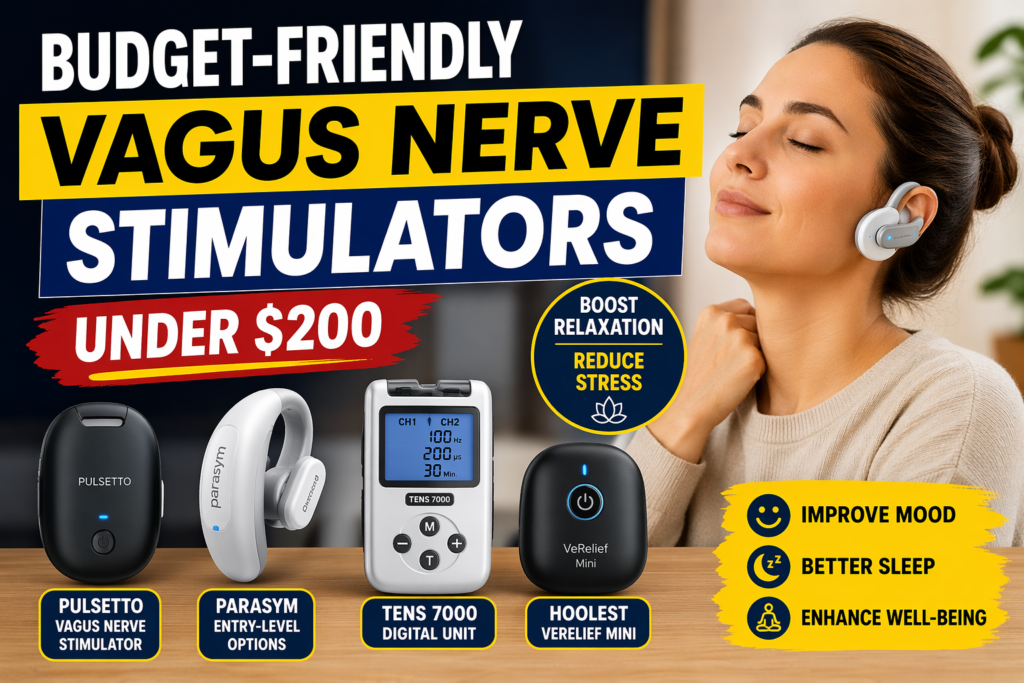
Compare budget-friendly vagus nerve stimulators in 2026, including true under-$200 options, affordable alternatives, features, safety, pricing, and buying tips.
LifeCareBalance.com is reader-supported. When you buy through links on our site, we may earn an affiliate commission at no extra cost to you. As an Amazon Associate, we earn from qualifying purchases.
Vagus nerve stimulation has become increasingly popular among people looking for non-invasive wellness tools for relaxation, stress management, and nervous-system support.
But there is a problem with shopping for these devices: the price range is wide, product categories are confusing, and many online articles mix dedicated vagus nerve stimulators with ordinary TENS or EMS units.
If your budget is around $200, the decision becomes even more important.
A device advertised as a “vagus nerve stimulator” is not automatically equivalent to another device using the same phrase. Some products use cervical electrical stimulation, some use auricular stimulation around the ear, while other wellness products use vibration or completely different mechanisms.
This guide focuses on what budget-conscious buyers should actually check before purchasing.
Important price note: Prices change frequently. At the time of this guide’s research, Hoolest VeRelief Prime was listed at $199, while current Pulsetto models were priced above $200 on the manufacturer’s website. That means an older article listing Pulsetto as an under-$200 option can quickly become outdated.
If you are new to the category, start with our guide to Vagus Nerve Stimulation and How It Works before comparing devices.
Quick Answer: What Can You Actually Get for Under $200?
The under-$200 category is smaller than many buying guides suggest.
At the time of research, Hoolest VeRelief Prime was listed at approximately $199, making it one of the clearest dedicated options around the $200 price ceiling. The company’s current lineup lists VeRelief Prime at $199, while its older VeRelief Mini has been discontinued.
Meanwhile, popular devices such as Pulsetto currently sit above the strict $200 threshold, although promotions can change the effective price.
That distinction matters because a buyer searching for “under $200” should not be presented with a $250–$300 device simply because it was previously discounted.
For that reason, this guide separates:
- True under-$200 options
- Near-$200 options
- Affordable alternatives above $200
- Products that should not be confused with dedicated VNS devices
What Is a Vagus Nerve Stimulator?
A vagus nerve stimulator is a device intended to deliver stimulation to pathways associated with the vagus nerve.
Consumer non-invasive devices generally use approaches such as:
- Cervical stimulation around the neck
- Auricular stimulation around parts of the ear
- Handheld electrical stimulation
- Other sensory or vibration-based approaches marketed for nervous-system support
These are different from implanted medical VNS systems used for specific medical indications.
The distinction is important because a consumer wellness device should not automatically be described as treating a medical condition simply because the same general stimulation concept is used in clinical medicine.
Research into non-invasive vagus nerve stimulation is active, but researchers continue to study the most effective stimulation locations, parameters, populations, and clinical applications.
Why Are Budget VNS Devices So Difficult to Compare?
The biggest problem is that “VNS device” is not a single product category.
Two devices may both mention vagus nerve stimulation while differing substantially in:
- Stimulation location
- Electrical parameters
- Session length
- Device design
- Evidence base
- Regulatory status
- App requirements
- Consumable costs
- Warranty
- Return policy
- Intended use
This is why price alone should not determine your purchase.
A $199 device and a $299 device may offer very different user experiences.
At the same time, the more expensive device is not automatically better simply because it costs more.
Best Vagus Nerve Stimulator Around $200
Hoolest VeRelief Prime

- REPLACEABLE HYDROGEL TIPS: Soft, pre-hydrated gel tips provide direct skin contact without the need to apply separate co…
- FIVE STIMULATION MODES: Features five distinct modes – Worry, Sleep, Stress, Performance and Panic – with adjustable int…
- PORTABLE AND RECHARGEABLE: Compact, lightweight and pocket-sized design makes the device easy to carry and convenient fo…
Hoolest currently lists the VeRelief Prime at $199. It is a handheld device designed around electrical stimulation and is marketed for rapid relaxation and nervous-system support.
Its biggest advantage for a budget-conscious buyer is simple:
It actually sits at the $200 price ceiling.
That makes it much more relevant to a strict under-$200 search than products that are currently $250–$300.
What stands out
- Handheld design
- Short sessions
- Portable format
- No large wearable required
- Listed at $199
- Designed specifically around vagal/nervous-system stimulation
What to consider
Because it is handheld, you need to remain involved during the session.
That may be perfectly acceptable if you prefer a short, focused routine.
It may be less convenient if you want a hands-free device that you can wear while reading, working, or relaxing.
Hoolest also lists different product configurations and protection/gel options, so buyers should check the current checkout terms rather than assuming the initial device price represents every long-term cost.
What Happened to the VeRelief Mini?
This is an important update that older articles can miss.
Hoolest states that the VeRelief Mini has been discontinued. Existing Mini owners can still receive support under the company’s stated warranty/upgrade terms.
That means an article recommending the Mini as a current $200 option is outdated.
If you see the VeRelief Mini mentioned on an older comparison page, check the manufacturer’s current lineup before purchasing.
What About Pulsetto?
Pulsetto is one of the most frequently mentioned consumer vagus nerve stimulation devices, but it no longer fits a strict “under $200” article based on its current official pricing.
The manufacturer’s current US page lists:
- Pulsetto Lite: around $269
- Pulsetto FIT: around $269
- Premium/newer versions can cost more
Promotional pricing may change these numbers temporarily.
That does not make Pulsetto irrelevant.
It simply means it belongs in the affordable alternative section rather than being presented as an under-$200 product.
Why Buyers Consider Pulsetto

Pulsetto uses a hands-free neck-based design and provides app-supported programs.
The manufacturer describes the device as a general wellness product rather than a medical device.
Independent reviews have also highlighted its hands-free design and relatively accessible price compared with some premium consumer VNS products.
However, buyers should distinguish between:
- Manufacturer claims
- User experiences
- Independent testing
- Peer-reviewed evidence
Those are not interchangeable.
Pulsetto vs. a $200 Budget
If your maximum budget is truly $200, do not choose Pulsetto simply because an old article says it is under $200.
Instead, consider two approaches:
Strict $200 budget:
Look at currently available products around $200 and verify the exact price before purchase.
Flexible $200–$300 budget:
Compare the added features, design, warranty, app experience, and total ownership cost of products such as Pulsetto.
This gives you a more realistic purchasing decision than forcing every device into an artificial “under $200” category.
Are Cheap TENS Units the Same as Vagus Nerve Stimulators?
No.
This is one of the biggest problems with budget VNS articles.
A standard TENS unit is generally designed for electrical stimulation used for pain-related applications. It should not automatically be described as a dedicated vagus nerve stimulator.
Our current article previously included a generic TENS unit as a VNS recommendation. That section should be removed.
A consumer should not assume that:
TENS + neck placement = proven VNS device.
Stimulation parameters, electrode placement, device design, and intended use all matter.
Research on non-invasive vagus nerve stimulation uses specific stimulation protocols, and the evidence cannot automatically be transferred to every inexpensive electrical stimulation device.
What About Ear-Clip Vagus Nerve Stimulators?
Auricular vagus nerve stimulation, often called taVNS, is another major category.
These devices stimulate parts of the outer ear associated with vagal innervation.
The advantage is that ear-based devices can be compact and portable.
However, buyers should pay attention to the actual device, stimulation parameters, evidence, and regulatory status instead of assuming every ear clip provides the same type of stimulation.
A systematic review of taVNS safety found that reported adverse events were generally uncommon, with ear pain, headache, and tingling among the more frequently reported issues. The review also noted limitations in adverse-event reporting across studies.
How Much Evidence Exists for Consumer VNS Devices?
This is where buyers should be careful.
There is meaningful scientific research on non-invasive vagus nerve stimulation, but that does not mean every commercial consumer device has been independently validated for every advertised benefit.
A 2026 review noted that clinical evidence varies considerably between devices and that many consumer VNS products do not have device-specific randomized clinical evidence.
That creates an important distinction:
Evidence for a stimulation method is not automatically evidence for a specific consumer product.
Before buying, ask:
- Has this exact device been studied?
- Or is the evidence based on the general stimulation method?
- Is the study independent?
- What population was studied?
- What outcome was measured?
- Was the study randomized or controlled?
- Are the manufacturer’s claims broader than the research?
These questions can help you avoid exaggerated wellness claims.
Can Vagus Nerve Stimulation Help With Stress?
Research into non-invasive VNS and nervous-system regulation continues to develop.
Some studies have reported changes in physiological measures or outcomes related to stress and emotional state, but consumer devices should not be presented as guaranteed treatments for anxiety, depression, or other medical conditions.
Even independent testing articles emphasize that users should not expect dramatic or universal results from consumer VNS products.
For broader non-device approaches, our Quick Stress Relief Products 2026 guide covers other relaxation-oriented tools.
Can VNS Help With Sleep?
Sleep is one of the most frequently marketed reasons for using consumer VNS devices.
Research is ongoing, and a 2026 systematic review and meta-analysis examined transcutaneous auricular VNS for sleep disorders and related outcomes including sleep, anxiety, depression, and safety.
However, research findings should not be converted into a promise that a specific consumer device will improve your sleep.
If sleep is your primary goal, consider VNS as one possible wellness tool rather than a replacement for established sleep habits or professional evaluation when symptoms persist.
You can also see our Sleep Tracker Buying Guide 2026 if you want to monitor sleep patterns alongside a broader wellness routine.
How to Choose a Budget VNS Device
1. Start With Your Maximum Budget
Set the actual amount you are willing to spend.
For example:
- Under $100
- $100–$200
- $200–$300
- Above $300
This prevents you from gradually moving from a $150 budget to a $400 purchase simply because every more expensive product has additional features.
2. Identify the Stimulation Method
Check whether the device uses:
- Cervical electrical stimulation
- Auricular electrical stimulation
- Vibration
- Another mechanism
Do not treat all mechanisms as interchangeable.
3. Check the Session Length
Shorter sessions may be easier to incorporate into a daily routine.
Some devices use sessions lasting only a few minutes, while others require longer periods.
4. Consider Hands-Free vs. Handheld
This is one of the most important practical differences.
Hands-free:
- Easier to relax during a session
- Can be convenient for routines
- May be more comfortable for some users
Handheld:
- Usually simple
- Portable
- May allow precise positioning
- Requires you to hold the device
Neither format is automatically right for everyone.
5. Check Recurring Costs
The purchase price is not always the total cost.
Check for:
- Conductive gel
- Replacement electrodes
- Memberships
- Premium apps
- Replacement accessories
- Shipping
- Extended warranty
For example, independent testing of Pulsetto has highlighted ongoing conductivity-medium and optional app costs as part of total ownership.
6. Check the Return Policy
A stimulation device is personal.
Comfort and sensation can vary considerably.
A clear return policy can therefore matter almost as much as the initial purchase price.
7. Look at Evidence Separately From Marketing
Manufacturer claims are useful for understanding intended features.
They should not be treated as independent clinical evidence.
Look for:
- Peer-reviewed research
- Independent testing
- Device-specific studies
- Clear safety information
- Transparent limitations
Budget VNS Buying Mistakes to Avoid
Mistake 1: Trusting an Old Price
Wellness-device pricing changes frequently.
A product listed at $179 six months ago may now cost $250 or more.
Always check the current price.
Mistake 2: Calling Every TENS Unit a VNS Device
A generic electrical stimulation unit should not automatically be classified as a dedicated vagus nerve stimulator.
Mistake 3: Assuming “Natural” Means Risk-Free
Non-invasive does not mean suitable for every person.
Mistake 4: Treating User Reviews as Clinical Evidence
User experiences can help you understand comfort and usability.
They cannot establish that a device treats a medical condition.
Mistake 5: Ignoring Recurring Costs
A low initial price can become less attractive if the device requires expensive consumables or subscriptions.
Mistake 6: Buying Based Only on the Number of Programs
A device with 10 programs is not necessarily more useful than one with three well-designed programs.
Mistake 7: Expecting Immediate Medical Results
Wellness-device experiences vary.
Avoid purchasing with the expectation of guaranteed changes in anxiety, depression, sleep, pain, digestion, or other medical outcomes.
Safety: Who Should Be Careful With VNS Devices?
Anyone considering electrical stimulation around the neck or ear should read the manufacturer’s safety instructions carefully.
Extra caution is appropriate for people with:
- Implanted electronic medical devices
- Certain heart conditions
- Neurological conditions
- Seizure disorders
- Pregnancy
- Recent surgery
- Other conditions specifically listed in the device instructions
The exact contraindications depend on the product.
Do not assume that the safety instructions for one VNS device apply to another.
If you have a medical condition, take prescription medication, or use an implanted medical device, discuss the specific product with your healthcare professional before using it.
What Side Effects Can Occur?
Non-invasive stimulation is generally designed to avoid surgery, but that does not mean there can never be side effects.
Research on auricular VNS has reported issues such as:
- Ear discomfort
- Tingling
- Headache
- Skin irritation
The frequency and severity can vary by protocol and device.
Stop using a device if it causes significant discomfort and follow the manufacturer’s safety guidance.
Under $200 vs. $200–$300: What Changes?
This is a more useful way to think about the category than simply asking which device is “best.”
| Budget | What to Expect |
|---|---|
| Under $100 | Very limited dedicated VNS choices; be careful with generic electrical devices |
| $100–$200 | Small number of dedicated or discounted options; verify current availability |
| Around $200 | VeRelief Prime is currently listed at $199 |
| $200–$300 | More established consumer options become available, including current Pulsetto models |
| $300+ | More premium designs and additional features become available |
Prices can change, so use the table as a buying framework rather than a permanent price list. Current manufacturer listings show VeRelief Prime at $199 and Pulsetto above the $200 threshold.
Should You Buy a Used or Refurbished VNS Device?
A refurbished device can reduce the initial cost, but there are additional considerations.
Check:
- Who refurbished it?
- Is the battery still reliable?
- Are electrodes or contact surfaces replaceable?
- Is the warranty transferable?
- Can you return it?
- Are accessories included?
- Has the manufacturer approved the refurbishment?
Hoolest currently lists a certified-refurbished VeRelief Prime at a lower price than a new unit, although buyers should carefully check the current warranty and protection-plan terms.
For a device that makes direct skin contact, condition and hygiene also deserve attention.
What If Your Budget Cannot Reach $200?
You do not need to purchase a VNS device simply because it is trending.
Breathing exercises, meditation, physical activity, regular sleep, and other established wellness habits can be part of a stress-management routine without requiring an electrical stimulation device.
A VNS device is an optional wellness tool—not a requirement for maintaining a healthy nervous system.
Our Best Wellness Products for 2026 guide covers broader wellness options if you want to compare alternatives.
How to Use a VNS Device More Responsibly
If you decide to purchase one:
Start Conservatively
Use the lowest comfortable setting recommended by the manufacturer.
Follow the Manual
Do not copy settings from another device or another person’s routine.
Keep Sessions Consistent
A manageable routine is generally easier to maintain than occasional long sessions.
Track Your Own Experience
Pay attention to:
- Comfort
- Session consistency
- Relaxation
- Sleep routine
- Any unwanted sensations
Avoid treating subjective changes as proof of medical treatment.
Stop if Something Feels Wrong
Pain, significant dizziness, unusual symptoms, or other concerning reactions should not simply be ignored.
VNS Devices vs. Other Relaxation Tools
A VNS device is only one category of wellness technology.
Depending on your goal, alternatives may include:
- Breathing tools
- Meditation apps
- Massage devices
- Sleep trackers
- Light-based wellness products
- Fitness trackers
- Relaxation wearables
If your goal is simply stress relief rather than electrical stimulation specifically, compare several approaches before spending money.
Our Trending Wellness Products for 2026 guide provides a broader look at current wellness technology.
FAQ
What is the cheapest real vagus nerve stimulator?
Prices change, but Hoolest VeRelief Prime is currently listed by the manufacturer at $199, placing it at the $200 price ceiling.
Is Pulsetto under $200?
Not based on the current official US pricing reviewed for this guide. Pulsetto’s current listings place its lower-cost models above $200, although promotions can change the effective price.
Is the VeRelief Mini still available?
Hoolest states that the VeRelief Mini has been discontinued.
Are cheap TENS units the same as VNS devices?
No. A TENS device should not automatically be treated as a dedicated vagus nerve stimulation device. Stimulation parameters, placement, intended use, and evidence matter.
Can VNS devices reduce anxiety?
Research is ongoing. Some studies investigate effects related to stress and emotional state, but consumer wellness devices should not be presented as guaranteed treatments for anxiety or other mental-health conditions.
Can VNS improve sleep?
Some research is investigating transcutaneous VNS for sleep-related outcomes, but evidence varies by protocol and device. A consumer VNS should not be treated as a guaranteed sleep treatment.
Are vagus nerve stimulators safe?
Non-invasive stimulation has been studied for safety, but side effects can occur and suitability varies by person and device. Follow the specific manufacturer’s safety instructions.
Do VNS devices require a prescription?
Requirements depend on the specific product, country, and intended use. Do not assume that every consumer wellness VNS product has the same regulatory status as a prescription medical VNS system.
How long should a VNS session last?
Session length varies considerably by device. Follow the manufacturer’s instructions rather than applying a generic 10- or 20-minute rule to every product.
Is a more expensive VNS device automatically better?
No. Price can reflect design, app features, warranty, materials, stimulation approach, and brand positioning. It does not by itself establish better clinical effectiveness.
Final Thoughts
Finding a vagus nerve stimulator on a budget requires more research than simply searching for the cheapest electrical device.
The first thing to understand is the actual price range.
At the time of this guide’s research, Hoolest VeRelief Prime was available at approximately $199, while current Pulsetto models were above the strict $200 limit. Older recommendations that place Pulsetto under $200 may therefore be outdated.
The second issue is evidence.
Non-invasive vagus nerve stimulation is an active research area, but evidence for a stimulation method should not automatically be treated as proof that every consumer device produces the same results.
Finally, avoid confusing generic TENS products with dedicated VNS devices simply because both use electrical stimulation.
For a budget buyer, the smarter approach is to compare the actual device, mechanism, current price, total ownership cost, safety instructions, return policy, and evidence—not just the marketing headline.
If your budget is strictly $200, focus on products that genuinely meet that limit. If you can move into the $200–$300 range, a wider selection becomes available and deserves a separate comparison rather than being forced into an under-$200 list.;https://lifecarebalance.com/
Pingback: best adjustable dumbbells under $100 for home gym - lifecarebalance.com