
LifeCareBalance.com is reader-supported. When you buy through links on our site, we may earn an affiliate commission at no extra cost to you. As an Amazon Associate, we earn from qualifying purchases.
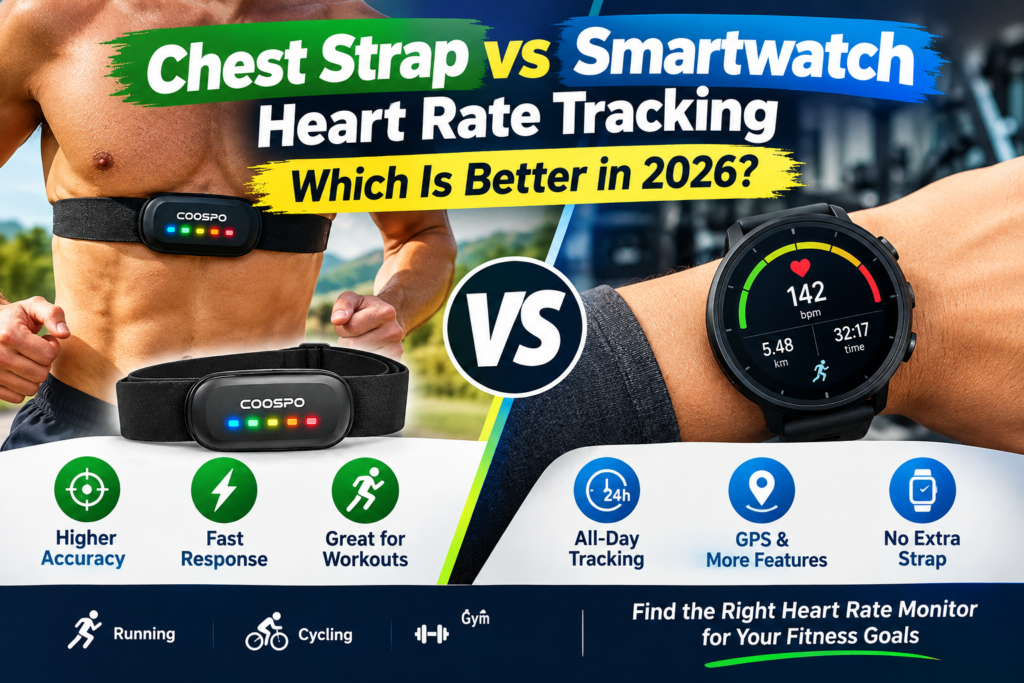
If you want to track your heart rate during workouts, you have two popular options: a chest strap heart rate monitor or a smartwatch with a built-in optical sensor. Both can help you monitor exercise intensity, but they work differently and may perform differently depending on the activity.
A smartwatch is convenient because you can wear it throughout the day to track workouts, daily activity, and sleep on supported models. A chest strap, such as the COOSPO H9Z, is designed primarily for exercise and measures electrical signals associated with your heartbeat.
So, which option should you choose in 2026?
For people who prioritize responsive heart rate readings during intervals, cycling, or structured training, a compatible chest strap is often a strong choice. For everyday convenience, all-day monitoring, and an all-in-one wearable, a smartwatch may be the better fit.
This guide compares the two approaches, explains their advantages and limitations, and helps you choose the right setup for your fitness goals.

- Precision Heart Rate Tracking: COOSPO H9Z is equipped with an advanced HR sensor, our heart rate monitor chest strap del…
- Rechargeable & Long-Lasting Battery: Say goodbye to disposable batteries! H9Z built-in rechargeable battery that offers …
- Comfortable Wear: Crafted with soft, breathable materials and an adjustable strap, our heart rate monitor ensures a secu…

- Easy-to-use running watch monitors heart rate (this is not a medical device) at the wrist and uses GPS to track how far,…
- Battery life: up to 2 weeks in smartwatch mode; up to 20 hours in GPS mode
- Plan your race day strategy with the PacePro feature (not compatible with on-device courses), which offers GPS-based pac…
Quick Answer: Chest Strap vs Smartwatch
- Choose a chest strap if you want dedicated workout heart rate tracking, particularly during activities with rapid changes in intensity.
- Choose a smartwatch if you want everyday heart rate monitoring, activity tracking, and additional wearable features without purchasing a separate sensor.
- Consider using both if you want the convenience of a smartwatch and the workout readings of a compatible chest strap.
A chest strap is not automatically better for every person or every workout. Accuracy depends on the specific devices, how they are worn, and the type of exercise being performed.
1. How Does a Chest Strap Heart Rate Monitor Work?
A chest strap uses electrodes positioned against the skin to detect electrical signals generated by the heart. The sensor processes those signals and transmits heart rate information to a compatible watch, phone, cycling computer, or fitness application.
The COOSPO H9Z is one example of this type of monitor. It supports Bluetooth and ANT+ connectivity, allowing it to work with compatible receiving devices.
Chest straps are particularly useful when you want heart rate information during a structured workout without relying on a wrist-based optical sensor.
Advantages of chest straps
- Designed specifically for heart rate tracking during exercise.
- Can respond quickly to changes in exercise intensity.
- Compatible models can connect to watches, phones, and cycling computers.
- Useful for interval training and heart rate zone workouts.
- Can be worn with a smartwatch to provide workout heart rate data on supported devices.
Limitations of chest straps
- You need to wear an additional piece of equipment around your chest.
- Some users find straps uncomfortable during long workouts.
- Electrodes may need moisture or proper skin contact to obtain a reliable signal.
- Most basic models do not independently provide GPS, sleep tracking, or a full daily activity dashboard.
- Batteries need charging or replacement, depending on the model.
For a closer look at one rechargeable option, read our COOSPO H9Z Review 2026.
2. How Does a Smartwatch Measure Heart Rate?
Most smartwatches use optical heart rate sensors. These sensors shine light into the skin and measure changes in blood volume to estimate pulse rate.
The technique is commonly known as photoplethysmography, or PPG.
A smartwatch can use this technology to record heart rate during exercise and, on supported models, throughout the day and overnight.
Advantages of smartwatches
- Convenient for all-day wear.
- No separate chest strap is required.
- Can track workouts, steps, and other activity metrics.
- Supported models can record sleep and resting heart rate.
- Some watches include GPS, training features, notifications, and other smart functions.
Limitations of smartwatches
- Wrist movement can affect optical readings.
- Fit and sensor contact can influence results.
- Some activities, including rowing, weightlifting, and gripping bicycle handlebars, can make wrist measurements more challenging.
- Battery life may be reduced by GPS, continuous tracking, and other demanding features.
- Advanced features may require a more expensive watch.
For most people, the biggest advantage of a smartwatch is convenience. You can track more than heart rate without adding another device to your workout routine.
3. Chest Strap vs Smartwatch: Main Differences
| Feature | Chest Strap | Smartwatch |
|---|---|---|
| Measurement method | Electrical signals detected through chest electrodes | Usually optical pulse measurement at the wrist |
| Workout responsiveness | Often strong during changing exercise intensity | Depends on the watch and activity |
| All-day heart rate | Usually requires a compatible receiver and is not the main purpose of basic models | Available on supported watches |
| Sleep tracking | Generally not available on basic chest straps | Available on supported models |
| GPS tracking | Usually requires another device | Available on GPS-equipped watches |
| Wearing comfort | Requires a strap around the chest | Worn on the wrist |
| Battery maintenance | Rechargeable or replaceable, depending on model | Usually requires periodic charging |
| Cycling compatibility | Supported models connect to compatible bike computers | Supported watches can record cycling workouts |
| Workout data | Primarily heart rate, with additional features on some models | Heart rate plus other supported fitness metrics |
| Best use | Dedicated workout heart rate tracking | Everyday wear and broader fitness tracking |
The right option depends on whether you prioritize specialized workout monitoring or the convenience of a single wearable.
4. Which Is More Accurate: Chest Strap or Smartwatch?
Accuracy is one of the main reasons people consider a chest strap.
A chest strap measures electrical activity associated with the heartbeat, while a typical smartwatch estimates pulse rate using light. These are different measurement methods, and both can produce useful information when used correctly.
Research comparing wearable monitors has found that chest straps can agree more closely with ECG measurements than some wrist-based optical devices during exercise. However, results vary by device and activity, and older studies should not be treated as direct tests of every smartwatch sold in 2026.
For example, a study published in Medicine & Science in Sports & Exercise compared wearable heart rate monitors during different aerobic activities. It found that agreement between wrist-based devices and ECG varied with exercise type, while the tested chest strap showed strong agreement with ECG.
Read the study here:
Variable Accuracy of Wearable Heart Rate Monitors During Aerobic Exercise — PubMed
Why smartwatch readings can fluctuate
Optical sensors depend on the quality of the signal detected through the skin. Readings may be affected by:
- A loose watch strap.
- Repeated wrist movement.
- Gripping equipment tightly.
- Cold conditions that reduce blood flow near the skin.
- The type and intensity of exercise.
A chest strap can also produce unreliable readings if it moves, the electrodes have poor contact, or the battery is low.
Accuracy verdict: A chest strap is often a sensible choice when responsive workout heart rate data is important. A modern smartwatch may still perform well, particularly during steady activities, and is more convenient for continuous daily tracking.
5. Which Is Better for Running?
Both options can be suitable for runners.
A smartwatch is convenient for everyday running because it can combine heart rate, GPS, pace, distance, and workout history in one device. You do not need to wear a separate sensor.
A chest strap can be useful for runners who perform intervals, hill repeats, tempo workouts, or structured heart rate training. During these sessions, rapid changes in intensity may make responsive heart rate measurements particularly valuable.
Choose a chest strap for running if:
- You regularly perform interval sessions.
- You want to monitor changes in heart rate during intense efforts.
- You already own a compatible sports watch.
- You prefer a dedicated workout sensor.
Choose a smartwatch if:
- You want one device for most running needs.
- GPS pace and distance are important.
- You also want daily activity and sleep tracking.
- You prefer not to wear an additional strap.
Running recommendation: Beginners can start with a suitable smartwatch. Runners who need dedicated heart rate data for structured training may benefit from adding a compatible chest strap.
6. Which Is Better for Cycling?
Cycling introduces a particular challenge for wrist-based optical sensors: riders often grip handlebars for extended periods, which can affect sensor contact and blood flow at the wrist.
A chest strap avoids relying on wrist contact and can transmit heart rate data to a compatible bike computer or indoor cycling application.
A smartwatch is still useful for recording rides, GPS routes, and broader training information. Compatibility is important if you want to send heart rate data from a chest strap to the watch.
Before buying a chest strap, check whether your bike computer or training application supports Bluetooth or ANT+ heart rate sensors.
For a comparison between two dedicated chest straps, see our COOSPO H9Z vs Garmin HRM-Dual comparison.
Cycling recommendation: Consider a chest strap if you want dedicated heart rate readings while riding, especially with an indoor trainer or cycling computer. A smartwatch is still useful for GPS and broader ride tracking.
7. Which Is Better for Weightlifting and Gym Workouts?
Weightlifting involves movements that can make wrist-based optical heart rate measurements more challenging. Wrist flexion, gripping dumbbells, and repeatedly changing arm position can interfere with sensor contact.
A chest strap may provide a useful alternative during strength training, especially if you want to monitor heart rate between sets or during circuit workouts.
However, heart rate alone does not tell you how much weight you lifted, how strong you are, or whether a particular workout was effective. It is only one part of your training information.
A smartwatch remains useful for recording workouts, tracking general activity, and accessing supported training features.
Gym recommendation: Choose a chest strap if heart rate monitoring during exercise is your main priority. Choose a smartwatch if you want a broader record of your workouts and daily activity.
8. Can You Use a Chest Strap and Smartwatch Together?
Yes, provided the chest strap and watch support the required connection.
For example, a compatible Garmin watch can use an external chest strap to receive heart rate data during a recorded activity. The exact setup and available features depend on the watch and sensor.
A typical setup looks like this:
- Wear the chest strap according to its instructions.
- Open the watch’s sensor settings.
- Add or pair the compatible external heart rate sensor.
- Start a supported workout.
- Check that the watch is receiving the external heart rate signal.
Garmin explains how its watches use chest straps and optical sensors in its official support guide:
Garmin: Frequently Asked Questions About Chest Strap Heart Rate Monitors
When a compatible Garmin watch records an activity using an external strap, it may prioritize the strap’s heart rate data. This behavior depends on the watch and its supported features.
Using both devices can provide the best balance of convenience and dedicated workout tracking, but you do not necessarily need both.
9. Battery Life and Maintenance
Battery life depends on the specific model and how you use it.
A basic chest strap may last many workouts between charges or battery replacements. A smartwatch generally needs periodic charging, and GPS or continuous tracking can increase power consumption.
The COOSPO H9Z, for example, uses a rechargeable battery and is listed by its manufacturer at approximately 50 hours of operating time. That is a manufacturer specification, not a guarantee for every usage pattern.
Before buying either type, consider:
- How often you train.
- Whether you prefer charging or replacing a battery.
- Whether you want to wear the device overnight.
- How frequently you use GPS and other power-intensive features.
- How easy the strap or watch is to clean.
For a chest strap, clean and dry the strap as directed by the manufacturer. For a smartwatch, keep the sensor area clean and wear the device snugly according to its instructions.
10. Price and Overall Value
There is no universal price winner because both categories include budget and premium products.
A basic chest strap may cost less than a feature-rich smartwatch, but a chest strap is primarily a heart rate sensor and may require another device to display and record its data.
A smartwatch may cost more initially, but it can combine multiple features in one purchase.
When comparing value, consider what you actually need:
- Heart rate tracking only.
- GPS and pace.
- Daily activity and sleep monitoring.
- Compatibility with cycling equipment.
- Advanced workout metrics.
- The convenience of one device instead of two.
If you already own a compatible smartwatch, adding a chest strap may be more cost-effective than purchasing another watch. If you do not own a wearable, a smartwatch may offer more features for everyday use.
11. Who Should Buy a Chest Strap?
A chest strap is a good option for people who want dedicated heart rate monitoring during workouts.
It may be particularly useful for:
- Runners following structured training plans.
- Cyclists using bike computers or indoor training applications.
- Athletes who want responsive heart rate readings during intervals.
- People who already own a compatible sports watch.
- Users who do not need sleep tracking or all-day wearable features from the sensor.
If you are considering the COOSPO H9Z, read our COOSPO H9Z setup and troubleshooting guide to learn about pairing, wearing the strap, charging, and resolving connection issues.
12. Who Should Buy a Smartwatch?
A smartwatch is usually the more convenient option if you want a wearable for everyday life as well as exercise.
It may be a better fit for:
- Beginners who want basic workout tracking.
- People who want daily heart rate monitoring.
- Users interested in sleep and activity tracking.
- Runners who want GPS, pace, distance, and heart rate in one device.
- Anyone who prefers not to wear a chest strap.
A smartwatch is not automatically less useful because it uses an optical sensor. For many everyday activities, it provides convenient and informative heart rate data.
If you mainly want to observe long-term trends rather than analyze every interval, a smartwatch may be all you need.
13. Trusted Sources and Further Reading
These resources provide additional information about heart rate monitoring, wearable accuracy, and device compatibility.
- Cleveland Clinic: Heart Rate Monitors — explains how heart rate monitors work and the differences between measurement technologies.
- Garmin Support: Chest Strap Heart Rate Monitor FAQs — explains optical sensors, chest straps, and compatible Garmin setups.
- PubMed: Variable Accuracy of Wearable Heart Rate Monitors During Aerobic Exercise — research comparing wearable readings across different exercise conditions.
- Garmin Support: Optical Heart Rate Accuracy Tips — practical advice about fit and factors that can affect wrist-based readings.
- British Heart Foundation: Types of Heart Rate Monitors — general information about chest straps, smartwatches, and monitoring limitations.
These resources support general comparisons, but they do not establish that every chest strap is more accurate than every smartwatch.
Frequently Asked Questions
Is a chest strap more accurate than a smartwatch?
A chest strap can provide more reliable heart rate measurements during certain types of exercise, especially when wrist movement affects optical readings. Performance varies by model and activity, so no single rule applies to every device.
Can I use a chest strap without a smartwatch?
Yes. A compatible smartphone app, cycling computer, or other supported receiver can display heart rate data. You need a compatible device to view the transmitted readings.
Do smartwatches measure heart rate continuously?
Many smartwatches can record heart rate throughout the day and during sleep, although sampling frequency and available features vary by model and settings.
Is the COOSPO H9Z suitable for beginners?
It can be suitable for beginners who want a dedicated chest strap and have a compatible phone, watch, or fitness device. Make sure you understand the pairing process before your first workout.
Should I wear a chest strap all day?
Most basic chest straps are intended primarily for workouts rather than continuous all-day monitoring. A smartwatch is generally more convenient for tracking heart rate throughout the day.
Which is better for interval training?
A compatible chest strap is often a strong choice for interval training because it can respond quickly to changes in exercise intensity. Your receiving device and workout setup still matter.
Can a smartwatch replace a chest strap completely?
For many recreational users, yes. If you are satisfied with your watch’s readings and features, you may not need another sensor. A chest strap remains useful when dedicated workout heart rate tracking is a priority.
Final Verdict: Chest Strap vs Smartwatch
The best choice depends on how you exercise and how much information you want to collect.
Choose a chest strap if you prioritize dedicated workout heart rate monitoring, particularly for running intervals, cycling, and structured training.
Choose a smartwatch if you want convenience, everyday heart rate tracking, sleep monitoring, GPS, and other fitness features in one wearable.
Choose both if you already own a compatible watch and want to add a dedicated sensor for selected workouts.
For many people, a smartwatch is the easiest starting point. For athletes who care about responsive workout heart rate data, a compatible chest strap such as the COOSPO H9Z can be a useful addition.
Affiliate disclosure: LifeCareBalance may earn a commission from qualifying purchases made through affiliate links, at no additional cost to the reader.
Health disclaimer: Wearable heart rate readings are intended for general fitness monitoring and are not a substitute for medical diagnosis, emergency assessment, or professional medical advice.