
LifeCareBalance.com is reader-supported. When you buy through links on our site, we may earn an affiliate commission at no extra cost to you. As an Amazon Associate, we earn from qualifying purchases.
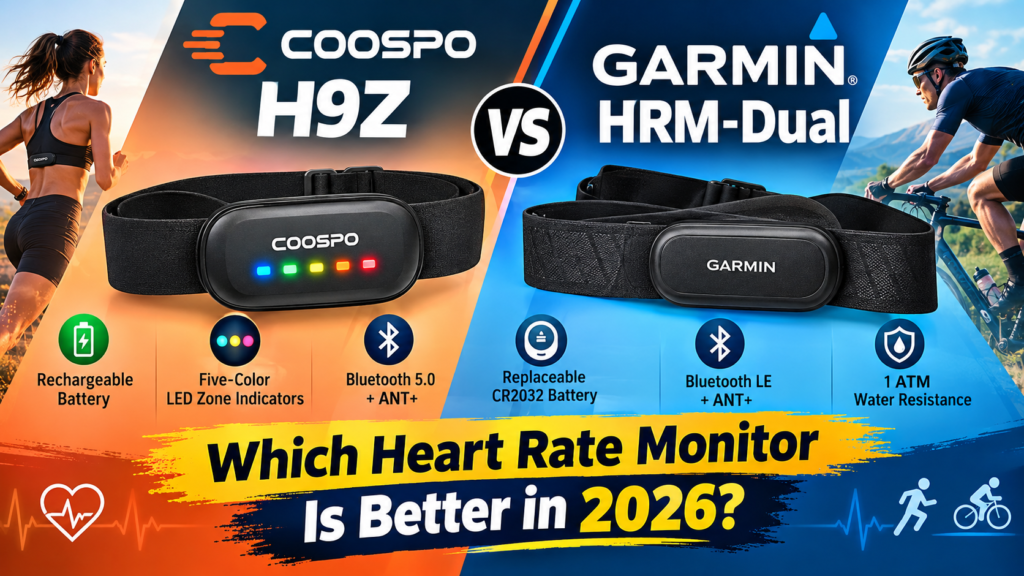
Choosing between the COOSPO H9Z and Garmin HRM-Dual comes down to three practical questions: Do you prefer a rechargeable battery or a replaceable coin cell? Do you want built-in heart rate zone indicators? And how much are you willing to spend on a chest strap for running, cycling, gym workouts, or indoor training?
Both heart rate monitors use Bluetooth and ANT+ wireless connectivity, allowing them to work with compatible fitness devices and applications. However, their battery designs, extra features, and long-term maintenance requirements are different.
The COOSPO H9Z is worth considering if you want a rechargeable chest strap with five-color LED heart rate zone indicators. The Garmin HRM-Dual is an alternative for people who prefer a replaceable battery and a simple sensor designed to work with compatible Garmin devices and other supported equipment.
This comparison explains the important differences, who should choose each model, and what to check before purchasing.
Quick Answer: COOSPO H9Z vs Garmin HRM-Dual
Choose the COOSPO H9Z if you prefer USB charging, visual heart rate zone indicators, and a chest strap with useful workout feedback built into the sensor.
Choose the Garmin HRM-Dual if you prefer a replaceable CR2032 coin-cell battery, an adjustable washable strap, and straightforward heart rate transmission without needing to recharge the sensor.
Neither monitor is automatically more accurate in every situation. Fit, electrode contact, sweat, movement, device compatibility, and the receiving app can all affect the readings you see.
COOSPO H9Z vs Garmin HRM-Dual: Comparison Table

- Precision Heart Rate Tracking: COOSPO H9Z is equipped with an advanced HR sensor, our heart rate monitor chest strap del…
- Rechargeable & Long-Lasting Battery: Say goodbye to disposable batteries! H9Z built-in rechargeable battery that offers …
- Comfortable Wear: Crafted with soft, breathable materials and an adjustable strap, our heart rate monitor ensures a secu…

- HRM dual features a soft strap that is comfortable and adjustable
- Simply remove the heart rate module, and it’s washable, too
- Don’t worry about running out of juice
| Feature | COOSPO H9Z | Garmin HRM-Dual |
|---|---|---|
| Monitor type | Chest strap | Chest strap |
| Wireless connectivity | Bluetooth 5.0 and ANT+ | Bluetooth Low Energy and ANT+ |
| Battery | Rechargeable lithium battery | Replaceable CR2032 coin cell |
| Published battery life | Approximately 50 hours | Up to 3.5 years under Garmin’s stated usage conditions |
| Heart rate zone LEDs | Five-color LED indicators | No equivalent five-color zone indicator |
| Charging | USB charging dock/cable | No charging required |
| Strap maintenance | Follow COOSPO’s cleaning instructions | Removable sensor module and washable strap |
| Water resistance | IP67; not intended for swimming | 1 ATM rating |
| Best for | Rechargeable convenience and visual zone feedback | Long battery life and simple heart rate transmission |
Specifications are based on manufacturer information. Battery life varies with use, and water resistance ratings should not be interpreted as permission to swim with either device.
1. Design and Wearing Comfort
Both monitors use a chest strap to measure heart rate during exercise. Instead of relying on a smartwatch’s optical sensor, a chest strap uses electrodes against the skin to detect electrical signals associated with the heartbeat.
The advantage is that chest straps can respond quickly to changes in exercise intensity, making them useful for activities such as running intervals, cycling, rowing, and structured cardio workouts.
COOSPO H9Z design
The COOSPO H9Z combines a compact sensor with an adjustable chest strap. Its design includes a rechargeable battery and five-color LED indicators that provide visual feedback about heart rate zones.
This can be useful when you want to check workout intensity without repeatedly looking at your phone or watch. However, the LEDs do not replace the display of a compatible receiving device, and their usefulness depends on how you train.
For the best contact, position the strap snugly around your chest and follow the manufacturer’s instructions for preparing the electrodes.
Garmin HRM-Dual design
The Garmin HRM-Dual uses an adjustable, soft chest strap with a removable electronic module. Garmin specifies an adjustable strap length of approximately 25 to 52 inches.
The removable module makes it possible to wash the strap according to Garmin’s instructions without treating the electronic unit as a washable component.
Its design is intentionally straightforward. You wear the strap, pair it with a compatible device, and monitor your heart rate through that device.
Comfort verdict: Neither model is guaranteed to fit everyone better. Chest circumference, strap adjustment, fabric sensitivity, and the way the sensor sits against the skin are more important than brand alone.
2. Battery Life: Rechargeable vs Replaceable
Battery design is one of the clearest differences between these monitors.
COOSPO H9Z battery
COOSPO lists approximately 50 hours of battery life for the H9Z. The device has a rechargeable lithium battery, and the manufacturer recommends charging with a DC 5V power source or a computer USB port.
The main advantage is convenience: you do not need to purchase a replacement coin cell each time the battery runs out.
The trade-off is that you need to remember to recharge the monitor. If you train frequently, charging becomes part of your regular equipment routine.
Garmin HRM-Dual battery
Garmin specifies a user-replaceable CR2032 battery with a life of up to 3.5 years, based on an average of one hour of use per day.
That is a substantial convenience for people who do not want to charge another fitness accessory. When the battery eventually runs out, you replace the coin cell instead of recharging the sensor.
Actual battery life depends on usage and operating conditions, so the published maximum should not be treated as a guarantee for every user.
Battery verdict: COOSPO is the more suitable option if you prefer rechargeable equipment. Garmin is attractive if you would rather replace a coin cell occasionally than charge a sensor regularly.
3. Connectivity: Bluetooth and ANT+
Connectivity determines whether a heart rate monitor can communicate with your phone, watch, cycling computer, or training application.
Both the COOSPO H9Z and Garmin HRM-Dual support Bluetooth and ANT+. That makes either one worth considering for a compatible fitness setup.
However, support for a wireless standard does not mean that every app, watch, or piece of gym equipment will work with every feature.
Using the COOSPO H9Z
The H9Z supports Bluetooth 5.0 and ANT+. COOSPO identifies compatibility with iPhone and Android phones, compatible sports watches, cycling computers, and supported fitness applications.
Before buying, check whether your preferred application can connect to an external Bluetooth heart rate sensor. Some apps support only selected sensors or have device-specific setup requirements.
You should also check whether the app can display the information you want, rather than assuming the sensor itself provides every training metric.
Using the Garmin HRM-Dual
The Garmin HRM-Dual transmits real-time heart rate through ANT+ and Bluetooth Low Energy. Garmin describes compatibility with supported Garmin devices, online training applications such as Zwift, and compatible fitness equipment.
This makes it a practical option for someone who already uses a Garmin watch or a supported indoor training setup.
Nevertheless, the exact compatibility depends on your receiving device, application, and connection method.
Connectivity verdict: Both offer useful wireless options. Your existing equipment should determine the better choice, not the name printed on the strap.
4. Heart Rate Accuracy During Workouts
Heart rate accuracy matters when you use data to manage training intensity, compare workouts, or follow a structured exercise plan.
Both products are chest-strap monitors, but that does not prove they will produce identical readings in every workout.
The H9Z’s manufacturer advertises an accuracy figure of approximately ±1 beat per minute under its stated conditions. This should be treated as a manufacturer claim, not as proof that the device will remain within that margin during every activity.
Garmin describes the HRM-Dual as a monitor for consistent, real-time heart rate transmission. A comparable independent, controlled head-to-head test would be needed to establish which device performs better across different activities.
What can affect your readings?
Several practical factors can influence heart rate measurements:
- A strap that is too loose or positioned incorrectly.
- Dry electrodes before sufficient skin contact has been established.
- Movement that causes the sensor to shift.
- A depleted battery or an unstable wireless connection.
- Compatibility problems with the receiving app or device.
For either monitor, follow the setup instructions and make sure the electrodes maintain good contact with your skin.
If the reading suddenly looks unrealistic, check the strap position and connection before assuming the sensor is defective.
Accuracy verdict: There is not enough evidence here to declare one model universally more accurate. Choose based on verified compatibility and features, and evaluate readings under your normal training conditions.
5. Heart Rate Zone Indicators and Training Feedback
This is an area where the COOSPO H9Z offers a more visible built-in feature.
COOSPO H9Z: Five-color LED indicators
The H9Z includes five-color LED indicators designed to represent heart rate zones. COOSPO also describes configurable LED and alert functions through its supported applications.
This may help runners and cyclists recognize changes in intensity without constantly checking a screen.
However, a color indicator is only useful when the zone thresholds are configured appropriately. Heart rate zones are estimates based on a chosen method, and generic age-based formulas may not accurately represent every individual’s maximum heart rate.
Garmin HRM-Dual: Straightforward transmission
The Garmin HRM-Dual focuses on transmitting heart rate data to compatible devices. It does not provide the same built-in five-color LED feedback feature as the H9Z.
You can still view heart rate zones if your connected watch or application supports them. The difference is that the feedback comes from the receiving device rather than an equivalent set of colored LEDs on the strap.
Training-feedback verdict: The COOSPO H9Z has the advantage if you specifically want built-in visual zone indicators. The Garmin HRM-Dual is sufficient if your watch or training app already displays the information you need.
6. Water Resistance and Maintenance
Water resistance is worth checking if you train outdoors, sweat heavily, or exercise in different weather conditions.
COOSPO H9Z
COOSPO specifies an IP67 water-resistance rating but explicitly states that the H9Z should not be used for swimming.
Do not interpret IP67 as a swimming rating. Follow the manufacturer’s guidance for cleaning and drying the strap, and avoid exposing charging contacts or electronic components to unsuitable conditions.
Garmin HRM-Dual
Garmin specifies a 1 ATM water-resistance rating for the HRM-Dual. Follow the official product instructions for water exposure and maintenance rather than assuming it is suitable for every aquatic activity.
Garmin’s removable sensor design also allows the strap to be washed separately, following the manufacturer’s cleaning guidance.
Maintenance verdict: Both require sensible care. If swimming is your main use case, verify that a specific monitor is explicitly designed for swimming before purchasing it.
7. Price and Overall Value
Prices change with retailer, stock, sales, and region. Check the current US purchase price for each model before deciding.
The COOSPO H9Z may appeal to budget-conscious buyers who want rechargeable operation and additional visual feedback. The Garmin HRM-Dual may appeal to buyers who value a long-lasting replaceable battery and a simple sensor.
To compare value fairly, consider more than the initial purchase price:
- The current price of each model.
- Whether it works with your existing watch or app.
- Whether you prefer charging or replacing batteries.
- Whether built-in zone LEDs are useful to your training.
- The availability and cost of replacement straps or other accessories.
A less expensive sensor is not a better deal if it does not work with your preferred equipment.
Value verdict: Choose the COOSPO H9Z for its rechargeable design and additional indicators. Consider the Garmin HRM-Dual if long battery life and simple operation are your priorities.
8. Which Monitor Is Better for Running?
For running, both monitors can transmit heart rate to a compatible watch or training application.
The COOSPO H9Z may appeal to runners who want visible heart rate zone feedback and do not mind recharging the sensor. Its indicators can be useful during interval sessions when you want a quick visual reference.
The Garmin HRM-Dual is a sensible alternative for runners who want to connect a chest strap to a compatible Garmin watch or other supported device without managing frequent charging.
For either model, fit the strap correctly and confirm that your receiving device recognizes the external sensor before starting a workout.
Running recommendation: Select the H9Z for its extra visual feedback or the HRM-Dual for its replaceable battery and straightforward design.
9. Which Monitor Is Better for Cycling and Indoor Training?
Cyclists often use chest straps with bike computers, indoor cycling applications, and compatible training equipment.
Both monitors support ANT+ and Bluetooth, but the receiving device must support the relevant heart rate sensor connection.
Before purchasing, check:
- Whether your bike computer accepts ANT+ heart rate sensors.
- Whether your indoor cycling application supports Bluetooth heart rate monitors.
- Whether you need to connect the sensor to more than one device at a time.
- Whether the receiving device can display heart rate zones or training alerts.
Do not assume that all devices support the same number of simultaneous connections. Verify the specific connection requirements of your setup.
Cycling recommendation: Either monitor can be appropriate when compatibility is confirmed. Choose the H9Z if its LED indicators matter to you, or the HRM-Dual if you prefer its battery design.
10. Pros and Cons
COOSPO H9Z
Pros
- Rechargeable battery.
- Manufacturer-listed battery life of approximately 50 hours.
- Bluetooth 5.0 and ANT+ connectivity.
- Five-color heart rate zone LED indicators.
- Compatibility with supported smartphones, watches, and fitness applications.
Cons
- Requires regular charging.
- IP67 does not mean it is suitable for swimming.
- Actual readings depend on fit, setup, and receiving-device compatibility.
- Manufacturer accuracy claims should not be mistaken for independent comparative testing.
Garmin HRM-Dual
Pros
- Replaceable CR2032 battery.
- Manufacturer-listed battery life of up to 3.5 years under stated usage conditions.
- Bluetooth Low Energy and ANT+ connectivity.
- Adjustable strap with a removable sensor module.
- A straightforward option for compatible Garmin and third-party setups.
Cons
- No equivalent built-in five-color LED zone indicator.
- Requires replacement batteries eventually.
- Compatibility must still be confirmed for individual apps and devices.
- Its higher or lower purchase price should be assessed using current retailer listings rather than assumptions.
11. Buying Advice: Which One Should You Choose?
Use this simple decision guide before purchasing.
| Your priority | Better starting point |
|---|---|
| Rechargeable battery | COOSPO H9Z |
| Built-in five-color zone LEDs | COOSPO H9Z |
| Replaceable coin-cell battery | Garmin HRM-Dual |
| Long stated battery life | Garmin HRM-Dual |
| Existing compatible Garmin setup | Compare compatibility and price; HRM-Dual is a natural option |
| Lowest total cost | Compare current prices and maintenance costs |
| Swimming | Verify a dedicated swimming-compatible model instead |
Neither product should be purchased solely because of its brand reputation or a single advertised specification. Confirm the connection type, strap fit, battery preference, and features you will actually use.
12. How This Comparison Fits With Our Other COOSPO H9Z Guides
If you are still deciding whether the H9Z itself is suitable for your workouts, read our COOSPO H9Z Review 2026. That guide focuses on the individual monitor rather than comparing it with a competing model.
If your main decision is between COOSPO and Polar, continue with our COOSPO H9Z vs Polar H10 comparison. It covers a different competitor and helps readers compare the H9Z with another established chest-strap option.
These guides serve different search intents: an individual product review, a comparison against Polar, and this comparison against Garmin.
13. Trusted Sources for Checking Specifications
Before ordering, verify product information using these three external resources:
- COOSPO H9Z official product page — for H9Z specifications, charging information, features, and manufacturer guidance.
- Garmin HRM-Dual official product page — for Garmin’s product information and compatibility details. If the US page does not load, use the Garmin HRM-Dual regional product page.
- REI Expert Advice: Heart Rate Monitors Buying Guide — for general guidance on heart rate monitor types, wireless connectivity, and choosing a sensor for your training setup.
Manufacturer pages are the best starting point for official specifications. General buying guides can help explain how those specifications relate to your exercise needs.
Frequently Asked Questions
Is the COOSPO H9Z better than the Garmin HRM-Dual?
It depends on your priorities. The H9Z offers rechargeable operation and five-color heart rate zone indicators. The HRM-Dual offers a replaceable battery and a long stated battery life. Neither is a universal winner.
Which monitor has the longer battery life?
Garmin specifies up to 3.5 years for the HRM-Dual under its stated usage conditions. COOSPO lists approximately 50 hours for the rechargeable H9Z. These figures describe different battery designs and usage conditions, so they should not be compared as if they were identical test results.
Does the COOSPO H9Z work with Garmin watches?
The H9Z supports Bluetooth and ANT+. It may work with a Garmin watch that supports the relevant external heart rate sensor connection. Check the exact watch model’s compatibility before buying.
Does the Garmin HRM-Dual work with non-Garmin devices?
Yes, it can work with compatible third-party devices and applications that support Bluetooth Low Energy or ANT+ heart rate sensors. Compatibility depends on the specific device and application.
Can I swim with the COOSPO H9Z?
COOSPO specifies IP67 water resistance but explicitly says not to use the H9Z for swimming. Choose a monitor specifically designed for your intended swimming activity instead.
Which monitor is better for beginners?
Both can suit beginners who want external heart rate readings. The H9Z may be attractive if you want visual zone indicators and rechargeable operation. The HRM-Dual may be preferable if you want a simple strap with a replaceable battery.
Do I need a smartwatch to use either monitor?
Not necessarily. A compatible smartphone application or other supported receiver may display the transmitted heart rate. Check the receiving device’s compatibility before purchasing.
Are chest straps always more accurate than smartwatches?
Not in every circumstance. Chest straps can be useful for responsive heart rate tracking during changing exercise intensity, but results depend on fit, sensor design, and the activity. A blanket claim that one type is always more accurate would be misleading.
Final Verdict
The COOSPO H9Z and Garmin HRM-Dual serve similar basic purposes, but they suit different preferences.
Choose the COOSPO H9Z if you want a rechargeable chest strap with five-color LED heart rate zone indicators.
Choose the Garmin HRM-Dual if you prefer a replaceable coin-cell battery, a long stated battery life, and straightforward heart rate transmission to compatible devices.
Before buying either model, confirm compatibility with your watch, phone, cycling computer, or training application. The best monitor is the one that fits comfortably, works with your equipment, and provides the information you need for your workouts.
Disclosure: LifeCareBalance may earn a commission from qualifying purchases made through affiliate links, at no additional cost to the reader. Product specifications and prices can change; verify the latest information with the manufacturer or retailer before purchasing.
Health note: These products are intended for exercise monitoring, not for diagnosing medical conditions or replacing professional medical advice.