
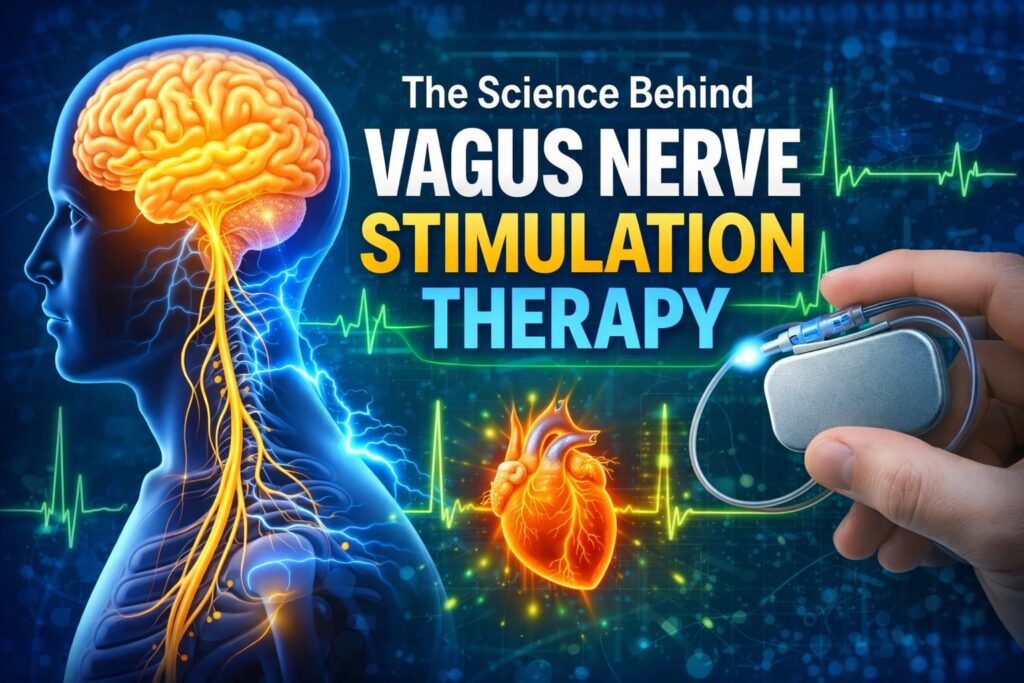
Discover the science behind vagus nerve stimulation therapy, how it works, its benefits for mental health, stress relief, and overall wellness in this complete guide.
LifeCareBalance.com is reader-supported. When you buy through links on our site, we may earn an affiliate commission at no extra cost to you. As an Amazon Associate, we earn from qualifying purchases.
Vagus nerve stimulation has become a major topic in neuroscience, mental wellness, sleep research, and the growing market for at-home wellness devices.
But the phrase “vagus nerve stimulation” is now used to describe several very different things.
There is established medical VNS, which uses an implanted device and is prescribed for specific medical conditions. There are also non-invasive forms of vagus nerve stimulation being studied in clinical research, including transcutaneous and auricular approaches. And then there are everyday practices such as slow breathing, meditation, exercise, and relaxation routines that may influence autonomic nervous-system activity but should not automatically be described as medical VNS.
Understanding this distinction matters.
The research is promising in some areas, particularly for certain neurological conditions and emerging non-invasive applications, but it does not mean that every consumer “vagus nerve” device can treat anxiety, insomnia, depression, inflammation, or other health conditions.
This guide explains what the vagus nerve does, how medical and non-invasive VNS differ, what current research actually shows, what remains uncertain, and what consumers should consider before trying a stimulation device.
What Is the Vagus Nerve?
The vagus nerve is the tenth cranial nerve, or cranial nerve X.
It travels from the brainstem through the neck and into the chest and abdomen, creating important communication pathways between the brain and organs throughout the body.
The vagus nerve is involved in several physiological processes, including communication with the:
- Heart
- Lungs
- Digestive tract
- Brainstem
- Autonomic nervous system
It is an important part of the parasympathetic nervous system, which is involved in functions such as resting, digestion, and recovery.
However, describing the vagus nerve simply as an “on switch for relaxation” is an oversimplification.
The nervous system is a complex network, and the vagus nerve is only one component of that network.
What Is Vagus Nerve Stimulation?
Vagus nerve stimulation (VNS) is a form of neuromodulation in which electrical stimulation is used to influence vagal nerve activity.
Traditional VNS involves a surgically implanted device.
According to Cleveland Clinic, implanted VNS is used for selected people with difficult-to-control epilepsy and certain cases of treatment-resistant depression, and it is also used as an adjunct to rehabilitation after certain strokes.
This is very different from buying a consumer wellness device online.
Medical VNS
Traditional implanted VNS generally involves:
- A pulse generator implanted under the skin
- An electrode connected to the vagus nerve in the neck
- Programmed electrical stimulation
- Ongoing medical supervision
Because implantation is involved, it is a medical treatment rather than a general wellness product.
Non-Invasive VNS
Researchers have also developed non-invasive approaches.
These may include:
- Transcutaneous cervical VNS
- Transcutaneous auricular VNS
- Other externally delivered stimulation methods
These techniques are being investigated for a variety of applications, but the evidence depends heavily on the specific device, stimulation location, protocol, condition being studied, and research population.
That is why you should never assume that evidence from one VNS device applies automatically to every product marketed as a “vagus nerve stimulator.”
Medical VNS vs. Consumer Wellness Devices
This is one of the most important distinctions for consumers.
A device may be marketed using terms such as:
- Nervous-system regulation
- Vagus stimulation
- Stress relief
- Relaxation
- Recovery
- Sleep support
Those marketing terms do not necessarily mean that the product has been clinically proven to treat a medical condition.
For example, a wearable that provides vibration is not automatically equivalent to an electrical VNS device.
Likewise, a consumer device that delivers electrical stimulation is not automatically equivalent to an implanted medical VNS system.
Why the distinction matters
The evidence should be evaluated based on:
- The exact device
- The stimulation method
- The stimulation location
- The population studied
- The condition being investigated
- The study design
- Whether the research was independent or manufacturer-supported
This is one of the biggest gaps in many online VNS articles.
How Does Vagus Nerve Stimulation Work?
Researchers still do not have one complete explanation for every effect of VNS.
The vagus nerve connects with brainstem structures and communicates with multiple systems throughout the body.
Depending on the stimulation method and target, VNS may influence neural signaling and autonomic regulation.
However, it is inaccurate to reduce the mechanism to:
“VNS activates the vagus nerve and immediately puts your body into rest-and-digest mode.”
Human physiology is more complicated than that.
Cleveland Clinic also notes that researchers do not know precisely how VNS produces all of its therapeutic effects.
Does Vagus Nerve Stimulation Increase HRV?
Heart rate variability, or HRV, is often mentioned in VNS marketing.
HRV measures variation in the timing between heartbeats and can provide information about autonomic regulation when interpreted appropriately.
But this does not mean:
Higher HRV = better health.
And it does not mean every VNS device will increase HRV.
Research examining transcutaneous auricular VNS and HRV has produced mixed results. One Bayesian meta-analysis found no meaningful acute effect of taVNS on vagally mediated HRV compared with sham stimulation in healthy participants.
That makes HRV an area where consumers should be particularly careful with marketing claims.
If a device claims to dramatically improve HRV, look for research on that specific device and protocol, rather than relying on general VNS research.
What Does the Research Say About Sleep?
Sleep is one of the most actively researched areas for non-invasive vagus nerve stimulation.
A 2026 systematic review and meta-analysis examined 14 randomized controlled trials of transcutaneous auricular VNS for sleep disorders. The researchers reported improvements in sleep quality, sleep-onset time, and anxiety- and depression-related scores, while also describing the current evidence as preliminary because of study heterogeneity and limitations in clinical interpretation.
Another 2026 systematic review and meta-analysis examined 13 randomized controlled trials of transcutaneous VNS and reported improvements in sleep quality and insomnia severity.
These findings are interesting, but they should not be translated into:
“VNS cures insomnia.”
The more accurate conclusion is:
Early research suggests that certain non-invasive VNS protocols may improve some sleep-related outcomes, but larger and better-controlled research is still needed.
For people primarily interested in sleep tracking and recovery data, our Sleep Tracker Buying Guide 2026 covers another category of wellness technology and explains why consumer sleep metrics should be interpreted carefully.
Can Vagus Nerve Stimulation Help With Anxiety?
This is another area attracting significant research attention.
Some studies have reported improvements in anxiety-related measurements following non-invasive VNS.
A 2026 systematic review and meta-analysis of taVNS for sleep disorders found reductions in anxiety and depression scale scores alongside improvements in sleep outcomes. However, the authors emphasized that the evidence remains preliminary.
Other research is investigating VNS for trauma- and stressor-related disorders, but the field is still developing.
Therefore, it is better to say:
“VNS is being studied as a potential tool for anxiety and stress-related symptoms.”
It is not appropriate to promise that a consumer VNS device will treat an anxiety disorder.
Anyone experiencing persistent or severe anxiety should discuss appropriate treatment options with a qualified healthcare professional.
Vagus Nerve Stimulation and Depression
Implanted VNS has a much more established medical history than consumer wellness stimulation.
Cleveland Clinic describes VNS as an approved treatment option for selected adults with long-term or recurrent major depression that has not responded adequately to multiple antidepressant treatments.
This does not mean:
“A consumer vagus nerve stimulator treats depression.”
Those are completely different claims.
Medical VNS involves a specific medical device, clinical eligibility criteria, programming, monitoring, and a defined therapeutic context.
Consumer wellness devices should not be presented as substitutes for professional treatment.
Is Vagus Nerve Stimulation an Anti-Inflammatory Treatment?
The vagus nerve is involved in pathways connecting the nervous and immune systems, and researchers have investigated VNS in relation to inflammatory processes.
This has led to research into conditions involving inflammation and immune regulation.
However, “VNS reduces inflammation” is too broad for a consumer wellness article.
Research into the anti-inflammatory effects of VNS is ongoing, and results from experimental or disease-specific research should not be interpreted as proof that a consumer device can treat chronic inflammation.
The 2026 scientific literature continues to describe VNS as an expanding area of research across neurological, psychiatric, cardiovascular, immune, and other conditions.
What About Breathing Exercises?
Slow, controlled breathing is often described online as a way to “stimulate the vagus nerve.”
A more careful explanation is that slow breathing can influence autonomic and cardiovascular regulation and may support relaxation.
You do not need a VNS device to practice slow breathing.
For example, you might try:
- Sitting comfortably
- Relaxing your shoulders
- Breathing slowly through the nose
- Allowing the abdomen to expand naturally
- Keeping the breathing comfortable rather than forcing deep breaths
- Practicing for several minutes
The goal should be comfortable, controlled breathing—not trying to create a dramatic physiological sensation.
What About Meditation and Mindfulness?
Meditation and mindfulness can be useful parts of a stress-management routine.
They should not, however, be presented as equivalent to VNS therapy.
A person may use:
- Meditation
- Slow breathing
- Yoga
- Exercise
- Regular sleep
- Time outdoors
- Relaxation routines
as part of a broader wellness strategy.
These practices can complement a healthy lifestyle whether or not someone uses a stimulation device.
What About Cold Exposure?
Cold exposure has become another popular “vagus nerve” trend.
Cold water can produce strong autonomic responses, but that does not mean cold exposure should automatically be described as a vagus nerve treatment.
If you are interested in cold exposure, treat it as a separate practice and consider your overall health, tolerance, and safety.
There is no need to force extreme cold exposure simply because it is trending online.
What About Humming, Singing, or Gargling?
You may see claims that humming, singing, gargling, or similar activities directly “activate the vagus nerve.”
These claims are often presented with more certainty than the evidence supports.
These activities can certainly be part of relaxation, breathing, communication, or mindfulness routines.
But they should not be marketed as equivalent to clinical VNS.
What Are the Potential Benefits of Non-Invasive VNS?
Based on current research, areas being investigated include:
- Sleep quality
- Insomnia symptoms
- Anxiety-related symptoms
- Mood-related outcomes
- Autonomic regulation
- Neurological rehabilitation
- Pain
- Other physiological processes
The important word is “investigated.”
Not every potential application has reached the same level of evidence.
Some uses have stronger clinical support than others, while several consumer wellness applications remain early-stage.
What Are the Risks and Side Effects?
Safety depends on the type of stimulation.
Implanted VNS carries risks associated with both surgery and electrical stimulation.
Reported stimulation-related effects can include:
- Voice changes or hoarseness
- Cough
- Tingling
- Throat discomfort
- Headache
- Breathing-related symptoms
- Pain
Non-invasive VNS avoids surgical implantation, but that does not mean every device is risk-free.
A systematic review of transcutaneous VNS studies found that side effects were generally mild in the research reviewed, with local skin irritation among the more common reported problems.
Always follow the specific manufacturer’s instructions for an electrical stimulation device.
Who Should Be Careful With VNS Devices?
Do not assume that a non-invasive device is appropriate for everyone.
People with significant medical conditions, implanted electronic devices, heart rhythm problems, pregnancy, or other relevant health concerns should discuss the device with a qualified healthcare professional before use.
The appropriate precautions can vary depending on the device.
For implanted VNS, medical eligibility and contraindications are much more specific.
Cleveland Clinic lists several situations in which implanted VNS may not be appropriate, including certain heart, respiratory, neurological, and other medical conditions.
How to Evaluate a Vagus Nerve Stimulator Before Buying
If you are considering a consumer device, do not start with the marketing slogan.
Start with the evidence.
1. Identify the Stimulation Method
Is it:
- Electrical stimulation?
- Auricular stimulation?
- Cervical stimulation?
- Vibration?
- Another form of sensory stimulation?
These should not automatically be treated as interchangeable.
2. Look for Research on the Exact Device
Research on “VNS” in general is not the same as research on the product you are considering.
Ideally, look for published studies that identify the specific device.
3. Check the Study Population
A study in healthy adults does not automatically apply to people with:
- Depression
- Anxiety disorders
- Epilepsy
- Insomnia
- Cardiovascular conditions
- Chronic pain
4. Check What Outcome Was Actually Measured
A study may measure:
- Sleep scores
- Anxiety questionnaires
- HRV
- Blood pressure
- Pain
- Mood
- Brain activity
One positive outcome does not prove improvement in every area.
5. Look for Independent Research
Manufacturer-funded research can be useful, but independent replication adds important context.
6. Avoid “Miracle” Claims
Be skeptical of products claiming to:
- Cure anxiety
- Fix depression
- Eliminate inflammation
- Guarantee deep sleep
- Dramatically increase HRV
- Replace medication
- Replace therapy
Those claims go far beyond what most consumer VNS evidence can establish.
Vagus Nerve Stimulation Devices vs. Other Wellness Tools
Consumers often compare VNS devices with other relaxation products.
They serve different purposes.
VNS Devices
Designed to deliver a specific form of neuromodulation or stimulation.
Massage Guns
Designed primarily for mechanical percussion and muscle-focused recovery.
For related recovery tools, see our Massage Gun Buying Guide 2026.
Sleep Trackers
Designed to monitor sleep-related signals and trends rather than actively stimulate the nervous system.
Meditation Tools
Designed to support mindfulness, breathing, relaxation, or attention practices.
General Stress-Relief Products
These may include weighted blankets, relaxation tools, headphones, lighting, and other products.
Our Stress Relief Products Guide covers several of these categories.
The important point is that monitoring, stimulation, relaxation, and physical recovery are different functions.
Where VNS Fits Into a Broader Wellness Routine
VNS should not be viewed as a replacement for basic health habits.
A stronger wellness foundation still includes:
- Consistent sleep
- Regular physical activity
- Balanced nutrition
- Stress-management skills
- Social connection
- Time for recovery
- Appropriate medical care
A device can be an optional tool within that routine.
It should not become the entire routine.
For a broader look at current wellness technology and self-care tools, see our Best Wellness Products for 2026.
Should You Buy a Vagus Nerve Stimulator?
There is no single answer for everyone.
If your primary interest is general relaxation, first consider whether simpler strategies such as breathing exercises, meditation, exercise, and better sleep habits already meet your needs.
If you are interested in a device, evaluate:
- The exact stimulation method
- Evidence for that device
- Safety information
- Manufacturer instructions
- Warranty and support
- Return policy
- Total cost
- Whether a subscription is required
- Whether the product makes medical claims
For readers specifically interested in consumer devices, our Vagus Nerve Stimulators for Daily Use article provides a separate device-focused resource.
Keeping that article focused on products while this guide focuses on science, evidence, safety, and interpretation helps avoid unnecessary topic duplication.
What the Current Evidence Really Tells Us
The most useful way to understand VNS in 2026 is to separate what is established from what is still being investigated.
More Established
Implanted VNS has recognized medical applications for selected patients, including certain cases of epilepsy, treatment-resistant depression, and stroke rehabilitation.
Promising but Still Developing
Non-invasive VNS research is expanding, particularly in areas such as sleep and anxiety-related outcomes. Recent meta-analyses have reported promising findings but also emphasize limitations and the need for better trials.
Still Uncertain
Claims that every consumer VNS device can:
- Dramatically increase HRV
- Treat anxiety
- Cure insomnia
- Reduce chronic inflammation
- Replace mental-health treatment
- Improve every aspect of wellness
are not supported by one universal body of evidence.
The device, protocol, population, and outcome all matter.
Common Vagus Nerve Stimulation Mistakes to Avoid
Mistake 1: Treating Every Device as the Same
A medical implant, an auricular electrical stimulator, and a vibration wearable are not automatically equivalent.
Mistake 2: Confusing Relaxation With Medical Treatment
Feeling relaxed after using a device does not prove that the device treated a medical condition.
Mistake 3: Taking Marketing Claims as Clinical Evidence
Look for peer-reviewed research rather than relying only on testimonials.
Mistake 4: Using HRV as a Simple Health Score
HRV is context-dependent and should not be treated as a universal measure of health.
Mistake 5: Replacing Professional Care
A consumer wellness device should not replace appropriate medical or mental-health treatment.
Mistake 6: Expecting Immediate Results
Even where research is promising, study outcomes do not mean every person will experience the same result.
Frequently Asked Questions
What is vagus nerve stimulation?
Vagus nerve stimulation is a form of neuromodulation that uses stimulation to influence activity associated with the vagus nerve. Traditional medical VNS uses an implanted device, while non-invasive forms are also being researched.
Is vagus nerve stimulation scientifically proven?
The answer depends on the specific use. Implanted VNS has established medical applications for selected conditions. Non-invasive VNS is an active research field, with promising but still developing evidence for areas such as sleep and anxiety-related outcomes.
Can VNS help with sleep?
Recent systematic reviews suggest that certain non-invasive VNS protocols may improve sleep quality and insomnia-related measures, but the evidence is still considered preliminary and additional high-quality research is needed.
Can VNS help with anxiety?
Some studies report improvements in anxiety-related measures, but non-invasive VNS should not be presented as a proven replacement for established anxiety treatment. Current research is still developing.
Does VNS increase HRV?
Not necessarily. Research on the effect of non-invasive VNS on HRV has produced inconsistent results, and one meta-analysis found no meaningful acute effect on vagally mediated HRV compared with sham stimulation in healthy participants.
Are vagus nerve stimulators safe?
Safety varies by device and stimulation method. Non-invasive approaches generally avoid surgical risks, but users can still experience side effects such as local skin irritation or discomfort. Implanted VNS has additional surgical and stimulation-related risks.
Is Apollo Neuro the same as an electrical VNS device?
No. Apollo Neuro uses tactile vibration rather than electrical stimulation of the vagus nerve. It should therefore not automatically be treated as equivalent to an electrical VNS device or implanted VNS therapy.
Can breathing exercises stimulate the vagus nerve?
Slow, comfortable breathing can influence autonomic regulation and support relaxation. However, breathing exercises should not be described as equivalent to medical VNS therapy.
Can a consumer VNS device replace therapy or medication?
No. Consumer wellness devices should not be used as substitutes for prescribed treatment, psychotherapy, or professional medical care.
What should I check before buying a vagus nerve device?
Look at the stimulation method, exact device, published evidence, safety information, manufacturer instructions, warranty, return policy, and whether the product makes claims that go beyond its available evidence.
Final Takeaway
Vagus nerve stimulation is a fascinating area of modern neuroscience, but the term has become broader than the science itself.
There is a major difference between medical VNS, non-invasive VNS research, and everyday relaxation practices.
The strongest approach is therefore not to believe every claim—or dismiss the entire field—but to look at the evidence behind the specific device, method, condition, and outcome.
Research published in 2026 suggests that some non-invasive VNS approaches may have useful effects on sleep and certain anxiety- or mood-related measures, but researchers continue to call for larger and better-designed studies.
For consumers, the practical lesson is simple:
Treat vagus nerve stimulation as an evolving area of science, not a universal wellness cure.
Use evidence to evaluate devices, keep expectations realistic, follow safety instructions, and continue to prioritize the fundamentals of good health.
That makes VNS a much more useful topic to understand—and a much safer category to navigate.
Pingback: Budget-Friendly Vagus Nerve Stimulators Under $200 - lifecarebalance.com