
LifeCareBalance.com is reader-supported. When you buy through links on our site, we may earn an affiliate commission at no extra cost to you. As an Amazon Associate, we earn from qualifying purchases.
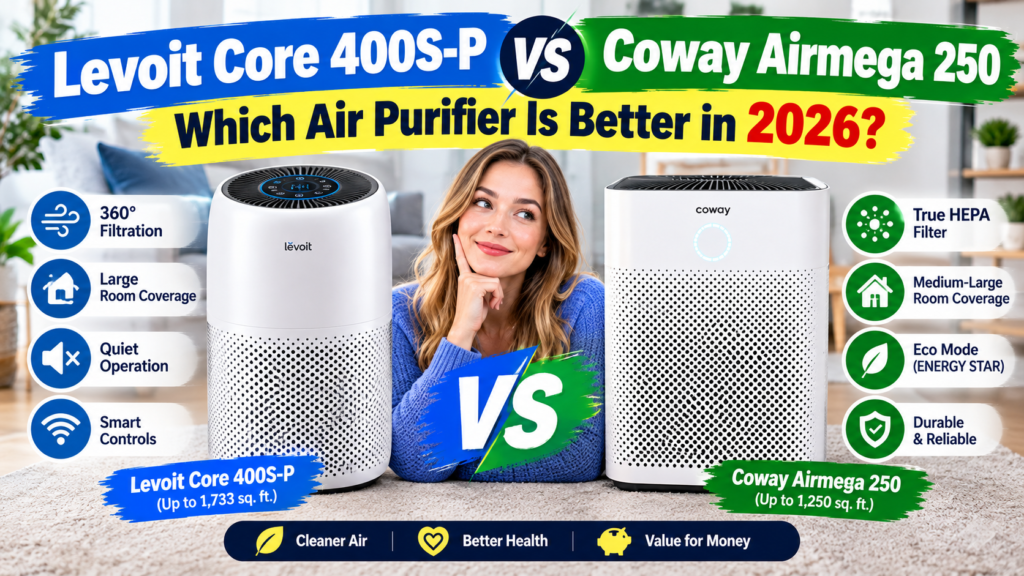
The Levoit Core 400S-P is the better value for most budget-conscious buyers, especially if you want app control, voice commands, a compact cylindrical design, and lower replacement-filter costs. The Coway Airmega 250 is worth considering if you prefer a washable pre-filter and slightly higher published smoke and dust CADR figures.
The two models are closer in particle-cleaning capacity than their prices might suggest. Levoit lists CADR ratings of 231 CFM for smoke, 240 for dust, and 259 for pollen. Coway lists 249 CFM for smoke, 261 for dust, and 230 for pollen. That means Coway leads on smoke and dust, while Levoit leads on pollen.
The main differences are practical rather than dramatic:
- Price: Levoit has a substantially lower list price.
- Smart features: Levoit includes Wi-Fi, the VeSync app, voice control, and a numeric air-quality display.
- Pre-filter maintenance: Coway has a removable, washable pre-filter.
- Room sizing: Both manufacturers publish coverage figures based on different air-change rates, so headline square footage should not be compared without context.
- Noise: Independent testing of the original Levoit Core 400S and Coway Airmega 250S suggests that the Levoit offers more particle-cleaning performance at quieter fan speeds. These are test results for those tested versions, not a direct laboratory comparison of the exact current models.
This comparison uses published specifications and identified third-party testing. LifeCareBalance has not independently laboratory-tested either product.
Levoit Core 400S-P vs. Coway Airmega 250: Side-by-Side Comparison

- 𝐖𝐇𝐘 𝐂𝐇𝐎𝐎𝐒𝐄 𝐀𝐇𝐀𝐌 𝐕𝐄𝐑𝐈𝐅𝐈𝐃𝐄 𝐀𝐈𝐑 𝐏𝐔𝐑𝐈𝐅𝐈𝐄𝐑𝐒: AHAM (Association of Home Appliance Manufacturers) is an ANSI-accredited organiz…
- 𝐀𝐇𝐀𝐌 𝐕𝐄𝐑𝐈𝐅𝐈𝐃𝐄 & 𝐓𝐑𝐔𝐒𝐓𝐄𝐃 𝐁𝐘 𝐄𝐗𝐏𝐄𝐑𝐓𝐒: Certified by the Association of Home Appliance Manufacturers (AHAM), the Core 400S-P…
- 𝐇𝐈𝐆𝐇-𝐄𝐅𝐅𝐈𝐂𝐈𝐄𝐍𝐂𝐘 𝐀𝐈𝐑 𝐏𝐔𝐑𝐈𝐅𝐈𝐂𝐀𝐓𝐈𝐎𝐍 𝐅𝐎𝐑 𝐋𝐀𝐑𝐆𝐄 𝐑𝐎𝐎𝐌𝐒: The LEVOIT Core 400S-P Air Purifier is designed for powerful whole-roo…

- [Coverage] Optimized to clean spaces up to 930 sq. ft. in 30 minutes or up to 1,860 sq. ft. in 60 minutes.
- [HyperCaptive Filtration System] Dynamic combination of a washable pre-filter, activated carbon filter, and HEPA Filter …
- [Air Quality Indicator] 24/7 pollution monitor air quality throughout the day, adjusting purification to the necessary l…
| Feature | Levoit Core 400S-P | Coway Airmega 250 |
|---|---|---|
| Typical manufacturer price checked | $189.99 sale; $219.99 list | $399 list |
| Model | Core 400S-P | AP-1720H |
| Smoke CADR | 231 CFM | 249 CFM |
| Dust CADR | 240 CFM | 261 CFM |
| Pollen CADR | 259 CFM | 230 CFM |
| Manufacturer room-size figures | 1,718 sq. ft. at 1 ACH; 358 sq. ft. at 4.8 ACH | 1,860 sq. ft. at 1 ACH; 930 at 2 ACH; 465 at 4 ACH |
| Filtration | Three-stage filter with particle filtration and activated carbon | Washable pre-filter plus Max2 filter with HEPA and activated carbon |
| Rated power | 38 W | 64 W |
| Manufacturer noise range | 22–52 dB | 22–54 dB(A) |
| Dimensions | 10.8 × 10.8 × 20.5 inches | 18.5 × 19.7 × 8.3 inches |
| Weight | About 11 lb | 20.5 lb |
| App control | Yes, VeSync | No on standard 250 |
| Voice control | Alexa and Google Assistant | Not listed for standard 250 |
| Numeric PM2.5 display | Yes | No; color-based indicator |
| Pre-filter maintenance | Attached to the combined filter | Removable and washable |
| Replacement filter price checked | $49.99 standard filter | $89 Max2 filter |
| Filter replacement timing | Depends on use; third-party reviewers commonly estimate 6–8 months | Coway lists about one year; its product highlights also state 6–12 months |
Prices and specifications can change. Confirm the current product page and exact model before ordering. The Airmega 250S is a separate connected version.
Price and Value: Is Coway Worth the Extra Money?
At the prices checked for this comparison, Levoit’s sale price was $189.99, with a listed price of $219.99. Coway listed the Airmega 250 at $399. That creates a price difference of approximately $180–$210 before taxes and shipping.
The difference buys a different maintenance design and slightly higher smoke and dust CADR ratings—not a twofold increase in particle-cleaning capacity.
Coway’s washable pre-filter is convenient for homes with hair, lint, and larger airborne debris. The Levoit has more connected features at a lower price, and its cylindrical shape occupies less floor space.
The price comparison also depends on whether Levoit is on sale. Promotional pricing can change, and retailer prices may differ from manufacturer prices.
Check the current manufacturer listings before buying:
If your primary goal is getting adequate filtration for a medium-sized room, compare the required CADR and recurring costs before paying extra for design or connectivity.
CADR Comparison: Which One Cleans Air Faster?
CADR stands for Clean Air Delivery Rate. It estimates the volume of filtered air a purifier delivers, with separate ratings commonly published for smoke, dust, and pollen. A higher CADR generally means faster particle removal when the models are compared on the same basis.
The current figures listed for these models are:
| Particle type | Levoit Core 400S-P | Coway Airmega 250 | Higher published figure |
|---|---|---|---|
| Smoke | 231 CFM | 249 CFM | Coway |
| Dust | 240 CFM | 261 CFM | Coway |
| Pollen | 259 CFM | 230 CFM | Levoit |
These values show why neither purifier should be declared the overall winner using a single CADR number. Your priority matters. For smoke and dust, Coway has the higher listed values. For pollen, Levoit has the higher listed value.
Levoit’s older Core 400S materials sometimes show a single 260 CFM figure. That older number should not replace the current model’s particle-specific ratings. The current Core 400S-P listing and ENERGY STAR record give 231 smoke, 240 dust, and 259 pollen CFM.
For another overview of model ratings, room size, and air-change assumptions, see the LifeCareBalance Air Purifier Buying Guide for Beginners 2026.
Room Size: Why the Coverage Numbers Look So Different
Room coverage is one of the easiest air-purifier specifications to misunderstand. A purifier can be advertised for a very large area if the manufacturer assumes only one air change per hour. That does not mean it will clean that room as quickly as it would clean a smaller room.
ACH means air changes per hour. Four ACH means the purifier delivers the equivalent of four room volumes of clean air each hour, based on the relevant airflow and room volume.
Coway lists the Airmega 250 at:
- 1,860 sq. ft. at 1 ACH
- 930 sq. ft. at 2 ACH
- 465 sq. ft. at 4 ACH
Levoit lists the Core 400S-P at 1,718 sq. ft. at 1 ACH and 358 sq. ft. at 4.8 ACH.
Those figures use different ACH assumptions. For a fair comparison, use the same benchmark for both models.
Using the AHAM Two-Thirds Rule
The Association of Home Appliance Manufacturers (AHAM) recommends selecting an air cleaner with a smoke CADR at least two-thirds of the room’s floor area. This is a useful shopping rule for comparing particle-cleaning capacity, assuming standard ceiling height.
Using that guideline:
- Levoit: 231 CFM ÷ 0.67 ≈ 346 sq. ft.
- Coway: 249 CFM ÷ 0.67 ≈ 373 sq. ft.
These are approximate room-size estimates using the smoke CADR and the two-thirds rule. They are not guarantees of identical performance in every room.
For a more demanding target, room-size estimates will be smaller. Ceiling height, room layout, open doorways, pollution sources, and the speed at which you run the purifier also affect real-world results.
AHAM explains its approach in the AHAM Verifide room air cleaner directory.
Practical Room-Size Guidance
Rooms up to about 200 sq. ft.
Either model should offer considerable capacity for a typical room of this size. You may be able to run the purifier at a lower speed, depending on your desired cleaning rate and the source of particles.
Rooms around 200–350 sq. ft.
Both are plausible choices. Levoit’s lower cost and app controls make it appealing, while Coway provides slightly higher smoke and dust CADR figures.
Rooms around 350–400 sq. ft.
Coway has more room on paper under the AHAM two-thirds rule. Levoit may still be suitable, but the amount of airflow you need and the noise you will tolerate become more important.
Rooms above 400–500 sq. ft.
Neither should automatically be treated as a fast-cleaning solution for a large open-plan area. Consider a higher-CADR purifier or multiple units, and calculate the required airflow for the actual room.
For additional options, compare the models in our Best Air Purifiers for Large Rooms in 2026 guide.
Filtration: What Each Purifier Actually Uses
Both models combine particle filtration with activated carbon, but the filter assemblies are different.
Levoit Core 400S-P
Levoit uses a cylindrical, three-stage filter assembly. It includes a layer for larger debris, a particle filter, and activated carbon for some odors and gases.
The filter is replaced as an assembly. This simplifies installation, but it means you cannot separately rinse and reuse the pre-filter in the same way as Coway’s removable pre-filter.
Levoit also offers specialized replacement-filter options with different carbon quantities and intended uses. More carbon may be useful for some odors, but it does not guarantee removal of every gas or chemical.
Coway Airmega 250
Coway uses a washable pre-filter followed by its Max2 filter, which combines particle filtration and activated carbon.
The washable layer can catch larger debris before it reaches the main filter. You can remove it, clean it according to the manufacturer’s instructions, allow it to dry fully, and reinstall it.
This is a practical advantage for homes with shedding pets or frequent lint and dust. However, the main Max2 filter still needs replacement according to Coway’s maintenance guidance.
Does Either Have Better HEPA Filtration?
Both manufacturers make high-efficiency particle-filtration claims, but marketing language, a test method, and an independent certification are not interchangeable.
Levoit’s current product listing describes a three-stage filter and its current Core 400S-P appears in ENERGY STAR’s record as a room air cleaner with a “HEPA-Type” filter. Coway describes its Max2 filter as combining activated carbon with Green True HEPA filtration.
Do not assume that the wording on one product box proves that the entire purifier performs better than the other. For shopping purposes, compare the CADR ratings, independent testing, and the specific evidence available for each model.
A high-efficiency particle filter is intended to reduce airborne particles; activated carbon can adsorb some gases and odors, but its performance depends on the amount of carbon and the contaminant. Neither purifier should be assumed to remove every VOC or solve an indoor pollution source by itself.
Noise: Which One Is Better for a Bedroom?
Both brands publish noise ranges that are broadly similar. Levoit lists 22–52 dB, while Coway lists 22–54 dB(A). Manufacturer noise figures are not always directly comparable because measurement distances, background noise, and test methods may differ.
Independent reviewer HouseFresh measured the original U.S. Levoit Core 400S and the Coway Airmega 250S from three feet away. Those results provide useful context, but they should not be presented as a controlled, same-session test of the exact current Core 400S-P and standard Airmega 250.
HouseFresh reported the following figures:
| Setting | Levoit Core 400S tested by HouseFresh | Coway Airmega 250S tested by HouseFresh |
|---|---|---|
| Sleep | 35.5 dBA | 35.7 dBA |
| Speed 1 | 38.3 dBA | 36.5 dBA |
| Speed 2 | 43.2 dBA | 50.2 dBA |
| Highest speed | 60.3 dBA | 59.3 dBA |
The Levoit has more fan-speed steps, making it easier to adjust the balance between airflow and noise. HouseFresh also estimated that the tested Levoit delivered more particle-cleaning airflow below 45 dBA than the tested Coway 250S.
That matters because a purifier only helps while it is running. If you find high fan speeds distracting, a model with more usable quiet settings may be easier to leave on throughout the day or night.
For bedroom use, choose based on the airflow you need at a tolerable noise level—not the lowest decibel number printed in a product listing.
Smart Features: Levoit Has the Clear Advantage
The standard Coway Airmega 250 does not have Wi-Fi or app control. The Airmega 250S is the connected version.
Levoit Core 400S-P includes:
- VeSync app control
- Remote operation and scheduling
- Filter-life notifications
- Air-quality updates
- Alexa and Google Assistant compatibility
- A numeric PM2.5 display
Coway Airmega 250 includes automatic operating modes and an air-quality indicator, but it does not offer the same connected features on the base model.
Levoit’s numeric display can be convenient for observing changes after cooking, cleaning, or other activities that produce particles. However, a consumer sensor is not a complete indoor-air-quality monitor, and a displayed PM2.5 value does not establish that every pollutant is absent.
If you want smart-home integration without paying for an upgraded Coway version, Levoit is the straightforward choice.
Replacement Filters and Three-Year Cost
Purchase price is only part of the ownership cost. The replacement filter’s price and service life can change the total significantly.
At the prices checked for this comparison:
- Levoit standard replacement filter: $49.99
- Coway Max2 replacement filter: $89
Coway lists the Max2 filter’s expected life as about one year, while its product information also mentions a 6–12-month range. Levoit’s replacement interval depends on use; independent reviewers commonly plan around six months, with some guidance allowing a longer interval.
The exact replacement schedule should follow the current manual, filter indicator, and actual conditions in your home.
Estimated Filter Cost Over Three Years
For a transparent comparison, the following estimates assume that the filter supplied with each new purifier covers the first service interval. Only additional replacement filters are counted. These figures exclude electricity, taxes, shipping, and any promotional discounts.
| Replacement schedule | Levoit at $49.99/filter | Coway at $89/filter |
|---|---|---|
| Replacement every 12 months | About $99.98 for 2 replacements | About $178 for 2 replacements |
| Replacement every 6 months | About $249.95 for 5 replacements | About $445 for 5 replacements |
The six-month Coway scenario is a conservative illustration, not a claim that every user will need five replacements in three years. The actual interval may be longer.
This comparison shows that Levoit’s filter is less expensive per replacement, but filter longevity matters too. If Coway’s Max2 lasts close to a full year in your home, its annual filter expense is lower than it would be under a six-month schedule.
Check the exact filter model before purchasing. Genuine replacement filters help ensure the product matches the manufacturer’s intended fit and specifications.
Energy Use: Which Costs Less to Run?
Levoit lists rated power of 38 watts and standby power below 2 watts. Coway lists 64 watts for the Airmega 250.
These manufacturer figures are useful for planning, but they do not mean either purifier draws its rated power constantly at every speed. Actual energy use depends on fan setting, automatic-mode behavior, and how long the unit runs.
For a simple illustration, assume both units operate continuously at their rated power:
| Calculation | Levoit 38 W | Coway 64 W |
|---|---|---|
| Energy per 24 hours | 0.912 kWh | 1.536 kWh |
| Energy over 30 days | 27.36 kWh | 46.08 kWh |
| Monthly cost at $0.20/kWh | About $5.47 | About $9.22 |
These are calculations, not measured monthly bills. Real consumption may be lower when the purifier runs on quieter settings or adjusts itself automatically.
Levoit’s lower rated power is an advantage for shoppers who intend to run a purifier for long periods. The difference in actual electricity cost will depend on your local rate and operating habits.
Dust, Pollen, Pets, and Smoke: Which Should You Choose?
For Dust
Coway has the higher listed dust CADR: 261 CFM versus Levoit’s 240 CFM. If dust removal is the primary priority, Coway has the advantage on this published figure.
Neither purifier replaces vacuuming, cleaning surfaces, or reducing sources of dust. Settled dust is not the same as airborne dust.
For Pollen
Levoit has the higher listed pollen CADR: 259 CFM compared with Coway’s 230 CFM. That gives Levoit the paper advantage for this particle category.
A purifier may reduce airborne pollen, but it cannot eliminate all pollen entering through doors, windows, clothing, or other routes. People with significant allergy symptoms should follow advice from a qualified healthcare professional.
For Pets
Coway’s removable, washable pre-filter is useful for catching larger debris such as fur and lint. Levoit’s cylindrical design and specialized replacement-filter options may appeal to buyers who also want app control or a filter marketed for pet-related odors.
Remember that airborne pet dander, visible hair, and odors are different problems. Neither purifier eliminates the need for regular cleaning.
For Smoke
Coway has a modest advantage in published smoke CADR: 249 CFM versus Levoit’s 231 CFM. For smoke particles, room size and the amount of clean air delivered are key considerations.
Activated carbon may help with some gaseous compounds and odors, but the effectiveness depends on carbon quantity and the specific pollutants. During wildfire smoke events, follow local public-health guidance, reduce outdoor-air infiltration when advised, and use a purifier sized for the space.
Pros and Cons
Levoit Core 400S-P
Pros
- Lower upfront price.
- Wi-Fi, app control, and voice-assistant compatibility.
- Numeric PM2.5 display.
- Higher published pollen CADR.
- Lower rated power.
- Compact cylindrical design.
- Lower price per standard replacement filter.
Cons
- Lower published smoke and dust CADR than Coway.
- Combined filter assembly does not provide Coway’s separate washable pre-filter.
- Replacement interval depends on use and can affect long-term costs.
- Manufacturer specifications and older reviews may use different CADR figures.
Coway Airmega 250
Pros
- Higher published smoke and dust CADR.
- Removable, washable pre-filter.
- Automatic modes and a simple indicator system.
- Shallow front-to-back depth.
- Max2 filter’s listed life is about one year, subject to use.
Cons
- Higher purchase price.
- More expensive replacement filter.
- Higher rated power.
- Heavier and wider than the Levoit.
- No Wi-Fi or app control on the standard model.
- Published coverage figures need ACH context.
Alternatives Worth Considering
If neither model fits your needs, compare these options before purchasing.
- Coway Airmega 250S: Consider this if you prefer Coway’s design and want app connectivity.
- Levoit Vital 200S-P: Worth checking if a removable pre-filter and pet-hair maintenance are more important than a cylindrical shape.
- Levoit Core 600S-P: Consider a higher-capacity Levoit if your room needs more airflow than the Core 400S-P can comfortably provide.
- Coway Airmega 300 or 400 series: Compare their published CADR and coverage if you need a larger-room option.
For more choices, use our Best Air Purifiers for Large Rooms in 2026 roundup. Compare models using the same room-size and ACH assumptions instead of choosing by the largest headline number.
Frequently Asked Questions
Is the Levoit Core 400S-P better than the Coway Airmega 250?
Not for every buyer. Levoit costs less and offers more smart features, while Coway has higher published smoke and dust CADR and a washable pre-filter. Levoit has the higher published pollen CADR.
Which has a higher CADR?
Coway lists 249 CFM for smoke and 261 for dust. Levoit lists 231 for smoke and 240 for dust. Levoit lists 259 CFM for pollen, above Coway’s 230.
Does the standard Coway Airmega 250 have Wi-Fi?
No. The standard Airmega 250 does not list Wi-Fi or app control. The Airmega 250S is the connected version.
Which is quieter?
Manufacturer noise ranges are similar. Independent tests of the original Core 400S and Coway 250S suggest the Levoit provides more particle-cleaning airflow at some moderate noise levels. Because the tested models and test conditions differ, treat those results as useful context rather than a definitive same-model laboratory comparison.
How often should I replace the filters?
Coway lists the Max2 filter at about one year, although its product information also says 6–12 months. Levoit’s interval depends on usage, and independent reviewers commonly estimate six to eight months. Follow the current manufacturer’s instructions.
Which is better for a room around 350 square feet?
Both are worth considering. Using AHAM’s two-thirds rule, Levoit’s 231 CFM smoke CADR corresponds to about 346 square feet, while Coway’s 249 CFM corresponds to about 373 square feet. Actual performance depends on room conditions and operating speed.
Does activated carbon remove all household odors?
No. Activated carbon can adsorb some gases and odor-causing compounds, but effectiveness depends on the carbon amount and the specific contaminant. Source control and ventilation remain important.
Final Verdict: Which Air Purifier Should You Buy?
For most shoppers watching their budget, the Levoit Core 400S-P is the better overall value. It costs substantially less, offers app and voice control, has a numeric PM2.5 display, and uses less rated power. Its pollen CADR is also higher.
The Coway Airmega 250 is a reasonable alternative if you prioritize a washable pre-filter and slightly higher published smoke and dust CADR. Those advantages may matter more in a home with substantial lint or airborne dust, but they do not automatically justify the higher price for everyone.
Choose based on the pollutant you care about, the room size, the airflow you can tolerate at a comfortable noise level, and the cost of replacement filters. Read the ACH assumptions behind coverage claims and verify the exact model before ordering.
Neither product should be treated as a substitute for ventilation, pollution-source control, or medical care. A purifier is one part of a practical indoor-air-quality strategy.
Affiliate disclosure: LifeCareBalance is reader-supported. As an Amazon Associate, we may earn from qualifying purchases at no extra cost to you. Product specifications and prices can change; verify current details with the manufacturer before purchasing.