
LifeCareBalance.com is reader-supported. When you buy through links on our site, we may earn an affiliate commission at no extra cost to you. As an Amazon Associate, we earn from qualifying purchases.
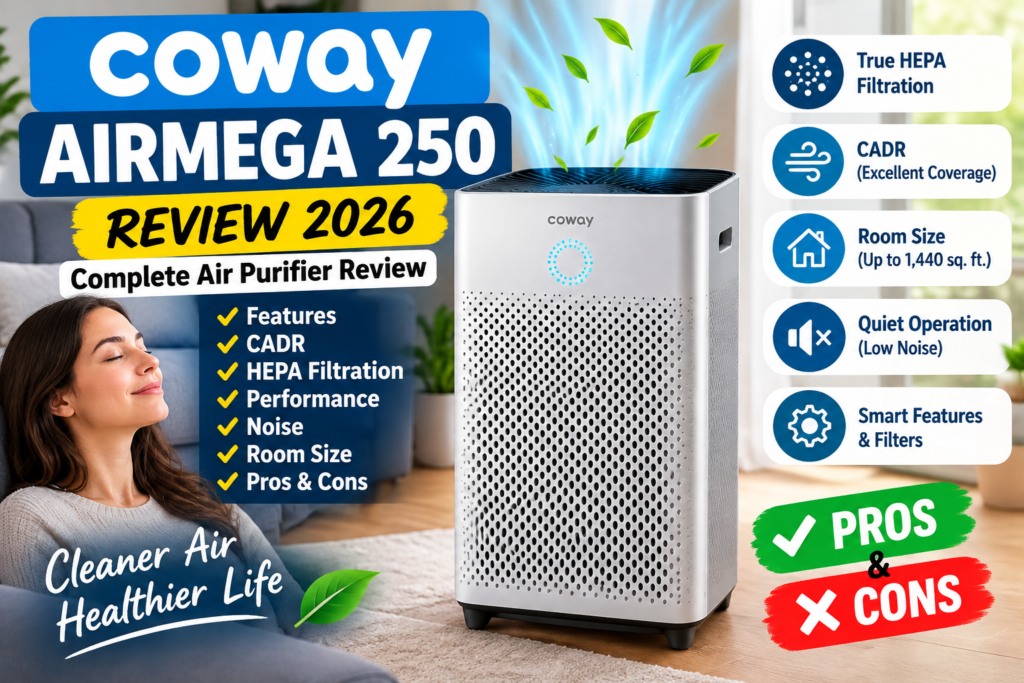
The Coway Airmega 250 (model AP-1720H) is a mid-size room air purifier built for strong particle filtration with little upkeep. It pairs a washable pre-filter with one Max2 filter that combines HEPA and activated carbon. Coway rates it at a CADR of 249 for smoke, 261 for dust and 230 for pollen.
Under EPA’s sizing rule, those numbers suit rooms of roughly 380 sq. ft. or less at a strong air-change rate. It can also serve larger rooms if you accept slower air turnover. It fits buyers who want automatic fan control and a single filter change each year.
It is harder to justify for a small room, a tight budget, or a need for app control. Coway’s own Mighty and Levoit’s Core 400S list similar CADR figures for less money.
How this review was prepared: This is an editorial analysis. It draws on Coway’s published specifications, manufacturer pages for the comparison models, and U.S. EPA guidance. LifeCareBalance has not run laboratory or long-term hands-on tests on the Airmega 250. We therefore report no measured performance or noise readings, and manufacturer claims are attributed to the manufacturer.
Coway Airmega 250 Specifications
The table below follows the official Coway Airmega 250 product page.
| Specification | Coway Airmega 250 |
|---|---|
| Model | AP-1720H |
| Smoke CADR | 249 |
| Dust CADR | 261 |
| Pollen CADR | 230 |
| 1 ACH coverage | 1,860 sq. ft. |
| 2 ACH coverage | 930 sq. ft. |
| 4 ACH coverage | 465 sq. ft. |
| Filtration | Washable pre-filter + Max2 filter (HEPA + activated carbon) |
| Noise | 22–54 dB(A) |
| Filter life | About 1 year (Max2) |
| Dimensions (W × H × D) | 18.5 × 19.7 × 8.3 in |
| Weight | 20.5 lb |
| Power | 64 W |
| Modes | Smart Mode (Auto, Sleep, Eco) and Rapid Mode; fan speeds 1–3 |
| Timer | 1, 4 or 8 hours |
| Air-quality monitoring | Yes (real-time) |
| Wi-Fi/app | No (the Airmega 250S adds it) |
| Coway U.S. list price | $399 (checked Sept. 20, 2026; may change) |
Coverage claims depend on air changes per hour (ACH) and testing assumptions. Coway lists three figures for this model, and other brands or regions may publish different room sizes for the same CADR. The 930 sq. ft. headline is the 2 ACH number, not a “best fit” room size.
What Is the Coway Airmega 250?
The Airmega 250 is Coway’s mid-range large-room purifier. It is wide and shallow (8.3 inches deep), so it fits against a wall or on a low table more easily than a tower of similar capacity. Coway describes the design as three-stage filtration with filter-change indicators, Smart Mode and Rapid Mode.
The standard 250 has no Wi-Fi. The 250S is the connected version. According to Coway, it filters and covers the same area but adds app control, voice control and remote scheduling.
If you’re still deciding whether a purifier belongs in your routine, see our roundup of air purifiers for healthier indoor living.
Coway Airmega 250 Filtration System
Coway describes three stages: a washable pre-filter, then a Max2 filter that houses HEPA and activated carbon. Each stage does a different job, and only some of it involves gases.
Washable Pre-Filter
The pre-filter is designed to catch larger debris such as hair, lint and coarse dust. That keeps the finer filter from clogging early. Coway says it slides out, can be rinsed and hangs on the unit to dry.
Its value is practical. It’s a free, reusable first layer, and it means part of the maintenance costs nothing.
HEPA Filtration
Coway calls its filter “Green True HEPA.” On its filter page, Coway says the HEPA layer captures 99.97% of airborne allergens as small as 0.3 microns.
That matches the benchmark in EPA’s explanation of HEPA filters. EPA says HEPA can theoretically remove at least 99.97% of dust, pollen, mold, bacteria and other airborne particles at 0.3 microns. EPA notes that 0.3 microns is the hardest size to catch, so larger and smaller particles are trapped more efficiently.
HEPA works on particles only. It doesn’t capture gases.
Activated Carbon Filter
The carbon layer is a separate stage for odors and gases. Coway says the Max2’s honeycomb carbon layer targets odors and gases. EPA’s guidance adds two cautions:
- CADR ratings apply to particles only, and no widely used rating system exists for gas removal.
- Carbon filters work best when they contain a large amount of material.
The Coway pages we reviewed don’t state how much carbon the filter contains. Treat the carbon stage as helpful for everyday household odors. It isn’t a proven answer for heavy chemical exposure.
Coway Airmega 250 CADR Explained
CADR (clean air delivery rate) is a standardized measure of how much filtered air a purifier delivers. EPA’s guide to air cleaners in the home explains how it works:
- What it means: The higher the CADR, the more particles the air cleaner removes and the larger the area it can serve.
- Three ratings: Tobacco smoke, dust and pollen stand in for small, medium and large particles. Smoke CADR matters most for fine particles (PM2.5), the size range of greatest health concern.
- Speed: The rating is typically measured at the highest fan speed. At lower speeds the purifier filters less air.
- Particles only: CADR says nothing about gas or odor removal.
EPA’s sizing rule of thumb is that CADR should be about two-thirds of the room’s floor area (8-foot ceilings). EPA’s table pairs a 400 sq. ft. room with a 260 CFM minimum. The Airmega 250’s 249 smoke CADR lands at roughly 380 sq. ft. by that rule.
Coway’s 930 sq. ft. figure isn’t a contradiction. It’s the same airflow spread across a bigger room, so each air change takes longer.
How Much Room Does the Airmega 250 Cover?
You can estimate air changes per hour yourself. Divide CADR × 60 by the room’s volume in cubic feet. With an 8-foot ceiling and Coway’s 249 smoke CADR, that works out to about 1,867 ÷ floor area (sq. ft.).
The table shows our calculations at maximum fan speed, not test results.
| Room type (example size) | Approx. ACH at max speed | Practical takeaway |
|---|---|---|
| Small bedroom (120 sq. ft.) | ~16 | Far more capacity than needed; you’d run low speeds |
| Medium bedroom (200 sq. ft.) | ~9 | Comfortable margin, so low speeds can do the work |
| Home office (150 sq. ft.) | ~12 | Ample capacity |
| Living room (350 sq. ft.) | ~5 | Close to EPA’s two-thirds guideline |
| Large open room (700 sq. ft.) | ~2.7 | Works, with slower turnover; consider a stronger unit or a second one |
Coway’s 465 sq. ft. figure (4 ACH) and 930 sq. ft. figure (2 ACH) are valid math. For allergy, dust or smoke concerns, the higher-ACH end of the range is the more useful benchmark. EPA also advises sizing up for ceilings above 8 feet and considering the whole space in open floor plans.
Coway Airmega 250 Performance
We haven’t measured performance, so this section explains what the design and specifications suggest. It follows EPA guidance, and each item is framed as filtration that may help reduce airborne particles, not a guarantee.
Dust
Dust is the Airmega 250’s strongest rating, at a CADR of 261. Fine household dust is the easiest use case for a HEPA-based purifier. Filtration doesn’t replace vacuuming or wet-wiping, because dust that has already settled stays where it is.
Pollen
Pollen carries the lowest CADR of the three (230). Pollen grains are relatively large, so HEPA filtration should capture them well when they’re airborne. Keeping windows closed during high-pollen days makes any purifier’s job easier.
Pet Dander
Dander particles fall within the range HEPA filters are designed to capture. The washable pre-filter also catches pet hair. Filtration reduces airborne dander but doesn’t remove what has settled on furniture and bedding.
Smoke
Smoke CADR is 249. EPA’s indoor air filtration guidance suggests a smoke CADR of at least two-thirds of the room’s square footage. It also suggests running the purifier continuously on the highest fan setting during a smoke event, with doors and windows closed when it is safe to do so.
For wildfire smoke, size the room accordingly. That means about 370–380 sq. ft. or smaller for this model.
EPA also advises choosing CARB-certified air cleaners to avoid ozone. Coway’s spec sheet lists no ionizer or ozone-producing component for the 250. Shoppers who want certification confirmation can check California’s list themselves.
Odors and Gases
Odors, VOCs and other gases are a different problem from particles. HEPA doesn’t capture them, and CADR doesn’t measure them. The carbon layer is the only stage aimed at gases.
If you’re dealing with a specific chemical or persistent gas source, fix the source and ventilate. Look for purifiers that disclose how much carbon they contain. Coway’s Airmega 350 page lists optional filters aimed at VOCs, which the 250 doesn’t offer.
Mold-Related Particles
A HEPA purifier may capture some airborne mold spores. EPA is explicit that air cleaners can’t fix a mold problem, because mold is caused by moisture. The fix is to remove the moisture source and clean up the mold. A purifier may reduce some mold particles and, in some cases, musty odors, but it doesn’t solve the underlying problem.
Coway Airmega 250 Noise Level
Coway lists the noise range as 22–54 dB(A). Its page says Sleep Mode stays “whisper-quiet,” with tap controls for the indicator light.
Coway’s page doesn’t say how far from the unit the levels were measured, or which fan setting maps to each end of the range. A few practical points:
- Sleep use: The low end is the relevant figure for bedrooms. Coway positions Sleep Mode for overnight use, but we haven’t measured it.
- Low-speed operation: With a purifier this large for a typical bedroom, low speeds still deliver decent air turnover (see the ACH table above).
- Maximum speed: EPA notes that about 50 dB is roughly the operating noise of a modern refrigerator. The top of Coway’s range (54 dB(A)) is a bit above that, so full speed is likely to be noticeable in a quiet room. Rapid Mode uses maximum power until the air clears.
Noise also depends on the room, so treat the specs as a guide.
Air Quality Sensor and Smart Modes
Coway says the Airmega 250 monitors air quality 24/7 and adjusts purification to what’s needed. The main controls are:
- Smart Mode (Auto): Adjusts airflow based on the room’s air quality, which Coway says saves energy.
- Sleep Mode: A quiet setting with dimmer lighting for overnight use.
- Eco Mode: An energy-saving setting listed under Smart Mode. The 250’s page doesn’t spell out how it behaves, and Coway describes Eco Mode differently on other models. Check the manual before assuming it works the same way.
- Rapid Mode: Runs at maximum power until the air quality improves.
- Manual speeds and timer: Fan levels 1–3 and 1-, 4- or 8-hour timers.
Coway’s product page doesn’t specify what types of pollutants the sensor detects. Many consumer purifier sensors respond to airborne particles, so don’t assume it reacts to odors or gases unless the manual says so.
Filter Replacement and Maintenance
Pre-filter: Coway says it slides out for rinsing, then hangs to dry. A filter-change indicator prompts you to clean it, based on how much air has been processed.
Max2 filter: Coway’s spec table lists a filter life of about one year. Its highlights section says “up to 6–12 months.” That range is the honest planning number, because filter life depends on air quality, how many hours you run it and your environment. Coway’s indicator is the best guide.
The Max2 filter page lists a replacement at $89 as of September 20, 2026. It contains one Max2 filter for the 250 and 250S. Prices change, and Coway advertises subscription discounts.
A rough estimate (ours, not Coway’s): a yearly replacement works out to about $7.42 per month, and twice a year would double it. Follow the manufacturer’s maintenance instructions in the manual.
Coway Airmega 250 Energy Use
Coway lists 64 W. The listing doesn’t say which fan setting that figure applies to, so treat it as a planning number, not a prediction.
Estimate (our calculation): 64 W × 24 hours = 1.536 kWh per day. Over 30 days, that’s 46.08 kWh.
| Electricity rate | Estimated monthly cost (24/7 at 64 W) |
|---|---|
| $0.15/kWh | ≈ $6.91 |
| $0.20/kWh | ≈ $9.22 |
| $0.30/kWh | ≈ $13.82 |
Real usage is usually lower, since Smart Mode adjusts fan speed. Your own rate and run time are what count.
Coway Airmega 250 Pros and Cons
Pros
- Coway rates its CADR at 249 (smoke), 261 (dust) and 230 (pollen).
- The washable pre-filter cuts down on filter changes.
- HEPA and activated carbon are combined in one filter, with a listed life of about a year.
- Real-time air-quality monitoring, Smart Mode, Rapid Mode and Sleep Mode are included.
- It’s slim at 8.3 inches deep.
- The listed noise floor is 22 dB(A).
Cons
- It’s larger and heavier (20.5 lb) than compact bedroom purifiers.
- At $399 list, it costs more than rivals with similar CADR. Levoit’s Core 400S-P and Coway’s own Mighty list lower prices.
- A replacement filter runs $89.
- No Wi-Fi or app on the standard model.
- Maximum speed (up to 54 dB(A)) may be noticeable.
- Coverage headlines need ACH context. The 930 sq. ft. figure is a 2 ACH number.
- Coway’s newer Airmega 350 lists higher CADR at a lower price ($339), so compare before buying.
Coway Airmega 250 vs Coway Mighty
Figures come from Coway’s U.S. product pages, checked September 20, 2026.
| Airmega 250 | Airmega Mighty (AP-1512HH) | |
|---|---|---|
| CADR (smoke/dust/pollen) | 249 / 261 / 230 | 233 / 246 / 240 |
| Coverage | 465 sq. ft. at 4 ACH; 930 at 2 ACH | 361 sq. ft. at 4.8 ACH; 874 at 2 ACH |
| Filtration | Washable pre-filter + Max2 (HEPA + carbon) | Pre-filter + deodorization filter + HEPA + bipolar device |
| Noise | 22–54 dB(A) | 24–53 dB(A) |
| Size / weight | 18.5 × 19.7 × 8.3 in / 20.5 lb | 16.8 × 18.3 × 9.6 in / 12.3 lb |
| Power | 64 W | 77 W |
| Controls | Smart Mode, Rapid Mode, speeds 1–3, timer | Auto, speeds 1–3, Eco, timer |
| Maintenance | One filter, about 1 year | Deodorization filter about 6 months; HEPA about 1 year |
| List price | $399 | $239.99 |
The two use different ACH reference points (4 versus 4.8), so the coverage numbers can’t be compared directly. On smoke CADR, the 250 is about 7% higher. On pollen, the Mighty is slightly higher.
The 250 makes more sense for larger rooms, one-filter simplicity and lower power draw. The Mighty makes more sense for a bedroom-size space at a lower price, if you don’t mind two filters. Which is better depends on your room and priorities.
Coway Airmega 250 vs Levoit Core 400S
Levoit sells the Core 400S-P, the current version. Older reviews of the original 400S quote different figures (260 CFM and 403 sq. ft., for example). The numbers below come from Levoit’s current U.S. page.
| Airmega 250 | Levoit Core 400S-P | |
|---|---|---|
| CADR | 249 smoke / 261 dust / 230 pollen | 231 CFM (single figure listed) |
| Coverage | 465 sq. ft. at 4 ACH; 930 at 2 ACH | 358 sq. ft. at 4.8 ACH; 1,718 at 1 ACH |
| Filtration | Washable pre-filter + HEPA/carbon Max2 | Three-stage filter with carbon |
| Smart features | Sensor + Smart Mode; no app | Wi-Fi, VeSync app, Alexa/Google, laser dust sensor |
| Noise | 22–54 dB(A) | 22–52 dB (marketing says “as low as 24 dB”) |
| Dimensions / weight | 18.5 × 19.7 × 8.3 in / 20.5 lb | 10.8 × 10.8 × 20.5 in / 11 lb |
| Power | 64 W | 38 W |
| Replacement filter | $89 (Max2) | $49.99 (3-stage) |
| List price | $399 | $189.99 sale ($219.99 list) |
At the same 4.8 ACH formula, Coway’s smoke CADR gives roughly 390 sq. ft., versus Levoit’s 358. The gap is modest.
Levoit wins clearly on price, smart features, weight and footprint. Levoit’s product page doesn’t state filter life, so per-year cost needs the manual. The Airmega makes sense if you prefer a slim, wide unit and a single HEPA/carbon filter without app dependence.
Coway Airmega 250 vs Airmega 300/400
Coway’s July 2026 comparison guide gives these figures. Confirm current pricing and availability, because we didn’t verify prices for the 300 and 400.
| Airmega 250 | Airmega 300 | Airmega 400/400S | |
|---|---|---|---|
| Coverage (Coway) | 930 sq. ft. | 1,256 sq. ft. | 1,560 sq. ft. |
| CADR (smoke/dust/pollen) | 249 / 261 / 230 | 285 / 306 / 339 | 328 / 328 / 400 |
| Noise | 22–54 dB(A) | 22–52 dB(A) | 22–52 dB(A) |
| Wi-Fi | 250S only | 300S | 400S |
According to Coway, the S versions differ only in connectivity. The 300 and 400 step up in CADR and coverage.
Coway’s newer Airmega 350 is also worth checking. Its page lists CADR of 352 (smoke), 376 (dust) and 450 (pollen), 2,640 sq. ft. at 1 ACH and a $339 price. The 350 uses different filter options, including a VOC-oriented one.
Who Should Buy the Coway Airmega 250?
- Medium-to-large room owners: Bedrooms, offices and living rooms up to roughly 380 sq. ft. get strong turnover, and bigger spaces get workable coverage.
- Households dealing with dust or pollen: The 261 dust and 230 pollen ratings suit airborne-particle concerns.
- Pet owners worried about airborne dander: HEPA plus a washable pre-filter for hair is a sensible setup.
- People who want automatic fan control: Smart Mode adjusts speed without input.
- Anyone who prioritizes low maintenance: One filter change per year, plus a rinsable pre-filter.
Who Should Skip It?
- Small-room shoppers: In a 100–150 sq. ft. room, you’re paying for capacity you can’t use. A smaller purifier costs less.
- Buyers wanting a compact unit: At 20.5 lb and 18.5 inches wide, it’s not a small device.
- App and Wi-Fi seekers: The standard 250 has none. Consider the 250S or a competitor with an app.
- People with specific gas or VOC concerns: Check carbon quantity carefully, and consider addressing the source.
- Budget-focused shoppers: Cheaper alternatives list comparable CADR.
Is the Coway Airmega 250 Worth It in 2026?
It depends on room size and priorities. For a room of about 300–400 sq. ft., or a larger space where you accept slower air turnover, the 250 offers solid filtration with simple upkeep. Its weak spots are price and the absence of app control.
Before buying, compare it with the Mighty, Levoit’s Core 400S-P and Coway’s Airmega 350, since all list comparable or better CADR for less. If those don’t fit your room, filter preferences or feature needs, the 250 remains a reasonable pick.
None of this is medical advice. Anyone with asthma or serious allergies should talk to a healthcare professional about their overall plan.
Frequently Asked Questions
1. Is the Coway Airmega 250 worth buying in 2026?
It can be, for medium-to-large rooms where you want low-maintenance filtration. At $399 list, it costs more than rivals with similar CADR, so compare first.
2. What size room can the Coway Airmega 250 clean?
Coway lists 930 sq. ft. at 2 ACH and 465 sq. ft. at 4 ACH. EPA’s two-thirds guideline suggests about 380 sq. ft. for smoke-focused, higher-turnover use.
3. Does the Coway Airmega 250 have a true HEPA filter?
Coway calls it Green True HEPA and states 99.97% capture at 0.3 microns. That matches EPA’s HEPA benchmark.
4. How often should the Airmega 250 filter be replaced?
Coway’s spec table lists about one year. Its highlights say up to 6–12 months. Follow the filter indicator and manual.
5. Is the Coway Airmega 250 good for allergies?
EPA says studies with portable HEPA cleaners have found improvements in some allergy and asthma symptoms, though not always major ones. It may help reduce airborne allergens, but it isn’t a cure.
6. Is the Airmega 250 good for smoke?
Its smoke CADR is 249, which suits rooms up to roughly 370–380 sq. ft. under EPA’s guidance. Run it on high in a closed room during smoke events.
7. How loud is the Coway Airmega 250?
Coway lists 22–54 dB(A). We haven’t measured it. The top end is a bit above a refrigerator’s typical operating noise, per EPA’s reference.
8. Does the Airmega 250 remove odors?
The activated carbon layer is designed to reduce odors and gases. Effectiveness depends on the amount of carbon, which Coway’s pages don’t specify.
9. How much electricity does the Airmega 250 use?
Coway lists 64 W. Running 24/7 at that draw would use about 46 kWh a month, or roughly $7–14 at $0.15–0.30 per kWh (our estimate).
10. What is the difference between the Airmega 250 and 250S?
According to Coway, the 250S adds Wi-Fi, the IoCare+ app, voice control and remote scheduling. Filtration and coverage are the same.
11. Is the Airmega 250 better than the Coway Mighty?
It depends. The 250 has a somewhat higher smoke CADR, one filter per year and lower power draw. The Mighty is lighter and $159 cheaper at list price, with two filters to maintain.