
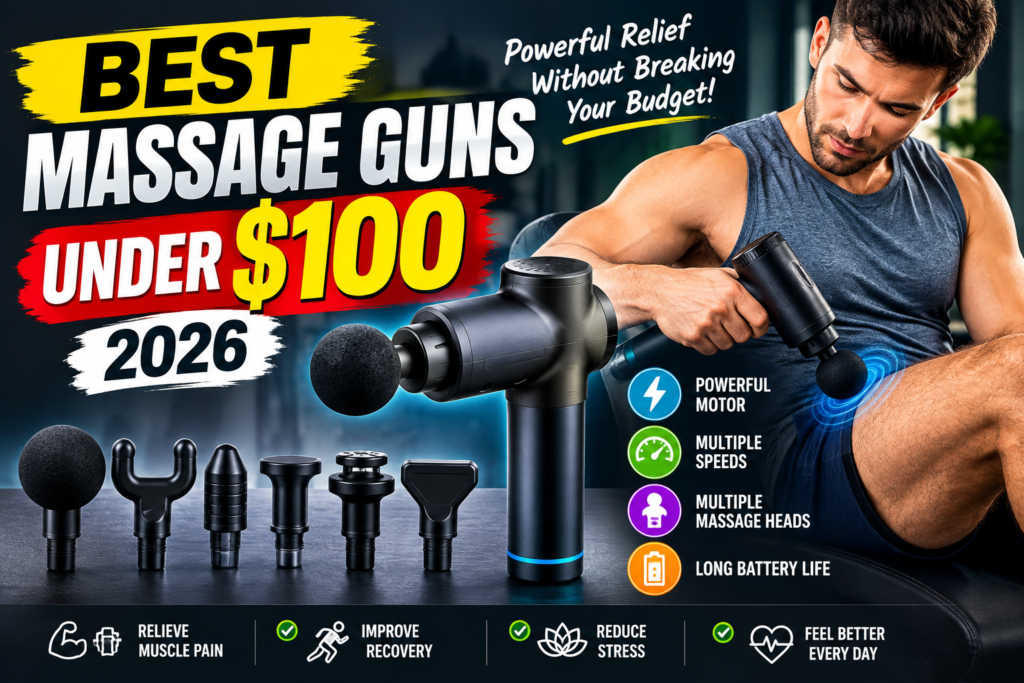
Compare the best massage guns under $100 in 2026 — real amplitude and stall-force data, budget tiers, safety tips, and honest tradeoffs vs. premium models.
LifeCareBalance.com is reader-supported. When you buy through links on our site, we may earn an affiliate commission at no extra cost to you. As an Amazon Associate, we earn from qualifying purchases.
If you’ve shopped for a massage gun lately, you’ve probably noticed that every listing screams the same numbers: 3,200 RPM, 12mm amplitude, 50 lbs of stall force. It’s easy to assume the biggest numbers win. They don’t. A massage gun under $100 can absolutely deliver real, useful percussion therapy — but only if you understand which specs actually affect how it feels on your body, and which ones are just marketing filler.
This guide is for beginners who’ve never used a percussion massager, desk workers dealing with tight traps and low-back tension, runners and weekend athletes who want faster recovery without a $300 investment, and anyone comparing the flood of similar-looking TOLOCO, RENPHO, Bob and Brad, LifePro, and Mebak listings on Amazon. We’ll walk through what amplitude and stall force actually mean, which budget massage guns hold up to scrutiny, and — just as importantly — what you’re giving up compared to premium models like the Theragun Pro or Hypervolt 2 Pro.
Best Massage Guns Under $100 at a Glance
Prices fluctuate frequently on Amazon, so treat these as approximate. Amplitude and stall-force figures marked “mfr.” are manufacturer claims; figures marked “measured” come from independent testers who physically tested the units.
| Product | Approx. Price | Amplitude | Stall Force | Speeds | Attachments | Battery | Weight | Best For |
|---|---|---|---|---|---|---|---|---|
| TOLOCO EM26 | $40–$60 | 12mm (mfr.) / ~10mm (measured) | ~30–35 lbs (measured) | 7–20, depending on version | 10 | Up to 6 hrs | ~2.1 lbs | Best overall value / beginners |
| Bob and Brad Q2 Mini | $50–$70 | 7mm | Not independently verified | 5 (1,800–3,000 PPM) | 5 | Up to 4 hrs | ~1 lb | Travel & portability |
| RENPHO Active | $50–$65 | 8–10mm | Not independently verified | 5 | 4 | Up to 4 hrs | ~1.4 lbs | Light daily use, quiet operation |
| Legiral Le3 | $60–$90 | 16mm (mfr.) | Not independently verified | Multiple | 6 | 2–6 hrs | Mid-weight | Deeper amplitude on a budget |
| Mebak 3 | ~$99.99 | 12mm (mfr.) / ~10.5mm (measured) | 53 lbs (mfr.) / ~30–44 lbs (measured) | 5 (950–3,000 RPM) | 7 | 2–3 hrs | ~1.85 lbs | Deep-tissue on dense muscle |
| RENPHO Power Massage Gun | ~$99.99 | 12mm | ~50 lbs (independently tested) | 5 | 6 | ~4 hrs | ~1.5 lbs | Athletes wanting real stall force |
| LifePro SonicPro | $70–$95 | 12mm (mfr.) | 75 lbs (mfr., unverified) | 10 | 9 | Several hrs | ~2.5 lbs | Attachment variety |
Best Massage Guns Under $100 in 2026
TOLOCO EM26 — Best Overall Value

- Quick Pain Relief: The TOLOCO deep tissue massage gun has a high penetration force of 12mm, up to 3200 rpm, which effect…
- Long Battery Life: Percussion massage gun with a USB charging cable (Charging Plug Not Include), which means it can be e…
- 10 Professional Massage Heads: Muscle massage gun with 10 replaceable massage heads, not only helps users relax various …
Why it stands out: The EM26 is Amazon’s best-selling massage gun for a reason — it’s consistently one of the cheapest ways to get a real percussion massager with a touchscreen, a carrying case, and 10 attachment heads. TOLOCO advertises a 12mm amplitude and up to 3,200 RPM, but independent testers who used calipers to physically measure the stroke found the real figure closer to 10mm, with a verified stall force in the 30–35 lb range based on independent verification of the EM26’s 35 lbs stall force and 12mm depth — with the caveat that the amplitude doesn’t match the spec sheet in practice. PluggedinpicksPluggedinpicks
Key specs: ~10–12mm amplitude, up to 3,200 RPM, 10 heads, ~6-hour battery, USB-C charging, 40–50dB noise, plastic housing.
Pros: Excellent price-to-feature ratio, huge attachment selection, genuinely quiet, widely reviewed.
Cons: Amplitude underdelivers versus the spec sheet; straight handle limits comfort on longer sessions; plastic build feels less premium than metal-chassis competitors.
Who should buy it: Beginners and budget shoppers who want a fully functional massage gun without spending more than a nice dinner out. Who should skip it: Anyone specifically chasing deep-tissue penetration on very dense muscle — you’ll feel more vibration than percussion at higher pressure.
Bob and Brad Q2 Mini — Best for Travel

- Developed by Famous Physical Therapists – Trust your recovery to the experts. Designed by Bob and Brad, the “Most Famous…
- Lightweight Portability for On-The-Go Relief – Weighing just 0.95lbs, this mini massager is engineered for ultimate trav…
- Compact Size, Uncompromised Power – Don’t let the mini size fool you; this device delivers a “Compact but Powerful” expe…
Why it stands out: Designed by physical therapists Bob Schrupp and Brad Heineck, the Q2 Mini trades power for portability. It’s genuinely pocket-sized, weighing under a pound, with fast USB-C charging.
Key specs: 7mm amplitude, 5 speeds (1,800–3,000 PPM), 5 heads, ~4-hour battery, ~40dB noise.
Pros: Extremely light and quiet, fast charging, great for carry-ons and gym bags.
Cons: 7mm amplitude is shallow by design — this is a gentler, more vibration-forward device, not a deep-tissue tool.
Who should buy it: Travelers, office workers, and anyone who wants light daily relief for the neck, shoulders, and forearms. Who should skip it: Anyone wanting serious pressure on glutes, quads, or lats.
RENPHO Active — Best for Quiet, Everyday Use

- Connect to a Library of Video-Guided Classes: App-connected massage gun with professional video courses showing how to t…
- Deep-Targeted Relief: This deep tissue massage gun features a brushless motor that delivers 45 lbs of force and 10mm amp…
- On-Demand Recovery When Needed: 18-watt fast charging via USB-C reaches full charge in just 1.5 hours and lasts up to 3 …
Why it stands out: RENPHO’s entry-level line keeps things simple: five speeds, a handful of attachments, and consistently low noise levels that make it one of the more couch-friendly options in this price range.
Key specs: ~8–10mm amplitude, 5 speeds, 4 attachments, ~4-hour battery, brushless motor.
Pros: Quiet, lightweight, straightforward controls.
Cons: Lower amplitude and stall force than RENPHO’s own step-up “Power” model; not built for aggressive deep-tissue work.
Who should buy it: Beginners and anyone who wants a gentle, low-drama recovery tool for everyday soreness. Who should skip it: Athletes managing dense, chronically tight muscle groups.
Legiral Le3 — Best Amplitude for the Price
Why it stands out: The Le3 punches above its price with a manufacturer-claimed 16mm amplitude — a figure normally reserved for $300+ devices — plus a long battery life and a full attachment set.
Key specs: 16mm amplitude (manufacturer claim, not independently re-verified in our research), 6 attachments, 2–6 hour battery depending on speed, 50–65dB noise.
Pros: Long battery life, generous attachment kit, strong value if the amplitude claim holds up in practice.
Cons: Noise level runs higher than quieter competitors; as with most budget guns, treat the 16mm figure as an upper-bound claim rather than a guarantee.
Who should buy it: Shoppers who prioritize stroke depth over ultra-quiet operation. Who should skip it: Anyone using the device late at night in shared spaces.
Mebak 3 — Best for Denser Muscle Groups

- You Get What You Pay For: We work out daily and invest a lot of time and effort into our fitness. Therefore, it’s even m…
- Professional Massager with 53-Pound Force: The Mebak 3 massage gun offers 12MM amplitude and 53 pounds of stall force to…
- Seven Massager Heads: The Mebak 3 features 7 heads and 5 speed levels (950 – 3000 RPM) for versatile muscle pain relief….
Why it stands out: The Mebak 3 includes a built-in LED pressure sensor — a feature usually reserved for $200+ devices — plus a removable, replaceable battery that extends the device’s practical lifespan.
Key specs: 12mm amplitude (mfr.) / ~10.5mm measured, 53 lbs stall force (mfr.) / roughly 30–44 lbs measured depending on speed, 7 heads, 5 speeds (950–3,000 RPM), 39–50dB noise.
Pros: LED pressure feedback, replaceable battery, seven attachment heads cover most muscle groups, priced right at the top of the sub-$100 range.
Cons: Battery life is shorter (2–3 hours) than most competitors here; amplitude and stall force run below the advertised numbers, which is typical for this category.
Who should buy it: Anyone who wants the closest thing to a “prosumer” feel under $100. Who should skip it: Frequent travelers who need all-day battery life.
RENPHO Power Massage Gun — Best for Athletes on a Budget
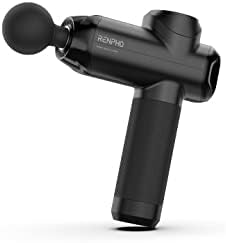
- Powerful Massage Gun Deep Tissue – Equipped with a high-torque brushless motor with 12MM amplitude, the massager gun can…
Why it stands out: This is the strongest stall-force performer on this list at its price. At its competitive $99.99 price point, offering a 50 lb stall force and 4-hour battery life represents strong value in the current market, and the 12mm amplitude gives it real depth for a device under $100. MedGrade
Key specs: 12mm amplitude, ~50 lbs stall force, 5 speeds, LED touch display, 6 attachments, FSA/HSA eligible.
Pros: Genuinely strong stall force for the price, quiet motor, touch display, good battery life.
Cons: At the very top of the “under $100” ceiling — watch for price creep above $100 depending on sales.
Who should buy it: Athletes and runners who apply firm pressure and want a budget gun that won’t bog down under it. Who should skip it: Anyone who needs sub-$60 pricing.
LifePro SonicPro — Best Attachment Variety

- BUILT FOR ATHLETIC RECOVERY: Lifepro Sonic Pro percussion massage gun is designed with athletes in mind. It features a p…
- CUSTOM SPEEDS AND ATTACHMENTS: Lifepro Sonic Pro deep muscle massage gun is equipped with 10 speed levels and 9 intercha…
- QUIET MOTOR, STRONG PERFORMANCE: Our cordless muscle massager gun is built with a high-torque brushless motor that opera…
Why it stands out: With 9 interchangeable heads and 10 speed levels, the SonicPro offers more customization options than most of its budget peers, plus a manufacturer-claimed 75 lb stall force.
Key specs: 12mm amplitude, 75 lbs stall force (manufacturer claim, unverified independently), 10 speeds, 9 heads, ~2.5 lb weight.
Pros: Wide attachment selection for targeting small and large muscle groups, competitive pricing.
Cons: The 75 lb stall-force claim is significantly higher than what independent testers typically measure on similarly priced devices, so treat it with healthy skepticism.
Who should buy it: Shoppers who want maximum attachment flexibility. Who should skip it: Buyers who want every spec independently verified before purchase.
How We Chose the Best Massage Guns Under $100
Our selections were weighed against motor performance and amplitude, stall force under real pressure, speed range and control granularity, attachment variety and usefulness, battery life and charging method, noise output, weight and ergonomics, warranty length, brand reliability based on review volume and consistency, and overall value relative to price. Where independent measurements from testing outlets conflicted with manufacturer claims, we noted both.
Amplitude vs. Stall Force: What Matters More?
Amplitude is how far the massage head physically travels with each stroke — measured in millimeters. A higher amplitude (say, 14–16mm) reaches deeper into muscle tissue with less need to push. A lower amplitude (6–8mm) feels gentler and more like a rapid vibration than a true percussive strike.
Stall force is how much resistance the motor can handle — how hard you can press into the muscle — before the head slows down or stops moving. Higher stall force means the device keeps working even when you lean into it.
Neither number alone tells the full story. A gun with high amplitude but low stall force can bog down the moment you apply real pressure. A gun with high stall force but shallow amplitude will feel powerful but won’t penetrate as deeply. And RPM (percussions per minute) — the number most brands lead with — measures speed, not depth or power; a fast, shallow gun can still feel weak on a tight glute or lat. The best budget picks balance all three rather than maxing out one spec at the expense of the others.
Are Massage Guns Under $100 Actually Good?
Honestly — yes, for most people, most of the time. Budget massage guns under $100 can deliver real percussion, reasonable battery life, and useful attachment variety. Where they fall short of premium models is consistency: motors in this price range are more likely to slow under heavy pressure, amplitude specs are more likely to be optimistic, and plastic housings show wear faster than metal-reinforced chassis. Noise control and ergonomic handle design also tend to improve as price rises. Warranty coverage is another gap — most budget guns offer 90 days to one year, while premium brands like Ekrin offer lifetime coverage. None of this makes a sub-$100 gun useless; it just means you’re trading some polish and long-term durability for a much lower price.
Best Massage Gun Under $100 for Different Users
- Beginners: TOLOCO EM26 — simple controls, forgiving amplitude, low cost of entry.
- Athletes: RENPHO Power Massage Gun — the strongest verified stall force under $100.
- Runners: Mebak 3 or TOLOCO EM26 — both handle calves and quads without excessive noise.
- Neck and shoulder tension: Bob and Brad Q2 Mini — shallow amplitude is actually a plus in sensitive areas.
- Back muscle tension: RENPHO Power or LifePro SonicPro — more stall force and attachment options for larger muscle groups.
- Travel: Bob and Brad Q2 Mini — sub-1-lb weight and fast USB-C charging.
- Quiet operation: RENPHO Active — consistently rated among the quietest budget options.
- Deeper muscle work: Legiral Le3 or Mebak 3 — highest claimed/measured amplitude in this price bracket.
- Best overall value: TOLOCO EM26.
For a broader breakdown of how to weigh these use cases against your specific goals, see our full guide to choosing the right massage gun and our benefits of massage guns for athletes article.
What Does the Research Say About Massage Guns?
Percussive therapy has a growing but still-developing evidence base. Physical therapist Gary Calabrese, DPT, explained to Cleveland Clinic that a massage gun works like a mini hammer, repeatedly impacting soft tissue and increasing blood flow to the area, which can decrease tight muscle tissue and help elongate muscle fibers. When used properly, these devices are generally safe and effective at delivering quick relief to areas where people commonly hold tension, like the neck, shoulders, and lower back. clevelandclinicclevelandclinic
It’s important to separate what the evidence supports from what marketing implies. Research has not shown that massage guns improve speed, power, or endurance, though they may improve range of motion and perceived fatigue, and limited evidence suggests they may offer a short-term performance boost for a single lift or effort by priming the muscle beforehand. Systematic reviews of percussive and vibration therapy (see the PMC review at pmc.ncbi.nlm.nih.gov/articles/PMC10532323 and the related PubMed review at pubmed.ncbi.nlm.nih.gov/37020441) generally describe modest, short-term improvements in flexibility, stiffness, and perceived soreness, with evidence quality still considered low to moderate and outcomes varying across individuals. Massage guns are not a treatment for injuries, chronic pain conditions, or inflammation, and they should not replace medical care. clevelandclinicclevelandclinic
How to Use a Massage Gun Safely
Cleveland Clinic’s general guidance is a useful baseline: start with the lowest intensity, let the massage gun provide the pressure rather than pushing down yourself, move slowly along the muscle, and limit use to no more than a couple of minutes per muscle group. Avoid bones, joints, the spine, and the front or side of the neck — dragging the device over a bony area like the nape of the neck causes kickback and can lead to pain or injury. Never use a massage gun over open wounds, fresh bruising, or acute injuries. clevelandclinicclevelandclinic
People with blood-clotting disorders, those taking blood thinners, anyone who has had recent surgery, and people with osteoporosis or spine disorders should talk to a healthcare provider before using a percussion massager (see Cleveland Clinic’s broader massage safety guidance). This article is educational and not a substitute for individualized medical advice.
Massage Gun vs. Foam Roller
Foam rollers rely on your body weight for pressure and require more effort and floor space, but they’re inexpensive, cover larger surface areas at once, and are excellent for beginners learning self-myofascial release. Massage guns offer more precision — you can target a single trigger point directly — and require far less physical effort, since the device does the work. Massage guns are more portable in the sense that they fit in a bag, though foam rollers are lighter and cheaper overall. For most people, the two tools complement each other rather than compete: rollers for broad warm-ups, massage guns for targeted spot work.
Massage Gun vs. Recovery Boots
These two categories solve different problems. Massage guns target specific muscles with direct, localized percussion — ideal for a tight calf or sore trap. Recovery boots (pneumatic compression sleeves) apply sequential air pressure across the entire leg to support circulation and reduce the feeling of heaviness after long runs, flights, or leg-day sessions. Runners and endurance athletes often benefit from both: a massage gun for spot treatment and boots for full-leg recovery. See our best leg recovery boots guide for options in that category.
What Do You Give Up by Staying Under $100?
Compared to $200–$400+ devices like the Theragun Pro or Hypervolt 2 Pro (see our head-to-head comparison), budget guns typically trade away: motor consistency under sustained heavy pressure, verified amplitude and stall force that match the spec sheet, quieter operation at high speeds, more refined ergonomic handle angles, app connectivity and guided routines, metal or reinforced housings versus plastic, and longer warranties (lifetime warranties are common on premium brands, versus 90 days to one year on most budget models). None of this means expensive devices are automatically more effective for everyday soreness — it means you’re paying for consistency, durability, and extra features rather than a fundamentally different massage experience.
Frequently Asked Questions
Is a massage gun under $100 worth it? For general muscle tension, warm-ups, and post-workout soreness, yes — most budget models deliver a genuinely useful massage, even if their specs run slightly below what’s advertised.
What is the best massage gun under $100? There’s no single universal winner; the TOLOCO EM26 offers the strongest all-around value, while the RENPHO Power Massage Gun offers the most verified stall force for athletes.
How much stall force should a massage gun have? For general use, 20–30 lbs is enough. Athletes working dense muscle groups may want 40+ lbs to avoid the motor bogging down under pressure.
Is higher amplitude always better? No. Higher amplitude means deeper penetration, but it can also feel too intense for sensitive areas or beginners. 8–12mm suits most people; save 14mm+ for experienced users targeting large muscle groups.
Are cheap massage guns safe? Generally yes, when used as directed — on muscle tissue, at appropriate intensity, avoiding bones and joints. Safety concerns are more about technique than price point.
Can you use a massage gun every day? Short daily sessions (a few minutes per muscle group) are generally fine for most healthy adults, but give any single sore spot a break if it stays tender or irritated.
Can massage guns help sore muscles? Yes — used properly, they can increase blood flow, relieve muscle tightness, and reduce post-exercise soreness perception. clevelandclinic
Can you use a massage gun on your neck? Only carefully, on the muscle tissue at the sides and back of the neck at low speed — never directly on the spine, throat, or bony areas.
Can a massage gun help back pain? It may offer temporary relief for muscular tension-related back discomfort, but it isn’t a treatment for structural or chronic back conditions — see a healthcare provider for those.
How long should you use a massage gun? Generally no more than 1–2 minutes per muscle group, per Cleveland Clinic guidance, to avoid overworking the tissue.
Conclusion
A massage gun under $100 won’t match the consistency, amplitude accuracy, or warranty coverage of a $300 flagship — but for everyday tension, post-workout soreness, and general recovery, several budget models genuinely deliver. Match the device to your use case rather than the biggest number on the box: the TOLOCO EM26 for overall value and beginners, the RENPHO Power Massage Gun for athletes who need real stall force, the Bob and Brad Q2 Mini for travel, and the Mebak 3 or Legiral Le3 if you want more amplitude without crossing the $100 line. Compare current pricing and availability before you buy, since deals shift often, and always weigh your budget against how much power and durability you actually need. For quick relief options beyond massage guns, check out our quick stress relief products guide.