
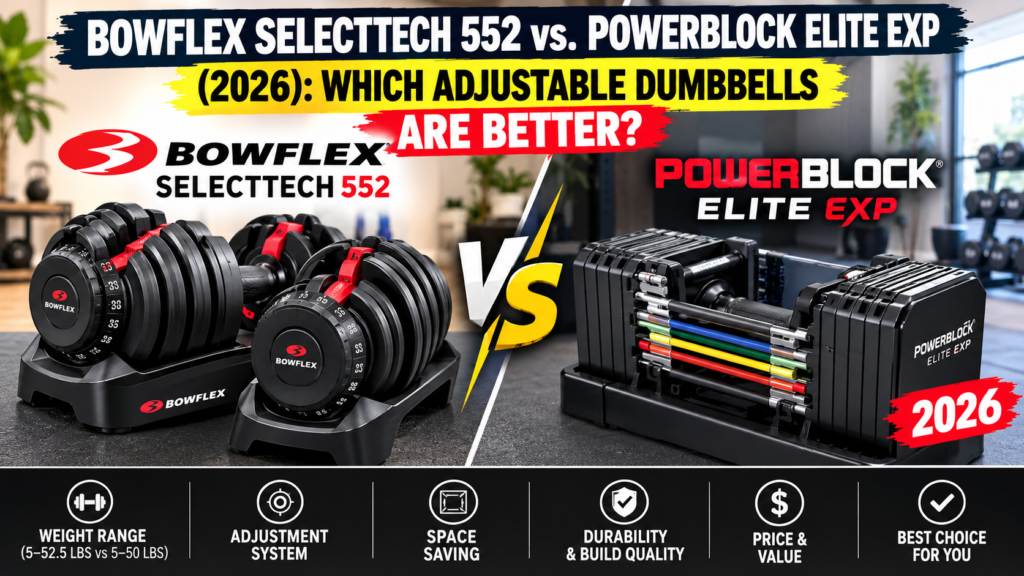
Compare Bowflex SelectTech 552 vs PowerBlock Elite EXP in 2026. Explore weight range, adjustment systems, expansion compatibility, safety, and value.
LifeCareBalance.com is reader-supported. When you buy through links on our site, we may earn an affiliate commission at no extra cost to you. As an Amazon Associate, we earn from qualifying purchases.
Choosing between the Bowflex SelectTech 552 and PowerBlock Elite EXP comes down to three main factors: how quickly you want to change weights, how much resistance you need, and whether you want the option to expand your dumbbells in the future.
The Bowflex SelectTech 552 uses a dial-based adjustment system and offers a maximum of 52.5 pounds per dumbbell. The PowerBlock Elite EXP uses a selector-pin system, starts with a maximum of 50 pounds per dumbbell in its initial configuration, and offers a model-specific expansion path for lifters who need more weight.
Both can support a wide range of home workouts. However, they differ in shape, adjustment method, expansion options, and ownership considerations. There is also an important safety distinction: older Bowflex 552 dumbbells were included in a major 2025 recall, so buyers should verify the exact product and its recall status before purchasing a used or older unit.
This comparison examines the features that matter most so you can choose the better fit for your home gym.
Quick Answer: Bowflex 552 or PowerBlock Elite EXP?

- QUICK ADJUSTMENT DIALS: Switch between weight settings with a quick twist of the dials, from 5 to 52.5 pounds per dumbbe…
- SPACE-SAVING DESIGN: Get more workout in less space by replacing 15 separate weights with a single, all-in-one set.
- PREMIUM METAL COMPONENTS: Reinforced with durable metal plates and a locking system to keep weights in-place.

- ADJUSTABLE DUMBBELLS SET: Elevate your fitness and performance with strength-training equipment that adjusts with you. T…
- COMPACT & PORTABLE: The adjustable, convenient, and compact dumbbells provide innovative strength training for an easy-t…
- EASY & QUICK ADJUSTABILITY: Quickly adjust the weight set up or down for your exercise with the secure magnetic polyprop…
Choose the Bowflex SelectTech 552 if you prefer a traditional dumbbell shape, quick dial-based adjustments, and a weight range that meets your current training needs.
Choose the PowerBlock Elite EXP if you prefer its compact block design and want a potential path to heavier weights through expansion kits confirmed to fit your exact model.
Neither is the best choice for every lifter. If you mainly perform curls, lateral raises, shoulder presses, and moderate-weight home workouts, the Bowflex’s range may be sufficient. If you expect to progress to heavier rows, presses, lunges, or other demanding exercises, the PowerBlock’s compatible expansion options may be more useful.
Before buying either product, compare the current manufacturer’s specifications and warranty terms. For Bowflex, also review the official BowFlex recall information.
Bowflex SelectTech 552 vs. PowerBlock Elite EXP: Comparison Table
| Feature | Bowflex SelectTech 552 | PowerBlock Elite EXP |
|---|---|---|
| Initial weight range | 5–52.5 lb per dumbbell | 5–50 lb per dumbbell |
| Adjustment method | Dial-based selector | Selector pin and weight stack |
| Weight progression | 2.5 lb increments at lower settings; larger increments at higher settings | Depends on the exact model and included adder weights |
| Expansion | No official expansion path for the 552 | Compatible expansion options may be available for the exact Elite EXP model |
| Shape | Traditional dumbbell-style profile | Compact block-and-cage profile |
| Storage | Molded tray included | Compact base; confirm the contents of the selected package |
| Adjustment experience | Convenient for quick weight changes | Requires selecting and inserting the correct pin |
| Best fit | Home workouts and fast exercise transitions | Lifters who prefer the block design and compatible expansion options |
| Safety consideration | Older units were included in the 2025 recall | Verify the exact model, accessories, and current safety information |
| Warranty | Confirm the terms for the current product | Confirm the terms for the exact model and retailer |
Specifications, package contents, warranties, and product availability can change. Check the manufacturer’s current listing before ordering.
1. Bowflex SelectTech 552 Overview
The Bowflex SelectTech 552 is an adjustable dumbbell designed to replace multiple pairs of traditional dumbbells. Instead of picking up a different pair for every exercise, you select a weight using the adjustment dials while the dumbbell rests in its tray.
The system offers a range from 5 to 52.5 pounds per dumbbell. This makes it suitable for many common home exercises, including biceps curls, triceps extensions, shoulder presses, chest presses, and rows.
What makes the Bowflex 552 appealing?
Its main attraction is convenience. A dial lets you select a different resistance without manually loading individual plates. That can be especially useful when alternating between exercises that require different weights.
The familiar dumbbell-style shape may also feel more natural to people accustomed to conventional gym equipment. The supplied tray keeps the dumbbells organized when they are not in use.
The maximum weight is fixed, however. The SelectTech 552 does not have an official expansion kit that increases its maximum resistance. If your training eventually requires more than 52.5 pounds per hand, you will need a different solution.
What about the Results Series 552?
Bowflex now lists a product called the Results Series 552 SelectTech Dumbbells. Its official product page describes a 5–52.5-pound range, quick adjustment dials, storage trays, and metal components that connect the plates to the handle.
Do not automatically assume that an older SelectTech 552 and a current Results Series 552 are identical in every respect. When buying, verify the product name, design, seller, and applicable safety information on the official BowFlex Results Series 552 product page.
For more detailed coverage of the product, see our Bowflex SelectTech 552 review.
2. PowerBlock Elite EXP Overview
The PowerBlock Elite EXP uses a different design. Its weight plates sit inside a compact block-shaped housing, and a selector pin determines how much weight you lift.
The initial configuration offers a range of 5–50 pounds per dumbbell. Certain compatible expansion configurations can provide additional resistance, but you must identify your exact model before purchasing extra plates.
Why consider the PowerBlock Elite EXP?
The first advantage is its expansion concept. Rather than automatically replacing the entire set when you need more resistance, you may be able to add a compatible expansion kit.
The second advantage is its compact design. The block shape can be convenient when storage space is limited, although its housing feels different from a conventional dumbbell and may not suit every user’s preferences.
The selector pin also provides a straightforward way to choose a weight. You need to make sure the pin is fully inserted and that the selected configuration is correct before lifting.
A critical expansion compatibility warning
PowerBlock sells several product families with similar names. Their expansion kits are not universally interchangeable.
The manufacturer’s official expansion guide explains that different series use different components. Its EXP expansion collection also explicitly warns that those kits are not compatible with the PowerBlock 50 or Elite EXP.
Therefore, do not buy a kit simply because its listing says “EXP,” “Elite,” “Stage 2,” or “Stage 3.” Confirm compatibility with the exact dumbbell model and generation. If the manufacturer’s information is unclear, contact PowerBlock before ordering.
For a closer look at the dumbbell itself, read our PowerBlock Elite EXP review.
3. Weight Range: Which One Gives You More Room to Progress?
Weight range is one of the most important differences between these systems.
The Bowflex 552 reaches 52.5 pounds per hand. For many home users, that is enough for a substantial range of upper-body exercises and moderate-resistance training. Beginners may take considerable time to approach the maximum on many movements.
The limitation becomes more relevant when your strength increases. Rows, lunges, split squats, and Romanian deadlifts can eventually require more resistance, depending on your training experience and goals.
The PowerBlock Elite EXP starts at 50 pounds per hand. That is slightly below the Bowflex’s maximum in its initial configuration, but compatible expansion options may allow a higher maximum.
Expansion is not automatic, and you should not assume every Elite EXP set can use every advertised PowerBlock expansion kit. Verify the exact model and the current manufacturer’s compatibility instructions before calculating your potential maximum weight.
The practical decision: If you expect to stay within approximately 50 pounds per hand, compare comfort, price, and ease of adjustment first. If you expect to need more resistance, prioritize a verified expansion path or consider a heavier-capacity adjustable dumbbell system.
4. Progressive Overload: Which Is Better for Long-Term Training?
Progressive overload means gradually increasing the challenge of your workouts. You can do this by adding resistance, performing more repetitions, increasing sets, or improving control and range of motion.
Neither adjustable dumbbell automatically produces better muscle growth. Your results depend on your training program, consistency, nutrition, recovery, and the challenge of your exercises.
For beginners
Both products can support a beginner routine. New lifters usually have many ways to progress before reaching the top weight, and they can develop technique while learning how to select the correct resistance.
The Bowflex may appeal to beginners who want quick dial adjustments. The PowerBlock may suit beginners who prefer its compact design and expect to investigate compatible expansion options later.
For intermediate lifters
As your strength improves, the size of each weight increment becomes more important. Smaller increases can be helpful when a larger jump would make an exercise difficult to perform with good technique.
Check the actual increment pattern of the specific model rather than assuming that either system offers the same increment at every weight. This is especially important for isolation exercises such as lateral raises, where a small increase can feel substantial.
For advanced lifters
Advanced users should pay particular attention to maximum resistance. If you regularly need loads above the Bowflex 552’s ceiling, the 552 may become limiting.
A PowerBlock configuration with verified higher capacity may offer more flexibility. However, if your training requires very heavy dumbbells beyond that system’s limits, compare other high-capacity options before purchasing.
5. Adjustment System: Dial vs. Selector Pin
Bowflex SelectTech 552: Dial adjustment
The Bowflex uses dials to select the required weight. You place the dumbbell in its tray, select the desired setting, and lift it out.
This system can make exercise transitions convenient, particularly during supersets or circuits. The user does not need to handle separate plates for each weight change.
The main consideration is that the dumbbell must be used as directed. Follow the manufacturer’s instructions for setting the dials, seating the dumbbell in the tray, and handling the plates. Never assume a selector is correctly engaged without checking it.
PowerBlock Elite EXP: Selector pin
The PowerBlock uses a pin to select the desired weight from the stack. Once you are familiar with the color-coded system and weight markings, changing resistance can become routine.
Some users may prefer the straightforward pin-based design. Others may prefer the dial because it feels closer to selecting a weight on a traditional adjustable device.
Which is faster? The Bowflex dial may be more convenient for rapid changes, but actual transition time depends on the user and workout.
Which is easier to learn? Both require some familiarization. Read the instructions and practice changing weights while the dumbbell is safely supported before starting a workout.
6. Shape, Grip, and Range of Motion
The Bowflex 552 has a more conventional dumbbell profile. People who are used to fixed dumbbells may find the shape familiar during curls, presses, and rows.
The PowerBlock’s block-like housing is a more distinctive design. Its compact profile may be convenient for some movements, but the surrounding housing can feel different near the wrist, forearm, or body.
This matters during exercises where the dumbbell approaches your shoulders, chest, or thighs. Your hand size, wrist mobility, technique, and the selected weight can all influence comfort.
Neither shape is universally superior. If possible, try each design before buying. If that is not possible, review the dimensions and return policy and consider whether you have experienced discomfort with similarly shaped equipment.
7. How They Perform in Common Exercises
| Exercise | What to consider |
|---|---|
| Dumbbell bench press | Both can work; check whether the housing feels comfortable near your chest and shoulders. |
| Shoulder press | Prioritize secure grip, comfortable wrist position, and manageable resistance. |
| Biceps curls | The Bowflex’s familiar shape may appeal to traditional-dumbbell users; the PowerBlock housing may feel different near the forearm. |
| Lateral raises | Small weight increments can be particularly useful because these exercises often use lighter resistance. |
| One-arm rows | Maximum available weight and a comfortable grip may matter more as you become stronger. |
| Goblet squats | Consider how easily you can hold the selected dumbbell securely against your body. |
| Lunges | Choose a weight you can control without compromising balance or technique. |
| Romanian deadlifts | Check whether the available resistance is sufficient for your current and anticipated training. |
| Triceps extensions | Comfort and secure handling matter, especially when the weight is held overhead. |
These are general design considerations, not claims that either product has been tested by LifeCareBalance in every exercise.
8. Build Quality, Safety, and Durability
Adjustable dumbbells combine several components that must work together: handles, weight plates, selectors, locking mechanisms, and storage trays or housings.
Both systems should be handled according to the manufacturer’s instructions. Do not intentionally drop them, throw them, or use them in ways their instructions prohibit. Inspect the equipment regularly for visible damage, loose components, or problems with weight selection.
The PowerBlock’s steel-stack and block-style design differs from the Bowflex’s dial-and-tray construction. However, appearance alone does not establish which product will last longer in every home gym. Maintenance, handling, usage frequency, and product condition all matter.
The 2025 Bowflex 552 recall
The Bowflex recall deserves special attention because it affects purchasing decisions.
On June 5, 2025, the U.S. Consumer Product Safety Commission announced a recall of approximately 3.84 million BowFlex 552 and 1090 adjustable dumbbells. The reported hazard was that weight plates could detach from the handle during use. The CPSC notice reported hundreds of plate-detachment incidents and 111 reported injuries in the units covered by the notice.
Read the official CPSC recall notice and the manufacturer’s recall information before buying or using an older unit.
Do not assume that a used dumbbell is safe because it looks undamaged, because a seller says it was barely used, or because its serial number is difficult to locate. Follow the official instructions to determine whether a particular unit is affected and what remedy applies.
The newer Results Series 552 is listed separately by Bowflex. Buyers should verify the exact product being sold rather than treating every product with “552” in its name as interchangeable.
This recall is a significant ownership consideration, but it should not be used to make unsupported claims about the safety of every Bowflex product currently sold.
9. Storage and Space Requirements
Both products can save considerable space compared with a rack of fixed-weight dumbbells.
The Bowflex comes with a molded tray that holds the dumbbells and their unused plates. That can make it easier to keep the equipment together and organized.
The PowerBlock has a compact block-shaped design and sits on a base. Its shape may suit some storage spaces better than others, so check the product dimensions and the space needed to lift it comfortably from its base.
Remember to leave room around the equipment for safe movement. A dumbbell that fits under a desk or on a shelf may still be inconvenient if you cannot pick it up, change the weight, and exercise without obstruction.
If space is your main concern, our compact adjustable dumbbells for small spaces guide provides additional options to consider.
10. Price and Long-Term Value
The better value depends on the current purchase price, your training needs, and whether you will need additional weight later. Prices and promotions change, so compare current listings rather than relying on a fixed price from an older review.
Bowflex 552 value
The Bowflex can be a practical purchase if its weight range suits your routine and you value dial-based adjustments. Its lack of an official expansion path means that outgrowing the maximum weight may require buying a different set.
Before ordering, verify that the listing is for the intended current product and review the seller’s return policy and the applicable warranty.
PowerBlock Elite EXP value
The PowerBlock may offer more long-term flexibility if your exact model supports the expansion configuration you need. But the initial purchase price is only part of the total cost: compatible expansion kits, shipping, and any additional accessories can increase the eventual investment.
Do not base a budget on an expansion kit until PowerBlock has confirmed that it works with your particular dumbbells.
For a broader overview of features and budgets, see our adjustable dumbbells buying guide.
11. Pros and Cons
Bowflex SelectTech 552
Pros
- Dial-based weight selection is convenient for changing resistance.
- Familiar dumbbell-style shape.
- Weight range is suitable for many home workouts.
- Storage tray keeps the equipment organized.
- Can replace multiple pairs of fixed dumbbells.
Cons
- Maximum resistance is 52.5 pounds per hand.
- No official expansion path for the 552.
- Requires correct use of the adjustment and locking system.
- Older units were included in the 2025 recall, so recall verification is essential.
PowerBlock Elite EXP
Pros
- Compact block-style design.
- Selector-pin system allows weight selection without loading individual plates.
- May offer a compatible path to higher resistance, depending on the exact model.
- Can replace multiple pairs of fixed dumbbells.
- Worth considering for lifters who want to investigate expansion options.
Cons
- The block housing feels different from a traditional dumbbell.
- Expansion compatibility must be verified carefully.
- Additional expansion kits can increase the total cost.
- The selector-pin system may be less intuitive for some first-time users.
12. Which Is Better for Beginners?
For a beginner who wants straightforward home workouts and expects to stay within the Bowflex’s weight range, the SelectTech 552 may be a good fit. Its dial system makes weight changes convenient, and its familiar shape may feel natural.
The PowerBlock Elite EXP is also worth considering if you prefer its design or want to investigate a compatible expansion path. Beginners do not need to buy every possible expansion kit immediately; the right choice depends on the exercises they plan to perform and the resistance they can use with good technique.
Neither product guarantees better results. A consistent routine, proper exercise technique, and gradual progression matter much more than the logo on your equipment.
13. Which Is Better for Muscle Building and Strength?
Both systems can support muscle-building workouts when their weight ranges match the user’s training needs.
For muscle growth, the most important factors include adequate training volume, consistency, progressive challenge, recovery, and nutrition. You do not need the heaviest dumbbells available to make progress, but you do need enough resistance for your chosen exercises.
For strength-focused training, maximum weight becomes more important as you advance. If you already need more than 52.5 pounds per hand, the Bowflex 552 is unlikely to provide the resistance you want for those movements. A verified higher-capacity PowerBlock configuration or another heavy-duty adjustable dumbbell may be more appropriate.
If you are new to strength training, choose equipment that allows you to learn safely and progress gradually rather than buying capacity you may never use.
14. Which One Should You Buy?
Use these decision rules to narrow your choice:
- Choose Bowflex SelectTech 552 if you value dial adjustments, prefer a traditional dumbbell shape, and its maximum weight suits your current and expected workouts.
- Choose PowerBlock Elite EXP if you prefer the block design and have verified that the exact model and compatible expansion options match your long-term training plans.
- Consider another adjustable dumbbell if you need substantially more resistance, dislike both adjustment systems, or cannot verify the expansion compatibility you require.
- Delay purchasing a used Bowflex 552 until you have checked the official recall information and confirmed the status of the specific unit.
Before making a final decision, compare the current product price, return policy, warranty, available weight increments, and dimensions. These details can make a bigger difference to your day-to-day experience than a small difference in maximum weight.
Frequently Asked Questions
Is the Bowflex SelectTech 552 still subject to a recall?
The CPSC announced a recall of specified BowFlex 552 and 1090 adjustable dumbbells in June 2025. Check the official recall notice and Bowflex’s current recall page to determine whether a particular unit is affected and what remedy is available.
Is the Results Series 552 the same as the original SelectTech 552?
Bowflex lists the Results Series 552 as a current product with a 5–52.5-pound range and dial adjustment. Do not assume all older and newer units are identical. Verify the exact model, design, and safety information on the manufacturer’s current product page.
Can the PowerBlock Elite EXP expand to 90 pounds per hand?
Some PowerBlock configurations have expansion paths to 90 pounds per hand, but kit compatibility depends on the exact product series and model. Confirm the correct expansion kit with the official PowerBlock compatibility information before purchasing.
Which dumbbell is faster to adjust?
The Bowflex’s dial system is designed for convenient weight changes and may be faster for some users. The PowerBlock uses a selector pin. Actual speed depends on familiarity with each system and the workout.
Which is better for small apartments?
Both can save space compared with a full rack of fixed dumbbells. Compare their dimensions, storage arrangements, and the room required to lift and use them safely.
Which is better for muscle growth?
Neither product is inherently better for muscle growth. Both can work if their available weights suit your exercises and you follow a consistent training program with progressive challenge.
Should I buy the expansion kits with the PowerBlock immediately?
Not necessarily. Start with the resistance you need now and consider expansion only when your training requires it. First confirm that the kit is compatible with your exact model and compare the total cost.
Is a used Bowflex 552 a good deal?
Only consider a used unit after checking the official recall information and confirming the unit’s status. A low price does not outweigh an unresolved safety issue.
Final Verdict
The Bowflex SelectTech 552 and PowerBlock Elite EXP offer different approaches to adjustable home-gym training.
The Bowflex is appealing for users who want dial-based adjustments, a familiar shape, and a weight range that meets their needs. Its recall history makes it especially important to verify the exact model and applicable safety information before purchasing.
The PowerBlock Elite EXP is appealing for users who like its compact block design and want to explore compatible expansion options. However, expansion compatibility is model-specific, and buyers should not assume that a kit advertised for another PowerBlock series will fit.
The best choice is the one that safely accommodates your current workouts, leaves enough room for your realistic training goals, and fits your budget without relying on unverified specifications.
Editorial note: This comparison is based on published manufacturer information and the official CPSC recall notice. LifeCareBalance has not claimed first-hand laboratory testing of these products. Prices, warranties, product configurations, and recall remedies may change; verify current details with the manufacturer before purchasing.