
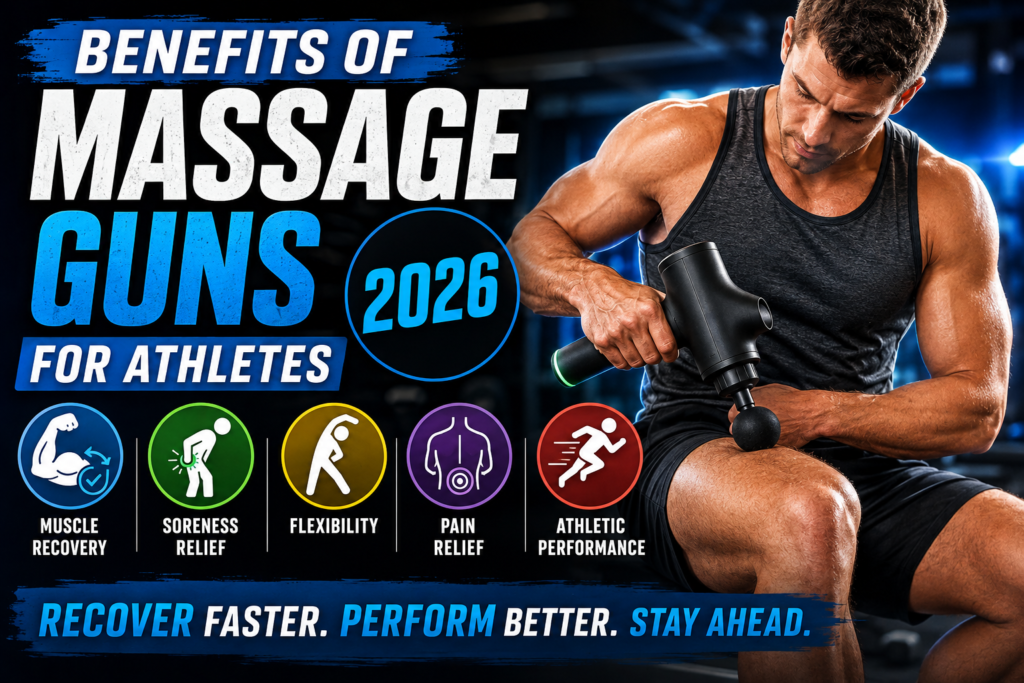
Discover the benefits of massage guns for athletes in 2026. Learn how percussion therapy may support muscle recovery, reduce soreness, improve flexibility, relieve muscle tension, and enhance athletic performance.
LifeCareBalance.com is reader-supported. When you buy through links on our site, we may earn an affiliate commission at no extra cost to you. As an Amazon Associate, we earn from qualifying purchases.
This article is for educational purposes only and is not a substitute for professional medical advice. LifeCareBalance.com is a participant in the Amazon Associates Program; we may earn a commission from qualifying purchases at no extra cost to you.
If you’ve spent any time in a gym, on a track, or on the sideline of a football field in the last few years, you’ve probably seen one: a handheld device buzzing away on someone’s quad or shoulder. The benefits of massage guns for athletes have become one of the most talked-about topics in sports recovery, and for good reason — these devices are portable, easy to use, and can genuinely support how athletes feel before and after training.
But massage guns are also surrounded by a lot of marketing hype. Some claims — like “flushes out lactic acid” or “prevents injuries” — simply aren’t supported by current research. This guide takes a more grounded approach. We’ll walk through what massage guns can realistically do for athletes, what the science actually says, how to use one safely, and what to look for if you’re considering buying one.
What Is a Massage Gun and How Does It Work?
A massage gun (also called a percussion massage device or percussive therapy device) is a handheld tool that delivers rapid, repetitive pulses — typically 1,200 to 3,200 percussions per minute — into muscle tissue through an oscillating head. This is often referred to as percussion therapy for athletes, and it’s designed to mimic (and intensify) some of the mechanical effects of a deep-tissue massage.
The working theory behind percussive therapy involves a few mechanisms:
- Mechanical stimulation of muscle tissue and fascia, which may temporarily change how “tight” or “stiff” a muscle feels
- Stimulation of sensory receptors, which can influence the perception of pain and muscle tension
- A short-term increase in local blood flow to the treated area
It’s worth being precise here: research suggests percussion therapy may temporarily increase local blood flow in the treated muscle, but it is not a guaranteed or whole-body circulatory effect, and massage guns are not a substitute for cardiovascular exercise or medical circulatory treatment.
Benefits of Massage Guns for Athletes
Below are the main massage gun benefits for athletes that current evidence and typical use cases support — along with honest context about what each one does and doesn’t mean.
Supports Muscle Recovery
One of the most common reasons athletes reach for a massage gun for muscle recovery is to help muscles feel less tight and more “ready” between sessions. A 2023 systematic review published in the Journal of Functional Morphology and Kinesiology looked at the available research on massage guns and concluded that their use has become increasingly popular in both clinical and sports contexts, even though there is still limited information to guide practitioners. That review found massage guns can help with short-term recovery-related outcomes, but it also found they appear to be ineffective for improving strength, and did not produce gains in explosive activities like jumping. In other words: a massage gun may help a muscle feel more recovered, but it isn’t going to make you stronger or more explosive on its own.
May Reduce Post-Workout Soreness (DOMS)
Delayed onset muscle soreness (DOMS) is the dull, aching soreness that shows up 24–72 hours after a hard workout. It’s caused by microscopic muscle fiber damage and the resulting inflammatory response — not, as is commonly and incorrectly claimed, by a buildup of lactic acid. Lactate is cleared from the muscles within an hour or two of exercise, long before soreness typically sets in.
A 2025 randomized controlled trial published in Frontiers in Public Health studied percussion massage therapy in physically active young men after a squat protocol designed to induce DOMS. Researchers compared static stretching to short-duration and long-duration percussive massage treatment, measuring pain, range of motion, jump height, and muscle activity at multiple points over 48 hours. The longer-duration percussive treatment group showed measurably lower soreness ratings at the 48-hour mark compared to the other groups — evidence that percussive therapy may meaningfully support massage gun recovery benefits, at least for perceived soreness, when used for a sufficient duration.
May Improve Flexibility and Range of Motion
This is one of the better-supported benefits in the research. Multiple studies have found short-term improvements in joint range of motion following percussive massage use — for example, ankle dorsiflexion and plantarflexion range have shown measurable, if temporary, gains in several trials. A literature review on percussion massage guns and lower-limb mobility referenced a meta-analysis of 39 studies finding that percussion therapy reduced perceived muscle soreness and increased joint range of motion across the studies analyzed.
It’s important to frame this correctly: these are acute, short-term changes measured immediately or shortly after use — not permanent flexibility gains. A massage gun for flexibility works best as a warm-up or mobility supplement, not a replacement for a consistent stretching or mobility program.
Helps Relieve Muscle Tension and Stiffness
Many athletes describe an immediate sensation of “loosening up” after using a massage gun on a tight muscle group. This is a commonly reported and plausible short-term effect tied to the mechanical and neurological response to percussive stimulation. It’s a genuinely useful, low-risk tool for managing the feeling of tightness — but it does not change the underlying structure of the muscle or tendon.
Supports Relaxation After Training
Beyond the physical effects, many athletes use a massage gun as part of a wind-down routine after intense training. The rhythmic pressure can have a calming, almost meditative effect for some people, which may support the transition from high training stress back to a resting state. This is a subjective, individual benefit rather than a measurable performance outcome, but it’s a legitimate part of why athletes keep reaching for these devices.
May Support Warm-Up and Mobility
Used briefly and at a light-to-moderate intensity, a massage gun may help prepare tight muscle groups for movement by temporarily reducing the feeling of stiffness and briefly improving range of motion. However, research on using percussive therapy immediately before explosive or high-intensity performance is mixed at best. The same lower-limb mobility literature review found no statistically significant improvement in squat jump or countermovement jump height, and no significant change in dynamic balance performance, when percussive massage was applied right before muscular performance testing — and the study’s authors specifically recommended against using short bouts of percussive massage immediately before activities requiring explosive lower-limb strength or balance. This is exactly why the timing and intensity of use matters more than most marketing suggests.
Helps Athletes Manage Recovery Between Sessions
For athletes training multiple times per week, a massage gun can be one small piece of a broader between-session recovery routine — alongside sleep, hydration, nutrition, and active recovery like light cardio or mobility work. It’s a tool that fits into a recovery system; it is not the recovery system itself.
What Massage Guns Cannot Do
To keep this article evidence-aware, it’s worth being direct about the limits:
- They do not build muscle or replace progressive resistance training
- They do not guarantee injury prevention
- They do not cure injuries, tendon damage, or chronic pain
- The evidence that they break up “scar tissue” is insufficient to support that claim
- They do not meaningfully improve strength, explosive power, or agility
- They are not a substitute for professional physical therapy or rehabilitation
What Does the Research Say About Massage Guns for Athletes?
Research on percussion therapy has grown substantially over the past five years, but it’s still a relatively young field, and findings are mixed depending on the outcome measured.
Stronger evidence:
- Short-term (acute) improvements in joint range of motion and flexibility
- Reduced perceived muscle soreness in the 24–48 hours following exercise-induced muscle damage, particularly with longer treatment durations
Promising but still developing evidence:
- Reductions in perceived muscle tension and stiffness
- Support for recovery-related comfort between training sessions
Limited or inconsistent evidence:
- Effects on actual muscle strength
- Improvements in explosive performance metrics like vertical jump height, sprint speed, or agility — several studies found no benefit, and at least one found a slight decrease in jump height after use immediately before testing
Claims not well supported by current evidence:
- Building muscle mass
- Breaking down scar tissue
- Guaranteeing injury prevention
- Whole-body circulation improvements
- Curing chronic pain or injuries
A useful summary from the Journal of Functional Morphology and Kinesiology systematic review put it plainly: massage guns can help improve short-term range of motion, flexibility, and recovery-related outcomes, but their use for strength, balance, acceleration, agility, and explosive activities is not recommended. That’s a fair, evidence-based summary of where the science currently stands.
Another systematic literature review published in the International Journal of Sports Physical Therapy reached a similar conclusion, noting a lack of specific research on how percussive therapy affects physiological adaptations like muscle strength, and calling for more rigorous studies before broader performance claims can be made.
How Athletes Should Use a Massage Gun
Before a Workout
Light, brief percussion (roughly 30–60 seconds per muscle group) at a low-to-moderate intensity may help reduce the feeling of stiffness and support a warm-up routine. Save the aggressive, high-intensity settings for after training — using maximum intensity right before a competitive event or explosive lift is not well supported and, per the research above, may not help (and could even work against you on jump- or power-based movements).
After a Workout
This is where most athletes get the most value. Post-workout use can help address the perceived tightness and soreness that builds up after training. That said, a massage gun should not be treated as a complete recovery solution — pair it with proper hydration, protein intake, and sleep, which have a far larger evidence base for recovery than any recovery tool.
On Recovery Days
On lighter training days, a massage gun can be used at lower intensity across major muscle groups as part of a broader mobility and relaxation routine — alongside stretching, foam rolling, or light active recovery like walking or easy cycling.
Before Competition
If you plan to use a massage gun as part of a pre-competition warm-up, keep it light, brief, and familiar. Competition day is not the time to try a new device, a higher intensity setting, or a longer session than you’re used to. Test your routine in practice first, and understand how your body responds before relying on it ahead of something important.
Massage Gun Benefits for Different Athletes
Different sports place stress on different muscle groups, so the way athletes use a massage gun tends to vary:
- Runners commonly target the calves, quadriceps, hamstrings, and IT band area (approaching the IT band and surrounding muscle carefully, avoiding direct pressure on the band itself and bony prominences like the hip and knee).
- Weightlifters and bodybuilders often focus on the quads, glutes, lats, and shoulders — muscle groups that see heavy mechanical load and frequently report post-session tightness.
- Cyclists tend to prioritize the quadriceps, hip flexors, and calves, given the repetitive nature of the pedal stroke.
- Football and soccer players frequently target the hamstrings, quads, and calves, which are common strain sites in sprinting and cutting movements.
- Basketball players often focus on the calves, quads, and lower back, given the demands of repeated jumping and lateral movement.
- General gym athletes typically use a massage gun across whichever muscle groups feel tightest after a session — often the upper back, shoulders, and legs.
Across every sport, the same rule applies: target soft muscle tissue, and avoid bones, joints, and tendons directly.
Massage Gun Safety: What Athletes Should Avoid
Massage guns are generally considered low-risk when used correctly, but they are not risk-free. In fact, medical literature has documented at least one serious adverse event: a 2021 case report published in the journal Physical Therapy described a young woman who developed rhabdomyolysis — a serious condition involving the breakdown of muscle tissue — after a coach used a percussion massage gun on her thigh muscles following a cycling session. The authors noted that percussion massage guns are commonly used by professional athletes and non-athletes for warm-up and physical recovery, yet at the time there were no published clinical or evidence-based reports on their benefits, indications, contraindications, or side effects, and concluded that caregivers, sports professionals, and the public should recognize the potentially serious adverse effects of these devices and ensure they are used appropriately and safely, especially in people with an underlying condition. That case involved an underlying, undiagnosed health condition, but it’s a useful reminder that “handheld and easy to buy” doesn’t mean “impossible to misuse.”
Avoid using a massage gun on:
- Bones and bony prominences (kneecaps, shins, ankles, elbows, spine)
- The spine directly
- The front of the neck
- Joints
- Open wounds, cuts, or skin irritation
- Bruises
- Areas with significant swelling
- Acute injuries or recent strains/sprains
- Recent surgical sites
- Areas with reduced or numb sensation
Also avoid:
- Excessive pressure or pressing the device hard into tissue
- Holding the device in one spot for an extended period
- Using high intensity settings as a default starting point
Stop immediately if you experience: sharp pain, numbness, tingling, or any unusual or worsening discomfort.
If you have a circulation disorder, a recent fracture or injury, a nerve condition, are pregnant, or are taking blood-thinning medication, talk to a doctor or physical therapist before using a percussion massage device. This article is not a substitute for individualized medical advice.
7 Common Massage Gun Mistakes Athletes Should Avoid
- Starting at maximum intensity. More pressure is not automatically more effective, and it increases the risk of bruising or discomfort.
- Assuming harder is always better. Muscle response to percussive therapy doesn’t scale linearly with force.
- Staying on one spot too long. Move the device slowly across the muscle rather than holding it in place.
- Using it directly on bones or joints. This is uncomfortable at best and risky at worst.
- Using it aggressively on an acute injury. A fresh strain, sprain, or muscle tear needs rest and proper care, not percussion.
- Treating it as a complete recovery plan. Sleep, nutrition, and hydration do more for recovery than any device.
- Experimenting with new settings right before competition. Save the higher intensities and longer sessions for training days, not game day.
What Features Should Athletes Look for in a Massage Gun?
If you’re comparing devices, here’s what actually matters for athletic use:
| Feature | Why It Matters |
|---|---|
| Adjustable speed/intensity | Lets you match the setting to the muscle group and your comfort level |
| Stall force | Indicates how much pressure the motor can handle before slowing down — relevant for larger muscle groups |
| Amplitude | The depth the head travels into the tissue per stroke; higher amplitude can reach deeper tissue |
| Battery life | Matters for athletes who travel to practices, gyms, or competitions |
| Weight | A lighter device is easier to use on yourself for longer sessions |
| Grip/ergonomics | Affects how easily you can reach your back, shoulders, or hamstrings solo |
| Attachment variety | Different heads suit different muscle groups and sensitivities |
| Noise level | Quieter motors are more practical in shared gym or locker room settings |
| Portability | A gym bag-friendly size matters for athletes on the go |
| Warranty | A longer warranty reflects manufacturer confidence in durability |
| Price/value | The most expensive option isn’t automatically the best fit for your needs |
If you want a deeper breakdown of these features, our full massage gun buying guide walks through how to match a device to your training style and budget.
Massage Gun vs Other Recovery Methods
A massage gun is one tool among several, not a replacement for all of them:
- Foam rolling offers similar tension-relief benefits over a larger surface area and doesn’t require batteries, but can be less precise for targeting a specific tight spot.
- Static stretching remains one of the better-supported methods for longer-term flexibility gains, compared to the acute, short-lived improvements from percussive therapy.
- Active recovery (light movement like walking, swimming, or easy cycling) supports circulation and recovery in ways a handheld device cannot replicate.
- Sleep and nutrition are, by a wide margin, the biggest levers for recovery — no recovery gadget outperforms consistent sleep and adequate protein and calorie intake.
- Other recovery technology, such as red light therapy panels, targets recovery through a different mechanism and can be used alongside — rather than instead of — a massage gun.
The most effective approach for most athletes is combining a few of these methods rather than relying on any single one.
Best Massage Guns for Athletes: What to Consider Before Buying
Two of the most talked-about premium options among athletes are the Theragun Pro and the Hypervolt 2 Pro. Both offer strong stall force, multiple attachments, and adjustable intensity — but they differ in ergonomics, noise level, and price, which matters depending on how and where you plan to use one.
If you’re deciding between the two, our detailed Theragun Pro vs Hypervolt 2 Pro comparison breaks down the practical differences for athletes. We’ve also published in-depth, standalone reviews if you want to look at each device individually: our Theragun Pro review and our Hypervolt 2 Pro review.
Premium devices aren’t required to get real benefit — mid-range massage guns with adjustable intensity and decent stall force can cover most athletes’ needs. The right choice depends on how often you’ll use it, which muscle groups you’re targeting most, and your budget.
Frequently Asked Questions
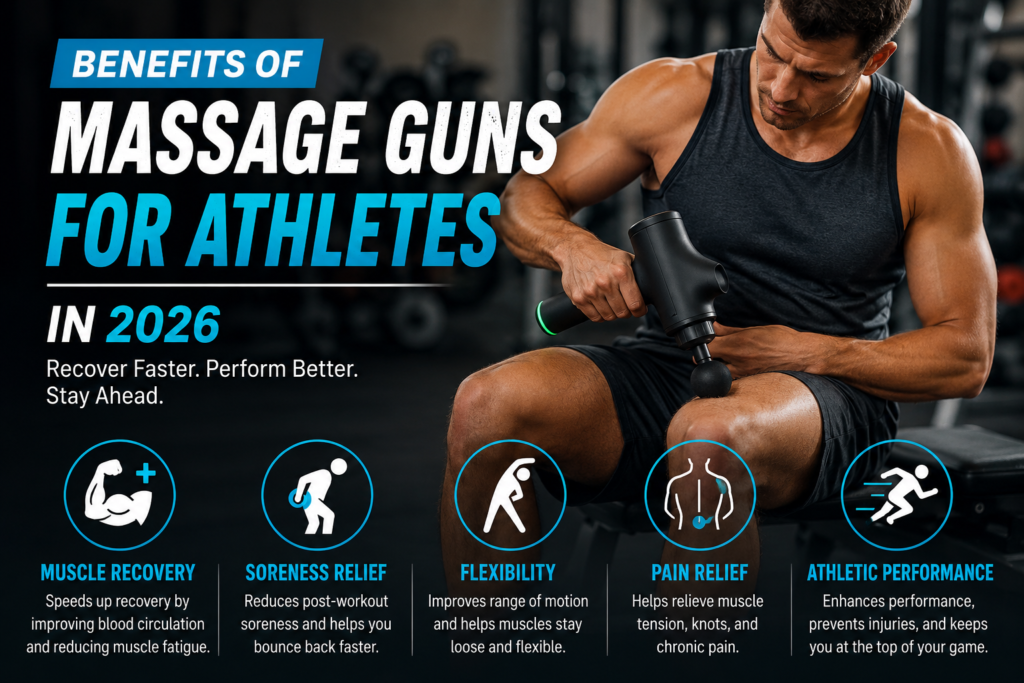
Are massage guns good for athletes? They can be a useful part of a recovery and warm-up routine, particularly for managing perceived muscle soreness and short-term flexibility. They work best alongside — not instead of — sleep, nutrition, and proper training structure.
Do massage guns help with muscle recovery? Research suggests they may support recovery-related comfort and reduce perceived soreness, especially with adequate treatment duration, but they don’t replace the biological recovery process that happens through rest and nutrition.
Can a massage gun reduce DOMS? Evidence, including a 2025 randomized controlled trial, suggests percussive massage may reduce perceived post-exercise soreness, particularly with longer treatment sessions. It’s a supportive tool, not a guaranteed fix.
Should athletes use a massage gun before or after a workout? Both can be useful. Before a workout, keep sessions brief and light as part of a warm-up. After a workout, it can help address tightness and perceived soreness. Avoid maximum intensity right before explosive or competitive performance.
Can massage guns improve flexibility? They may produce short-term, temporary improvements in range of motion. For lasting flexibility gains, a consistent stretching or mobility program is better supported by research.
How long should an athlete use a massage gun? Most sessions on a single muscle group are brief — generally a minute or two of movement across the area rather than sustained pressure in one spot. Total session length varies by device and individual comfort.
Can massage guns improve athletic performance? The current evidence does not support meaningful improvements in strength, explosive power, or agility from massage gun use. Their benefit lies more in recovery and short-term mobility than in performance enhancement.
Are massage guns safe for injured muscles? Massage guns should not be used on acute injuries, recent strains or sprains, swelling, or bruising. If you have an injury, consult a doctor or physical therapist before using percussive therapy.
What areas should athletes avoid with a massage gun? Avoid bones, joints, the spine, the front of the neck, open wounds, bruises, swelling, and areas with reduced sensation. Stick to soft muscle tissue.
Are expensive massage guns better for athletes? Not automatically. Price often reflects build quality, battery life, and stall force, but many mid-range devices offer everything most athletes need. Match the features to your actual use case rather than assuming the priciest model is best.
Final Verdict
The real benefits of massage guns for athletes are genuine but specific: short-term relief from perceived muscle tightness and soreness, temporary improvements in range of motion, and a convenient tool to support warm-up and recovery routines. What they are not is a shortcut to strength, a cure for injuries, or a replacement for sleep, nutrition, and smart training.
Used thoughtfully — light before training, more targeted after training, and always kept off bones, joints, and injured tissue — a massage gun can be a practical, low-risk addition to an athlete’s recovery toolkit. Just keep expectations grounded in what the evidence actually shows, not what marketing copy promises.;https://lifecarebalance.com/