
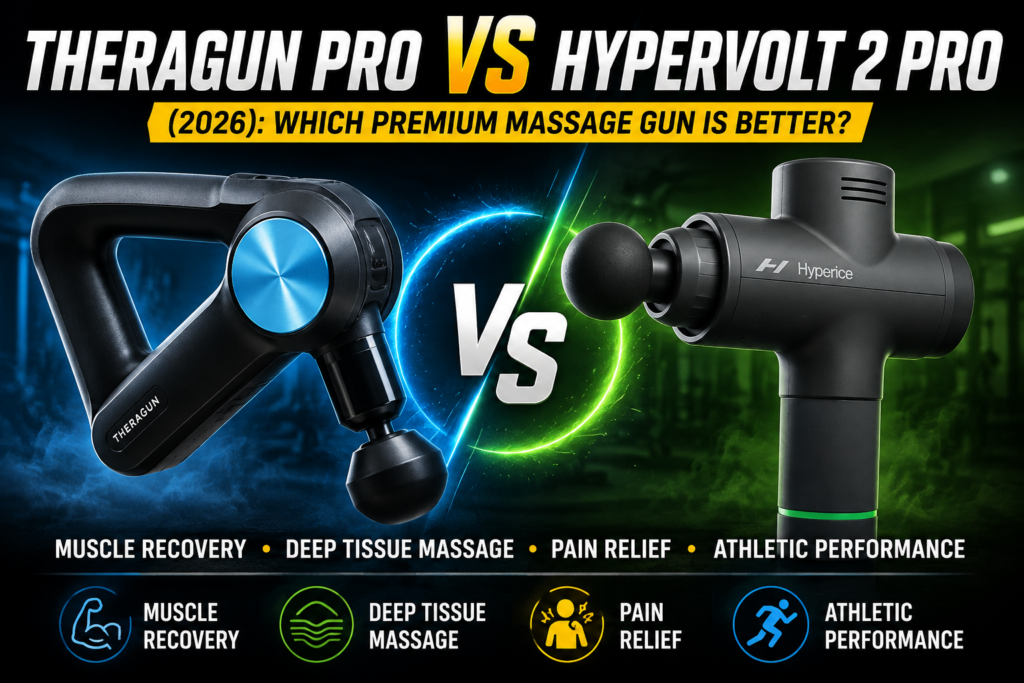
Compare the Theragun PRO 5th Gen and Hyperice Hypervolt 2 Pro. Explore features, ergonomics, battery life, pricing, safety, and newer alternatives.
LifeCareBalance.com is reader-supported. When you buy through links on our site, we may earn an affiliate commission at no extra cost to you. As an Amazon Associate, we earn from qualifying purchases.
Choosing between the Therabody Theragun PRO 5th Gen and the Hyperice Hypervolt 2 Pro is not simply a question of which massage gun has the biggest motor or the most impressive specifications. Both are premium percussion massage devices, but they approach comfort, control, and everyday usability differently.
The Theragun PRO emphasizes a triangular multi-grip handle, an adjustable arm, an onboard OLED screen, and six attachment heads. The Hypervolt 2 Pro offers a traditional handle, five speed settings, a pressure sensor, Bluetooth connectivity, and a removable battery.
There is also an important 2026 consideration: Hyperice now lists the Hypervolt 3 and Hypervolt 3 Pro in its US lineup. Buyers interested in the Hypervolt 2 Pro should therefore compare its actual selling price with the newer models rather than automatically treating it as the latest flagship.
This comparison examines the devices’ published features, practical trade-offs, evidence on percussion massage, and the questions to answer before spending money on either one. It is based on manufacturer information and published research, not a new hands-on test of both devices.
Quick Answer: Theragun PRO or Hypervolt 2 Pro?
Choose the Theragun PRO 5th Gen if its triangular grip, adjustable arm, screen-based routines, and attachment selection suit the way you plan to use a massage gun. Its design may be especially appealing when reaching different body areas independently.
Consider the Hypervolt 2 Pro if you prefer its conventional grip, five-speed dial, pressure feedback, and removable-battery design—and can find a genuine unit at a price that makes sense compared with newer Hypervolt models.
Best overall buying advice: Do not pay more for a premium massage gun simply because it advertises higher amplitude or stall force. Ergonomics, comfort, current price, warranty, and the areas you intend to massage can matter more to your decision.
Neither device has been established as clinically superior to the other for muscle recovery or athletic performance.
Theragun PRO vs. Hypervolt 2 Pro: Comparison Table
The following table separates manufacturer-published specifications from features that need individual verification. Prices and warranty terms can change, so confirm the exact product and generation before ordering.
| Feature | Theragun PRO 5th Gen | Hypervolt 2 Pro |
|---|---|---|
| Brand | Therabody | Hyperice |
| Device type | Percussion massage gun | Percussion massage gun |
| Handle | Triangular multi-grip | Traditional pill-shaped handle |
| Adjustable arm | Yes | No |
| On-device screen | OLED screen with guided routines | Digital speed dial |
| Speed settings | Five preset levels; app customization available | Five |
| Advertised battery life | Up to 120 minutes | Up to approximately 3 hours |
| Battery design | Rechargeable battery | Removable battery |
| Included attachments | Six | Five |
| Bluetooth | Yes | Yes |
| Pressure feedback | On-device force feedback and guided interface | Pressure sensor with visual feedback |
| Listed weight | Approximately 2.2 lb on current manufacturer page | Approximately 2.6 lb |
| Current buying consideration | Confirm generation and current US price | Compare with Hypervolt 3 and Hypervolt 3 Pro |
| Best reason to consider it | Multi-grip ergonomics and guided controls | Pressure feedback and familiar handle design |
Sources: Therabody’s official Theragun PRO page and Hyperice’s official product lineup.
Important: The figures above are not the result of a standardized, side-by-side laboratory test. Differences in measurement methods, retail bundles, battery configurations, and product generations can affect comparisons.
1. Price and Value: What Are You Actually Paying For?
Price is one of the most important differences to consider, particularly when comparing an older premium device with newer models.
The original Hypervolt 2 Pro has appeared at different prices across retailers and promotional periods. Theragun PRO pricing also varies by generation, seller, and sale.
Instead of assuming that the Hypervolt 2 Pro always costs $250 less, compare the actual checkout prices for the exact models available to you.
What justifies a premium price?
A more expensive massage gun may provide features such as:
- A grip that makes difficult body areas easier to reach.
- A more adjustable handle or arm.
- Guided routines and on-device controls.
- A removable battery or a convenient charging system.
- More attachment options.
- Better access to manufacturer support and replacement accessories.
These features can improve convenience, but they do not automatically mean the user will experience better recovery outcomes.
When is the cheaper option better value?
A lower-priced model is often the more sensible purchase if you plan to use it occasionally, primarily massage your legs, or do not need advanced app features.
The Hypervolt 2 Pro may offer good value when discounted, but compare it with the Hypervolt 3 and Hypervolt 3 Pro before buying.
The Theragun PRO may be worth the additional cost if its ergonomics and controls genuinely solve a problem for you. Its price is harder to justify if you mainly need a straightforward tool for occasional muscle massage.
2. Design and Ergonomics
The most noticeable design difference is the way you hold and position each device.
Theragun PRO: Triangular multi-grip handle

- Smarter and Quieter: Theragun PRO is the ultimate deep tissue personal massager for recovery and pain relief. Redesigned…
- Ergonomic Design with Patented Triangle Handle: Handheld massager with flexible positioning for reduced stress on the wr…
- 6 High-Quality Attachments: Micro-Point works as a muscle stimulator, Supersoft is best used on joints, bones and sensit…
The Theragun PRO uses a triangular handle intended to provide multiple grip positions. This can help users adjust their hand position while targeting different muscle groups.
Its adjustable arm also offers additional positioning options. Depending on your mobility and the area you are trying to reach, this may make self-massage more convenient.
The main advantage is flexibility of positioning rather than a guarantee of greater massage effectiveness.
Hypervolt 2 Pro: Traditional handle

- The Hypervolt 2 Pro is our strongest percussion device, offering deep-penetrating relief to stiff muscles, so you can tr…
- Warm up and recover like the pros do, with guided routines from top athletes and automatic speed adjustment with the Blu…
- Think of Hypervolt like a massage therapist to massage away all your stress and tension. Get rid of muscle knots and loo…
The Hypervolt 2 Pro uses a conventional handle with a digital speed dial.
Some users may find this arrangement familiar and straightforward. Others may prefer a multi-grip design when reaching across the body or attempting to massage a difficult-to-reach area.
The best choice depends on your hand size, grip comfort, shoulder mobility, and intended use.
Which is easier to hold?
There is no universally correct answer.
A device can be relatively light yet awkward to position, while a heavier device may feel comfortable in one position and tiring in another. If possible, try the grip before buying, especially if you intend to use the massage gun independently.
Neither device should be used to forcefully reach the spine or other vulnerable structures.
3. Power, Amplitude, and Stall Force
Massage-gun specifications can look impressive, but they require careful interpretation.
What is amplitude?
Amplitude refers to the distance the massage head travels during each percussion stroke.
The Theragun PRO 5th Gen is commonly listed with a 16 mm amplitude. The Hypervolt 2 Pro is often reported as approximately 14 mm by third-party sources, although Hyperice does not consistently publish an official amplitude figure for this model on its product information.
A longer stroke changes the character of the percussion. It does not, by itself, prove that a device produces better recovery or is appropriate for every muscle group.
What is stall force?
Stall force describes how much resistance a motor can tolerate before its movement slows or stops, according to the measurement method used.
Higher figures can be useful when comparing devices tested under the same conditions. However, published stall-force figures are not always measured consistently across manufacturers or independent reviewers.
Do not treat conflicting stall-force numbers as directly comparable without knowing how they were measured.
Does the Theragun PRO hit harder?
Some users may prefer its percussion characteristics, and its published 16 mm amplitude is a useful specification to know. However, the available evidence does not establish that it delivers superior clinical recovery outcomes to the Hypervolt 2 Pro.
Your comfort, the applied pressure, attachment choice, and duration of use are also important.
For general users, the most powerful option is not necessarily the most useful one.
4. Speed Settings and Controls
Both devices provide five speed settings, but their control experiences differ.
The Theragun PRO combines physical controls with an OLED screen and guided routines. The Hypervolt 2 Pro uses a digital dial and provides visual feedback through its pressure-sensing system.
Theragun PRO controls
Its onboard screen can display information and guide users through selected routines. The Therabody app also provides access to additional guided content and personalization options.
These features may appeal to someone who prefers a structured routine instead of manually deciding how to use the device each time.
Hypervolt 2 Pro controls
The digital dial provides a direct way to select an intensity. Its pressure indicator offers feedback about the amount of pressure being applied.
This can be useful for users learning to avoid pushing too hard, although it is not a medical measurement and does not guarantee safe technique.
Which control system is better?
Choose the Theragun PRO if you value screen-based guidance and multiple grip positions. Consider the Hypervolt 2 Pro if you prefer a straightforward dial and visible pressure feedback.
Neither system is essential for someone who wants only a simple, short massage routine.
5. Battery Life and Charging
Battery specifications matter most when they match your usage.
Therabody currently lists up to 120 minutes of battery life for the Theragun PRO 5th Gen. Hyperice lists approximately three hours for the Hypervolt 2 Pro.
These are manufacturer-advertised figures, not guarantees of continuous operation at every speed.
Theragun PRO
The battery and charging arrangement should be checked against the exact generation and retail package. Do not assume that an older review’s battery bundle applies to every current listing.
For professional or repeated use, confirm battery replacement availability and the cost of additional accessories before buying.
Hypervolt 2 Pro
The removable battery is a practical feature because a compatible spare can reduce downtime when you have access to a second charged battery.
However, confirm whether a spare is included. A removable battery does not mean the product automatically comes with two batteries.
Which has better battery value?
The Hypervolt 2 Pro’s advertised runtime is longer than the current Theragun PRO 5th Gen’s advertised runtime. That does not necessarily make it the better purchase for everyone.
Consider the length and frequency of your sessions, battery replacement costs, charging convenience, and whether the exact model remains supported.
6. Attachments: Which Set Is More Useful?
The Theragun PRO 5th Gen includes six attachments: Supersoft, Standard Ball, Dampener, Wedge, Thumb, and Micro-point.
The Hypervolt 2 Pro includes five: Fork, Ball, Cushion, Flat, and Bullet.
Attachment names and intended uses can vary across brands, so compare the actual heads included in the specific package.
Theragun PRO attachments
- Standard Ball: A general-purpose option for appropriate larger muscle groups.
- Dampener: A softer-contact option for gentler use.
- Wedge: A shaped head designed for certain muscle contours.
- Thumb: A more concentrated contact shape.
- Micro-point: A head with small contact points.
- Supersoft: A softer option for users who prefer less intense contact.
Hypervolt 2 Pro attachments
- Ball: A general-purpose head for suitable muscle areas.
- Flat: A broad contact surface.
- Cushion: A softer-contact option.
- Bullet: A narrower contact point.
- Fork: A split head that requires care around sensitive structures.
Having more attachments does not automatically make a massage gun better. Many users rely on one or two comfortable heads for most sessions.
Avoid using narrow or firm heads aggressively on sensitive areas, bony prominences, or injured tissue. Never direct percussion onto the spine or front and sides of the neck.
7. Noise and Everyday Comfort
Noise can matter if you live in an apartment, share a bedroom, work from home, or plan to use a massage gun around other people.
The Hypervolt 2 Pro is marketed with QuietGlide technology. The Theragun PRO uses QuietForce motor technology.
Neither marketing name establishes an independently measured noise advantage.
Published decibel figures can vary depending on the distance from the device, the selected speed, the attachment, and the surrounding environment. A fair comparison requires the same measurement method for both products.
Which should you choose for a shared space?
Look for a reliable independent test that measures both devices under identical conditions. If no such test is available, avoid relying on precise decibel differences from unrelated reviews.
If quiet operation is especially important, also consider the newer Hypervolt lineup rather than limiting your choice to the older Hypervolt 2 Pro.
8. App Features and Guided Routines
Both devices offer Bluetooth connectivity and app-related features.
The Therabody app provides guided routines and device personalization. The Hyperice app supports connected routines and speed-related features for compatible devices.
The value of these features depends on whether you will use them.
A beginner may appreciate instructions that provide structure. An experienced user who prefers a simple routine may rarely open the app.
Neither app should be treated as a substitute for professional advice about an injury or persistent pain.
9. Do Massage Guns Actually Improve Recovery?
It is important to separate temporary comfort from proven improvements in athletic performance.
A systematic review published in 2023 examined massage-gun research and found possible improvements in flexibility, range of motion, and certain recovery-related outcomes. However, the evidence base was small and included studies with methodological limitations.
Read the review in PubMed: The Effects of Massage Guns on Performance and Recovery.
A second systematic review found potential benefits for some short-term musculoskeletal outcomes, while also highlighting limitations in study quality and reporting. See PubMed: The Effect of Percussive Therapy on Musculoskeletal Performance and Experiences of Pain.
These reviews do not prove that the Theragun PRO is better than the Hypervolt 2 Pro. They also do not establish that either device prevents injury or guarantees faster recovery.
For post-workout soreness
Some people find massage helpful for temporary comfort after exercise. However, soreness is influenced by training load, exercise selection, sleep, nutrition, and individual factors.
A massage gun should complement sensible training and recovery habits rather than replace them.
For flexibility
Short-term range-of-motion improvements are among the potential benefits reported in the research. Results vary, and a massage gun is not a substitute for a complete mobility program.
For athletic performance
Do not buy a more expensive device on the assumption that it will automatically increase strength, speed, or endurance.
The most useful device is one you can use comfortably and appropriately as part of a broader routine.
10. Safety: Important Considerations Before Buying
Percussion massage is not appropriate for every body area or medical situation.
The Cleveland Clinic provides general information about massage guns, their potential uses, and precautions: Cleveland Clinic: Are Massage Guns Worth It?.
Basic precautions include:
- Start at a low intensity and use comfortable pressure.
- Use the device on suitable soft muscle tissue.
- Avoid direct use over bones, joints, and the spine.
- Avoid the front and sides of the neck.
- Do not use percussion on open wounds, bruises, or acutely injured areas.
- Stop if you experience sharp pain, numbness, tingling, or unusual discomfort.
If you have a bleeding disorder, take anticoagulant medication, have reduced sensation, have recently had surgery, or have unexplained pain or swelling, consult an appropriate healthcare professional before using a massage gun.
Persistent pain or suspected injury should be assessed appropriately rather than repeatedly treated with percussion.
11. Which Massage Gun Is Best for Different Buyers?
For frequent gym users
Either device may suit someone who regularly uses percussion massage. Prioritize comfortable handling, appropriate intensity control, and features you will actually use.
For runners
Consider weight, grip comfort, and how easily you can reach the calves and thighs. You do not automatically need a professional-level device to support a basic recovery routine.
For desk workers
Comfort and ease of handling may matter more than maximum advertised force. A lighter or less expensive device could be sufficient for occasional muscle massage.
For personal trainers and professional settings
Battery replacement, cleaning, durability, warranty coverage, and support are important considerations. Verify the manufacturer’s current terms and whether the device is suitable for the intended frequency of use.
For beginners
Look for manageable intensity, simple controls, and an attachment that feels comfortable. More power is not necessarily a benefit when learning how to use a percussion device.
For travelers
Weight, case dimensions, charging requirements, and current airline rules matter. Manufacturer statements about travel suitability should not be interpreted as a guarantee that every battery configuration meets every airline’s requirements.
12. Should You Consider the Newer Hypervolt 3 Models?
Yes. This is one of the most important buying considerations in 2026.
Hyperice’s current US lineup includes the Hypervolt 3 and Hypervolt 3 Pro. The company lists the Hypervolt 3 Pro at a regular US price of $349 on its product collection page, although prices and availability can change.
Visit the official Hyperice Hypervolt lineup to compare the current models.
If a Hypervolt 2 Pro is available at a discount, compare its price, warranty, battery condition, included accessories, and return policy with the newer devices.
An older model can still be a reasonable purchase when the price is attractive and support is available. But it should not be presented as the newest Hyperice flagship.
For a broader comparison of premium and budget options, see our Premium vs. Budget Massage Guns in 2026 guide.
13. Product and Amazon Buying Checks
Before buying either device, verify the exact generation and variant.
Theragun PRO 5th Gen
Check that the listing explicitly identifies the fifth generation and confirm the included attachments, battery, charging equipment, warranty, and seller.
The manufacturer’s current product information is available at Therabody Theragun PRO.
Hypervolt 2 Pro
Confirm that the listing is for the Hypervolt 2 Pro—not the Hypervolt 2, Hypervolt 3, Hypervolt 3 Pro, or Hypervolt Go.
Also check the battery, attachment heads, charger, warranty, and seller’s return policy.
For this comparison, do not rely on an ASIN copied from an unrelated listing or an older review. Confirm that the Amazon US product page matches the exact product generation before adding an affiliate link.
Frequently Asked Questions
Is the Theragun PRO better than the Hypervolt 2 Pro?
Not for every user. The Theragun PRO offers a multi-grip handle, adjustable arm, and guided screen-based routines. The Hypervolt 2 Pro offers a traditional handle, pressure feedback, and a removable battery. The better choice depends on comfort, features, and price.
Which has the longer advertised battery life?
The Hypervolt 2 Pro is advertised at approximately three hours, while the current Theragun PRO 5th Gen is listed at up to 120 minutes. Actual runtime depends on use and battery condition.
Does the Theragun PRO have greater amplitude?
The Theragun PRO 5th Gen is listed at 16 mm amplitude. The Hypervolt 2 Pro is commonly reported at approximately 14 mm by third-party sources, but Hyperice does not consistently publish this as an official specification. These figures alone do not establish superior recovery outcomes.
Is the Hypervolt 2 Pro still worth buying in 2026?
It may be worth considering if you find a genuine unit at a competitive price and confirm that its warranty and accessories meet your needs. Compare it with the Hypervolt 3 and Hypervolt 3 Pro before purchasing.
Which device is quieter?
Hyperice markets the Hypervolt 2 Pro with QuietGlide technology, while Therabody uses QuietForce technology. A definitive decibel winner requires comparable independent measurements.
Can massage guns improve muscle recovery?
Research suggests potential benefits for short-term flexibility, range of motion, and some recovery-related outcomes. The evidence is limited, and neither device is proven to guarantee faster recovery or improved athletic performance.
Can I use a massage gun every day?
Frequency depends on your tolerance, the area being treated, and the manufacturer’s instructions. Avoid excessive pressure, vulnerable structures, and injured tissue. Seek professional advice if you have a relevant medical condition or persistent symptoms.
Is a more powerful massage gun always better?
No. Comfort, grip, control, attachment selection, and appropriate use can matter more than a single power specification. More intense percussion is not automatically more effective.
Which is better for beginners?
Either may work for a beginner who can use it comfortably and follow appropriate safety instructions. Prioritize simple controls and manageable intensity rather than maximum force.
Do I need the smartphone app?
No. App features can be helpful for guided routines and customization, but they are optional for users who prefer a simple manual routine.
Final Verdict: Theragun PRO vs. Hypervolt 2 Pro
The Theragun PRO 5th Gen and Hyperice Hypervolt 2 Pro offer different approaches to premium percussion massage.
The Theragun PRO stands out for its multi-grip design, adjustable arm, onboard screen, and six included attachments. The Hypervolt 2 Pro offers five speeds, pressure feedback, a removable battery, and a traditional grip.
However, the Hypervolt 2 Pro’s place in the older generation of Hyperice products matters in 2026. Compare it with the newer Hypervolt lineup before deciding that a discounted older model is the best value.
Our recommendation: Choose based on comfort, intended use, current price, warranty, and the features you will genuinely use. Do not pay a premium simply for higher advertised numbers or promises of superior recovery.
Neither device is a medical treatment, and neither has been established as clinically superior to the other.
Editorial note: This comparison is based on published manufacturer specifications, available product information, and peer-reviewed research. LifeCareBalance did not conduct a new hands-on, side-by-side laboratory test for this article.
Affiliate disclosure: LifeCareBalance may earn a commission from qualifying purchases made through affiliate links, at no additional cost to the reader.