
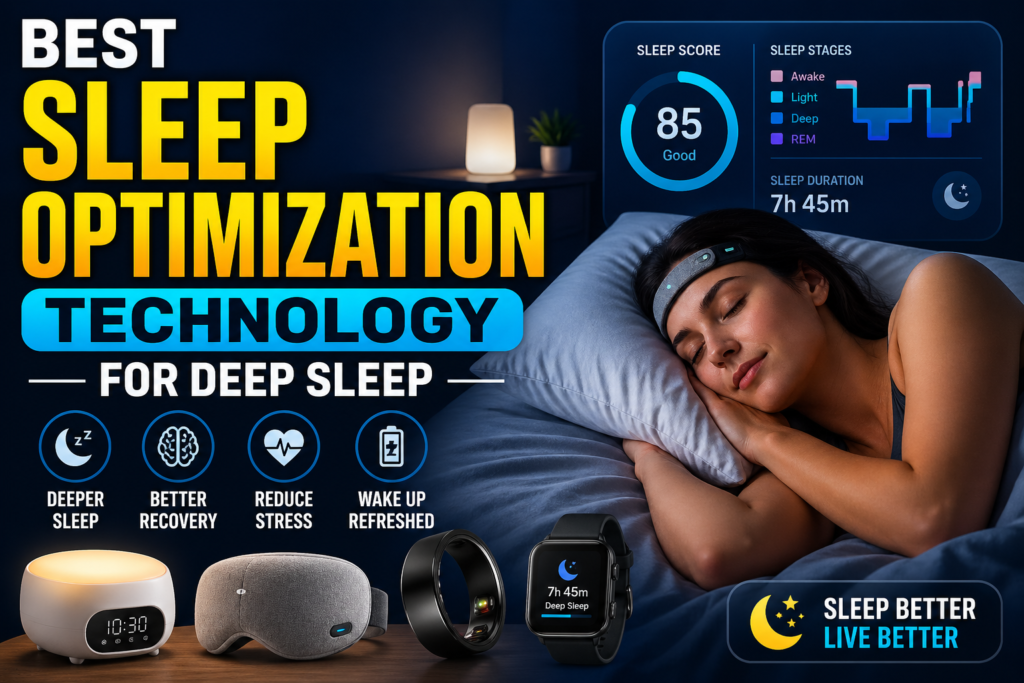
Discover the best sleep optimization technology for deeper, better-quality sleep in 2026, including smart beds, cooling systems, sleep trackers, sound devices, and smart lighting.
LifeCareBalance.com is reader-supported. When you buy through links on our site, we may earn an affiliate commission at no extra cost to you. As an Amazon Associate, we earn from qualifying purchases.
Better sleep technology is no longer limited to a smartwatch or a sleep-tracking ring. In 2026, the sleep-tech market includes smart beds, temperature-control systems, sleep headphones, sound machines, smart lighting, sunrise alarms, contactless sleep monitors, and wearable devices designed to help people understand their nightly patterns.
But there is an important distinction that many sleep-tech roundups miss:
Some technology measures sleep. Other technology changes the environment in which you sleep.
That difference matters.
A sleep tracker may tell you that your sleep was fragmented. A cooling system may help regulate the temperature of your sleeping environment. A sound machine may reduce distracting background noise. A smart light may help create a more consistent evening and morning routine.
The best sleep optimization technology is therefore not necessarily the device with the most sensors or the highest price. It is the technology that addresses your specific sleep problem without creating unnecessary complexity.
This guide looks at the most useful categories of sleep technology in 2026, what each category is designed to do, what to look for before buying, and where the evidence or marketing claims deserve caution.
Quick answer: The best sleep optimization technology depends on your biggest sleep obstacle. Smart temperature-control systems can be useful for people who sleep too hot, sound technology can help mask disruptive environmental noise, smart lighting and sunrise alarms can support a more consistent light-based routine, while sleep trackers can help identify long-term patterns. For many people, improving the sleep environment may be more valuable than adding another device that simply produces more data.
What Is Sleep Optimization Technology?
Sleep optimization technology refers to consumer devices designed to measure, influence, or improve aspects of the sleep environment and bedtime routine.
These products generally fall into several categories:
- Sleep trackers and smart rings
- Smart beds and mattress systems
- Temperature-control systems
- White-noise and sound machines
- Sleep headphones and earbuds
- Smart lighting and sunrise alarms
- Contactless sleep monitors
- Smart sleep masks
- Sleep-focused apps and digital coaching
These technologies solve different problems.
A wearable is primarily a measurement and feedback tool. A cooling mattress system is an environmental intervention. A sunrise alarm focuses on the transition between sleep and wakefulness. A sound machine is designed to make the acoustic environment more consistent.
That means it makes little sense to ask which category is universally “best.”
The better question is:
What is preventing you from getting the sleep you want, and can technology realistically address that problem?
Sleep Tracking vs. Sleep Optimization: What Is the Difference?
This is one of the most important distinctions to understand before buying anything.
A sleep tracker can estimate:
- Total sleep time
- Sleep and wake periods
- Sleep consistency
- Heart rate
- HRV
- Respiratory rate
- Skin temperature
- Estimated sleep stages
- Recovery or readiness metrics
That information can be useful for identifying trends.
However, a tracker does not automatically improve your sleep simply because it collects more information.
Our Sleep Tracker Buying Guide 2026 goes deeper into sleep-tracker accuracy, form factors, subscriptions, privacy and sleep-stage limitations.
The key point is simple:
Measurement and intervention are not the same thing.
If your bedroom is too hot, collecting another sleep score may not solve the problem. If traffic noise repeatedly wakes you, a sound-management solution may be more relevant. If your bedtime and wake time vary dramatically, a smart lighting or sunrise routine may be more useful than another wearable.
The strongest sleep-tech strategy often combines one useful measurement tool with one or two targeted environmental improvements, rather than filling the bedroom with gadgets.
1. Smart Temperature-Control Technology
Temperature is one of the most interesting areas of premium sleep technology.
Smart temperature systems can use a mattress pad, cover, or integrated bed system to adjust the sleeping surface according to programmed or automated settings.
This category is especially attractive to:
- Hot sleepers
- Couples with different temperature preferences
- People living in warm climates
- People who want more precise temperature control
- Premium buyers building a high-end sleep environment
Some smart beds and temperature systems can provide independent controls for different sides of the bed.
What to Look For
When evaluating a smart temperature-control system, consider:
- Independent left/right temperature control
- Manual controls
- App controls
- Automatic scheduling
- Temperature range
- Noise from the control unit
- Cleaning and maintenance
- Mattress compatibility
- Subscription requirements
- Long-term operating cost
A premium system should not be judged solely by how many “smart” features it offers.
The real question is whether the temperature control is useful enough to justify the cost and complexity.
Best for: Hot sleepers, couples with different temperature preferences, and premium sleep environments.
Potential drawback: High upfront cost and, depending on the system, recurring membership fees.
2. Smart Beds and Adjustable Sleep Systems
Smart beds have evolved beyond simple adjustable bases.
Modern systems may combine:
- Firmness adjustment
- Head and foot elevation
- Sleep tracking
- Temperature management
- Massage features
- Snore-related adjustments
- App controls
- Independent settings for couples
The strongest smart-bed products combine several sleep technologies into one ecosystem.
However, buyers should be careful not to assume that “smart” automatically means better.
A smart bed can become expensive very quickly when you combine the mattress, base, accessories, and ongoing subscriptions.
Who Should Consider a Smart Bed?
A smart bed makes the most sense for someone who is already considering a premium mattress upgrade and wants technology integrated into that purchase.
It may be less attractive if you already own a high-quality mattress and only need to solve one specific problem such as heat or noise.
Best for: Premium buyers building an integrated sleep environment.
Potential drawback: High cost and greater dependence on a proprietary ecosystem.
3. Sleep Trackers and Smart Rings
Wearables remain one of the most popular forms of sleep technology because they make sleep data accessible without requiring a major bedroom upgrade.
Smart rings are particularly attractive for overnight use because they are small and screen-free.
A premium sleep wearable may provide:
- Sleep duration
- Sleep consistency
- Estimated sleep stages
- Overnight heart rate
- HRV
- Temperature trends
- Recovery insights
- Readiness scores
For readers interested in Oura specifically, our Oura Ring 5 Sizing Guide 2026 explains why fit and overnight comfort matter.
The Biggest Mistake With Sleep Trackers
Do not treat the number on the screen as a laboratory measurement.
Consumer devices generally estimate sleep stages using combinations of movement and physiological signals. They do not normally measure brain waves in the same way as a clinical sleep study.
That means:
Use sleep data to identify patterns, not to diagnose yourself.
For example, one unusually low deep-sleep estimate does not automatically mean something is wrong.
Longer-term patterns are generally more useful than obsessing over one night.
Our How Sleep Tracking Can Improve Recovery in 2026 covers the relationship between sleep tracking, HRV, resting heart rate and recovery in greater detail.
Best for: People who want measurable sleep and recovery trends.
Potential drawback: Data overload, subscription costs, and the temptation to overinterpret estimated sleep stages.
4. White-Noise and Sound Technology
Noise is one of the simplest reasons sleep can be interrupted.
Traffic, neighbors, pets, roommates, partners, air conditioners, or sudden household sounds can make an otherwise comfortable bedroom difficult to sleep in.
Sound machines work differently from headphones.
Instead of delivering audio directly into your ears, they create a consistent background sound that can help mask sudden environmental changes.
Popular options include:
- White noise
- Pink noise
- Brown noise
- Fan sounds
- Nature sounds
- Ambient soundscapes
What Makes a Good Sound Machine?
Look for:
- Adjustable volume
- Natural-sounding audio
- Timer options
- Continuous playback
- Easy controls
- Low operating noise
- Compact design
- Travel-friendly construction if needed
The goal is not to make the bedroom louder.
The goal is to make disruptive changes in the sound environment less noticeable.
Best for: Light sleepers dealing with inconsistent environmental noise.
Potential drawback: Not everyone likes continuous background sound, and excessive volume is not desirable.
5. Sleep Headphones and Sleep Earbuds
Sleep-focused headphones take the sound concept further by delivering audio directly to the user.
They can be useful for people who share a bedroom with a partner or live in a noisy environment.
Some designs are built specifically for sleeping and may use:
- Low-profile speakers
- Flat earcups
- Bluetooth
- Sleep timers
- Ambient sound
- Noise masking
- Relaxation audio
Side sleepers should pay particular attention to physical comfort.
A product that feels fine while sitting upright may become uncomfortable after several hours against a pillow.
Best for: People who need personal audio control or noise masking.
Potential drawback: Comfort varies significantly by sleeping position.
6. Smart Lighting and Circadian-Friendly Technology
Light is one of the most important environmental signals affecting the body’s internal timing system.
That makes lighting an interesting part of sleep technology.
A smart lighting setup can help create different environments for different times of day:
Morning: brighter, energizing light.
Evening: dimmer, warmer light.
Pre-bed: minimal stimulation and a calmer environment.
Some sunrise alarm clocks gradually increase light before the desired wake time.
This approach can be more natural for people who dislike waking up abruptly to a loud alarm.
What to Look For
Consider:
- Adjustable brightness
- Color temperature
- Sunrise simulation
- Sunset routines
- Scheduling
- App control
- Manual controls
- Compatibility with your existing smart-home system
The biggest mistake is buying an expensive smart-lighting system without actually creating a consistent routine.
Technology works best when it supports a habit.
Best for: People with inconsistent evening routines, early-morning wake schedules, or interest in structured light exposure.
7. Contactless Sleep Monitoring
Not everyone wants to wear a ring, watch, or band overnight.
Contactless sleep monitors are designed for these users.
Depending on the technology, these devices may sit under the mattress, beside the bed, or use sensors to collect information without requiring physical contact.
Potential advantages include:
- No wearable
- No overnight charging on the body
- Comfortable for people who dislike wrist or finger devices
- Long-term passive monitoring
However, contactless technology has its own limitations.
Shared beds, movement, device placement, and the exact sensor technology can affect the usefulness of the data.
This is another category where buyers should look beyond marketing claims and investigate how the device actually measures sleep.
Best for: People who dislike wearable sleep trackers.
Potential drawback: Less direct physiological information with some systems and possible challenges in shared bedrooms.
8. Smart Sleep Masks
A traditional sleep mask simply blocks light.
A smart sleep mask may combine blackout coverage with additional features such as:
- Built-in audio
- Bluetooth
- Relaxation programs
- Wake-up lighting
- Sleep timers
- App controls
The category is attractive because it combines several bedtime functions into a single wearable.
But buyers should be skeptical of dramatic claims about “guaranteed deep sleep,” brain-wave optimization, or medical-grade sleep-stage tracking unless those claims are supported by credible evidence.
The most obvious benefits of a sleep mask are often the simplest ones:
darkness, comfort, and convenience.
Best for: Travelers, light-sensitive sleepers, and people who want integrated audio.
Potential drawback: Comfort and evidence quality vary considerably between products.
9. Sleep Apps and Digital Coaching
Sleep apps are often overlooked because they do not look as impressive as a smart mattress or wearable.
But software can be one of the most useful parts of a sleep-technology setup.
A good app may help users:
- Establish a consistent bedtime
- Track sleep habits
- Review trends
- Create relaxation routines
- Manage sound
- Set reminders
- Interpret wearable data
- Build healthier bedtime habits
The important distinction is between an app that simply displays data and one that helps turn data into practical decisions.
A beautiful graph is not necessarily useful.
A simple recommendation that helps you consistently change a behavior may be far more valuable.
Which Sleep Technology Should You Buy?
Instead of buying whatever appears highest on a “best sleep gadgets” list, start with your biggest problem.
| Your Main Problem | Technology to Consider |
|---|---|
| Bedroom is too hot | Temperature-control system |
| Partner and you prefer different temperatures | Dual-zone temperature system |
| Traffic or neighbors wake you | Sound machine or sleep headphones |
| You want to understand your sleep patterns | Sleep tracker or smart ring |
| You dislike wearing devices | Contactless sleep monitor |
| You struggle with consistent wake times | Sunrise alarm |
| Evening lighting is too stimulating | Smart lighting |
| You travel frequently | Portable sleep mask or compact sound device |
| You want a premium all-in-one setup | Smart bed ecosystem |
| You want better sleep data for training | Sleep tracker + recovery metrics |
This problem-first approach is more useful than simply ranking ten unrelated products from #1 to #10.
Product Picks Worth Considering
Product 1: Oura Ring 5

- THE WORLD’S SMALLEST SMART RING – 40% smaller than the previous generation, Oura Ring 5 is thinner, lighter and smaller …
- SIZING IS ESSENTIAL – Oura Ring 5 uses unique sizing different from standard jewelry rings and other Oura Ring generatio…
- EVERYDAY HEALTH SENSING – Oura tracks over 50 health metrics, including sleep, activity, stress, heart health, metabolic…
Best for: Premium sleep and recovery tracking
The Oura Ring 5 is a strong option for buyers who want a discreet wearable focused heavily on sleep, recovery and broader wellness tracking.
Use it primarily as a trend and behavior tool, rather than treating every estimated sleep-stage number as exact.
Product 2: Eight Sleep Pod 4
Best for: Active temperature management
A temperature-control sleep system such as the Eight Sleep Pod 4 is aimed at buyers who want more active control over the sleeping surface.
This is a premium category, so the total cost—including hardware and any ongoing membership—should be evaluated before purchasing.
Product 3: Hatch Restore 3

- 𝗖𝗿𝗲𝗮𝘁𝗲 𝗵𝗲𝗮𝗹𝘁𝗵𝘆 𝘀𝗹𝗲𝗲𝗽 𝗵𝗮𝗯𝗶𝘁𝘀: 𝖱𝖾𝗌𝗍𝗈𝗋𝖾 𝟥 𝗂𝗌 𝖽𝖾𝗌𝗂𝗀𝗇𝖾𝖽 𝗍𝗈 𝗁𝖾𝗅𝗉 𝗒𝗈𝗎 𝖻𝗎𝗂𝗅𝖽 𝖺 𝖻𝖾𝖽𝗍𝗂𝗆𝖾 𝗋𝗈𝗎𝗍𝗂𝗇𝖾 𝗍𝗁𝖺𝗍 𝗊𝗎𝗂𝖾𝗍𝗌 𝗒𝗈𝗎𝗋 𝗆𝗂𝗇𝖽 𝗌𝗈 𝗒𝗈𝗎 𝖼𝖺𝗇 …
- 𝗛𝗮𝘁𝗰𝗵+ 𝗦𝘂𝗯𝘀𝗰𝗿𝗶𝗽𝘁𝗶𝗼𝗻: 𝖯𝗎𝗋𝖼𝗁𝖺𝗌𝖾 𝗂𝗇𝖼𝗅𝗎𝖽𝖾𝗌 𝟥𝟢-𝖽𝖺𝗒 𝖿𝗋𝖾𝖾 𝗍𝗋𝗂𝖺𝗅 𝗈𝖿 𝖧𝖺𝗍𝖼𝗁+ 𝗉𝗋𝖾𝗆𝗂𝗎𝗆 𝖼𝗈𝗇𝗍𝖾𝗇𝗍 𝖺𝗇𝖽 𝖿𝖾𝖺𝗍𝗎𝗋𝖾𝗌, 𝖿𝗈𝗋 𝗇𝖾𝗐 𝗌𝗎𝖻𝗌𝖼𝗋𝗂𝖻𝖾𝗋𝗌 𝗈𝗇𝗅…
- 𝗨𝗻𝘄𝗶𝗻𝗱 𝗻𝗶𝗴𝗵𝘁𝗹𝘆: 𝖱𝖾𝗌𝗍𝗈𝗋𝖾 𝗁𝖾𝗅𝗉𝗌 𝗒𝗈𝗎 𝖼𝗋𝖾𝖺𝗍𝖾 𝖺 𝖻𝖾𝖽𝗍𝗂𝗆𝖾 𝗋𝗈𝗎𝗍𝗂𝗇𝖾 𝗌𝗈 𝗒𝗈𝗎 𝖼𝖺𝗇 𝖿𝖺𝗅𝗅 𝖺𝗌𝗅𝖾𝖾𝗉 𝖾𝖺𝗌𝗂𝖾𝗋 𝖺𝗇𝖽 𝖿𝖺𝗌𝗍𝖾𝗋. 𝖯𝗋𝖾𝗉𝖺𝗋𝖾 𝗒𝗈𝗎𝗋 𝗆𝗂𝗇𝖽 𝖿…
Best for: Smart bedtime and wake-up routines
A smart sleep clock can combine lighting, sound and structured routines in a much simpler package than a smart bed.
This type of product can be particularly appealing if your biggest issue is an inconsistent bedtime or harsh wake-up routine.
Product 4: Soundcore Sleep A30

- Reduce Noise and Mask Snoring: Noise reduction quiets traffic rumble, appliance hum, and other environmental disturbance…
- Barely-There Fit for Side Sleepers: Wake up without ear pain. At just 3 g each, these ultra-compact, soft silicone earbu…
- Sleep Stories to Calm Your Mind: Enjoy a curated selection of premium Sleep Stories from Calm. You can also explore a di…
Best for: Personal sleep audio and noise masking
Sleep-focused earbuds can make sense for people who need personal sound control without playing audio throughout the entire bedroom.
Comfort should be tested carefully, especially for side sleepers.
Product 5: Withings Sleep Analyzer
Best for: Contactless sleep tracking
A mattress-based sleep monitor can be an interesting alternative for someone who does not want to wear a ring or watch at night.
Before purchasing any contactless monitor, check exactly which metrics it measures and how those measurements are validated.
How Much Sleep Technology Do You Actually Need?
This is where many sleep-tech buyers go wrong.
A bedroom containing a smart ring, smart mattress, smart mask, sleep earbuds, sound machine, smart lights, air-quality monitor and multiple apps may produce more information than the average person can actually use.
More technology does not automatically equal better sleep.
For many people, a more sensible setup could be:
Option 1 — Simple
Sunrise alarm + comfortable sleep environment.
Option 2 — Data-focused
Sleep tracker + simple sound or lighting solution.
Option 3 — Premium
Smart temperature control + sleep tracker.
Option 4 — No wearable
Contactless sleep monitor + environmental technology.
The goal should be a low-friction sleep system, not a technology collection.
What Sleep Technology Cannot Do
Sleep technology should not be marketed as a substitute for healthy sleep habits or professional medical care.
A device cannot guarantee:
- More deep sleep
- Perfect REM sleep
- No nighttime awakenings
- Better health
- Prevention of sleep disorders
- A medical diagnosis
Consumer devices can provide useful information and environmental support, but their capabilities have limits.
If you regularly experience loud snoring, gasping during sleep, persistent insomnia, repeated nighttime awakenings, or significant daytime sleepiness, technology should not be your only response.
Discuss persistent symptoms with an appropriate healthcare professional.
Sleep Optimization Mistakes to Avoid
Buying the Most Expensive Device
Price does not automatically equal effectiveness.
Confusing Tracking With Improvement
A tracker can measure a problem without solving it.
Chasing Deep-Sleep Numbers
Estimated sleep stages are not laboratory measurements.
Ignoring Subscription Costs
A $300 device can become expensive if important features require years of recurring payments.
Buying Too Many Devices
Complexity can become its own problem.
Ignoring Comfort
If a device interrupts your sleep, its impressive specifications do not matter.
Trusting Every “AI Sleep” Claim
AI is increasingly used in consumer wellness technology, but the word itself does not prove accuracy or clinical effectiveness.
Ignoring Privacy
Sleep data can be highly personal. Review how the company collects, stores, shares and allows you to delete your information.
How to Build a Better Sleep-Tech Routine
Start with your bedroom rather than your shopping cart.
Step 1: Identify the problem
Are you too hot? Too cold? Distracted by noise? Waking too early? Unsure about your sleep schedule?
Step 2: Choose one technology that addresses that problem
Do not buy five devices immediately.
Step 3: Use it consistently
A technology that becomes part of your routine is more useful than a device that sits unused.
Step 4: Track meaningful outcomes
Pay attention to:
- Sleep consistency
- How rested you feel
- Nighttime interruptions
- Ease of falling asleep
- Morning wake-up experience
Step 5: Avoid obsessing over individual numbers
One bad night does not necessarily represent a problem.
Step 6: Reassess after several weeks
Ask whether the technology is actually helping.
If it is not improving your routine, comfort or understanding of your sleep, you may not need it.
Frequently Asked Questions
What is the best sleep optimization technology in 2026?
There is no single best device for everyone. Temperature-control technology can be valuable for hot sleepers, sound technology for noise-sensitive sleepers, smart lighting for routine and circadian support, and sleep trackers for people who want to understand long-term sleep patterns.
What technology is best for deep sleep?
No consumer device can guarantee deeper sleep. Technology may help address environmental factors such as temperature, noise or light, while trackers can help you observe patterns. Estimated deep-sleep measurements should not be treated as laboratory results.
Are sleep trackers worth buying?
They can be worthwhile if you genuinely want to monitor sleep patterns and use the information to make practical changes. They are less useful if you become anxious about every nightly score or expect the device to diagnose a problem.
Is a smart mattress better than a sleep tracker?
They solve different problems. A sleep tracker primarily measures and interprets sleep-related data, while a smart mattress can actively modify aspects of the sleep environment such as temperature, firmness or position.
Is sleep technology safe?
Most consumer sleep technologies are designed for ordinary wellness use, but safety depends on the specific product. Follow manufacturer instructions and do not treat a consumer device as a substitute for medical diagnosis or treatment.
Should I buy a sleep ring or a smartwatch?
Choose a smart ring if overnight comfort and discreet sleep tracking are your priorities. A smartwatch may make more sense if you want sleep tracking alongside workouts, notifications and broader fitness features.
Can sleep technology improve sleep quality?
Some technologies may support better sleep by addressing environmental factors such as excessive heat, disruptive noise or poorly timed light exposure. Results vary between individuals, and no device can guarantee improved sleep.
Final Verdict
The future of sleep technology is not simply about collecting more sleep data.
The more interesting shift is toward technology that helps people act on that information and improve the environment in which they sleep.
For some people, that means a smart ring that reveals inconsistent sleep patterns. For others, it means a cooling system that makes the bed more comfortable. Someone living beside a busy road may benefit more from sound technology, while a person struggling with an inconsistent wake time may prefer a sunrise alarm.
The best sleep optimization strategy is therefore personal.
Start with the problem.
Choose technology that addresses that problem.
Use it consistently.
Evaluate whether it actually helps.
And keep expectations realistic.
The most expensive bedroom is not necessarily the best bedroom. A thoughtful combination of comfortable temperature, controlled light, manageable noise, consistent routines and carefully selected technology can be more valuable than buying every new sleep gadget that reaches the market.
For readers who want to explore the measurement side of sleep technology, our Sleep Tracker Buying Guide 2026 is the best next step. For broader wellness technology and product ideas, see our Trending Wellness Products for 2026 and Best Wellness Products 2026 guides.
Important: Consumer sleep technology provides wellness information and estimates. It should not be used to diagnose or treat a sleep disorder. Persistent sleep problems or concerning symptoms should be discussed with a qualified healthcare professional.