
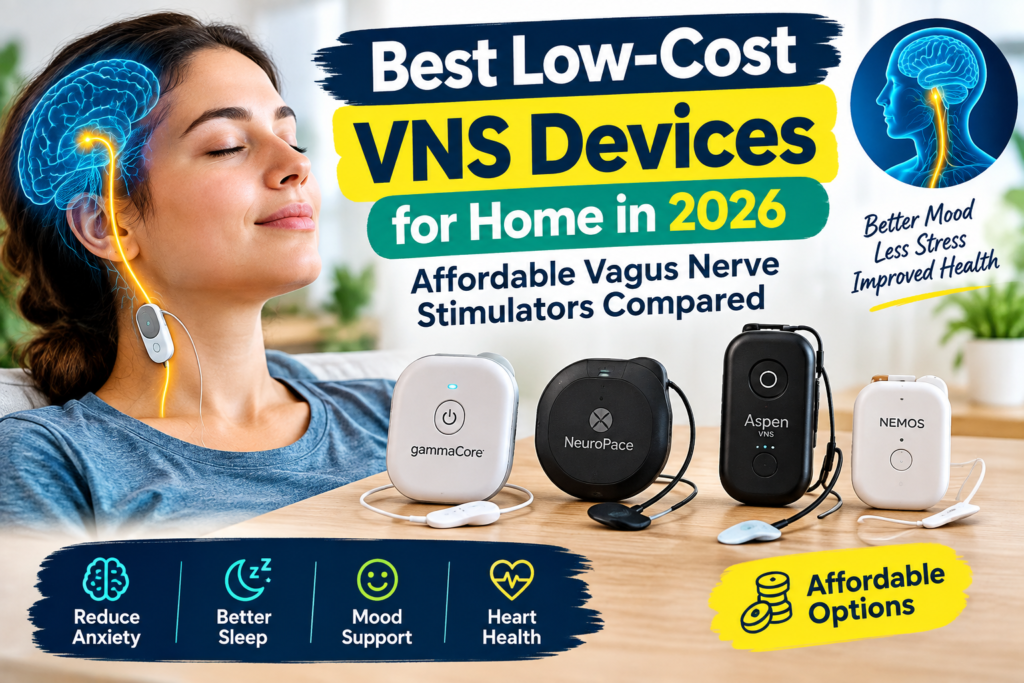
Compare the best low-cost VNS devices for home use in 2026. Learn about prices, stimulation methods, features, safety, evidence, and what to check before buying.
LifeCareBalance.com is reader-supported. When you buy through links on our site, we may earn an affiliate commission at no extra cost to you. As an Amazon Associate, we earn from qualifying purchases.
Vagus nerve stimulation has moved from a highly specialized medical technology into the consumer wellness market, with people now looking for compact devices they can use at home.
The challenge is that the phrase “vagus nerve stimulator” covers very different products. Some devices use electrical stimulation through the neck or ear. Others use vibration, sound, or other forms of sensory stimulation. Some are medical devices designed for specific conditions, while others are consumer wellness products.
That makes price comparison alone a poor way to choose a VNS device.
A $40 electrical stimulator is not automatically a low-cost alternative to a purpose-built vagus nerve stimulation device. Likewise, a $700 device is not automatically better simply because it costs more.
This guide focuses on lower-cost, non-invasive options for home use, while separating dedicated VNS devices from products that are marketed using vague nervous-system or relaxation language.
Important: Consumer VNS products are not interchangeable with implanted medical VNS systems. Evidence also varies significantly between stimulation methods and individual devices. This guide is for general consumer information and is not a substitute for medical advice.
Quick Answer: What Is the Best Low-Cost VNS Device for Home?
For shoppers who want a purpose-built consumer VNS device without moving into the highest-priced end of the market, the main factors to compare are stimulation method, placement, ease of use, recurring costs, comfort, evidence, and safety information.
A lower-priced dedicated device can make sense if you understand what it actually does and what the available evidence does—and does not—show.
One of the biggest mistakes is searching Amazon for “vagus nerve stimulator,” choosing the cheapest electrical device, and assuming it has been designed and validated specifically for vagus nerve stimulation.
It may not be.
A better buying strategy is to start with the technology rather than the price.
For a broader explanation of the science behind VNS, see our Vagus Nerve Stimulation Explained guide. Vagus Nerve Stimulation Explained
What Is a Vagus Nerve Stimulator?
A vagus nerve stimulator is a device intended to deliver stimulation associated with the vagus nerve.
There are several forms of VNS technology.
Non-Invasive Vagus Nerve Stimulation
Non-invasive VNS, sometimes called nVNS or tVNS depending on the approach, delivers stimulation through the skin rather than using an implanted system.
Common approaches include:
- Neck-based stimulation
- Ear-based stimulation
- Transcutaneous auricular vagus nerve stimulation
- Handheld stimulation devices
The exact location and electrical parameters matter because different devices can use different stimulation approaches.
The U.S. FDA maintains separate classifications for specific non-invasive vagus nerve stimulators used for medical purposes, including devices intended for headache treatment. That does not mean every consumer wellness device marketed as a VNS product has FDA clearance for the same purpose. FDA: Non-Invasive Vagus Nerve Stimulator Classification
Implanted Medical VNS
Implanted VNS is a different category.
An implanted system involves a surgically placed device and is used under medical supervision for specific medical indications. The FDA database lists implanted VNS systems separately from non-invasive devices. FDA: VNS Therapy System
A consumer should never assume that a home wellness device provides the same treatment as an implanted medical VNS system.
Why Low-Cost VNS Shopping Is More Complicated Than It Looks
Searching for inexpensive VNS devices can produce a confusing mix of:
- Dedicated VNS products
- TENS units
- EMS stimulators
- Relaxation devices
- Vibration products
- Generic electrical stimulation machines
- Imported devices with limited documentation
- Products using “vagus nerve” as a marketing keyword
This creates a major problem for buyers.
A generic electrical stimulation unit may be inexpensive, but that does not make it an appropriate substitute for a dedicated VNS product.
In fact, Amazon marketplace data shows that inexpensive TENS products can appear prominently for VNS-related searches. That is precisely why price alone should not determine your purchase.
What to Look for in an Affordable VNS Device
Before buying, evaluate these factors.
1. Stimulation Method
First determine whether the device uses:
- Ear-based electrical stimulation
- Neck-based electrical stimulation
- Another non-invasive stimulation approach
- Vibration or sound rather than electrical stimulation
Do not assume these methods are interchangeable.
2. Placement
Placement affects convenience and user experience.
Ear-based systems can be compact but may require precise positioning. Neck-based systems may be easier for some users to understand and operate but can feel different during stimulation.
3. Intensity Control
Adjustable intensity can be useful because stimulation comfort varies from person to person.
A beginner-friendly device should provide clear instructions rather than encouraging users to simply turn the intensity as high as possible.
4. Session Length
Short sessions can make a device easier to incorporate into a daily routine.
However, longer sessions are not automatically better. Follow the manufacturer’s instructions rather than creating your own stimulation schedule.
5. Recurring Costs
A device that looks inexpensive at checkout can become considerably more expensive if it requires:
- Monthly subscriptions
- Conductive gel
- Replacement electrodes
- Proprietary accessories
- Paid app features
Always calculate the total cost of ownership, not just the device price.
6. Return Policy and Warranty
This is particularly important with wearable or skin-contact devices.
Look for:
- Clear return terms
- Warranty coverage
- Customer support
- Replacement-part availability
- Clear instructions
A cheap device with poor support may become more expensive in the long run.
Lower-Cost VNS Devices Worth Comparing
The following products illustrate different approaches to the consumer VNS market.
Prices can change, so verify the current price before purchasing.
PRODUCT #1 — Pulsetto FIT (V2)

- RELAX IN SHORT, EASY SESSIONS – Pulsetto FIT is designed for brief daily use, offering calming moments through comfortab…
- MODERN WEARABLE FOR RELAXATION – Featuring a lightweight, ergonomic design, Pulsetto FIT offers an easy way to unwind an…
- THE PULSETTO APP IS INCLUDED: Pulsetto FIT comes with the Pulsetto app, so you can start your first session right away. …
Pulsetto FIT is a neck-worn consumer wellness device designed around non-invasive vagus nerve stimulation.
Its major advantage for budget-conscious shoppers is that it sits below some of the premium VNS products currently available.
The newer FIT model also illustrates an important point about VNS shopping: buyers should evaluate the complete ownership experience rather than looking only at the initial price.
Before purchasing, check:
- Current device price
- Whether an app or subscription is required for the features you want
- Session options
- Device fit
- Return policy
- Current manufacturer instructions
Best suited for: shoppers who want a dedicated consumer VNS wearable without moving directly into the premium price range.
Important: Manufacturer marketing claims should not be treated as independent clinical evidence. Research on non-invasive VNS as a category is still developing.
PRODUCT #2 — Truvaga 350
Truvaga 350 takes a different approach from a neck-worn device. It is a compact handheld VNS product designed for short sessions.
The manufacturer currently lists the Truvaga 350 at $325 and describes it as a simple device with 350 sessions included and no app or charging requirement.
That makes it interesting for buyers who want:
- Short sessions
- A handheld design
- No complicated setup
- No smartphone dependency for basic use
- A portable device for home or travel
Its higher upfront cost compared with generic electrical stimulators is important, but so is the fact that it is specifically designed and marketed as a VNS product rather than simply being a general-purpose TENS machine.
Best suited for: shoppers who prioritize simplicity and short, structured sessions.
PRODUCT #3 — Truvaga Plus
Truvaga Plus is not truly a budget device, so it should not be treated as the cheapest option.
However, it provides a useful comparison point for shoppers deciding whether spending more provides features they actually need.
The manufacturer currently lists the Truvaga Plus at $499 and describes two-minute sessions, rechargeable operation, app-guided sessions, and session tracking.
Best suited for: buyers who want a more feature-rich experience and are willing to move beyond the lower-cost category.
Why include it in a budget guide?
Because “low cost” is relative in this category. Comparing a lower-cost device with a premium benchmark helps buyers understand what they are paying extra for.
What About Nurosym?
Nurosym is frequently mentioned in VNS comparisons, but it does not belong in a true low-cost shortlist.
The manufacturer’s current pricing shows the device around €700, depending on the market. It is a CE-certified non-invasive neuromodulation wearable using an ear-based approach.
Independent reviews also identify its substantially higher price as one of the major barriers compared with lower-cost alternatives.
That does not mean the product should be ignored.
Instead, it is useful as a premium benchmark.
If your main goal is affordability, paying several hundred dollars more should require a clear reason—such as the device design, research position, comfort, support, or other features that matter specifically to you.
Should You Buy a $40 TENS Unit Instead?
This is one of the most important questions in the entire category.
You will find inexpensive TENS and EMS products when searching Amazon for vagus nerve stimulation devices.
Some may cost less than $50.
But a low price does not make a TENS unit a validated VNS device.
TENS devices are generally designed for electrical nerve stimulation for other purposes, such as pain management. A product appearing in an Amazon search result for “vagus nerve stimulator” is not automatically designed, tested, or cleared for vagus nerve stimulation.
This is one of the biggest weaknesses in many low-cost VNS buying guides: they treat marketplace search results as if they were medical-device validation.
We do not recommend making that assumption.
If a product is not specifically designed for the stimulation method you are researching, do not treat it as an equivalent substitute simply because it is cheaper.
How Strong Is the Evidence Behind Non-Invasive VNS?
This is where a good buying guide needs to be different from a marketing page.
Research on non-invasive VNS is growing, but the evidence is not equally strong for every device, protocol, or health outcome.
A systematic review and meta-analysis covering 177 studies and 6,322 participants found that transcutaneous auricular VNS was generally well tolerated in the studies reviewed. Reported adverse effects included ear discomfort, headache and tingling, while the researchers also noted inconsistent reporting of adverse events across studies. PubMed: Safety of Transcutaneous Auricular Vagus Nerve Stimulation
More recent research is also exploring sleep-related outcomes. A 2026 systematic review and meta-analysis of randomized trials reported improvements in several sleep-related measures and reductions in anxiety- and depression-related scale scores, but the authors emphasized heterogeneity and the need for larger, better-designed trials. PubMed: 2026 taVNS Sleep Meta-Analysis
That distinction matters.
Research on a stimulation method is not automatically research proving that a particular consumer device will produce the same result.
VNS for Sleep: What Should Buyers Expect?
Sleep is one of the most common reasons consumers look for VNS devices.
Current research is encouraging enough to justify continued investigation, but it does not support promising every buyer that a consumer VNS device will fix insomnia.
If sleep is your primary concern, look at the complete routine.
A device may be one component of a broader sleep strategy involving:
- Consistent sleep timing
- Reduced evening stimulation
- Appropriate exercise
- A comfortable sleep environment
- Stress management
- Tracking patterns over time
Our Sleep Tracker Buying Guide can help if you want to monitor sleep-related data alongside your wellness routine. Sleep Tracker Buying Guide 2026
VNS for Stress and Relaxation
Stress relief is another major reason people purchase consumer VNS devices.
However, phrases such as “reset your nervous system” or “eliminate anxiety” should be treated cautiously.
A device may feel relaxing to an individual without proving a specific medical effect.
This distinction is important:
Feeling relaxed after a session is a personal experience.
Proving that a device treats a medical condition is a clinical claim.
Those are not the same thing.
For readers interested in a broader range of non-device approaches and wellness tools, our Quick Stress Relief Products guide provides additional options. Quick Stress Relief Products
Safety: Who Should Be More Careful?
Non-invasive does not mean risk-free.
Published research generally reports mild and transient adverse effects for taVNS, but that does not mean every consumer product has identical safety characteristics.
Potential issues can include:
- Skin irritation
- Tingling
- Local discomfort
- Headache
- Dizziness or unpleasant sensations
- Discomfort from ear clips or electrodes
Follow the manufacturer’s instructions and stop using a device if stimulation causes concerning symptoms.
People with implanted electronic medical devices, significant cardiovascular conditions, neurological conditions, pregnancy-related concerns, or other medical issues should discuss the specific device with a qualified healthcare professional before use.
Do not use a consumer VNS device as a replacement for prescribed treatment.
How to Choose a VNS Device for Home Use
Instead of asking only:
“What is the cheapest VNS device?”
ask these seven questions:
1. Is it actually designed for VNS?
Look beyond the product title.
2. Where does it stimulate?
Ear, neck, or another location?
3. What evidence supports the method?
Separate research on VNS generally from evidence involving the actual device.
4. What does ownership really cost?
Include subscriptions, gel, accessories and replacement parts.
5. Is it comfortable enough to use consistently?
A theoretically impressive device is not useful if you dislike wearing it.
6. Are instructions clear?
Good instructions matter more than having dozens of confusing settings.
7. Does the company provide meaningful support?
Look for warranty information, returns and replacement options.
Low-Cost vs. Premium VNS: What Are You Really Paying For?
The biggest price differences in this market are not necessarily about “more stimulation.”
You may be paying for:
- Different hardware design
- Ear vs. neck placement
- App integration
- Rechargeable batteries
- Session tracking
- Customer support
- Research infrastructure
- Certifications
- Accessories
- Warranty and returns
- Brand development and distribution
A higher price does not automatically prove a stronger health benefit.
Likewise, a lower price does not automatically make a device poor quality.
The goal is to identify which features have real value for your use case.
Common Mistakes When Buying a Cheap VNS Device
Mistake 1: Choosing the Cheapest Electrical Device
A $30–$50 TENS unit may look attractive, but it should not automatically be classified as a dedicated VNS device.
Mistake 2: Confusing Marketing With Clinical Evidence
“Supports relaxation” is different from “treats anxiety.”
Mistake 3: Assuming FDA Clearance Applies to Every Device
FDA classifications are specific to particular devices and intended uses. Always verify the exact device and indication rather than relying on the phrase “FDA approved.” FDA Medical Device Database
Mistake 4: Ignoring Subscription Costs
A $200 device with an expensive recurring subscription may cost more over time than a $300 device with no monthly fee.
Mistake 5: Expecting Dramatic Results
Non-invasive VNS research remains an evolving field. Even positive studies do not mean every user will experience a dramatic change.
Mistake 6: Treating HRV as Proof That a Device Works
HRV can be useful as a physiological metric, but changes in a wearable metric should not automatically be interpreted as proof that a VNS device has produced a meaningful health outcome.
Mistake 7: Buying a Device Without Checking Return Terms
Comfort and stimulation sensation are highly individual. A clear return policy can be valuable.
How VNS Fits Into a Larger Wellness Routine
A VNS device should be viewed as one tool—not as the foundation of an entire wellness plan.
A practical routine could include:
- Regular physical activity
- Consistent sleep
- Slow breathing
- Mindfulness or meditation
- Healthy nutrition
- Stress-management habits
- Recovery practices
- Appropriate wellness technology
Our broader Best Wellness Products for 2026 guide covers additional categories for readers building a more complete wellness routine. Best Wellness Products for 2026
For readers specifically interested in the science, our Vagus Nerve Stimulation Explained article goes deeper into medical VNS, non-invasive stimulation, research, potential benefits and safety. Vagus Nerve Stimulation Explained
And for readers who want another device-focused VNS guide, see our Safe and Effective Vagus Nerve Stimulators for Daily Use article. Safe and Effective Vagus Nerve Stimulators for Daily Use
Frequently Asked Questions
Are cheap VNS devices safe?
Safety depends on the specific device, stimulation method, instructions and user. Published taVNS research generally reports mostly mild adverse effects, but consumer devices should not all be treated as equivalent. PubMed: taVNS Safety Review
What is the cheapest real VNS device?
Prices change frequently, and the lowest-priced product in a marketplace search is not necessarily a dedicated VNS device. A purpose-built device should be evaluated separately from generic TENS and EMS products.
Can I use a TENS unit for vagus nerve stimulation?
You should not assume that a generic TENS unit is an appropriate substitute for a purpose-built VNS device. The stimulation parameters, placement, intended use and device design may differ.
Is non-invasive VNS the same as implanted VNS?
No. Implanted VNS is a medical treatment involving a surgically implanted system, while non-invasive VNS delivers stimulation through the skin. They should not be treated as interchangeable technologies.
Can VNS help with sleep?
Research is investigating this question, and recent meta-analysis results are promising, but the evidence remains heterogeneous and should not be interpreted as a guarantee that a consumer device will treat insomnia. PubMed: 2026 taVNS Sleep Meta-Analysis
Can VNS treat anxiety?
Non-invasive VNS is being studied for anxiety-related outcomes, but consumer wellness devices should not be marketed as guaranteed treatments for anxiety disorders.
Do expensive VNS devices work better?
Price alone cannot establish effectiveness. Compare the stimulation method, evidence, usability, safety information, ownership costs and intended use.
How often should I use a VNS device?
Follow the manufacturer’s instructions for the specific device. Do not assume that longer or more frequent stimulation produces better results.
Should I buy a VNS device if I have a medical condition?
Speak with your healthcare professional first. Consumer VNS devices should not replace prescribed treatment or professional medical evaluation.
Final Takeaway
The best way to shop for a low-cost VNS device is not to find the cheapest electrical gadget on the internet.
Instead, identify what type of stimulation the device provides, where it is applied, what evidence supports that approach, how much the complete ownership experience costs, and what safety information the manufacturer provides.
For shoppers focused on affordability, a purpose-built consumer VNS device in the lower-to-mid price range may be more appropriate than a generic TENS unit simply because it is marketed for the vagus nerve.
At the same time, buyers should keep expectations realistic.
Non-invasive VNS is an active area of research, not a proven universal solution for stress, sleep, anxiety or every other wellness concern. The strongest buying decision is therefore one based on clear technology, transparent evidence, realistic claims, comfort, safety and total cost rather than flashy promises.
That approach can help you spend less while avoiding the much more expensive mistake of buying a device that does not actually match what you were looking for.
Pingback: best adjustable dumbbells for women beginners at home - lifecarebalance.com